
Last Updated May 9, 2026
Why inequality weakens resilience is not only a moral question. It is a systems question. Resilience depends on distributed capacity: the ability of households, communities, institutions, infrastructures, ecosystems, and economies to absorb disruption, preserve essential function, recover without severe scarring, and adapt before future shocks become catastrophic. A society can appear prosperous, technologically advanced, or institutionally stable in the aggregate while remaining deeply fragile if exposure to risk, access to protection, political voice, public services, savings, insurance, health, mobility, and recovery capacity are distributed unequally.
In unequal systems, shocks do not land on equal ground. They strike people and places with very different buffers. Some households have savings, insurance, secure housing, reliable energy, healthcare, transport, digital access, and institutional recognition. Others face insecure work, unsafe housing, weak drainage, limited healthcare, food insecurity, debt, exclusion from public systems, and little political power. The same hazard can therefore produce radically different outcomes. Inequality does not merely coexist with fragility. It actively helps produce it.
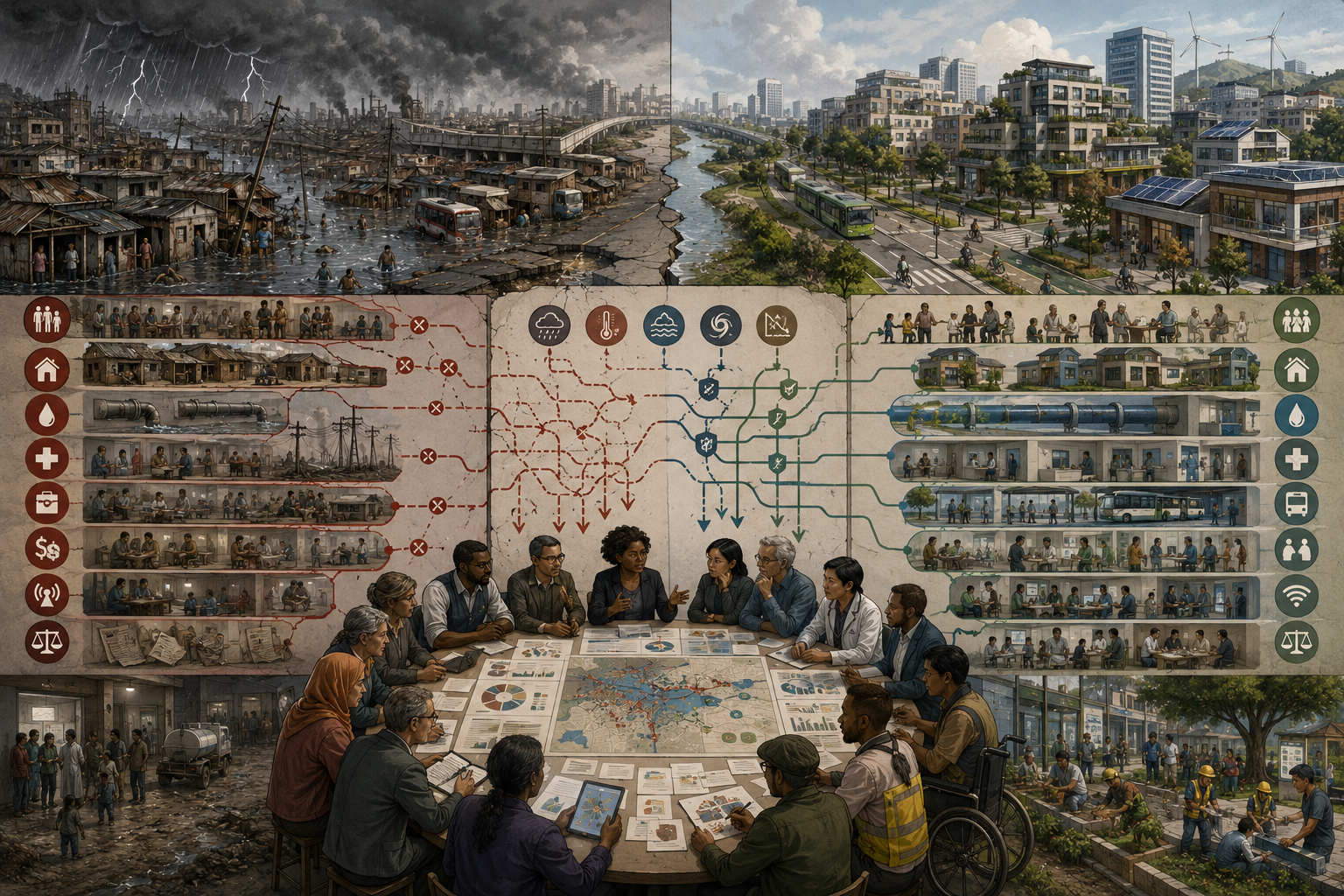
This article explains inequality as a structural driver of fragility. It examines how unequal exposure, thin household buffers, uneven services, weak infrastructure, territorial inequality, social exclusion, climate vulnerability, limited political voice, and fragmented trust reduce system resilience. It argues that equality should not be treated as a separate social objective added after risk management is complete. Equality is itself a resilience capacity because it distributes the means of survival, adaptation, recovery, and collective action more widely across society.
Why This Topic Matters
Inequality matters to resilience because systems are only as resilient as the conditions under which people actually live. If housing quality, transport access, drainage, energy reliability, healthcare, education, food security, legal recognition, financial protection, and political voice are sharply unequal, then the capacity to absorb disruption will also be unequal. In those conditions, shocks become amplifiers of existing disadvantage rather than temporary interruptions.
This is why aggregate strength can be misleading. A country may have high GDP while many households live without savings, secure housing, reliable care, or recovery support. A city may have advanced infrastructure while some neighborhoods lack drainage, tree canopy, safe transit, and emergency access. A region may show economic growth while peripheral communities experience depopulation, weak services, and declining trust. A household may be counted as employed while depending on insecure work that collapses during heat, flood, illness, conflict, or market disruption.
Resilience requires more than wealth at the top. It requires capacity distributed across the system. If capacity is concentrated, then the system’s apparent resilience may depend on the forced adaptability of people who are expected to absorb risk without protection. That is not resilience in the full sense. It is fragility displaced downward.
This topic also matters because many contemporary risks are filtered through unequal structures. Climate shocks, food insecurity, water stress, migration, disease outbreaks, infrastructure failures, cyber disruptions, debt crises, and public-service breakdown do not affect all people equally. They move through existing inequalities in income, land, housing, race, ethnicity, gender, disability, age, legal status, geography, and political power. Risk is therefore not only physical or technical. It is social, institutional, and historical.
When inequality is severe, recovery becomes uneven. Some groups rebuild quickly. Others face debt, displacement, hunger, asset loss, school interruption, health decline, or permanent livelihood damage. The shock may pass, but the scarring remains. Repeated shocks then deepen inequality further, creating a feedback loop between vulnerability and fragility.
This is why inequality should be treated as a core resilience variable. It shapes exposure before crisis, capacity during crisis, recovery after crisis, and adaptation before the next crisis arrives.
What Inequality Means in Resilience Terms
In resilience terms, inequality means unequal distribution of exposure, assets, capabilities, services, information, voice, institutional protection, and recovery power. Income inequality matters, but it is only part of the picture. A household’s resilience also depends on housing security, health, education, transport, water, sanitation, energy, digital access, care networks, savings, legal recognition, social protection, and the responsiveness of public institutions.
This broader understanding aligns with multidimensional poverty analysis. Poverty is not only lack of income; it is deprivation across health, education, living standards, security, and opportunity. Two households with similar income may have very different resilience if one has secure housing, health access, family support, and reliable public services while the other faces eviction, unsafe work, disability, debt, and weak infrastructure.
Inequality also has spatial form. It is built into neighborhoods, regions, rural districts, informal settlements, floodplains, peripheral zones, polluted corridors, drought-prone landscapes, and under-serviced territories. People do not experience inequality only as an abstract distribution. They experience it through where they live, which services reach them, how far they travel, which institutions recognize them, and which hazards they cannot avoid.
Inequality also has institutional form. Some people can access emergency assistance, insurance, courts, benefits, banking, healthcare, schooling, and public information. Others face bureaucratic barriers, documentation gaps, language exclusion, disability exclusion, digital exclusion, discrimination, or fear of state systems. When crisis arrives, administrative access becomes a resilience buffer.
Inequality also has political form. Communities with voice can demand protection, infrastructure, remediation, and recovery support. Communities without voice may remain exposed even when risk is known. Resilience is therefore linked to participation, representation, accountability, and public legitimacy.
A resilience-centered definition of inequality asks: who is exposed, who has buffers, who receives services, who is recognized, who can influence decisions, who recovers, and who is expected to absorb loss? These are not secondary equity questions. They are structural questions about how the system behaves under stress.
What Resilience Requires
Resilience requires the capacity to absorb disruption, preserve essential function, recover without severe long-term scarring, and adapt so that future risks are less damaging. That means resilience depends on buffers, redundancy, fallback options, public services, social trust, learning capacity, and fair access to support systems.
At the household level, resilience may include savings, secure housing, reliable income, health, food access, care support, insurance, transport, digital access, information, and social networks. At the community level, it may include mutual aid, trusted organizations, public spaces, local leadership, schools, clinics, safe infrastructure, and emergency systems. At the institutional level, it may include fiscal capacity, administrative reach, data quality, legitimacy, coordination, and accountability. At the ecological level, it may include healthy soils, water systems, biodiversity, tree canopy, floodplains, wetlands, and other living buffers.
When these capacities are broadly distributed, societies have more room to manage shocks without severe breakdown. A flood, heatwave, recession, disease outbreak, or infrastructure failure may still cause harm, but fewer people are pushed into irreversible loss. Recovery is faster and less unequal. Public systems retain legitimacy because protection is visibly shared.
When these capacities are concentrated narrowly, resilience exists for some groups but not for the system as a whole. Wealthier households may insure, relocate, cool their homes, work remotely, access healthcare, and rebuild. Poorer households may lose work, food, housing, documents, education, and health. The system may report recovery while parts of society remain in prolonged crisis.
Resilience also requires learning. Systems must be able to observe where harm occurred, understand why protection failed, revise policy, and invest before the next shock. Inequality can weaken this learning process when some losses are ignored, undercounted, or treated as normal.
A serious resilience framework therefore rejects false resilience: systems that appear stable only because the costs of disruption are hidden among people with low visibility and low power. Real resilience must be distributed enough to reduce cascading harm across society.
How Inequality Concentrates Exposure
Inequality weakens resilience first by concentrating exposure. Lower-income and socially marginalized populations are often more likely to live in hazard-prone areas, rely on fragile infrastructure, work in climate-exposed or insecure occupations, and have fewer options to relocate or shield themselves from danger. Exposure is not only where hazards occur. It is where people are forced to live and work relative to those hazards.
Housing markets are one pathway. When secure and serviced housing is unaffordable, households may settle in floodplains, informal settlements, unstable slopes, polluted zones, overheated neighborhoods, overcrowded rental housing, or distant peripheries with weak transport and limited services. The risk is then described as natural or individual, but it has been produced by land, housing, income, and planning systems.
Labor markets are another pathway. Outdoor workers, care workers, transport workers, construction workers, agricultural workers, waste workers, street vendors, delivery workers, and informal workers may face greater exposure to heat, storms, disease, income interruption, or unsafe conditions. Those with flexible work, paid leave, savings, and employer protections can avoid risk more easily. Those without those protections absorb more exposure directly.
Public infrastructure also shapes exposure. Weak drainage increases flood exposure. Lack of tree canopy increases heat exposure. Poor transit increases travel risk and reduces access to jobs, clinics, schools, shelters, and cooling centers. Inadequate sanitation increases disease risk. Unreliable electricity increases heat and communication vulnerability. These are not private failures; they are uneven public protections.
Environmental injustice concentrates exposure as well. Pollution, industrial hazards, waste sites, highways, contaminated water, poor air quality, and degraded ecosystems are often distributed unequally. Communities already facing social and economic disadvantage may also face higher environmental burdens.
This means inequality does not simply shape who suffers after the shock. It shapes who is placed in harm’s way before the shock happens. Exposure is socially organized. A resilience strategy that does not address unequal exposure is managing symptoms while leaving the production of risk intact.
How Inequality Thins Buffers and Adaptive Capacity
Inequality also weakens resilience by thinning buffers. A buffer is anything that allows people or systems to absorb disruption without catastrophic loss. Savings are a buffer. Food reserves are a buffer. Secure housing is a buffer. Insurance is a buffer. Paid leave is a buffer. Public health systems are buffers. Social protection, family networks, disability support, child care, safe transport, and legal rights are all buffers.
People with fewer buffers have less room for error. A short income interruption may trigger missed rent, debt, food insecurity, utility shutoff, school disruption, or delayed medical care. A small flood may destroy documents, tools, furniture, and savings. A heatwave may force workers to choose between income and health. A medical emergency may push a household into long-term debt. Repeated shocks can compound into permanent loss.
Adaptive capacity is also unequal. Wealthier households can install cooling, elevate homes, buy insurance, diversify income, relocate, access legal help, or absorb temporary losses. Poorer households may know the risks but lack the resources to act. Knowledge alone does not create adaptive capacity when options are constrained.
This is important because resilience is often framed as behavioral: prepare, adapt, evacuate, save, insure, relocate, or recover. But unequal systems make some of those choices unavailable. Telling households to adapt without changing the conditions that limit adaptation can become a way of shifting responsibility onto the vulnerable.
Thin buffers also create cascading effects. A household that sells productive assets after a shock may have lower future income. A child who leaves school during crisis may experience long-term earnings loss. A person who delays healthcare may face worsening illness. A family that takes high-interest debt may become less able to withstand the next shock. The original disturbance becomes a pathway into deeper vulnerability.
Inequality therefore turns shocks into scarring events. It narrows adaptive room before crisis begins and slows recovery afterward. A more resilient system reduces the number of people living so close to irreversible loss.
Services, Infrastructure, and Unequal Protection
Resilience depends heavily on public systems: water, sanitation, drainage, transport, electricity, healthcare, schools, communications, waste management, emergency response, social protection, and public information. Where these systems are unevenly distributed, resilience becomes uneven too.
Service inequality is one of the most concrete ways inequality becomes fragility. A household with reliable water, sanitation, drainage, electricity, healthcare, and transport experiences shocks differently from a household without them. A neighborhood with flood protection, shaded streets, clinics, transit, and emergency access is not exposed in the same way as a neighborhood with blocked drains, heat-trapping surfaces, unsafe housing, and limited public services.
Infrastructure is also cumulative. Weak drainage interacts with poor sanitation. Poor sanitation interacts with disease exposure. Poor transport limits access to work, school, clinics, shelters, and aid. Unreliable electricity affects cooling, communication, refrigeration, remote work, medical devices, and safety. These systems do not fail in isolation; they interact.
Unequal infrastructure creates unequal recovery. A well-serviced district may restore function quickly after a storm, while an under-serviced settlement faces repeated flooding, contamination, power loss, and delayed aid. A region with strong hospitals and roads can respond to emergencies faster than a region with weak facilities and poor connectivity. A school system with digital access can recover from disruption more easily than one where students lack devices, internet, or safe study space.
Protection gaps can be hidden by aggregate indicators. A city may report high water access while informal settlements rely on expensive vendors. A country may report high electricity access while reliability is poor in low-income regions. A region may report hospital coverage while travel time remains prohibitive for remote communities. Resilience measurement must therefore examine reliability, affordability, quality, accessibility, and distribution—not only nominal coverage.
Public infrastructure is moral infrastructure. It determines who is protected before private resources matter. If the geography of public protection follows wealth and political power, inequality becomes built into the physical system.
A more resilient society invests in the places where protection has historically been weakest, not only where asset values are highest.
Territorial Inequality and the Geography of Discontent
Inequality is not only interpersonal. It is territorial. Regions, cities, rural areas, small towns, post-industrial districts, informal settlements, island communities, borderlands, and peripheral territories often experience different levels of public investment, employment, infrastructure, service quality, institutional capacity, and political attention.
Territorial inequality weakens resilience because risk governance is place-based. Disaster response, healthcare access, climate adaptation, transport, water systems, schools, jobs, digital connectivity, and public trust all depend on territorial capacity. If some regions have stronger tax bases, better institutions, and more infrastructure while others experience decline or neglect, resilience becomes geographically uneven.
This matters politically as well as materially. Long-standing territorial inequality can weaken trust in government and generate a sense that public systems serve some places and abandon others. When people believe that institutions are selective, unresponsive, or distant, public legitimacy erodes. That erosion matters during crisis because resilience depends on cooperation, compliance, communication, and shared confidence.
The phrase “geography of discontent” captures an important dynamic. Places that experience long-term decline, service gaps, depopulation, weak opportunity, or underinvestment may become politically alienated. This is not simply resentment. It can reflect real patterns of unequal protection and unequal recognition. If resilience planning ignores territorial inequality, it may underestimate both material fragility and political instability.
Territorial inequality also shapes migration. People may move because local opportunities, services, water systems, climate conditions, or safety deteriorate. Receiving cities may then face pressure on housing, labor markets, infrastructure, and public services. If territorial inequality is not addressed upstream, risk can be displaced rather than reduced.
A resilient system must therefore think regionally. It must ask which territories have been structurally underprotected, which places face overlapping economic and environmental stress, and which communities lack the fiscal and institutional capacity to adapt. National resilience cannot be built only through high-performing metropolitan cores. It depends on the resilience of the wider territorial system.
Poverty, Fragility, and Development Risk
Poverty and fragility reinforce one another. Poverty reduces buffers, while fragility increases the likelihood that people will face conflict, weak institutions, climate stress, displacement, service disruption, economic volatility, and limited protection. In fragile settings, shocks often become more damaging because institutions have less capacity to prevent, respond, and repair.
This relationship is important because resilience cannot be reduced to hazard management. People facing poverty may live with multiple risks at once: food insecurity, unsafe housing, limited health access, weak education, debt, insecure work, violence, climate exposure, and administrative exclusion. A single shock can activate several of these vulnerabilities simultaneously.
Development gains can also be fragile. A household may rise above an income poverty threshold but remain vulnerable to falling back into poverty after illness, crop failure, conflict, job loss, debt, flood, heat, or displacement. A community may gain infrastructure but lack maintenance, governance, or financing to sustain it. A country may reduce poverty during stable growth but remain exposed to debt, commodity shocks, climate hazards, and institutional stress.
This is why multidimensional poverty analysis matters. It shows that poverty is not only about income at a point in time. It is about overlapping deprivations that shape people’s ability to live, act, and recover. A person without adequate nutrition, schooling, sanitation, housing, electricity, or health access faces a different resilience landscape than income alone can show.
Fragility also affects public finance. Governments facing conflict, debt, climate shocks, weak revenue, or institutional strain may struggle to invest in services, infrastructure, social protection, and adaptation. This can create a vicious cycle: weak investment increases vulnerability, vulnerability increases crisis costs, crisis costs reduce fiscal space, and reduced fiscal space limits future prevention.
A resilience strategy that ignores poverty and fragility may strengthen selected systems while leaving the deepest sources of vulnerability intact. Risk reduction must therefore be tied to development capability: education, health, livelihoods, institutions, peace, public services, and social protection.
Climate Risk and Social Vulnerability
Climate change makes the inequality-resilience relationship especially visible. Climate hazards such as heatwaves, floods, droughts, storms, wildfires, sea-level rise, crop stress, water insecurity, and disease shifts are physical phenomena, but their impacts are socially distributed. The same hazard can produce different outcomes depending on housing, income, infrastructure, health, labor, mobility, public services, and political recognition.
Social vulnerability determines who can avoid exposure, who can prepare, who receives warnings, who can evacuate, who can afford cooling, who can access water, who can stop working during dangerous heat, who can rebuild, and who can claim assistance. Climate adaptation therefore cannot be separated from inequality.
Climate risk also compounds with existing deprivation. Poor households may spend a higher share of income on food, water, energy, and transport—costs that can rise under climate stress. Informal workers may lose income during extreme weather. People with disabilities, older adults, children, pregnant people, and those with chronic illness may face heightened health risks. Migrants, undocumented people, or people without formal addresses may be excluded from aid. Rural households may face crop failure, water stress, or livestock loss. Urban households may face heat islands, flooding, and rent pressure after adaptation investments.
Climate finance can also be unequal. Resources may flow to large infrastructure, formal institutions, and high-value assets while local communities receive limited support. If climate finance does not reach vulnerable places and people, adaptation may reinforce existing inequalities.
Climate-resilient development requires the opposite approach. It connects adaptation and mitigation with human wellbeing, equity, justice, and development choices. It recognizes that cutting emissions and reducing vulnerability must happen together. A climate strategy that protects infrastructure while leaving people exposed remains incomplete. A development strategy that raises income while deepening climate exposure remains fragile.
Climate risk is therefore not only a future environmental problem. It is a present inequality problem. The more unequal a society is, the more likely climate hazards are to become socially concentrated harm.
Health, Education, and Human Capability
Resilience depends on human capability. Health, education, nutrition, care, knowledge, mobility, and social participation all shape the ability to prepare, respond, recover, and adapt. Inequality weakens resilience when these capabilities are unevenly distributed.
Health inequality is a major resilience issue. People with chronic illness, disability, poor nutrition, inadequate healthcare, unsafe housing, or high pollution exposure may be more vulnerable to heat, disease, disaster, displacement, and economic shock. A crisis can also worsen health inequality by interrupting care, medication, income, food, or sanitation. Public health is therefore not only a social service. It is resilience infrastructure.
Education matters because it expands adaptive capacity. Education can improve access to information, income opportunities, institutional navigation, and political participation. But education systems are themselves vulnerable to inequality. Shocks can interrupt schooling, especially for children in poor households, displaced families, conflict settings, or under-serviced regions. Learning loss can become long-term capability loss.
Care systems matter as well. Families often depend on unpaid care, especially during crisis. When public care systems are weak, shocks can shift additional burdens onto women, girls, older family members, and informal networks. This can reduce labor participation, income, education, health, and recovery capacity. Care should therefore be treated as part of resilience planning.
Human capability also shapes institutional access. A person who can read official warnings, use digital systems, travel to services, speak the dominant language, access legal help, and understand bureaucratic requirements has greater practical resilience than someone excluded by language, disability, digital barriers, documentation, discrimination, or poverty.
This is why resilience cannot be built only through physical infrastructure. A flood wall may reduce water exposure, but it does not replace healthcare, education, social protection, housing, care, or public trust. Human capability is a living buffer.
More equal societies are more resilient when they invest broadly in people’s ability to withstand and shape change. Capability is not merely a development outcome. It is a resilience condition.
Digital, Financial, and Administrative Exclusion
Modern resilience increasingly depends on digital, financial, and administrative access. Warnings may arrive by phone. Benefits may require online applications. Recovery payments may require bank accounts. Insurance claims may require documentation. Public information may be digital. Telehealth, remote work, school continuity, and emergency communication may all depend on connectivity.
Inequality weakens resilience when people are excluded from these systems. Digital exclusion may involve lack of internet, devices, electricity, digital literacy, accessible design, language access, or trust. Financial exclusion may involve lack of bank accounts, credit, insurance, savings, or affordable borrowing. Administrative exclusion may involve missing documents, informal addresses, immigration status, disability barriers, language barriers, or fear of public institutions.
These exclusions matter because they determine who can receive help quickly. During crisis, a household outside administrative systems may be invisible. A person without a formal address may not receive aid. A worker in the informal economy may not qualify for unemployment support. A renter may be excluded from property-based recovery programs. An undocumented person may avoid shelters or clinics. A person without digital access may miss warnings or benefits.
Digitalization can improve resilience, but only if it is inclusive. Otherwise, it can make public systems faster for those already connected and harder for those already excluded. Algorithmic systems can also reproduce inequality if they rely on incomplete data, proxy variables, or automated eligibility rules that misclassify vulnerable people.
Financial systems can have similar effects. Insurance can support recovery, but only for those who can afford coverage and meet eligibility requirements. Credit can help rebuild, but can also deepen debt. Disaster finance can restore assets, but may prioritize property owners over renters, informal workers, or displaced households.
Administrative access is therefore a core resilience issue. Inclusive resilience requires multiple channels: digital and non-digital, formal and community-based, language-accessible, disability-accessible, and trusted by marginalized communities. It requires data systems that recognize people without exposing them to harm.
A system is not resilient if help exists only for those already legible to power.
Inequality and Fragmented Collective Response
Inequality can weaken resilience by fragmenting collective response. Resilience depends partly on trust, legitimacy, cooperation, and the willingness of institutions and communities to coordinate under stress. Where inequality is severe, people may experience institutions as selective, exclusionary, punitive, or unresponsive. That can reduce trust and weaken the social conditions needed for adaptation and recovery.
Trust matters during emergencies. People need to believe warnings, use shelters, follow evacuation guidance, accept public-health measures, share information, and cooperate with agencies. If prior experience tells them that institutions ignore, exploit, surveil, or punish them, they may reasonably distrust official systems. This is not irrationality. It is the memory of unequal protection.
Inequality also affects political support for long-term resilience investment. People may resist public spending if they believe benefits flow to other groups or regions while their own communities remain neglected. Territorial inequality can deepen this perception. If infrastructure, jobs, schools, clinics, and climate investments are concentrated in already advantaged places, collective solidarity weakens.
Highly unequal systems may also encourage private exit. Wealthier households and firms may buy private security, private healthcare, private insurance, private education, private transport, backup power, and climate-controlled spaces. These private buffers may protect some people, but they can reduce pressure to improve public systems. The result is a dual resilience structure: private resilience for those who can pay, public fragility for those who cannot.
Collective response also requires shared information. Inequality can fragment information ecosystems when communities receive different warnings, use different languages, lack digital access, or distrust official data. Rumors, misinformation, and fear can spread where public communication is weak or exclusionary.
A resilient society requires more than individual preparedness. It requires public legitimacy. People must see that institutions protect widely, not selectively. They must have channels to participate, criticize, and seek remedy. Inequality weakens this foundation by making public systems appear partial.
The social fabric is not decorative. It is part of the operating system of resilience.
Why Equality Is a Resilience Capacity
Equality should be understood as a resilience capacity because broader access to services, assets, protections, and voice increases the number of people and places able to absorb disruption without cascading failure. Equality is not only a moral preference. It is a structural condition that determines how widely coping capacity is distributed.
More equal systems tend to reduce the number of households living at the edge of irreversible loss. They also reduce the number of communities left outside public protection. When more people have secure housing, healthcare, education, energy, water, savings, transport, information, and political voice, shocks are less likely to become disasters of abandonment.
Equality also creates redundancy. In unequal systems, survival capacity is concentrated. If public systems fail, only some people have private alternatives. In more equal systems, capacity is distributed across households, communities, institutions, and territories. This makes the system less brittle.
Equality also supports trust. When people believe public systems are fair, they are more likely to cooperate in crisis, support long-term investment, and accept shared sacrifice. When they believe systems are rigged, selective, or indifferent, legitimacy weakens.
This does not mean perfect equality is required for resilience, nor that every inequality has the same effect. It means that severe inequality creates structural fragility by concentrating exposure and stripping away buffers. A society can tolerate some variation in income or assets, but if those variations determine who survives, who adapts, and who is abandoned, resilience is compromised.
Equality also improves learning. When marginalized communities have voice, systems can see failure earlier. When data are disaggregated, hidden harms become visible. When institutions respond to those harms, adaptive capacity improves. Equality is therefore connected to information quality and governance learning.
The deeper point is this: resilience is not strongest when the most powerful parts of a system are protected. It is strongest when essential capacities are distributed widely enough that shocks do not repeatedly destroy the same people, places, and futures.
Pre-Distribution of Resilience
A key principle for more equal resilience is pre-distribution. Redistribution after harm matters, but it is not enough. Emergency aid, disaster relief, insurance payouts, cash transfers, and recovery programs are essential, but they arrive after damage has already occurred. Pre-distribution asks what protections, capabilities, services, and assets must be in place before the shock arrives.
Pre-distribution of resilience means safe housing before disaster, not only shelter afterward. It means drainage before flood, not only cleanup afterward. It means healthcare before heatwave, not only emergency treatment afterward. It means social protection before income loss, not only debt relief afterward. It means food security before price spikes, not only food aid afterward. It means public trust before crisis, not only communication campaigns afterward.
This is not only humane. It is efficient. Preventing irreversible loss is often less costly than repairing it. Keeping children in school is better than trying to reverse years of learning loss. Preventing eviction is better than managing homelessness. Reducing heat exposure is better than treating heat illness. Maintaining infrastructure is better than emergency reconstruction. Supporting livelihoods is better than rebuilding after collapse.
Pre-distribution also changes responsibility. It rejects the idea that people should individually prepare for risks produced by unequal systems. Households should not be expected to solve flood exposure created by land markets, weak drainage, and public underinvestment. Workers should not be expected to absorb heat risk created by labor insecurity and climate change. Communities should not be expected to self-protect where institutions have withheld services.
This does not eliminate the need for personal, household, or community preparedness. It places preparedness inside a fairer system. People can prepare more effectively when basic protections are already in place.
A resilience strategy centered on pre-distribution asks: what would reduce the need for emergency rescue? What would prevent crisis from becoming scarring? What capacities must be universal or near-universal for the system to remain stable under stress?
The answer is often basic: housing, health, water, sanitation, energy, transport, education, income security, legal recognition, and accountable public institutions.
Toward More Equal and More Resilient Systems
More equal and more resilient systems are built by reducing exposure, broadening access to quality services, strengthening social protection, supporting secure livelihoods, improving public health, investing in under-protected places, and giving affected communities real voice in decisions. The goal is not only to respond better after crisis. It is to prevent inequality from becoming the pathway through which crisis does its deepest damage.
First, risk assessments should be distributional. They should ask who is exposed, who has buffers, who lacks services, who is undercounted, and who recovers slowly. Citywide, national, or regional averages are not enough. Data should be disaggregated by place, income, gender, age, disability, race, ethnicity, migration status, tenure, and other relevant dimensions, while protecting privacy and avoiding surveillance harm.
Second, infrastructure investment should prioritize protection gaps. Drainage, sanitation, water, transport, electricity, health facilities, schools, digital access, and emergency systems should reach places where vulnerability is high and protection is low. Asset-value-based investment alone can reproduce inequality by prioritizing wealthy areas.
Third, social protection should be treated as resilience infrastructure. Cash transfers, unemployment support, food assistance, child benefits, disability support, pensions, health coverage, and disaster assistance reduce the likelihood that shocks become irreversible household losses.
Fourth, housing and land policy should reduce exposure. Safe, affordable, secure, serviced housing is one of the strongest resilience interventions available. Tenure security, anti-displacement protection, climate-sensitive housing upgrades, and inclusive urban planning all matter.
Fifth, communities should have power, not only consultation. People living with risk often understand failure pathways that official systems miss. Community organizations, local governments, Indigenous Peoples, workers, tenants, migrants, disabled people, youth, and older adults should shape resilience priorities.
Sixth, public institutions should be accountable. Claims of resilience should be auditable. Recovery should be tracked by group and place. Harms should be repaired. Decision-making should be transparent. Appeals should be accessible.
More equal systems are not automatically resilient, but severe inequality makes resilience weaker. The task is to build systems where protection, capability, and voice are distributed before crisis, not rationed afterward.
Mathematical Lens
An inequality-adjusted resilience score can be represented as a function of aggregate system capacity, distribution of protection, household buffers, service access, institutional trust, and adaptive capacity, reduced by exposure concentration, deprivation, exclusion, and recovery inequality. Let \(R_e\) represent equality-adjusted resilience:
R_e = \alpha C_s + \beta P_d + \gamma B_h + \delta S_a + \epsilon T_i + \zeta A_c – \lambda E_c – \mu D_m – \nu X_s – \xi G_r
\]
Interpretation: Equality-adjusted resilience rises when system capacity, distributed protection, household buffers, service access, institutional trust, and adaptive capacity are strong. It declines when exposure concentration, multidimensional deprivation, social exclusion, and recovery inequality are high.
A resilience inequality gap can be represented as:
G_i = R_a – R_e
\]
Interpretation: The inequality gap grows when aggregate resilience \(R_a\) is much higher than equality-adjusted resilience \(R_e\). A large gap suggests that the system looks resilient in aggregate while leaving many people or places under-protected.
A pre-distribution score can be represented as:
P_r = \frac{H_s + W_s + E_s + I_s + C_s + L_s + V_s}{7}
\]
Interpretation: Pre-distribution of resilience improves when housing security, water and sanitation, energy reliability, income security, care systems, legal recognition, and service visibility are broadly available before crisis occurs.
| Term | Meaning | Interpretive role |
|---|---|---|
| \(R_e\) | Equality-adjusted resilience | Represents resilience after accounting for whether protection and adaptive capacity are distributed across society. |
| \(C_s\) | System capacity | Represents aggregate institutional, fiscal, infrastructure, and social capacity. |
| \(P_d\) | Distributed protection | Represents whether protection reaches vulnerable groups and under-served places. |
| \(B_h\) | Household buffers | Represents savings, secure housing, food access, insurance, care, and other household coping capacity. |
| \(S_a\) | Service access | Represents practical access to health, water, sanitation, energy, transport, education, and emergency systems. |
| \(T_i\) | Institutional trust | Represents public legitimacy, responsiveness, fairness, and confidence in institutions. |
| \(A_c\) | Adaptive capacity | Represents the ability to prepare, adjust, recover, and reduce future risk. |
| \(E_c\) | Exposure concentration | Represents the degree to which hazards are concentrated among disadvantaged groups or places. |
| \(D_m\) | Multidimensional deprivation | Represents overlapping deficits in health, education, living standards, security, and opportunity. |
| \(X_s\) | Social exclusion | Represents exclusion from institutions, services, finance, data systems, legal recognition, or political voice. |
| \(G_r\) | Recovery inequality | Represents unequal recovery speed, support, compensation, and long-term scarring after shocks. |
| \(G_i\) | Resilience inequality gap | Represents the difference between aggregate resilience and equality-adjusted resilience. |
The equations are conceptual rather than predictive. Their purpose is to make the systems logic explicit: resilience cannot be understood only through aggregate capacity. It must be adjusted for who is exposed, who is protected, who has buffers, and who can recover.
Advanced Python Workflow: Inequality and Resilience Scoring
This Python workflow evaluates inequality-adjusted resilience by combining system capacity, distributed protection, household buffers, service access, institutional trust, adaptive capacity, social protection, and community voice against exposure concentration, multidimensional deprivation, social exclusion, recovery inequality, digital exclusion, and fiscal stress.
from __future__ import annotations

import pandas as pd
import numpy as np

INPUT_FILE = "inequality_resilience_panel.csv"
OUTPUT_FILE = "inequality_resilience_scores.csv"


def load_data(path: str) -> pd.DataFrame:
    """
    Load an inequality and resilience dataset.

    All *_index columns should be normalized to [0, 1].
    Higher values should mean more of the named property.

    Examples:
      - service_access_index: higher = stronger practical access to public services
      - distributed_protection_index: higher = protection reaches vulnerable groups more evenly
      - exposure_concentration_index: higher = hazards are more concentrated among disadvantaged groups
      - multidimensional_deprivation_index: higher = overlapping deprivation is more severe
    """
    df = pd.read_csv(path)

    required_columns = [
        "place_name",
        "jurisdiction",
        "place_type",
        "system_capacity_index",
        "distributed_protection_index",
        "household_buffer_index",
        "service_access_index",
        "institutional_trust_index",
        "adaptive_capacity_index",
        "social_protection_index",
        "community_voice_index",
        "exposure_concentration_index",
        "multidimensional_deprivation_index",
        "social_exclusion_index",
        "recovery_inequality_index",
        "digital_exclusion_index",
        "fiscal_stress_index",
    ]

    missing = [col for col in required_columns if col not in df.columns]

    if missing:
        raise ValueError(f"Missing required columns: {missing}")

    return df


def validate_indices(df: pd.DataFrame) -> pd.DataFrame:
    """Validate that all *_index fields are complete and normalized to [0, 1]."""
    index_columns = [col for col in df.columns if col.endswith("_index")]

    for col in index_columns:
        if df[col].isna().any():
            raise ValueError(f"Column '{col}' contains missing values.")

        if ((df[col] < 0) | (df[col] > 1)).any():
            raise ValueError(f"Column '{col}' contains values outside [0, 1].")

    return df


def compute_scores(df: pd.DataFrame) -> pd.DataFrame:
    """
    Compute aggregate resilience, equality-adjusted resilience,
    inequality pressure, and resilience inequality gap.
    """
    df = df.copy()

    df["aggregate_resilience_capacity_score"] = (
        0.22 * df["system_capacity_index"] +
        0.18 * df["service_access_index"] +
        0.16 * df["adaptive_capacity_index"] +
        0.14 * df["social_protection_index"] +
        0.12 * df["institutional_trust_index"] +
        0.10 * df["household_buffer_index"] +
        0.08 * df["community_voice_index"]
    ).clip(lower=0, upper=1)

    df["inequality_pressure_score"] = (
        0.22 * df["exposure_concentration_index"] +
        0.20 * df["multidimensional_deprivation_index"] +
        0.18 * df["social_exclusion_index"] +
        0.16 * df["recovery_inequality_index"] +
        0.13 * df["digital_exclusion_index"] +
        0.11 * df["fiscal_stress_index"]
    ).clip(lower=0, upper=1)

    df["equality_adjusted_resilience_score"] = (
        0.18 * df["system_capacity_index"] +
        0.18 * df["distributed_protection_index"] +
        0.15 * df["household_buffer_index"] +
        0.15 * df["service_access_index"] +
        0.12 * df["institutional_trust_index"] +
        0.12 * df["adaptive_capacity_index"] +
        0.06 * df["social_protection_index"] +
        0.04 * df["community_voice_index"] -
        0.18 * df["inequality_pressure_score"]
    ).clip(lower=0, upper=1)

    df["resilience_inequality_gap"] = (
        df["aggregate_resilience_capacity_score"] -
        df["equality_adjusted_resilience_score"]
    )

    df["protection_gap"] = (
        df["distributed_protection_index"] -
        df["exposure_concentration_index"]
    )

    df["resilience_band"] = np.select(
        [
            df["equality_adjusted_resilience_score"] >= 0.80,
            df["equality_adjusted_resilience_score"] >= 0.60,
            df["equality_adjusted_resilience_score"] >= 0.40,
        ],
        [
            "Strong equality-adjusted resilience",
            "Moderate equality-adjusted resilience",
            "Limited equality-adjusted resilience",
        ],
        default="Weak equality-adjusted resilience",
    )

    df["inequality_warning"] = np.select(
        [
            df["inequality_pressure_score"] - df["equality_adjusted_resilience_score"] >= 0.35,
            df["inequality_pressure_score"] - df["equality_adjusted_resilience_score"] >= 0.20,
            df["inequality_pressure_score"] - df["equality_adjusted_resilience_score"] >= 0.05,
        ],
        [
            "Severe inequality-driven fragility",
            "High inequality-driven fragility",
            "Moderate inequality-driven fragility",
        ],
        default="Lower inequality pressure or stronger distributed resilience",
    )

    return df


def build_summary(df: pd.DataFrame) -> pd.DataFrame:
    """Return a ranked summary table for inequality and resilience review."""
    columns = [
        "place_name",
        "jurisdiction",
        "place_type",
        "aggregate_resilience_capacity_score",
        "equality_adjusted_resilience_score",
        "inequality_pressure_score",
        "resilience_inequality_gap",
        "protection_gap",
        "resilience_band",
        "inequality_warning",
    ]

    summary = df[columns].copy()

    summary = summary.sort_values(
        by=[
            "equality_adjusted_resilience_score",
            "inequality_pressure_score",
            "resilience_inequality_gap",
        ],
        ascending=[False, True, True],
    ).reset_index(drop=True)

    return summary


def main() -> None:
    df = load_data(INPUT_FILE)
    df = validate_indices(df)
    scored = compute_scores(df)
    summary = build_summary(scored)

    summary.to_csv(OUTPUT_FILE, index=False)

    print("Inequality and resilience scoring complete.")
    print(summary.to_string(index=False))


if __name__ == "__main__":
    main()
This workflow is diagnostic rather than definitive. It does not claim that inequality or resilience can be reduced to one universal score. It helps analysts distinguish places that look resilient in aggregate from places where inequality-adjusted resilience is much weaker because protection, buffers, services, and recovery capacity are unevenly distributed.
Advanced R Workflow: Inequality, Exposure, and Adaptive Capacity Diagnostics
This R workflow summarizes equality-adjusted resilience by jurisdiction and place type. It is useful for comparing cities, regions, informal settlements, rural districts, peripheral territories, fragile contexts, and under-served communities.
library(readr)
library(dplyr)

input_file <- "inequality_resilience_panel.csv"
jurisdiction_output_file <- "inequality_resilience_jurisdiction_summary.csv"
place_type_output_file <- "inequality_resilience_place_type_summary.csv"

ineq_df <- read_csv(input_file, show_col_types = FALSE)

required_cols <- c(
  "place_name",
  "jurisdiction",
  "place_type",
  "system_capacity_index",
  "distributed_protection_index",
  "household_buffer_index",
  "service_access_index",
  "institutional_trust_index",
  "adaptive_capacity_index",
  "social_protection_index",
  "community_voice_index",
  "exposure_concentration_index",
  "multidimensional_deprivation_index",
  "social_exclusion_index",
  "recovery_inequality_index",
  "digital_exclusion_index",
  "fiscal_stress_index"
)

missing_cols <- setdiff(required_cols, names(ineq_df))

if (length(missing_cols) > 0) {
  stop(paste("Missing required columns:", paste(missing_cols, collapse = ", ")))
}

index_cols <- names(ineq_df)[grepl("_index$", names(ineq_df))]

invalid_index_cols <- index_cols[
  vapply(
    ineq_df[index_cols],
    function(x) any(is.na(x) | x < 0 | x > 1),
    logical(1)
  )
]

if (length(invalid_index_cols) > 0) {
  stop(
    paste(
      "Index columns must be complete and normalized to [0, 1]:",
      paste(invalid_index_cols, collapse = ", ")
    )
  )
}

ineq_df <- ineq_df %>%
  mutate(
    aggregate_resilience_capacity_proxy = (
      system_capacity_index +
        service_access_index +
        adaptive_capacity_index +
        social_protection_index +
        institutional_trust_index +
        household_buffer_index +
        community_voice_index
    ) / 7,
    inequality_pressure_proxy = (
      exposure_concentration_index +
        multidimensional_deprivation_index +
        social_exclusion_index +
        recovery_inequality_index +
        digital_exclusion_index +
        fiscal_stress_index
    ) / 6,
    equality_adjusted_resilience_proxy = (
      system_capacity_index +
        distributed_protection_index +
        household_buffer_index +
        service_access_index +
        institutional_trust_index +
        adaptive_capacity_index +
        social_protection_index +
        community_voice_index +
        (1 - inequality_pressure_proxy)
    ) / 9,
    resilience_inequality_gap = aggregate_resilience_capacity_proxy -
      equality_adjusted_resilience_proxy,
    protection_gap = distributed_protection_index - exposure_concentration_index,
    resilience_band = case_when(
      equality_adjusted_resilience_proxy >= 0.75 ~ "Strong equality-adjusted resilience",
      equality_adjusted_resilience_proxy >= 0.55 ~ "Moderate equality-adjusted resilience",
      equality_adjusted_resilience_proxy >= 0.35 ~ "Limited equality-adjusted resilience",
      TRUE ~ "Weak equality-adjusted resilience"
    )
  )

jurisdiction_summary <- ineq_df %>%
  group_by(jurisdiction) %>%
  summarise(
    avg_equality_adjusted_resilience = mean(equality_adjusted_resilience_proxy, na.rm = TRUE),
    avg_aggregate_resilience_capacity = mean(aggregate_resilience_capacity_proxy, na.rm = TRUE),
    avg_inequality_pressure = mean(inequality_pressure_proxy, na.rm = TRUE),
    avg_resilience_inequality_gap = mean(resilience_inequality_gap, na.rm = TRUE),
    avg_protection_gap = mean(protection_gap, na.rm = TRUE),
    avg_distributed_protection = mean(distributed_protection_index, na.rm = TRUE),
    avg_household_buffers = mean(household_buffer_index, na.rm = TRUE),
    avg_service_access = mean(service_access_index, na.rm = TRUE),
    avg_institutional_trust = mean(institutional_trust_index, na.rm = TRUE),
    avg_adaptive_capacity = mean(adaptive_capacity_index, na.rm = TRUE),
    avg_social_protection = mean(social_protection_index, na.rm = TRUE),
    avg_community_voice = mean(community_voice_index, na.rm = TRUE),
    avg_exposure_concentration = mean(exposure_concentration_index, na.rm = TRUE),
    avg_multidimensional_deprivation = mean(multidimensional_deprivation_index, na.rm = TRUE),
    avg_social_exclusion = mean(social_exclusion_index, na.rm = TRUE),
    avg_recovery_inequality = mean(recovery_inequality_index, na.rm = TRUE),
    observations = n(),
    .groups = "drop"
  ) %>%
  arrange(desc(avg_equality_adjusted_resilience))

place_type_summary <- ineq_df %>%
  group_by(place_type) %>%
  summarise(
    avg_equality_adjusted_resilience = mean(equality_adjusted_resilience_proxy, na.rm = TRUE),
    avg_aggregate_resilience_capacity = mean(aggregate_resilience_capacity_proxy, na.rm = TRUE),
    avg_inequality_pressure = mean(inequality_pressure_proxy, na.rm = TRUE),
    avg_resilience_inequality_gap = mean(resilience_inequality_gap, na.rm = TRUE),
    avg_protection_gap = mean(protection_gap, na.rm = TRUE),
    avg_distributed_protection = mean(distributed_protection_index, na.rm = TRUE),
    avg_household_buffers = mean(household_buffer_index, na.rm = TRUE),
    avg_service_access = mean(service_access_index, na.rm = TRUE),
    avg_institutional_trust = mean(institutional_trust_index, na.rm = TRUE),
    avg_adaptive_capacity = mean(adaptive_capacity_index, na.rm = TRUE),
    avg_social_protection = mean(social_protection_index, na.rm = TRUE),
    avg_community_voice = mean(community_voice_index, na.rm = TRUE),
    avg_exposure_concentration = mean(exposure_concentration_index, na.rm = TRUE),
    avg_multidimensional_deprivation = mean(multidimensional_deprivation_index, na.rm = TRUE),
    avg_social_exclusion = mean(social_exclusion_index, na.rm = TRUE),
    avg_recovery_inequality = mean(recovery_inequality_index, na.rm = TRUE),
    observations = n(),
    .groups = "drop"
  ) %>%
  arrange(desc(avg_inequality_pressure))

write_csv(jurisdiction_summary, jurisdiction_output_file)
write_csv(place_type_summary, place_type_output_file)

cat("Inequality resilience jurisdiction summary exported to:", jurisdiction_output_file, "\n")
print(jurisdiction_summary)

cat("\nInequality resilience place-type summary exported to:", place_type_output_file, "\n")
print(place_type_summary)
This workflow helps distinguish systems where capacity is broadly distributed from systems where aggregate strength hides deep inequality. It can support vulnerability assessment, social-protection planning, infrastructure targeting, climate adaptation, regional development, public legitimacy analysis, and resilience governance review.
GitHub Repository
Complete Code Repository
The full code distribution for this article, including inequality-adjusted resilience scoring, resilience inequality-gap diagnostics, SQL materials, optional governance-support tools, and supporting documentation, is available on GitHub.
Related Articles
- Risk, Poverty, and Development Fragility
- Resilience, Justice, and the Ethics of Transformation
- Urbanization, Informality, and Risk Exposure
- Climate Risk and Systemic Vulnerability
- Migration, Displacement, and Resilience
- Debt, Austerity, and the Erosion of Public Resilience
- Community Resilience, Trust, and Local Capacity
- Polycrisis, Systemic Risk, and the Future of Resilience Thinking
Further Reading
- Intergovernmental Panel on Climate Change (IPCC) (2022) Climate Change 2022: Impacts, Adaptation and Vulnerability. Available at: https://www.ipcc.ch/report/ar6/wg2/
- Intergovernmental Panel on Climate Change (IPCC) (2022) Chapter 18: Climate Resilient Development Pathways. In: Climate Change 2022: Impacts, Adaptation and Vulnerability. Available at: https://www.ipcc.ch/report/ar6/wg2/chapter/chapter-18/
- Organisation for Economic Co-operation and Development (OECD) (2023) OECD Regional Outlook 2023: The Longstanding Geography of Inequalities. Available at: https://www.oecd.org/en/publications/oecd-regional-outlook-2023_92cd40a0-en.html
- Organisation for Economic Co-operation and Development (OECD) (2025) States of Fragility 2025. Available at: https://www.oecd.org/en/publications/states-of-fragility-2025_81982370-en.html
- United Nations Development Programme (UNDP) and Oxford Poverty and Human Development Initiative (OPHI) (2024) Global Multidimensional Poverty Index 2024. Available at: https://hdr.undp.org/content/2024-global-multidimensional-poverty-index-mpi
- United Nations Development Programme (UNDP) (2026) Development at Risk. Available at: https://www.undp.org/sites/g/files/zskgke326/files/2026-02/undp-development-at-risk-v2.pdf
- World Bank (2024) 1.2 Billion People at High Risk from Climate Change Worldwide. Available at: https://www.worldbank.org/en/news/press-release/2024/10/31/1-2-billion-people-at-high-risk-from-climate-change-worldwide
- World Bank (2025) Understanding Social Vulnerability for More Effective Climate Action. Available at: https://openknowledge.worldbank.org/entities/publication/5ee78639-4d57-4149-a58d-5a0d8bb2fd00
- World Bank (n.d.) Social Dimensions of Climate Change. Available at: https://www.worldbank.org/ext/en/topic/social-development/social-dimensions-of-climate-change
References
- Intergovernmental Panel on Climate Change (IPCC) (2022) Climate Change 2022: Impacts, Adaptation and Vulnerability. Available at: https://www.ipcc.ch/report/ar6/wg2/
- Intergovernmental Panel on Climate Change (IPCC) (2022) Summary for Policymakers. In: Climate Change 2022: Impacts, Adaptation and Vulnerability. Available at: https://www.ipcc.ch/report/ar6/wg2/chapter/summary-for-policymakers/
- Intergovernmental Panel on Climate Change (IPCC) (2022) Chapter 18: Climate Resilient Development Pathways. In: Climate Change 2022: Impacts, Adaptation and Vulnerability. Available at: https://www.ipcc.ch/report/ar6/wg2/chapter/chapter-18/
- Intergovernmental Panel on Climate Change (IPCC) (2023) AR6 Synthesis Report: Summary for Policymakers. Available at: https://www.ipcc.ch/report/ar6/syr/downloads/report/IPCC_AR6_SYR_SPM.pdf
- Organisation for Economic Co-operation and Development (OECD) (2023) OECD Regional Outlook 2023: The Longstanding Geography of Inequalities. Available at: https://www.oecd.org/en/publications/oecd-regional-outlook-2023_92cd40a0-en.html
- Organisation for Economic Co-operation and Development (OECD) (2025) States of Fragility 2025. Available at: https://www.oecd.org/en/publications/states-of-fragility-2025_81982370-en.html
- United Nations Development Programme (UNDP) and Oxford Poverty and Human Development Initiative (OPHI) (2024) Global Multidimensional Poverty Index 2024. Available at: https://hdr.undp.org/content/2024-global-multidimensional-poverty-index-mpi
- United Nations Development Programme (UNDP) (2026) Development at Risk. Available at: https://www.undp.org/sites/g/files/zskgke326/files/2026-02/undp-development-at-risk-v2.pdf
- World Bank (2024) 1.2 Billion People at High Risk from Climate Change Worldwide. Available at: https://www.worldbank.org/en/news/press-release/2024/10/31/1-2-billion-people-at-high-risk-from-climate-change-worldwide
- World Bank (2024) Poverty, Prosperity, and Planet Report 2024. Available at: https://openknowledge.worldbank.org/server/api/core/bitstreams/f75dd18d-4e3f-44f9-b455-7f0d8e189609/content
- World Bank (2025) Understanding Social Vulnerability for More Effective Climate Action. Available at: https://openknowledge.worldbank.org/entities/publication/5ee78639-4d57-4149-a58d-5a0d8bb2fd00
- World Bank (n.d.) Social Dimensions of Climate Change. Available at: https://www.worldbank.org/ext/en/topic/social-development/social-dimensions-of-climate-change