
Last Updated May 9, 2026
Path dependence, lock-in, and resilience traps are essential concepts for understanding why systems often remain stuck in vulnerable, unjust, or unsustainable arrangements even when the risks are widely recognized. Sustainable systems are not shaped only by present conditions. They are shaped by inherited infrastructures, sunk investments, institutional routines, regulatory habits, social expectations, political bargains, economic dependencies, and ecological feedbacks that narrow the range of future options. Once these dynamics harden, systems may continue reproducing the very conditions that make them fragile. In that sense, resilience is not always benign. A system can be highly resilient in preserving an undesirable state.
This is one of the most important corrections to simplistic resilience language. Persistence is not the same as justice. Stability is not the same as sustainability. Recovery is not the same as transformation. A fossil-fuel economy can be resilient in protecting incumbent assets. A degraded fishery can be resilient in reproducing poverty and ecological decline. A flood-prone urban form can be resilient in defending existing land values. A racialized housing market can be resilient in preserving unequal exposure. A fragile public institution can be resilient in maintaining routines that prevent deeper reform.
Main Library
Publications
Article Map
Risk & Resilience
Related Topic
Adaptive Cycles
Related Topic
Thresholds
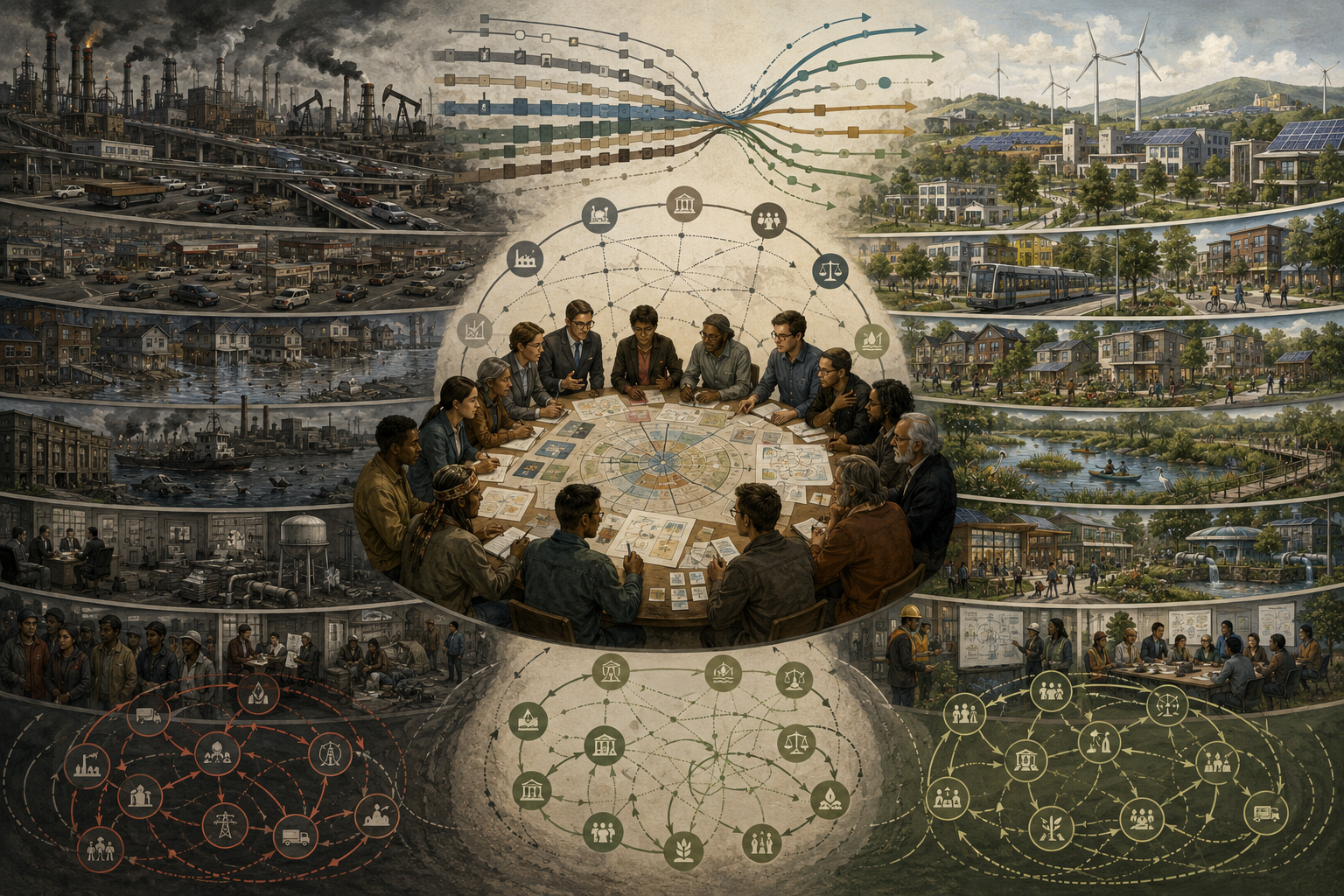
This article examines why systems do not always move toward better adaptation once stress becomes visible. It asks what path dependence and lock-in mean, how resilience traps form, why undesirable systems endure, why incremental change often fails, how justice is shaped by trapped systems, and what it takes to move from stuck resilience to genuine transformation.
Why These Concepts Matter
Path dependence, lock-in, and resilience traps matter because many systems do not fail from ignorance alone. They fail because harmful arrangements become embedded in infrastructures, rules, habits, investments, and expectations that are difficult to exit. A community may know that flood exposure is rising but remain tied to roads, property values, mortgages, zoning, insurance practices, and public revenue streams that keep development in risky places. A country may know that fossil-fuel dependence deepens climate risk but remain bound to refineries, pipelines, subsidies, skills, trade balances, campaign finance, and employment structures that defend the incumbent pathway. A city may know that car dependence is costly and unjust but continue widening roads because housing, commerce, financing, and public expectations are already organized around automobile mobility.
These concepts therefore reveal a deeper form of risk: not only exposure to external shocks, but entrapment inside pathways that reproduce exposure. They explain why recognizing a hazard does not automatically produce adaptation. Risk can be known, measured, mapped, debated, and still defended by the systems that benefit from continuity. The problem is not only cognitive. It is material, institutional, political, and ecological.
They also clarify why resilience language must be used carefully. A system can be resilient in preserving health, dignity, ecological function, and public capability. But a system can also be resilient in preserving exclusion, extraction, pollution, poverty, and vulnerability. In those cases, resilience is not the solution; it is part of the problem. What matters is not persistence by itself, but the ethical and ecological quality of what persists.
This distinction is especially important for sustainable systems. Sustainability is not achieved by making the present system endure at any cost. It is achieved by preserving and renewing the conditions for long-term wellbeing, ecological integrity, public legitimacy, and justice. Sometimes that means stabilizing systems. Sometimes it means transforming them. Path dependence and resilience traps help determine which is required.
The central question is therefore not simply, “How can this system survive stress?” It is also, “Is this a system worth preserving, or is its resilience protecting an undesirable state?”
What Path Dependence Means
Path dependence refers to the way earlier choices, events, investments, and institutional settlements shape later possibilities. It does not mean the future is mechanically predetermined. It means history changes the landscape of available action. Once a pathway is selected, resources, expectations, skills, institutions, standards, and political constituencies begin to accumulate around it. Over time, alternatives may remain imaginable but become more difficult, expensive, risky, or politically contested.
In sustainable systems, path dependence appears everywhere. Settlement patterns create future transport demand. Transport systems create future land-use patterns. Energy infrastructure shapes industrial location, household behavior, labor markets, and political influence. Agricultural systems shape soil health, seed systems, machinery, knowledge, subsidies, and supply chains. Water infrastructure shapes urban growth, ecological flows, public expectations, and institutional authority. Digital platforms shape administrative habits, data standards, business models, and public dependence.
Path dependence is powerful because it turns past decisions into present constraints. A highway built decades ago may still influence where people live, where firms locate, how air pollution is distributed, and which neighborhoods gain or lose access. A dam may reshape river ecosystems, irrigation systems, agricultural livelihoods, electricity supply, land values, and regional politics for generations. A fossil-fuel power system may shape everything from grid design to workforce training to household appliances.
It is also important to distinguish path dependence from simple habit. Path dependence is not merely people preferring familiar routines. It includes material assets, sunk costs, legal frameworks, technical standards, financing models, and political coalitions. People may want change and still remain constrained by the pathway they inherited. A household cannot easily abandon car dependence if affordable housing, jobs, schools, and transit are spatially separated. A farmer cannot easily shift production if markets, debts, equipment, subsidies, and climate risks are organized around existing practices. A city cannot easily redesign water or transport systems if infrastructure, budgets, and governance capacity are already locked into old patterns.
Path dependence therefore explains why better choices are not always immediately available. It is not enough to identify a superior future. Systems must also create the conditions that make movement toward that future feasible.
What Lock-In Means
Lock-in is the more rigid expression of path dependence. A system is locked in when a technology, infrastructure pattern, institutional arrangement, development model, or social practice becomes difficult to reverse even when better alternatives exist. Lock-in occurs when the cost of exit rises, the incumbent pathway gains defenders, complementary systems become aligned with it, and alternative pathways face barriers to entry.
Lock-in can be technological. A dominant technology becomes surrounded by supply chains, skills, standards, financing, maintenance systems, consumer expectations, and regulatory structures. Even when a cleaner or safer technology emerges, the incumbent may remain easier to finance, operate, insure, repair, and scale because the system already knows how to support it.
Lock-in can be infrastructural. Roads, pipelines, ports, power plants, drainage systems, water networks, transmission lines, and buildings last for decades. Their physical durability creates future obligations. Each maintenance cycle, extension, retrofit, and financing decision can deepen the pathway. What began as investment becomes dependence.
Lock-in can be institutional. Agencies, budgets, rules, professional cultures, procurement systems, performance metrics, and political authorities become organized around a familiar model. Even when leaders want reform, administrative routines may reward continuity. Institutions may be designed to manage a problem, not to eliminate the conditions that produce it.
Lock-in can also be social and cultural. Expectations about mobility, housing, consumption, food, water use, energy use, work, and convenience shape political possibility. Systems become difficult to change because people have organized their lives around them, even when those systems create long-term harm.
The danger of lock-in is that it narrows adaptive room. A system may continue functioning while its future options shrink. A coastal city may keep building in exposed zones because infrastructure, property markets, tax revenue, and political pressure are aligned with continued development. A region may remain dependent on water-intensive agriculture because land values, irrigation infrastructure, crops, credit, and local identity are tied to it. A nation may continue subsidizing fossil fuels because energy prices, jobs, industrial policy, geopolitical strategy, and incumbent influence reinforce the system.
Lock-in is therefore not only a barrier to efficiency or innovation. It is a resilience problem. A locked-in system may remain stable in the short term while becoming less capable of adapting to long-term reality.
What Resilience Traps Are
A resilience trap is a situation in which a system persists in an undesirable state because the feedbacks that stabilize it also prevent escape. The concept is especially important in social-ecological systems, where poverty, ecosystem degradation, weak governance, limited opportunity, and harmful incentives can reinforce one another. The system does not collapse outright, but it remains stuck in conditions that undermine long-term wellbeing.
The phrase may sound paradoxical because resilience is often treated as positive. But resilience is descriptive before it is normative. It describes persistence, recovery, and adaptive capacity. It does not by itself say whether the state being preserved is good. A corrupt institution can be resilient. A polluted industrial corridor can be resilient. A segregated housing market can be resilient. A degraded fishery can be resilient. A poverty trap can be resilient. The relevant question is always: resilience of what, for whom, and at whose expense?
Resilience traps often involve self-reinforcing feedbacks. A community may depend on degrading natural resources because poverty limits alternatives. Resource degradation then reduces income, which deepens poverty, which increases dependence on the degraded resource. A city may underinvest in infrastructure because its tax base is weak. Infrastructure failure then discourages investment and mobility, which weakens the tax base further. A region may depend on a polluting industry for jobs. Pollution damages health and ecosystems, but economic dependence makes transition politically difficult, which prolongs exposure.
These traps are difficult because short-term coping can reinforce long-term vulnerability. People make rational decisions under constraint, but the aggregate effect keeps the system stuck. A household may overuse a resource because it has no alternative. A city may patch failing infrastructure because it cannot afford redesign. A government may subsidize an incumbent industry because abrupt withdrawal would harm workers. Each decision may be understandable. Together, they reproduce the trap.
The lesson is that trapped systems often require more than behavior change or better information. They require new options, new institutions, new investments, new protections, and sometimes new distributions of power.
How Traps Form
Traps form when feedbacks align in ways that make the current state self-reproducing. Some feedbacks are economic: sunk costs, debt, specialized assets, price signals, subsidies, market concentration, and employment dependence. Some are institutional: rules, mandates, performance measures, procurement systems, professional norms, and bureaucratic authority. Some are political: organized interests, lobbying, campaign finance, local identity, and fear of transition costs. Some are ecological: degraded soils, declining fish stocks, invasive species, altered fire regimes, erosion, salinity, or reduced biodiversity. Some are social: poverty, exclusion, mistrust, limited mobility, or unequal access to education, land, capital, and voice.
These feedbacks do not act separately. They compound. A degraded ecosystem can reduce livelihoods. Reduced livelihoods can limit investment in restoration. Weak institutions can fail to enforce protection. Political actors can defend short-term extraction. Social exclusion can prevent affected communities from shaping decisions. The result is a durable but harmful equilibrium.
Traps also form through coping strategies that make sense in the short term. Farmers facing uncertain rainfall may use practices that preserve immediate yield but degrade soil over time. Cities facing budget stress may defer maintenance and patch infrastructure rather than redesign it. Households facing unreliable water may store water in ways that increase contamination risk. Workers facing precarious employment may remain tied to harmful industries because no protected transition pathway exists.
The trap is not that people are irrational. The trap is that available choices are structured by constraint. That is why moralizing about individual behavior is often misleading. Systems remain stuck because people are making constrained choices inside inherited pathways.
Traps also become more difficult to escape as time passes. The more investment accumulates around the incumbent arrangement, the more expensive transition appears. The more communities depend on a harmful pathway, the more politically risky change becomes. The more ecological degradation proceeds, the harder restoration becomes. The more trust is lost, the harder collective action becomes.
A resilience trap is therefore both a systems problem and a time problem. Delay does not merely postpone transformation. It can make transformation harder.
Positive Feedbacks and Undesirable Stability
Positive feedbacks amplify change. In resilience traps, they often amplify the conditions that keep the system stuck. This does not always mean explosive collapse. Sometimes positive feedbacks create stubborn stability by reinforcing the same undesirable state again and again.
Consider car-dependent urban development. Roads enable low-density expansion. Low-density expansion increases car dependence. Car dependence justifies road investment. Road investment spreads destinations farther apart. Transit becomes less viable. Walking becomes less safe. Household transport costs rise. Land-use expectations shift. The system becomes self-reinforcing. Even when congestion, emissions, inequality, and infrastructure costs become visible, the built environment keeps reproducing the pathway.
A similar pattern appears in fossil-fuel dependence. Existing fossil infrastructure supports jobs, tax revenue, political influence, technical expertise, household appliances, industrial processes, and financial assets. Those dependencies defend continued investment. Continued investment extends the lifespan of the system. The longer the system persists, the more transition costs accumulate. Lock-in deepens.
Positive feedbacks also operate in poverty-environment traps. Ecological degradation reduces productivity. Reduced productivity deepens poverty. Poverty limits capacity to invest in restoration, education, diversification, or political voice. Continued dependence on degraded resources further weakens ecological function. The system remains stable in a bad state because every constraint reinforces another.
Undesirable stability is dangerous because it can look like order. The system continues. Institutions operate. People adapt to scarcity. Infrastructure still functions barely enough to avoid total collapse. Markets continue pricing goods. Public agencies continue issuing plans. But underneath that apparent continuity, future options narrow.
This is why resilience analysis must examine feedback quality. A stabilizing feedback is not good simply because it stabilizes. The question is what it stabilizes. Does it preserve health, ecological function, rights, capability, and future optionality? Or does it preserve vulnerability, extraction, exclusion, and decay?
A system can be stable because it is healthy. It can also be stable because it is trapped.
Infrastructure and the Weight of Past Decisions
Infrastructure is one of the strongest carriers of path dependence because it lasts. Roads, bridges, ports, pipelines, power plants, dams, sewers, drainage networks, water treatment plants, buildings, rail corridors, airports, data centers, and transmission lines shape future choices long after the original decision-makers are gone. They organize space, behavior, investment, governance, and political expectation.
This durability can be useful. Infrastructure enables continuity, service provision, economic activity, and public life. But durability becomes dangerous when infrastructure is built around assumptions that no longer hold. A drainage system designed for historical rainfall may fail under changed precipitation. A coastal road built for past sea levels may become a recurring liability. A centralized grid designed around old generation patterns may struggle with new climate and demand conditions. A water system built around stable source quality may face salinity, contamination, or scarcity.
Infrastructure also creates sunk-cost pressure. Once a system is built, institutions often defend continued use because replacement is expensive. The logic of “we have already invested so much” can preserve harmful pathways. Instead of asking whether the pathway remains suitable, decision-makers may invest more to protect the previous investment. This can deepen lock-in.
Maintenance can also produce path dependence. Maintaining infrastructure is necessary, but maintenance can either preserve essential function while enabling transition or reinforce an obsolete system. A city may need to repair a road, but if every repair expands car dependence, it deepens lock-in. A utility may need to maintain fossil-fuel infrastructure for reliability, but if maintenance becomes a substitute for transition planning, it delays decarbonization. A flood-control system may need upgrades, but if upgrades encourage more development in exposed areas, they reproduce risk.
The challenge is not to abandon infrastructure, but to govern infrastructure as a long-term commitment. Every major infrastructure decision should ask: what future does this make easier, what future does it make harder, who benefits, who is exposed, and how reversible is the choice?
Infrastructure is never only technical. It is a material promise about the future.
Institutions, Routines, and Policy Inertia
Institutions carry path dependence through rules, budgets, authority, professional cultures, data systems, performance indicators, and routines. Once an institution is organized around a particular problem definition, it tends to reproduce that definition. Agencies built to manage flood damage may struggle to govern retreat or land-use transformation. Economic ministries built around growth metrics may struggle to account for ecological overshoot. Utilities built around centralized supply expansion may struggle to prioritize demand reduction, distributed resilience, and justice.
Policy inertia is not always incompetence. Institutions are designed to create stability, predictability, and continuity. Those qualities are valuable. But they become harmful when rules and routines preserve outdated assumptions. A policy system may continue using historical climate data even when forward-looking risk has changed. A budget system may favor capital projects over maintenance, prevention, or community capacity. A regulatory system may reward lowest-cost service while undercounting resilience. A procurement system may favor incumbent vendors and technologies. A planning process may require public input while giving real influence to already powerful actors.
Institutional lock-in also occurs through expertise. Professional training, models, standards, and methods shape what problems are visible. Engineers may see infrastructure failure. Economists may see price signals. Public administrators may see mandates and budgets. Ecologists may see feedbacks and thresholds. Community members may see lived vulnerability. If institutions privilege only one kind of expertise, they may reproduce blind spots.
Routines also protect power. A harmful system may endure because decision-making procedures make transformation difficult. Veto points, fragmented authority, legal constraints, lobbying, and procedural complexity can allow incumbent interests to delay change. Delay then becomes a form of lock-in.
Institutional resilience is therefore double-edged. Institutions must be stable enough to protect rights, deliver services, and coordinate action. But they must also be adaptive enough to revise assumptions, redistribute authority, learn from failure, and act before crisis. A resilient institution is not one that preserves every routine. It is one that can distinguish core public purpose from obsolete procedure.
Policy inertia becomes dangerous when institutions defend the pathway instead of the public good.
Technology, Markets, and Carbon Lock-In
Technology and markets can lock systems into harmful pathways when incumbent technologies accumulate advantages that alternatives struggle to overcome. These advantages include scale, infrastructure, standards, financing, repair networks, user familiarity, lobbying power, and complementary assets. A technology may remain dominant not because it is best for the future, but because the surrounding system has been built around it.
Carbon lock-in is one of the clearest examples. Fossil-fuel systems are not only fuel sources. They include extraction, pipelines, refineries, ports, power plants, vehicles, appliances, industrial processes, subsidies, financial assets, labor markets, geopolitical relationships, and political institutions. Transition is difficult because it must change an entire system, not merely replace one machine.
Markets can deepen lock-in when prices fail to include long-term harm. If carbon emissions, air pollution, public-health costs, ecological damage, and climate risk are externalized, incumbent high-emission technologies may appear cheaper than they really are. That apparent cheapness reinforces demand, investment, and political support. The market then rewards a pathway whose social cost is hidden.
Green technologies can also create new lock-ins if poorly governed. Large investments in one transitional technology may crowd out better long-term options. Battery supply chains may reproduce extractive patterns if recycling, labor standards, mineral governance, and alternative chemistries are neglected. Hydrogen infrastructure may be useful in some sectors but inefficient or risky if overextended where direct electrification is better. Carbon capture may help some industrial processes but become a delay mechanism if used to prolong fossil dependence.
The lesson is not that technology is bad. It is that technology must be understood as part of a system. A new technology can reinforce the old pathway, create a new pathway, or open space for transformation. Which one happens depends on policy, finance, standards, ownership, public accountability, labor protections, ecological safeguards, and timing.
Escaping lock-in requires more than innovation. It requires phasing out harmful incumbents, building enabling infrastructure, protecting affected workers and communities, aligning markets with public goals, and preventing new systems from reproducing old injustices.
Poverty, Ecology, and Social-Ecological Traps
Social-ecological traps show how poverty, ecological degradation, limited opportunity, and weak governance can become mutually reinforcing. These traps are especially important because they expose the injustice of treating unsustainable behavior as merely a matter of individual choice. People may depend on degrading resources because they lack secure land, alternative livelihoods, credit, education, political voice, or protection from exploitation.
In a fishery trap, declining fish stocks reduce income. Lower income can force fishers to intensify effort, use damaging methods, or accept exploitative trade relationships. Continued pressure further degrades the fishery, reducing future income. Conservation rules may be necessary, but if they ignore livelihoods, debt, market power, and food security, they may deepen poverty or fail politically.
In a land-degradation trap, poor soils reduce yields. Low yields reduce household income. Low income limits investment in soil restoration, diversified crops, irrigation, or education. Short-term survival pressures lead to further soil degradation. The ecological and social feedbacks reinforce each other.
In an urban poverty trap, underinvestment in housing, transport, drainage, schools, healthcare, and public safety reduces opportunity. Reduced opportunity weakens tax bases and political influence. Weak institutions then continue underinvesting. Climate hazards, pollution, and service failures hit the same communities hardest, reinforcing vulnerability.
These traps also reveal why transformation must be justice-centered. If people are trapped by unequal access to resources, markets, land, education, infrastructure, and political voice, then telling them to adapt is insufficient. Adaptation without redistribution can leave the trap intact. Restoration without livelihood support can punish those already constrained. Conservation without rights can become dispossession.
Social-ecological trap analysis therefore points toward integrated responses: ecological repair, livelihood diversification, public investment, rights protection, community governance, fair markets, education, health, infrastructure, and political inclusion. The goal is not only to reduce ecological pressure. It is to change the conditions that make harmful dependence rational.
Resilience traps often persist because people are forced to survive inside them. Breaking them requires expanding real options.
Why Incremental Change Often Fails
Incremental change often fails in trapped systems because the reforms are weaker than the feedbacks maintaining the trap. A small subsidy may not overcome a fossil-fuel system supported by infrastructure, political power, consumer dependence, and incumbent finance. A pilot restoration project may not overcome poverty, land insecurity, and market pressure. A new planning guideline may not overcome property interests, zoning lock-in, and infrastructure commitments. A public-awareness campaign may not overcome material constraints.
Incremental change can also be absorbed by the incumbent system. Reforms may reduce symptoms while preserving the underlying pathway. A city may add small green spaces while continuing car-dependent sprawl. A utility may add renewable capacity while maintaining fossil-fuel expansion. A government may publish resilience plans while continuing to approve development in high-risk areas. A company may announce sustainability commitments while preserving extractive supply chains. The system adapts enough to maintain legitimacy without transforming the structures that produce risk.
This does not mean incremental change is useless. Incremental steps can build capacity, test alternatives, create constituencies, reduce immediate harm, and prepare for larger transformation. The problem is when incrementalism becomes a substitute for structural change. Small changes matter when they accumulate toward pathway shift. They become traps when they stabilize the incumbent model.
Incremental change also fails when it ignores timing. Systems pass through moments when change is more or less possible. After disasters, economic shocks, political transitions, technological breakthroughs, legal rulings, social movements, or generational shifts, windows of opportunity may open. If alternatives are not prepared, the old system often reasserts itself. Crisis alone does not produce transformation. Prepared alternatives do.
The key question is whether incremental reforms loosen the trap or tighten it. Do they reduce dependence on the harmful pathway? Do they build new institutions and capacities? Do they protect people during transition? Do they change incentives? Do they redistribute power? Or do they make the old system more tolerable while leaving its logic intact?
Incremental change is useful when it is part of a transformation strategy. It is inadequate when it merely manages decline.
Justice and the Politics of Stuck Systems
Path dependence and lock-in are not politically neutral. Some groups benefit from stuck systems while others bear the costs. The benefits of continuity may flow to asset owners, incumbent industries, landlords, utilities, financial institutions, political actors, and consumers with higher incomes. The harms may fall on workers, renters, Indigenous communities, low-income households, polluted neighborhoods, small farmers, informal workers, disabled people, and future generations.
This is why resilience traps must be analyzed through power. A system may remain stuck not because everyone is equally trapped, but because those with influence are protected from the worst consequences. If affluent households can buy backup power, move away from pollution, insure property, absorb price shocks, or influence infrastructure investment, they may have less incentive to transform the system. Those most harmed may have the least power to force change.
Stuck systems often normalize unequal exposure. Flood-prone housing remains occupied by those with few alternatives. Polluting industries remain near marginalized communities. Underfunded water systems persist in poor regions. Car-dependent transport burdens households that cannot afford reliable vehicles. Heat vulnerability concentrates in neighborhoods with less tree cover, poor housing, and weaker political voice. These are not natural patterns. They are historical products.
Justice also matters during transition. Breaking lock-in can impose costs. Workers may lose jobs. Communities may lose tax bases. Households may face higher prices. Regions may need new infrastructure. If transition costs are imposed unfairly, resistance grows and transformation loses legitimacy. A just transition protects livelihoods, creates new opportunities, supports affected communities, and gives people real voice in shaping the future.
There is also a justice question around memory. Many locked-in systems are rooted in colonialism, racial segregation, land dispossession, extractive development, and unequal infrastructure investment. Treating lock-in as a technical problem alone can erase how the pathway was created. Sustainable transformation must therefore include historical accountability.
A system is not resilient in a morally serious sense if its persistence depends on sacrificing the same people repeatedly. Breaking traps requires changing not only technologies and policies, but also the distribution of safety, voice, burden, and benefit.
Windows of Opportunity and Transformative Capacity
Locked-in systems do not change easily, but they do change. Windows of opportunity can open when crises disrupt routines, when public attention shifts, when legal frameworks change, when new technologies become viable, when social movements gain strength, when incumbent coalitions weaken, or when generational expectations change. These moments do not guarantee transformation. They create openings in which prepared alternatives can move.
Transformative capacity is the ability to use those openings. It includes experimentation, coalition-building, public trust, financing, technical knowledge, legal authority, community organization, institutional flexibility, and protected pathways for affected people. A society that has not prepared alternatives may respond to crisis by rebuilding the old system. A society that has prepared alternatives may use disruption to shift course.
This is why experimentation matters. Pilot projects, community initiatives, demonstration infrastructure, regulatory sandboxes, local planning, cooperative ownership, ecological restoration, and alternative service models can build knowledge before a larger transition becomes possible. Experiments are not enough by themselves, but they create practical options.
Coalitions matter because transformation is political. Breaking lock-in usually threatens interests. New pathways need constituencies: workers, communities, firms, public agencies, scientists, unions, Indigenous nations, local governments, youth movements, professional associations, and investors aligned around change. Without coalitions, alternatives remain technical proposals without power.
Narrative also matters. Systems remain locked in partly because people believe there is no alternative, or that alternatives are unrealistic, threatening, or unfair. Transformative narratives show how a different pathway can protect people, repair harm, expand capability, and create a credible future. But narrative must be backed by material policy. Hope without institutions is fragile.
Windows of opportunity can close quickly. After disasters, the pressure to restore normalcy is intense. Insurance, emergency funding, contractors, political timelines, and public exhaustion may push toward rebuilding the familiar. Transformative capacity must therefore be ready before crisis.
Escaping lock-in is rarely spontaneous. It is prepared through years of groundwork that become visible when the window opens.
Breaking Path Dependence and Lock-In
Breaking path dependence and lock-in requires interventions that change feedbacks, not merely symptoms. The first task is diagnosis. What keeps the system stuck? Is it sunk infrastructure, debt, law, technical standards, cultural expectations, political influence, labor dependence, ecological degradation, weak public finance, or unequal power? Different lock-ins require different strategies.
The second task is reducing dependence on the incumbent pathway. This may require alternative infrastructure, diversified livelihoods, new technical standards, procurement reform, subsidy removal, public investment, retraining, community ownership, regulatory change, or legal protection. A pathway cannot be exited if people and institutions have nowhere else to go.
The third task is changing incentives. If harmful systems remain profitable while healthier alternatives are underfunded, lock-in persists. Carbon pricing, pollution regulation, public procurement, infrastructure grants, performance standards, insurance reform, land-use policy, and financial disclosure can alter the conditions under which decisions are made. But incentives must be designed with justice, because poorly designed transition policies can burden those least responsible.
The fourth task is protecting people during transition. Workers need income, training, pensions, labor rights, and new employment pathways. Communities need replacement tax bases, public services, infrastructure, and voice. Households need affordability protections. Indigenous and local communities need rights respected. Without protection, transition can deepen inequality and provoke backlash.
The fifth task is building adaptive institutions. Institutions must be able to learn, coordinate, revise assumptions, and act across sectors. Lock-in often persists because governance is fragmented. Climate, land, water, housing, energy, transport, finance, public health, and social policy must be connected.
The sixth task is preserving reversibility where possible. Flexible infrastructure, modular systems, adaptive management, and phased investment can reduce the risk of creating new lock-ins. Not every future can be predicted, so systems should avoid irreversible commitments when uncertainty is high.
Breaking lock-in is therefore not one act. It is a sequence: diagnose the trap, build alternatives, shift incentives, protect people, redistribute power, and redesign institutions so the new pathway can endure.
From Stuck Resilience to Transformative Resilience
The goal is not resilience of any system whatsoever. The goal is resilience of systems worth sustaining: systems that protect life, dignity, ecological function, public capability, and future optionality. This requires moving from stuck resilience to transformative resilience.
Stuck resilience preserves an undesirable state. It allows systems to continue despite harm. It stabilizes vulnerability, exclusion, pollution, or ecological decline. It may appear adaptive because people cope, institutions manage symptoms, and infrastructure continues to function. But the underlying pathway remains damaging.
Transformative resilience is different. It preserves the capacity to move toward more just, viable, and life-supporting arrangements. It includes adaptation, but not adaptation to injustice as a permanent condition. It includes recovery, but not recovery of the same harmful pathway. It includes stability, but not stability that protects extraction or exclusion. It includes change, but not change that abandons vulnerable people to bear the costs alone.
Transformative resilience requires a difficult balance. Systems must protect people now while changing the conditions that put them at risk. They must maintain essential services while redesigning infrastructure. They must support workers while phasing out harmful industries. They must restore ecosystems while protecting livelihoods. They must move quickly enough to avoid worsening risks while moving fairly enough to maintain legitimacy.
This is why path dependence, lock-in, and resilience traps are central to sustainable systems thinking. They explain why transformation is difficult, why persistence can be harmful, and why resilience must be evaluated ethically. They also show that escape is possible, but only when societies build the capacity to change course.
A system’s ability to endure is not enough. The deeper question is whether endurance carries people and ecosystems toward a livable future or keeps them bound to a damaging past. Resilience becomes meaningful when it includes the courage and capacity to leave bad pathways behind.
Mathematical Lens
A lock-in risk score can be represented as a function of sunk cost, infrastructure rigidity, institutional inertia, incumbent power, social dependence, technological incompatibility, and ecological feedbacks, reduced by alternative capacity, adaptive governance, public legitimacy, and just transition support. Let \(L_r\) represent lock-in risk:
L_r = \alpha S_c + \beta I_r + \gamma N_i + \delta P_i + \epsilon D_s + \zeta T_x + \eta F_e – \lambda A_c – \mu G_a – \nu J_t – \xi R_v
\]
Interpretation: Lock-in risk rises when sunk costs, infrastructure rigidity, institutional inertia, incumbent power, social dependence, technological incompatibility, and ecological feedbacks are strong. It declines when alternative capacity, adaptive governance, just transition support, and reversibility are stronger.
A resilience trap score can be represented as:
T_r = F_s \times F_e \times F_p \times (1 – O_a)
\]
Interpretation: Trap risk rises when social feedbacks \(F_s\), ecological feedbacks \(F_e\), and political-economic feedbacks \(F_p\) reinforce one another, especially when outside options \(O_a\) are weak.
A transformation readiness score can be represented as:
R_t = \frac{A_c + C_b + I_f + K_s + L_g + J_p + W_o}{7}
\]
Interpretation: Transformation readiness improves when alternative capacity, coalition-building, institutional flexibility, knowledge systems, legitimacy, justice protections, and windows of opportunity are present.
| Term | Meaning | Interpretive role |
|---|---|---|
| \(L_r\) | Lock-in risk | Represents the likelihood that a system remains stuck in a pathway that is difficult to reverse. |
| \(S_c\) | Sunk cost | Represents investment already committed to the incumbent pathway. |
| \(I_r\) | Infrastructure rigidity | Represents durable physical systems that constrain future options. |
| \(N_i\) | Institutional inertia | Represents rules, routines, mandates, and professional norms that preserve the current pathway. |
| \(P_i\) | Incumbent power | Represents political, financial, legal, and organizational power defending the existing system. |
| \(D_s\) | Social dependence | Represents jobs, identity, household routines, public revenue, and community livelihoods tied to the pathway. |
| \(T_x\) | Technological incompatibility | Represents standards, platforms, skills, and complementary assets that make alternatives harder to adopt. |
| \(F_e\) | Ecological feedback | Represents degraded ecological conditions that reinforce vulnerability or reduce recovery options. |
| \(A_c\) | Alternative capacity | Represents viable alternatives, pilots, infrastructure, skills, institutions, and financing for a new pathway. |
| \(G_a\) | Adaptive governance | Represents institutional ability to learn, coordinate, revise assumptions, and act across sectors. |
| \(J_t\) | Just transition support | Represents protections for workers, households, communities, and vulnerable groups during change. |
| \(R_v\) | Reversibility | Represents the degree to which harmful commitments can be modified, phased out, or redesigned. |
The equations are conceptual rather than predictive. Their purpose is to make the systems logic explicit: lock-in and resilience traps emerge when feedbacks reinforce the incumbent pathway faster than alternatives can develop.
Advanced Python Workflow: Lock-In and Trap-Risk Scoring
This Python workflow evaluates path dependence, lock-in risk, resilience trap pressure, and transformation readiness by combining sunk cost, infrastructure rigidity, institutional inertia, incumbent power, social dependence, technological incompatibility, ecological feedback, alternative capacity, adaptive governance, public legitimacy, justice transition support, and reversibility.
from __future__ import annotations

import pandas as pd
import numpy as np

INPUT_FILE = "path_dependence_lock_in_resilience_traps_panel.csv"
OUTPUT_FILE = "path_dependence_lock_in_resilience_traps_scores.csv"


def load_data(path: str) -> pd.DataFrame:
    """
    Load a path dependence, lock-in, and resilience trap dataset.

    All *_index columns should be normalized to [0, 1].
    Higher values should mean more of the named property.

    Examples:
      - sunk_cost_index: higher = more investment committed to the incumbent pathway
      - incumbent_power_index: higher = stronger political/economic defense of the pathway
      - alternative_capacity_index: higher = more viable alternatives available
      - justice_transition_index: higher = stronger protection for affected people during transition
    """
    df = pd.read_csv(path)

    required_columns = [
        "system_name",
        "sector",
        "pathway_type",
        "sunk_cost_index",
        "infrastructure_rigidity_index",
        "institutional_inertia_index",
        "incumbent_power_index",
        "social_dependence_index",
        "technological_incompatibility_index",
        "ecological_feedback_index",
        "alternative_capacity_index",
        "adaptive_governance_index",
        "public_legitimacy_index",
        "justice_transition_index",
        "reversibility_index",
    ]

    missing = [col for col in required_columns if col not in df.columns]

    if missing:
        raise ValueError(f"Missing required columns: {missing}")

    return df


def validate_indices(df: pd.DataFrame) -> pd.DataFrame:
    """Validate that all *_index fields are complete and normalized to [0, 1]."""
    index_columns = [col for col in df.columns if col.endswith("_index")]

    for col in index_columns:
        if df[col].isna().any():
            raise ValueError(f"Column '{col}' contains missing values.")

        if ((df[col] < 0) | (df[col] > 1)).any():
            raise ValueError(f"Column '{col}' contains values outside [0, 1].")

    return df


def compute_scores(df: pd.DataFrame) -> pd.DataFrame:
    """
    Compute lock-in pressure, transformation capacity,
    and trap-adjusted transformation readiness.
    """
    df = df.copy()

    df["lock_in_pressure_score"] = (
        0.16 * df["sunk_cost_index"] +
        0.16 * df["infrastructure_rigidity_index"] +
        0.16 * df["institutional_inertia_index"] +
        0.16 * df["incumbent_power_index"] +
        0.14 * df["social_dependence_index"] +
        0.11 * df["technological_incompatibility_index"] +
        0.11 * df["ecological_feedback_index"]
    ).clip(lower=0, upper=1)

    df["transformation_capacity_score"] = (
        0.22 * df["alternative_capacity_index"] +
        0.22 * df["adaptive_governance_index"] +
        0.18 * df["public_legitimacy_index"] +
        0.20 * df["justice_transition_index"] +
        0.18 * df["reversibility_index"]
    ).clip(lower=0, upper=1)

    df["resilience_trap_risk_score"] = (
        0.72 * df["lock_in_pressure_score"] -
        0.28 * df["transformation_capacity_score"]
    ).clip(lower=0, upper=1)

    df["transformation_readiness_score"] = (
        0.68 * df["transformation_capacity_score"] -
        0.32 * df["lock_in_pressure_score"]
    ).clip(lower=0, upper=1)

    df["escape_gap"] = (
        df["transformation_capacity_score"] -
        df["lock_in_pressure_score"]
    )

    df["trap_band"] = np.select(
        [
            df["resilience_trap_risk_score"] >= 0.80,
            df["resilience_trap_risk_score"] >= 0.60,
            df["resilience_trap_risk_score"] >= 0.40,
        ],
        [
            "Severe resilience trap risk",
            "High resilience trap risk",
            "Moderate resilience trap risk",
        ],
        default="Lower resilience trap risk",
    )

    df["transformation_warning"] = np.select(
        [
            df["lock_in_pressure_score"] - df["transformation_capacity_score"] >= 0.35,
            df["lock_in_pressure_score"] - df["transformation_capacity_score"] >= 0.20,
            df["lock_in_pressure_score"] - df["transformation_capacity_score"] >= 0.05,
        ],
        [
            "Severe transformation deficit",
            "High transformation deficit",
            "Moderate transformation deficit",
        ],
        default="Lower deficit or stronger transformation capacity",
    )

    return df


def build_summary(df: pd.DataFrame) -> pd.DataFrame:
    """Return a ranked summary table for lock-in and resilience trap review."""
    columns = [
        "system_name",
        "sector",
        "pathway_type",
        "lock_in_pressure_score",
        "transformation_capacity_score",
        "resilience_trap_risk_score",
        "transformation_readiness_score",
        "escape_gap",
        "trap_band",
        "transformation_warning",
    ]

    summary = df[columns].copy()

    summary = summary.sort_values(
        by=[
            "resilience_trap_risk_score",
            "lock_in_pressure_score",
            "escape_gap",
        ],
        ascending=[False, False, True],
    ).reset_index(drop=True)

    return summary


def main() -> None:
    df = load_data(INPUT_FILE)
    df = validate_indices(df)
    scored = compute_scores(df)
    summary = build_summary(scored)

    summary.to_csv(OUTPUT_FILE, index=False)

    print("Path dependence, lock-in, and resilience trap scoring complete.")
    print(summary.to_string(index=False))


if __name__ == "__main__":
    main()
This workflow is diagnostic rather than definitive. It helps analysts distinguish systems that are merely persistent from systems that have the transformation capacity needed to escape harmful pathways.
Advanced R Workflow: Path Dependence and Transformation Diagnostics
This R workflow summarizes lock-in pressure, transformation capacity, trap risk, and transformation readiness by sector and pathway type. It can support infrastructure transition planning, climate adaptation review, just transition strategy, social-ecological trap analysis, and resilience governance.
library(readr)
library(dplyr)

input_file <- "path_dependence_lock_in_resilience_traps_panel.csv"
sector_output_file <- "lock_in_sector_summary.csv"
pathway_output_file <- "lock_in_pathway_type_summary.csv"

trap_df <- read_csv(input_file, show_col_types = FALSE)

required_cols <- c(
  "system_name",
  "sector",
  "pathway_type",
  "sunk_cost_index",
  "infrastructure_rigidity_index",
  "institutional_inertia_index",
  "incumbent_power_index",
  "social_dependence_index",
  "technological_incompatibility_index",
  "ecological_feedback_index",
  "alternative_capacity_index",
  "adaptive_governance_index",
  "public_legitimacy_index",
  "justice_transition_index",
  "reversibility_index"
)

missing_cols <- setdiff(required_cols, names(trap_df))

if (length(missing_cols) > 0) {
  stop(paste("Missing required columns:", paste(missing_cols, collapse = ", ")))
}

index_cols <- names(trap_df)[grepl("_index$", names(trap_df))]

invalid_index_cols <- index_cols[
  vapply(
    trap_df[index_cols],
    function(x) any(is.na(x) | x < 0 | x > 1),
    logical(1)
  )
]

if (length(invalid_index_cols) > 0) {
  stop(
    paste(
      "Index columns must be complete and normalized to [0, 1]:",
      paste(invalid_index_cols, collapse = ", ")
    )
  )
}

trap_df <- trap_df %>%
  mutate(
    lock_in_pressure_proxy = (
      sunk_cost_index +
        infrastructure_rigidity_index +
        institutional_inertia_index +
        incumbent_power_index +
        social_dependence_index +
        technological_incompatibility_index +
        ecological_feedback_index
    ) / 7,
    transformation_capacity_proxy = (
      alternative_capacity_index +
        adaptive_governance_index +
        public_legitimacy_index +
        justice_transition_index +
        reversibility_index
    ) / 5,
    resilience_trap_risk_proxy = (
      lock_in_pressure_proxy +
        (1 - transformation_capacity_proxy)
    ) / 2,
    transformation_readiness_proxy = (
      transformation_capacity_proxy +
        (1 - lock_in_pressure_proxy)
    ) / 2,
    escape_gap = transformation_capacity_proxy - lock_in_pressure_proxy,
    trap_band = case_when(
      resilience_trap_risk_proxy >= 0.75 ~ "Severe resilience trap risk",
      resilience_trap_risk_proxy >= 0.55 ~ "High resilience trap risk",
      resilience_trap_risk_proxy >= 0.35 ~ "Moderate resilience trap risk",
      TRUE ~ "Lower resilience trap risk"
    )
  )

sector_summary <- trap_df %>%
  group_by(sector) %>%
  summarise(
    avg_resilience_trap_risk = mean(resilience_trap_risk_proxy, na.rm = TRUE),
    avg_lock_in_pressure = mean(lock_in_pressure_proxy, na.rm = TRUE),
    avg_transformation_capacity = mean(transformation_capacity_proxy, na.rm = TRUE),
    avg_transformation_readiness = mean(transformation_readiness_proxy, na.rm = TRUE),
    avg_escape_gap = mean(escape_gap, na.rm = TRUE),
    avg_sunk_cost = mean(sunk_cost_index, na.rm = TRUE),
    avg_infrastructure_rigidity = mean(infrastructure_rigidity_index, na.rm = TRUE),
    avg_institutional_inertia = mean(institutional_inertia_index, na.rm = TRUE),
    avg_incumbent_power = mean(incumbent_power_index, na.rm = TRUE),
    avg_social_dependence = mean(social_dependence_index, na.rm = TRUE),
    avg_technological_incompatibility = mean(technological_incompatibility_index, na.rm = TRUE),
    avg_ecological_feedback = mean(ecological_feedback_index, na.rm = TRUE),
    avg_alternative_capacity = mean(alternative_capacity_index, na.rm = TRUE),
    avg_adaptive_governance = mean(adaptive_governance_index, na.rm = TRUE),
    avg_public_legitimacy = mean(public_legitimacy_index, na.rm = TRUE),
    avg_justice_transition = mean(justice_transition_index, na.rm = TRUE),
    avg_reversibility = mean(reversibility_index, na.rm = TRUE),
    systems = n(),
    .groups = "drop"
  ) %>%
  arrange(desc(avg_resilience_trap_risk))

pathway_summary <- trap_df %>%
  group_by(pathway_type) %>%
  summarise(
    avg_resilience_trap_risk = mean(resilience_trap_risk_proxy, na.rm = TRUE),
    avg_lock_in_pressure = mean(lock_in_pressure_proxy, na.rm = TRUE),
    avg_transformation_capacity = mean(transformation_capacity_proxy, na.rm = TRUE),
    avg_transformation_readiness = mean(transformation_readiness_proxy, na.rm = TRUE),
    avg_escape_gap = mean(escape_gap, na.rm = TRUE),
    avg_sunk_cost = mean(sunk_cost_index, na.rm = TRUE),
    avg_infrastructure_rigidity = mean(infrastructure_rigidity_index, na.rm = TRUE),
    avg_institutional_inertia = mean(institutional_inertia_index, na.rm = TRUE),
    avg_incumbent_power = mean(incumbent_power_index, na.rm = TRUE),
    avg_social_dependence = mean(social_dependence_index, na.rm = TRUE),
    avg_technological_incompatibility = mean(technological_incompatibility_index, na.rm = TRUE),
    avg_ecological_feedback = mean(ecological_feedback_index, na.rm = TRUE),
    avg_alternative_capacity = mean(alternative_capacity_index, na.rm = TRUE),
    avg_adaptive_governance = mean(adaptive_governance_index, na.rm = TRUE),
    avg_public_legitimacy = mean(public_legitimacy_index, na.rm = TRUE),
    avg_justice_transition = mean(justice_transition_index, na.rm = TRUE),
    avg_reversibility = mean(reversibility_index, na.rm = TRUE),
    systems = n(),
    .groups = "drop"
  ) %>%
  arrange(desc(avg_lock_in_pressure))

write_csv(sector_summary, sector_output_file)
write_csv(pathway_summary, pathway_output_file)

cat("Lock-in sector summary exported to:", sector_output_file, "\n")
print(sector_summary)

cat("\nLock-in pathway-type summary exported to:", pathway_output_file, "\n")
print(pathway_summary)
This workflow helps identify where systems are most locked in, where transformation capacity is weakest, where just transition support is missing, and where public legitimacy or reversibility could create openings for change.
GitHub Repository
Complete Code Repository
The full code distribution for this article, including lock-in risk scoring, resilience trap diagnostics, SQL materials, optional governance-support tools, and supporting documentation, is available on GitHub.
Related Articles
- Adaptive Cycles, Panarchy, and System Renewal
- Thresholds, Tipping Points, and System Breakdown
- Feedback Loops, Delay, and Instability in Risk Systems
- Resilience, Justice, and the Ethics of Transformation
- Adaptation, Recovery, and Transformation
- Why Inequality Weakens Resilience
- Regenerative Resilience and the Repair of Living Systems
- Polycrisis, Systemic Risk, and the Future of Resilience Thinking
Further Reading
- Carpenter, S.R. and Brock, W.A. (2008) ‘Adaptive capacity and traps’, Ecology and Society, 13(2). Available at: https://www.ecologyandsociety.org/vol13/iss2/art40/
- Cinner, J.E. (2011) ‘Social-ecological traps in reef fisheries’, Global Environmental Change, 21(3), pp. 835–839. Available at: https://doi.org/10.1016/j.gloenvcha.2011.04.012
- Intergovernmental Panel on Climate Change (IPCC) (2023) AR6 Synthesis Report: Annex I Glossary. Available at: https://www.ipcc.ch/report/ar6/syr/downloads/report/IPCC_AR6_SYR_Annex-I.pdf
- Organisation for Economic Co-operation and Development (OECD) (2022) Strategic Investment Pathways for Resilient Water Systems. Available at: https://www.oecd.org/content/dam/oecd/en/publications/reports/2022/11/strategic-investment-pathways-for-resilient-water-systems_390da98e/9afacd7f-en.pdf
- Organisation for Economic Co-operation and Development (OECD) (2025) What Is Unique About Green Innovation? Evidence from Green Hydrogen, Green Steel, Batteries and Electric Vehicles. Available at: https://www.oecd.org/content/dam/oecd/en/publications/reports/2025/03/what-is-unique-about-green-innovation_988df7ca/97e8232d-en.pdf
- Stockholm Resilience Centre (2011) Social-Ecological Traps. Available at: https://www.stockholmresilience.org/download/18.3e9bddec1373daf16fa43c/1459560363484/INsights_Social-ecological%20traps_111108-2.pdf
- Stockholm Resilience Centre (2011) Transformations. Available at: https://www.stockholmresilience.org/download/18.3e9bddec1373daf16fa437/1459560363279/INsights_Transformations_111214-2.pdf
- Stockholm Resilience Centre (2016) Social-Ecological Traps. Available at: https://www.stockholmresilience.org/research/insights/2016-11-16-insight-5-social-ecological-traps.html
- Unruh, G.C. (2000) ‘Understanding carbon lock-in’, Energy Policy, 28(12), pp. 817–830. Available at: https://doi.org/10.1016/S0301-4215(00)00070-7
References
- Carpenter, S.R. and Brock, W.A. (2008) ‘Adaptive capacity and traps’, Ecology and Society, 13(2). Available at: https://www.ecologyandsociety.org/vol13/iss2/art40/
- Cinner, J.E. (2011) ‘Social-ecological traps in reef fisheries’, Global Environmental Change, 21(3), pp. 835–839. Available at: https://doi.org/10.1016/j.gloenvcha.2011.04.012
- Intergovernmental Panel on Climate Change (IPCC) (2014) AR5 Glossary. Available at: https://www.ipcc.ch/site/assets/uploads/2019/01/SYRAR5-Glossary_en.pdf
- Intergovernmental Panel on Climate Change (IPCC) (2023) AR6 Synthesis Report: Annex I Glossary. Available at: https://www.ipcc.ch/report/ar6/syr/downloads/report/IPCC_AR6_SYR_Annex-I.pdf
- Organisation for Economic Co-operation and Development (OECD) (2022) Strategic Investment Pathways for Resilient Water Systems. Available at: https://www.oecd.org/content/dam/oecd/en/publications/reports/2022/11/strategic-investment-pathways-for-resilient-water-systems_390da98e/9afacd7f-en.pdf
- Organisation for Economic Co-operation and Development (OECD) (2025) What Is Unique About Green Innovation? Evidence from Green Hydrogen, Green Steel, Batteries and Electric Vehicles. Available at: https://www.oecd.org/content/dam/oecd/en/publications/reports/2025/03/what-is-unique-about-green-innovation_988df7ca/97e8232d-en.pdf
- Stockholm Resilience Centre (2011) Social-Ecological Traps. Available at: https://www.stockholmresilience.org/download/18.3e9bddec1373daf16fa43c/1459560363484/INsights_Social-ecological%20traps_111108-2.pdf
- Stockholm Resilience Centre (2011) Transformations. Available at: https://www.stockholmresilience.org/download/18.3e9bddec1373daf16fa437/1459560363279/INsights_Transformations_111214-2.pdf
- Stockholm Resilience Centre (2016) Social-Ecological Traps. Available at: https://www.stockholmresilience.org/research/insights/2016-11-16-insight-5-social-ecological-traps.html
- Stockholm Resilience Centre (2021) Towards a Bridging Concept for Undesirable Resilience in Social-Ecological Systems. Available at: https://www.stockholmresilience.org/publications/publications/2021-01-08-towards-a-bridging-concept-for-undesirable-resilience-in-social-ecological-systems.html
- Tidball, K.G., Frantzeskaki, N. and Elmqvist, T. (2016) ‘Traps! An introduction to expanding thinking on persistent maladaptive states in pursuit of resilience’, Sustainability Science, 11, pp. 861–866. Available at: https://doi.org/10.1007/s11625-016-0398-9
- Unruh, G.C. (2000) ‘Understanding carbon lock-in’, Energy Policy, 28(12), pp. 817–830. Available at: https://doi.org/10.1016/S0301-4215(00)00070-7