
Last Updated May 10, 2026
The economics of AI systems and platform power concern how value is created, captured, concentrated, and governed across the technical and institutional stack of artificial intelligence. AI does not emerge as a neutral scientific capability detached from market structure. It is developed, deployed, priced, integrated, and monetized through layered systems of data, compute, chips, energy, cloud infrastructure, technical talent, model development, enterprise software, distribution channels, organizational adoption, and regulatory capacity. As a result, the future of AI is shaped not only by model quality or algorithmic progress, but by the economic architecture through which access, scale, bargaining power, dependency, and control are organized.
The central argument of this article is that AI should be understood as both a general-purpose technology and a platform-mediated system. As a general-purpose technology, AI can diffuse across sectors, raise productivity, alter firm organization, reshape work, and change complementary investment. As a platform-mediated system, however, its benefits and risks are filtered through concentrated layers of infrastructure, cloud dependence, model access, interoperability constraints, distribution control, pricing power, and downstream market structure. The most important economic question is therefore not only what AI can do, but who controls the bottlenecks through which it becomes economically real.
This matters because value creation and value capture are not the same. AI may create broad social and economic value while concentrating financial returns, strategic control, and institutional leverage in a smaller number of upstream firms. A downstream company may become more productive while becoming more dependent. A public agency may gain analytical capacity while losing control over infrastructure. A user may receive better service while a platform gains more power over attention, data, and access. The economics of AI systems therefore requires analysis of the full stack: inputs, infrastructure, models, distribution, adoption, governance, and public capacity.
Main Library
Publications
Article Map
Artificial Intelligence Systems
Related Topic
Data Systems & Analytics
Related Topic
Economic Systems
Related Topic
Institutions & Governance
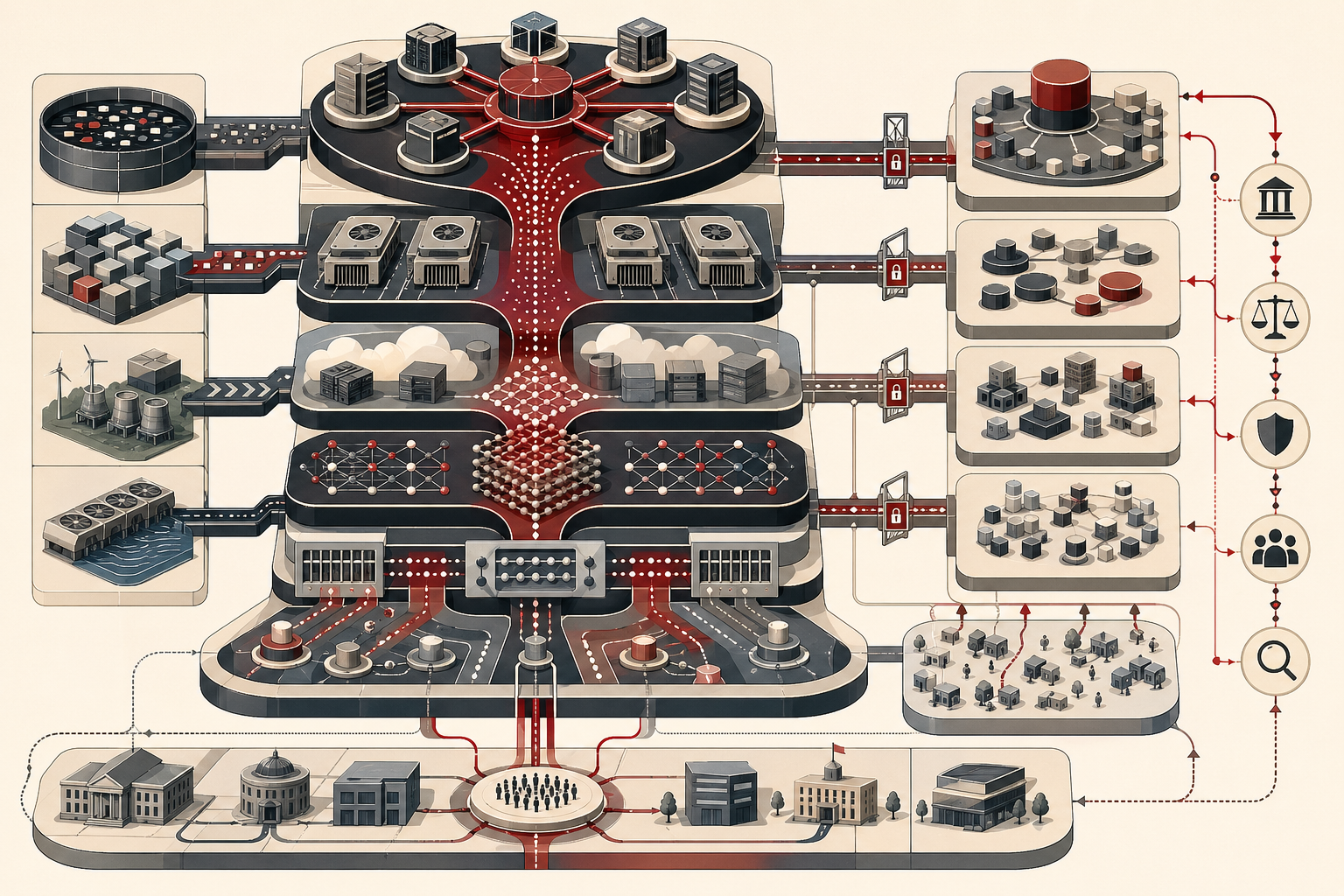
This article develops Economics of AI Systems and Platform Power as an advanced article within the Artificial Intelligence Systems knowledge series. It explains AI value chains, general-purpose technology, platform economics, data and compute bottlenecks, scale effects, fixed costs, cloud infrastructure, market concentration, downstream competition, productivity measurement, organizational complements, political economy, information power, competition policy, public capacity, and governance. Selected Python and R examples appear here, while the full GitHub repository contains expanded computational scaffolding for AI value-chain analysis, platform-dependence scoring, compute bottleneck modeling, concentration metrics, value-capture diagnostics, SQL metadata, governance documentation, and advanced Jupyter notebooks.
Why the Economics of AI Systems Matters
The economics of AI systems matters because artificial intelligence is not only a technical transformation. It is also a reorganization of economic power. AI systems require data, compute, chips, energy, engineering talent, cloud capacity, model-development infrastructure, distribution channels, and organizational integration. These inputs are not evenly distributed. Firms and regions that control them may shape the terms under which AI is built, accessed, priced, governed, and deployed.
AI can create broad economic value by improving productivity, automating tasks, expanding decision support, accelerating research, reducing coordination costs, and enabling new products. But value creation and value capture are not the same. A downstream firm may create value with AI while an upstream platform captures much of the surplus. A consumer may receive better service while a dominant ecosystem strengthens its gatekeeping position. A small firm may gain access to powerful tools while becoming more dependent on cloud, model, or distribution providers.
This is why AI economics must examine the full stack. The relevant question is not simply whether AI increases output. It is how AI changes market structure, bargaining power, entry conditions, productivity measurement, labor organization, infrastructure dependence, public capacity, and the distribution of gains. AI systems are economic systems because they organize access to capability through markets, platforms, institutions, and infrastructure.
AI\ Capability \neq Economic\ Power
\]
Interpretation: Technical capability becomes economic power only when it is connected to control over infrastructure, distribution, pricing, data, adoption, or governance.
| Layer | Economic Function | Power Question | Governance Concern |
|---|---|---|---|
| Compute and chips | Provide the physical basis for training and inference. | Who controls scarce infrastructure? | Access, concentration, energy demand, and geopolitical dependence. |
| Cloud infrastructure | Hosts models, APIs, data pipelines, and enterprise deployment. | Who sets pricing, reliability, and access conditions? | Vendor dependence, resilience, procurement, and auditability. |
| Data | Supports training, fine-tuning, evaluation, personalization, and monitoring. | Who controls high-quality, lawful, domain-relevant data? | Privacy, provenance, labor, consent, and data rights. |
| Models | Convert data and compute into reusable AI capability. | Who controls frontier capability and model access? | Safety, interoperability, dependency, and accountability. |
| Distribution | Connects AI capability to users, firms, and workflows. | Who controls interfaces, defaults, and market access? | Gatekeeping, bundling, switching costs, and platform leverage. |
| Governance | Shapes trust, legitimacy, risk management, and institutional adoption. | Who can audit, contest, regulate, and redirect AI systems? | Public capacity, competition policy, transparency, and accountability. |
Note: AI economics is not reducible to model performance. It depends on the layered system through which models become economic infrastructure.
Foundations of the Economics of AI Systems
AI economics is best understood at the level of systems rather than individual models. A model by itself is rarely the full economic unit of analysis. What matters is the broader pipeline: data acquisition, compute access, training, fine-tuning, evaluation, deployment, distribution, feedback, integration, monitoring, and recurring use. This means AI markets are shaped by innovation economics, industrial organization, platform economics, infrastructure economics, labor economics, public finance, and political economy.
The costs of building advanced systems can be very high, especially when training and deployment require specialized hardware, large-scale cloud infrastructure, engineering talent, power, cooling, networking, and high-quality data. Yet once those systems are operational, the incremental cost of serving additional users or embedding the same model across multiple applications can be comparatively low. This combination of high fixed cost and scalable reuse creates pressure toward scale and concentration.
At the same time, AI is not identical to earlier digital platform markets. Direct user-side network effects may sometimes be weaker than in classical social networks or marketplaces, but scale economies in training, inference, infrastructure, data access, ecosystem distribution, and enterprise bundling can still be powerful. The resulting market structure is shaped by a different mix of forces: supply-side scale, capital intensity, vertical integration, bottleneck inputs, data advantages, switching costs, and control over complementary layers.
| Economic Force | How It Appears in AI | Strategic Effect | Public-Interest Question |
|---|---|---|---|
| High fixed costs | Frontier training, data centers, talent, and infrastructure require large investment. | Large actors may gain scale advantages. | Can smaller firms, universities, public agencies, and civil society access meaningful AI capacity? |
| Low marginal replication | Models can be reused across many users and products once deployed. | Successful systems can scale quickly. | Do scale advantages lead to efficiency or durable dominance? |
| Vertical integration | Firms combine cloud, models, enterprise software, distribution, and user interfaces. | Control over one layer can shape another. | Can competitors access critical inputs on fair terms? |
| Data advantage | Usage, feedback, enterprise, and domain data can improve AI systems. | Incumbents may compound advantage. | Who controls data rights, provenance, and feedback loops? |
| Switching costs | Integration, contracts, workflows, embeddings, and tooling make migration difficult. | Customers may become locked into platforms. | Are interoperability and portability sufficient? |
| Complementary investment | Firms need workflow redesign, training, governance, and data systems. | Adoption benefits vary widely. | Will productivity gains be broad-based or concentrated? |
Note: AI markets are shaped by the interaction of technical cost structure, platform control, organizational adoption, and institutional capacity.
Economic\ AI = Technology + Infrastructure + Market\ Structure + Institutions
\]
Interpretation: AI becomes economically significant through the interaction of technical capability, infrastructure control, market organization, and institutional governance.
AI as a General-Purpose Technology
AI is often described as a general-purpose technology because it can be applied across many sectors, supports complementary innovation, and may alter production processes over time. Like electricity, semiconductors, computing, and the internet, AI is not limited to one final product category. It can become a flexible input into many forms of work: research, design, logistics, customer service, coding, analysis, writing, compliance, planning, forecasting, and decision support.
A general-purpose technology can be represented as:
Y = F(K,L,A_{\mathrm{AI}},C)
\]
Interpretation: Output \(Y\) depends on capital \(K\), labor \(L\), AI capability \(A_{\mathrm{AI}}\), and complementary assets \(C\).
The complement term matters. AI may not produce productivity gains unless firms redesign workflows, train workers, improve data governance, integrate software, and change organizational routines. Economic impact therefore depends not only on model capability, but on complementary investment.
This also explains why productivity effects may appear uneven. Some organizations will use AI as a shallow tool layer. Others will restructure processes around it. Some sectors will absorb AI quickly because work is digitized and measurable. Others will face regulatory, institutional, data, labor, or trust constraints. General-purpose technologies typically diffuse through waves of experimentation, complementary investment, and institutional adjustment rather than through immediate economy-wide transformation.
| Feature | Economic Meaning | AI Example | Strategic Implication |
|---|---|---|---|
| Broad applicability | The technology can be used across many sectors. | AI supports coding, search, design, logistics, research, finance, law, and education. | Economic effects may diffuse widely but unevenly. |
| Complementary innovation | New processes and products emerge around the technology. | Firms redesign workflows, interfaces, and decision systems around AI. | Adoption requires organizational and institutional change. |
| Long diffusion cycle | Productivity gains may take time to appear. | Early pilots precede deep operating-model transformation. | Measurement may lag actual capability development. |
| Sectoral variation | Benefits depend on data, regulation, trust, workflow, and labor structure. | Software may adopt faster than healthcare or public administration. | Economic impact cannot be assumed uniform. |
| Complement dependence | Technology value depends on other assets. | AI requires data systems, governance, training, evaluation, and integration. | Complement-rich firms may capture disproportionate gains. |
Note: Treating AI as a general-purpose technology explains why its effects may be broad, uneven, delayed, and dependent on complementary investment.
The AI Value Chain: Data, Compute, Models, and Distribution
The AI economy can be analyzed as a layered value chain. At minimum, this includes:
- inputs: data, compute, chips, energy, networking, talent, and capital;
- model development: training, fine-tuning, evaluation, alignment, and safety testing;
- deployment infrastructure: cloud services, APIs, orchestration layers, monitoring, and edge systems;
- distribution and integration: applications, enterprise software, consumer interfaces, workflow embedding, and platform channels;
- feedback and learning: usage data, evaluation logs, human review, product analytics, and model improvement loops.
This layered structure matters because power can accumulate at different points in the chain. A firm may not dominate the application layer yet still exert major influence by controlling compute access, model distribution, cloud infrastructure, enterprise integration, or default user interfaces. The economic question is therefore not simply who has the best model, but who controls the chain through which models become usable, scalable, and monetizable.
A value-chain view can be represented as:
Input \rightarrow Model \rightarrow Infrastructure \rightarrow Distribution \rightarrow Use \rightarrow Feedback
\]
Interpretation: AI value emerges through a chain of inputs, model development, deployment infrastructure, distribution, use, and feedback.
Seen in this way, AI resembles a full-stack system in which upstream bottlenecks can shape downstream competition. When the same actors occupy multiple layers simultaneously, the risk of strategic leverage increases.
| Value-Chain Layer | What It Controls | Economic Power Mechanism | Risk if Concentrated |
|---|---|---|---|
| Data | Training, evaluation, personalization, and feedback signals. | Quality, exclusivity, rights, and accumulated user interaction. | Data advantages compound and exclude weaker actors. |
| Compute | Training, inference, experimentation, and deployment scale. | Capital intensity, accelerator access, energy, and cloud capacity. | Compute scarcity limits who can build or compete. |
| Models | Reusable AI capability and API access. | Performance, pricing, safety controls, update cadence, and ecosystem adoption. | Downstream firms become dependent on model provider terms. |
| Infrastructure | Cloud, orchestration, monitoring, storage, and enterprise integration. | Bundling, reliability, procurement, and technical lock-in. | Infrastructure control becomes market leverage. |
| Distribution | User access, defaults, interfaces, marketplaces, and enterprise suites. | Gatekeeping, switching costs, visibility, and customer relationships. | Dominant platforms shape which AI systems are adopted. |
| Feedback | Learning from usage, evaluation, human review, and product behavior. | Data flywheels and iterative improvement. | Incumbents improve faster because they already control usage at scale. |
Note: AI economic power can emerge from any layer of the stack, not only from model development.
Scale Effects, Fixed Costs, and Economic Concentration
One of the defining economic features of AI systems is the role of scale. Training advanced models can require large fixed investments in accelerators, data-center capacity, energy, networking, engineering labor, and software tooling. These are not marginal investments. They are structural commitments that shape who can participate meaningfully at the frontier.
Once such investments are made, the resulting systems can often be repurposed, fine-tuned, served through APIs, integrated into many products, and distributed across large user bases. This creates a familiar economic pattern: high fixed costs combined with relatively low marginal replication costs. Under such conditions, scale can confer advantages in pricing, experimentation, deployment, iteration, and ecosystem control.
A simple cost structure can be represented as:
TC(q)=F+cq
\]
Interpretation: Total cost \(TC\) includes fixed cost \(F\) and marginal cost \(c\) for quantity \(q\).
Average cost is:
AC(q)=\frac{F}{q}+c
\]
Interpretation: Average cost falls as output \(q\) increases when fixed costs are large.
Scaling laws strengthened this tendency by making larger training runs economically legible as a route to improved capability. But the strategic implication is broader than performance alone. When capability is strongly related to access to capital-intensive inputs, firms with privileged access to those inputs may shape the competitive field long before downstream application markets mature.
This does not mean concentration is inevitable. It does mean that market structure in AI is strongly conditioned by the cost structure of scale. If frontier performance remains tightly linked to capital-intensive infrastructure, economic power is likely to accumulate around actors able to finance and coordinate that infrastructure.
| Scale Mechanism | How It Works | Concentration Pressure | Possible Counterforce |
|---|---|---|---|
| High fixed training costs | Frontier systems require large upfront investments. | Only well-capitalized actors can compete at the frontier. | Open models, public compute, specialized models, efficient architectures. |
| Low marginal reuse | One model can be deployed across many use cases. | Large providers spread fixed costs across more customers. | Domain specialization and local adaptation. |
| Compute procurement | Large actors secure accelerators and cloud capacity. | Scarce inputs may be allocated preferentially to incumbents. | Competitive cloud access, public-interest compute, supply diversification. |
| Distribution bundling | AI features are bundled into existing platforms and software suites. | Incumbents use distribution to accelerate adoption. | Interoperability, switching rights, open standards. |
| Feedback scale | Usage generates improvement signals. | Popular systems improve through more data and evaluation. | Data portability, shared benchmarks, independent evaluation infrastructure. |
Note: Scale can create real efficiency while also intensifying concentration. AI economics must evaluate both effects together.
High\ Fixed\ Cost + Scalable\ Reuse \rightarrow Scale\ Advantage
\]
Interpretation: When AI systems require large upfront investment but can be reused broadly, economic advantages tend to accumulate around actors with scale.
Platforms, Gatekeeping, and Strategic Control
Platform power in AI emerges when firms control critical interfaces between upstream capability and downstream use. This may occur through cloud hosting, API access, enterprise software suites, app ecosystems, operating systems, search surfaces, payment systems, identity layers, developer tools, or major distribution channels. In this setting, platform economics matters because the most important question is not only who builds models, but who controls the terms under which models become accessible to others.
In this sense, AI platform power is not simply about size. It is about gatekeeping. A firm with privileged control over compute, model distribution, default interfaces, or enterprise adoption pathways may shape which models are visible, affordable, interoperable, or contractually viable. Even if nominal competition exists at the model layer, the effective economic environment may still be constrained by gatekeeping at adjacent layers.
Platform control can be represented as:
P_{\mathrm{power}} = g(Gatekeeping,Scale,Switching\ Costs,Data,Distribution)
\]
Interpretation: Platform power depends on gatekeeping, scale, switching costs, data control, and distribution control.
This gatekeeping logic matters because AI is increasingly embedded in existing digital ecosystems rather than adopted in isolation. Firms that already control major operating environments can integrate AI into those environments in ways that reinforce cross-market dependence. Platform power therefore turns AI from a single technology into an extension of broader ecosystem control.
| Platform Control Point | Economic Mechanism | Example of Leverage | Policy Question |
|---|---|---|---|
| API access | Controls who can use model capability and on what terms. | Pricing, rate limits, content restrictions, contract terms. | Are access terms fair, transparent, and contestable? |
| Cloud integration | Bundles AI with infrastructure, storage, identity, and enterprise services. | Customers face migration costs and deep technical dependence. | Can users switch or multi-home without excessive friction? |
| Default interfaces | Controls the AI tools users encounter first. | Search, operating systems, productivity suites, enterprise software. | Do defaults reinforce dominance across adjacent markets? |
| Developer ecosystem | Shapes tools, documentation, marketplaces, and deployment paths. | Developers build around a dominant platform’s standards. | Are interoperability and portability protected? |
| Data feedback | Captures usage data, evaluation signals, and behavioral feedback. | Platform improves faster because it controls the learning loop. | Who owns and benefits from feedback data? |
| Distribution channel | Controls access to customers, enterprise buyers, or public attention. | Apps, search results, procurement channels, app stores, marketplaces. | Can competitors reach users on fair terms? |
Note: Platform power is often strongest where technical dependence, economic dependence, and distribution control reinforce one another.
Compute, Cloud Infrastructure, and Bottleneck Power
Compute has become one of the most important economic bottlenecks in AI. Access to accelerators, cloud capacity, power, networking, and data-center resources shapes who can train, fine-tune, deploy, and serve advanced systems. This makes compute not just a technical input, but a strategic one.
Cloud infrastructure is economically decisive because many firms do not own the compute stack on which their AI systems depend. Even when model development appears competitive, firms without reliable access to large-scale compute may remain structurally dependent on upstream infrastructure providers. This dependence can shape pricing, experimentation speed, product design, and which forms of deployment are feasible.
A compute constraint can be represented as:
Capability \leq h(Compute,Data,Talent,Capital)
\]
Interpretation: Model capability is constrained by compute, data, talent, and capital.
The economics of compute also extend beyond chips. Data-center construction depends on land, regulation, electricity, cooling, networking, water, supply chains, and long-term capital allocation. Shortages in any one layer can translate into scarcity across the whole system. As AI adoption grows, bottleneck power may increasingly reside not only in chips themselves, but in the infrastructure required to operationalize them.
This makes the compute layer a central site of economic and geopolitical power. Control over compute can influence who builds frontier systems, who competes downstream, which regions develop AI capacity, and which institutions participate meaningfully in the AI economy.
| Bottleneck | Economic Role | Potential Concentration Effect | Governance Concern |
|---|---|---|---|
| Accelerators | Enable training and inference at scale. | Scarce chips concentrate capacity among large buyers. | Supply-chain resilience, export controls, access inequality. |
| Cloud capacity | Provides elastic deployment and enterprise infrastructure. | Cloud providers become strategic gatekeepers. | Portability, procurement, outages, and pricing leverage. |
| Energy | Supports data-center operations and cooling. | Regions with energy capacity attract AI infrastructure. | Grid stress, emissions, water use, and local community impact. |
| Networking | Supports distributed training and low-latency deployment. | Large-scale infrastructure requires specialized coordination. | Reliability, resilience, and infrastructure concentration. |
| Talent | Designs, optimizes, evaluates, and governs AI systems. | High-skilled labor clusters around frontier firms and regions. | Unequal capacity across firms, universities, and public agencies. |
| Capital | Finances long-horizon infrastructure and model development. | Capital-intensive frontier AI favors large incumbents. | Market entry, public-interest investment, and regional inequality. |
Note: Compute is not only a technical resource. It is a strategic economic bottleneck that shapes who can participate in the AI economy.
Compute\ Scarcity \rightarrow Strategic\ Scarcity
\]
Interpretation: When compute access is scarce, control over infrastructure can become control over AI market participation.
Competition, Diffusion, and Downstream Market Dynamics
AI can simultaneously intensify and weaken competition. On one hand, it can reduce costs, improve matching, expand product quality, increase speed, and enable smaller firms to access capabilities that were previously unavailable. On the other hand, it can amplify incumbency advantages by enabling personalization, bundling, dynamic pricing, cross-market integration, data accumulation, and control over distribution.
This means the economics of AI cannot be reduced to a simple claim that the technology is either democratizing or monopolizing. Its competitive effects depend on how capabilities interact with existing market structure. In fragmented sectors, AI may lower coordination costs and improve entry conditions. In already concentrated ecosystems, it may reinforce incumbents through integration, data access, contractual leverage, and cross-market control.
Downstream markets are especially important because many of AI’s visible economic effects will appear there first: search, software, customer service, logistics, media, finance, healthcare, education, law, advertising, and professional tools. The same upstream model or infrastructure can support multiple downstream markets, creating opportunities for vertical leverage and differentiated pricing strategies.
A downstream competition effect can be represented as:
Competition_{\mathrm{downstream}} = f(Entry,Cost,Access,Switching,Control)
\]
Interpretation: Downstream competition depends on entry conditions, cost effects, access to AI inputs, switching costs, and control over strategic layers.
AI diffusion may therefore broaden access in some markets while reinforcing concentration in others.
| Competitive Effect | Pro-Competitive Channel | Concentration Channel | Assessment Question |
|---|---|---|---|
| Lower production costs | Smaller firms can automate tasks and improve productivity. | Large firms may deploy AI at greater scale and lower average cost. | Who captures the cost savings? |
| Better matching and personalization | New entrants can serve niche markets more effectively. | Incumbents with more data personalize more deeply. | Does personalization increase choice or lock-in? |
| Faster product development | Startups can prototype and ship faster. | Platforms can copy, bundle, or privilege their own services. | Can entrants reach users on fair terms? |
| Model access | APIs provide powerful capabilities without frontier training costs. | Dependence shifts bargaining power upstream. | Are access, pricing, and interoperability contestable? |
| Data feedback | Firms can improve from use and evaluation. | Large installed bases compound learning advantages. | Can users port data and feedback across systems? |
Note: AI can democratize capability while concentrating power. Which effect dominates depends on market structure, interoperability, data access, and platform control.
Productivity, Measurement, and Economic Output
AI is often justified economically through productivity claims, but measuring those gains is difficult. Many effects are indirect, platform-mediated, or diffused across workflows rather than captured in a single sectoral output category. AI may improve information processing, decision quality, coordination, responsiveness, software development, search, or administrative efficiency without immediately appearing as a new standalone product.
This creates a measurement problem. Traditional economic statistics are often better at capturing discrete goods and services than improvements in process quality, information filtering, service personalization, decision support, or organizational responsiveness. If AI primarily changes how work is coordinated, how decisions are made, or how existing systems operate, its gains may be real but difficult to quantify cleanly.
Productivity can be represented as:
Productivity = \frac{Output}{Input}
\]
Interpretation: Productivity measures output produced per unit of input, but AI may change both output quality and input structure.
This matters because measurement shapes investment, regulation, public expectations, and strategic decision-making. If productivity gains are overstated, the case for rapid restructuring may be exaggerated. If they are understated, institutions may fail to respond to genuine structural change. The economics of AI systems therefore includes not only production and competition, but also the problem of how value is observed, attributed, and counted.
| Measurement Challenge | Why It Matters | AI Example | Possible Measurement Response |
|---|---|---|---|
| Quality change | Output may improve without quantity increasing. | Better summaries, decisions, personalization, or code review. | Measure quality-adjusted output and error reduction. |
| Coordination improvement | AI may reduce search, communication, and administrative friction. | Faster case routing, document review, or internal knowledge retrieval. | Measure cycle time, backlog reduction, and decision latency. |
| Invisible labor shifts | Tasks may move, disappear, or become supervisory. | Employees spend less time drafting and more time reviewing. | Track task composition, review burden, and skill requirements. |
| Platform-mediated value | Productivity may depend on upstream systems. | Firms gain output through AI tools but pay more to providers. | Distinguish gross productivity from retained surplus. |
| Lagged complementary investment | Benefits may appear only after workflow redesign. | Initial pilots show limited gains before process transformation. | Measure adoption maturity and complementary investment. |
Note: AI productivity gains may be real but difficult to observe if they appear through quality, coordination, decision speed, or organizational learning rather than simple output quantity.
Measured\ Productivity \neq Total\ Economic\ Effect
\]
Interpretation: AI may change quality, coordination, speed, and learning in ways that traditional productivity measures capture imperfectly.
Firms, Complementarities, and Organizational Adoption
AI rarely creates value in isolation. It usually requires complementary assets: domain expertise, data governance, process redesign, training, software integration, trust, measurement, and organizational change. A firm may purchase access to sophisticated AI services and still fail to realize meaningful gains if those complements are weak or missing.
This is one reason adoption effects vary so widely across organizations. The benefits of AI depend not only on access to models, but on whether firms can adapt workflows, incentives, governance structures, and measurement systems to use them effectively. AI adoption is therefore a problem of organizational economics as much as technological procurement.
Complementarity can be represented as:
V_{\mathrm{AI}} = f(AI,Data,Workflow,Talent,Governance)
\]
Interpretation: AI value depends on AI capability and complementary organizational assets.
This connects directly to AI Systems in Organizations and Institutions. Economic value from AI is co-produced by organizational design. Systems create value when they are embedded into institutions capable of governing and exploiting them, not when they remain abstract capabilities disconnected from workflow or accountability.
| Complement | Economic Function | Failure if Missing | Strategic Implication |
|---|---|---|---|
| Data governance | Improves reliability, compliance, and reuse. | AI outputs depend on fragmented or untrusted data. | Data systems become economic infrastructure. |
| Workflow redesign | Converts AI output into operational value. | AI remains a side tool rather than a process improvement. | Productivity depends on operating-model change. |
| Human capability | Enables judgment, validation, and effective use. | Workers overtrust, underuse, or misuse AI systems. | Training and role redesign shape value capture. |
| Governance | Supports trustworthy deployment and risk management. | AI creates legal, reputational, or operational risk. | Governance becomes a strategic complement. |
| Measurement | Connects AI use to outcomes and learning. | Firms count seats, prompts, or pilots rather than value. | Economic gains require outcome-based evaluation. |
| Leadership alignment | Prioritizes investments and removes organizational barriers. | Pilots proliferate without strategic coherence. | AI adoption becomes a portfolio-management problem. |
Note: Organizational complements explain why access to the same AI tools can produce very different economic outcomes across firms.
Political Economy, Information Power, and Institutional Effects
AI platform power also has political-economy implications. Systems that intermediate search, recommendation, summarization, content generation, advertising, translation, ranking, and knowledge retrieval can reshape visibility, attention, bargaining power, and public discourse. This is not only a matter of firm profitability. It is a matter of informational governance.
When platforms mediate AI-generated or AI-ranked information at scale, they influence what becomes legible, salient, monetized, or marginalized. This can affect labor markets, media ecosystems, educational systems, scientific communication, public administration, and democratic processes. The economic structure of AI therefore has institutional consequences beyond the balance sheets of technology firms.
Information power can be represented as:
I_{\mathrm{power}} = f(Visibility,Ranking,Access,Attention,Trust)
\]
Interpretation: Information power depends on visibility, ranking control, access, attention, and trust.
In this sense, AI systems are simultaneously productive assets and governance-relevant infrastructures. Their economics cannot be separated from their institutional effects, because the same structures that generate profit may also shape visibility, dependency, and control.
| Domain | AI Platform Function | Institutional Effect | Governance Question |
|---|---|---|---|
| Search and knowledge | AI summarizes, ranks, and retrieves information. | Platforms influence what appears authoritative or visible. | How are sources, citations, and marginalized knowledge represented? |
| Media and attention | AI recommends, generates, moderates, and personalizes content. | Attention can be concentrated, polarized, or monetized. | Who governs amplification and visibility? |
| Labor markets | AI matches, scores, monitors, and evaluates workers. | Power shifts toward systems that define performance and opportunity. | Are workers able to understand, contest, and correct AI-mediated decisions? |
| Public administration | AI supports eligibility, triage, inspection, enforcement, and planning. | Public capacity may become dependent on private infrastructure. | Can public institutions audit and control critical AI systems? |
| Science and education | AI mediates search, synthesis, writing, tutoring, and research workflows. | Knowledge production may become dependent on platform tools. | How are epistemic diversity, access, and integrity protected? |
Note: Platform power is not only economic. It can shape what people see, know, trust, and act upon.
Governance, Competition Policy, and Public Capacity
Because AI markets involve layered bottlenecks, vertical dependencies, and uncertain diffusion, competition policy and governance become central. This is not only about classic antitrust in the narrow sense. It also includes interoperability, procurement design, cloud dependence, regional infrastructure capacity, data access, public-interest compute, auditability, transparency, and the conditions under which smaller firms, civic institutions, researchers, and public agencies can participate meaningfully in AI development and adoption.
Governance is especially important because market structure in AI is not fixed. Policy choices can influence openness, entry conditions, interoperability, public capacity, and the degree to which critical layers remain contestable. Public institutions therefore face a dual task: enabling innovation while preventing upstream bottlenecks from becoming persistent downstream dominance.
A public-capacity expression can be written as:
Public\ Capacity = f(Compute,Expertise,Procurement,Regulation,Data)
\]
Interpretation: Public capacity depends on compute access, expertise, procurement capability, regulation, and data infrastructure.
This links directly to AI Governance and Regulatory Systems. Economic structure and governance structure are intertwined. The shape of the AI economy will depend not only on private strategy, but on the capacity of public institutions to understand and govern layered technological markets.
| Governance Area | Economic Problem Addressed | Possible Tool | Desired Outcome |
|---|---|---|---|
| Interoperability | Switching costs and lock-in. | Open standards, portability rules, API transparency. | Users and firms can move across providers more easily. |
| Competition policy | Vertical leverage and market concentration. | Merger review, conduct rules, self-preferencing scrutiny. | Critical markets remain contestable. |
| Public-interest compute | Unequal access to AI infrastructure. | Public compute resources, university access, research infrastructure. | Researchers, public agencies, and smaller actors can participate. |
| Procurement capacity | Public agencies become dependent on opaque vendors. | Model procurement standards, audit rights, exit clauses. | Public institutions retain accountability and bargaining power. |
| Data governance | Unclear rights, provenance, and feedback ownership. | Data trusts, provenance standards, privacy rules, rights management. | Data value is governed transparently and lawfully. |
| Auditability | Opaque systems become economic and institutional infrastructure. | Documentation, reporting, testing, third-party audits. | AI systems can be examined, contested, and improved. |
Note: Public capacity is part of AI economics because institutions need enough expertise, infrastructure, and legal authority to govern markets they depend on.
Weak\ Public\ Capacity \rightarrow Private\ Infrastructure\ Dependence
\]
Interpretation: When public institutions lack AI expertise, compute access, procurement capacity, and audit rights, they may become dependent on private systems they cannot fully govern.
Limits, Tradeoffs, and Open Questions
Several unresolved questions remain central to the economics of AI systems:
- Will scale economies dominate long enough to entrench concentrated control, or will diffusion and specialization loosen that structure?
- How much AI value will be captured by upstream infrastructure providers versus downstream adopters?
- Will productivity gains be broad-based, or concentrated in firms and regions with the strongest complements?
- How should policymakers respond when systems that increase efficiency also intensify gatekeeping, price discrimination, or dependency?
- What forms of public capacity are necessary to keep AI markets contestable and socially beneficial?
- How should economic statistics capture AI-driven process quality, service improvement, and organizational learning?
- How should competition authorities evaluate vertical integration across compute, cloud, model, distribution, and application layers?
These are not peripheral questions. They are the economic core of the AI transition. The future of AI systems will depend not only on what the technology can do, but on who controls the layers through which it becomes economically actionable. AI is therefore not just a technical revolution. It is a reorganization of economic power across infrastructure, platforms, markets, labor, and institutions.
| Open Question | Why It Matters | What to Watch |
|---|---|---|
| Scale versus specialization | Determines whether frontier providers dominate or specialized systems flourish. | Model efficiency, open models, domain-specific AI, inference costs. |
| Upstream value capture | Determines whether downstream adopters retain gains. | API pricing, cloud contracts, model bundling, margin shifts. |
| Public capacity | Determines whether public institutions can govern and participate. | Procurement rules, public compute, technical expertise, audit rights. |
| Labor distribution | Determines who benefits from productivity gains. | Task redesign, wage effects, worker bargaining power, training access. |
| Competition policy | Determines whether AI markets remain contestable. | Vertical integration, self-preferencing, merger activity, interoperability. |
| Measurement | Determines whether economic impact is understood accurately. | Quality-adjusted productivity, service improvement, coordination gains. |
Note: The economics of AI remains unsettled because capability, adoption, market structure, and governance are changing at the same time.
Mathematical Lens
AI value creation can be represented as:
V_{\mathrm{created}} = f(Data,Compute,Model,Distribution,Complements)
\]
Interpretation: AI-created value depends on data, compute, models, distribution, and complementary assets.
Value capture can be represented as:
VC_i = \frac{S_i}{\sum_{j=1}^{n}S_j}
\]
Interpretation: Actor \(i\)’s value capture share \(VC_i\) equals its surplus \(S_i\) divided by total surplus across actors.
Concentration can be represented as:
H=\sum_{i=1}^{n}s_i^2
\]
Interpretation: Concentration rises when market or dependency shares \(s_i\) are dominated by a small number of firms.
Platform dependence can be represented as:
Dep = \frac{Criticality}{Substitutability}
\]
Interpretation: Dependence increases when an upstream capability is critical and difficult to substitute.
Average cost under high fixed cost can be represented as:
AC(q)=\frac{F}{q}+c
\]
Interpretation: Average cost declines with scale when fixed cost \(F\) is large and marginal cost \(c\) is comparatively low.
A platform-power score can be represented as:
P_{\mathrm{power}}=\alpha H+\beta Dep+\gamma S_c+\delta D_c+\eta G_k
\]
Interpretation: Platform power may increase with concentration \(H\), dependence \(Dep\), switching costs \(S_c\), data control \(D_c\), and gatekeeping \(G_k\).
A productivity-adjusted value expression can be written as:
\Delta Y = \Delta Productivity + \Delta Quality + \Delta Coordination
\]
Interpretation: AI may increase economic output through productivity, quality improvement, and better coordination.
This mathematical lens shows that AI economics is about value creation, value capture, concentration, dependence, fixed costs, platform power, and measurement.
Variables and System Interpretation
| Symbol or Term | Meaning | Typical Type | Economic Interpretation |
|---|---|---|---|
| \(V_{\mathrm{created}}\) | Created value | Economic value. | Total value generated by AI across products, workflows, and institutions. |
| \(VC_i\) | Value capture share | Ratio. | Share of AI-created surplus captured by actor \(i\). |
| \(F\) | Fixed cost | Cost parameter. | Upfront investment in compute, talent, infrastructure, and model development. |
| \(c\) | Marginal cost | Cost parameter. | Cost of serving additional units or users. |
| \(q\) | Scale or quantity | Usage or output. | Number of served users, tasks, API calls, or deployed use cases. |
| \(H\) | Concentration score | Market or dependency concentration. | Degree to which activity is concentrated among few actors. |
| \(Dep\) | Platform dependence | Risk measure. | Dependence on upstream providers, models, cloud, or distribution channels. |
| \(S_c\) | Switching costs | Friction measure. | Cost or difficulty of moving away from a platform or provider. |
| \(D_c\) | Data control | Strategic asset. | Control over data needed to train, evaluate, personalize, or improve AI. |
| \(G_k\) | Gatekeeping | Platform-control variable. | Ability to control access, visibility, interoperability, or pricing. |
| Complements | Organizational assets | Data, workflows, talent, governance, trust. | Assets required to convert AI capability into realized value. |
| Public capacity | Institutional capability | Compute, expertise, procurement, regulation. | Ability of public institutions to govern and participate in AI markets. |
Note: AI economic analysis should distinguish capability, value creation, value capture, dependence, concentration, and governance capacity.
Worked Example: Value Creation versus Value Capture
Suppose an AI system creates total surplus across an ecosystem:
S_{\mathrm{total}}=100
\]
Interpretation: The AI system creates 100 units of total economic surplus.
The surplus is divided among an upstream infrastructure provider, a model provider, a downstream application firm, and users:
S_{\mathrm{infra}}=35,\quad S_{\mathrm{model}}=25,\quad S_{\mathrm{app}}=20,\quad S_{\mathrm{users}}=20
\]
Interpretation: Different actors capture different portions of the AI-created surplus.
The downstream application firm’s value capture share is:
VC_{\mathrm{app}}=\frac{20}{100}=0.20
\]
Interpretation: The downstream firm captures 20 percent of total AI-created surplus.
If platform dependence increases and the upstream infrastructure provider raises prices, surplus may shift:
S_{\mathrm{infra}}=45,\quad S_{\mathrm{app}}=10
\]
Interpretation: The application firm may create value with AI while capturing less value because upstream bargaining power increases.
This example shows why AI strategy and AI economics must distinguish technical capability from economic control. A downstream firm may be more productive with AI and still become less powerful if dependency, pricing, and platform control shift surplus upstream.
| Actor | Initial Surplus | Value-Capture Share | After Upstream Price Shift | Economic Interpretation |
|---|---|---|---|---|
| Infrastructure provider | 35 | 35% | 45 | Captures more surplus when compute or cloud dependence increases. |
| Model provider | 25 | 25% | 25 | Captures value through model access, pricing, and ecosystem position. |
| Application firm | 20 | 20% | 10 | Creates value downstream but loses surplus when upstream bargaining power rises. |
| Users | 20 | 20% | 20 | May benefit through improved service, lower costs, or quality gains. |
Note: AI adoption can improve productivity while shifting economic power toward the actor that controls the bottleneck.
Computational Modeling
Computational modeling can make AI economics more concrete. A value-chain workflow can score actors across data control, compute access, distribution leverage, switching costs, and value capture. A platform-power workflow can estimate concentration and dependence. A productivity workflow can distinguish direct output effects from quality and coordination improvements. A governance workflow can document whether public or organizational capacity is sufficient to manage dependence and market power.
The selected examples below use lightweight synthetic workflows so the article remains readable and WordPress-friendly. The GitHub repository extends the same logic into advanced Jupyter notebooks, concentration metrics, platform-dependence analysis, value-capture modeling, compute bottleneck scoring, SQL metadata, governance checklists, and reproducible outputs.
A useful computational approach should not treat platform power as a single number. It should decompose the economic structure: market share, data control, compute control, distribution leverage, switching costs, gatekeeping, value capture, and substitutability. The goal is to make hidden dependence visible enough for strategy, governance, and public policy.
Platform\ Power = Concentration + Dependence + Gatekeeping + Switching\ Costs
\]
Interpretation: Platform power is multi-dimensional and should be evaluated across the full system of economic control.
Python Workflow: AI Platform Power and Value-Capture Diagnostics
Python is useful for scoring platform power, concentration, dependence, and value capture across an AI ecosystem.
"""
Economics of AI Systems and Platform Power

Python workflow: AI platform power and value-capture diagnostics.

This educational example demonstrates:
1. AI ecosystem actors
2. concentration measurement
3. platform-power scoring
4. dependency diagnostics
5. value-capture shares
6. governance-ready output files

It uses synthetic data for illustration.
"""

from __future__ import annotations

from pathlib import Path
import pandas as pd


OUTPUT_DIR = Path("outputs")
OUTPUT_DIR.mkdir(parents=True, exist_ok=True)


actors = pd.DataFrame(
    [
        {
            "actor": "cloud_compute_provider",
            "layer": "infrastructure",
            "market_share": 0.36,
            "data_control": 0.45,
            "distribution_control": 0.55,
            "switching_costs": 0.80,
            "gatekeeping_power": 0.85,
            "captured_surplus": 35.0,
        },
        {
            "actor": "foundation_model_provider",
            "layer": "model",
            "market_share": 0.28,
            "data_control": 0.70,
            "distribution_control": 0.60,
            "switching_costs": 0.65,
            "gatekeeping_power": 0.72,
            "captured_surplus": 25.0,
        },
        {
            "actor": "enterprise_application_firm",
            "layer": "application",
            "market_share": 0.18,
            "data_control": 0.55,
            "distribution_control": 0.45,
            "switching_costs": 0.40,
            "gatekeeping_power": 0.35,
            "captured_surplus": 20.0,
        },
        {
            "actor": "downstream_users",
            "layer": "user",
            "market_share": 0.18,
            "data_control": 0.20,
            "distribution_control": 0.10,
            "switching_costs": 0.25,
            "gatekeeping_power": 0.10,
            "captured_surplus": 20.0,
        },
    ]
)


def compute_platform_metrics(df: pd.DataFrame) -> tuple[pd.DataFrame, float]:
    """Compute concentration, platform power, dependency risk, and value capture."""
    scored = df.copy()

    concentration_score = float((scored["market_share"] ** 2).sum())

    scored["platform_power_score"] = (
        0.25 * scored["market_share"]
        + 0.20 * scored["data_control"]
        + 0.20 * scored["distribution_control"]
        + 0.20 * scored["switching_costs"]
        + 0.15 * scored["gatekeeping_power"]
    )

    total_surplus = scored["captured_surplus"].sum()
    scored["value_capture_share"] = scored["captured_surplus"] / total_surplus

    scored["dependency_risk"] = (
        0.40 * scored["switching_costs"]
        + 0.35 * scored["gatekeeping_power"]
        + 0.25 * scored["distribution_control"]
    )

    scored["power_band"] = pd.cut(
        scored["platform_power_score"],
        bins=[0, 0.30, 0.60, 1.00],
        labels=["low", "medium", "high"],
        include_lowest=True,
    )

    return scored.sort_values("platform_power_score", ascending=False), concentration_score


def summarize_by_layer(scored: pd.DataFrame) -> pd.DataFrame:
    """Summarize economic control metrics by layer."""
    return (
        scored.groupby("layer", as_index=False)
        .agg(
            actors=("actor", "count"),
            mean_market_share=("market_share", "mean"),
            mean_data_control=("data_control", "mean"),
            mean_distribution_control=("distribution_control", "mean"),
            mean_switching_costs=("switching_costs", "mean"),
            mean_gatekeeping_power=("gatekeeping_power", "mean"),
            mean_platform_power_score=("platform_power_score", "mean"),
            mean_dependency_risk=("dependency_risk", "mean"),
            total_captured_surplus=("captured_surplus", "sum"),
        )
        .sort_values("mean_platform_power_score", ascending=False)
    )


def write_governance_memo(scored: pd.DataFrame, concentration_score: float) -> None:
    """Write a plain-language memo for platform-power review."""
    top_actor = scored.iloc[0]
    highest_capture = scored.sort_values("value_capture_share", ascending=False).iloc[0]

    memo = f"""# AI Platform Power and Value-Capture Memo

Concentration score: {concentration_score:.3f}
Highest platform-power actor: {top_actor["actor"]}
Highest platform-power score: {top_actor["platform_power_score"]:.3f}
Highest value-capture actor: {highest_capture["actor"]}
Highest value-capture share: {highest_capture["value_capture_share"]:.3f}

Interpretation:
- Platform power is not identical to market share.
- Switching costs, gatekeeping, data control, and distribution can intensify dependence.
- Downstream value creation may coexist with upstream value capture.
- Economic governance should examine control points across the full AI stack.

Review questions:
1. Which layer captures the largest share of AI-created surplus?
2. Which layer creates the strongest dependency risk?
3. Can downstream firms switch providers without excessive cost?
4. Are users and public institutions dependent on opaque private infrastructure?
5. What interoperability or procurement safeguards would reduce lock-in?
"""

    (OUTPUT_DIR / "python_ai_platform_power_memo.md").write_text(memo)


def main() -> None:
    scored, concentration_score = compute_platform_metrics(actors)
    summary = summarize_by_layer(scored)

    scored.to_csv(OUTPUT_DIR / "python_ai_platform_power_scores.csv", index=False)
    summary.to_csv(OUTPUT_DIR / "python_ai_platform_power_summary.csv", index=False)

    write_governance_memo(scored, concentration_score)

    print("Concentration score:", round(concentration_score, 3))
    print("\nActor-level platform-power scores")
    print(scored)

    print("\nLayer summary")
    print(summary)


if __name__ == "__main__":
    main()
This workflow demonstrates that platform power is not identical to market share. It also depends on data control, switching costs, gatekeeping, and distribution leverage.
R Workflow: Platform Concentration and Dependency Scoring
R is useful for reporting concentration, value capture, and dependency risk across an AI value chain.
# Economics of AI Systems and Platform Power
#
# R workflow: platform concentration and dependency scoring.
#
# This educational workflow simulates:
# - AI ecosystem actors
# - concentration scoring
# - platform-power scoring
# - value-capture shares
# - dependency-risk diagnostics
# - governance-ready outputs

actors <- data.frame(
  actor = c(
    "cloud_compute_provider",
    "foundation_model_provider",
    "enterprise_application_firm",
    "downstream_users"
  ),
  layer = c(
    "infrastructure",
    "model",
    "application",
    "user"
  ),
  market_share = c(0.36, 0.28, 0.18, 0.18),
  data_control = c(0.45, 0.70, 0.55, 0.20),
  distribution_control = c(0.55, 0.60, 0.45, 0.10),
  switching_costs = c(0.80, 0.65, 0.40, 0.25),
  gatekeeping_power = c(0.85, 0.72, 0.35, 0.10),
  captured_surplus = c(35, 25, 20, 20)
)

concentration_score <- sum(actors$market_share^2)

actors$platform_power_score <-
  0.25 * actors$market_share +
  0.20 * actors$data_control +
  0.20 * actors$distribution_control +
  0.20 * actors$switching_costs +
  0.15 * actors$gatekeeping_power

actors$value_capture_share <-
  actors$captured_surplus / sum(actors$captured_surplus)

actors$dependency_risk <-
  0.40 * actors$switching_costs +
  0.35 * actors$gatekeeping_power +
  0.25 * actors$distribution_control

actors$power_band <- ifelse(
  actors$platform_power_score < 0.30,
  "low",
  ifelse(
    actors$platform_power_score < 0.60,
    "medium",
    "high"
  )
)

summary_table <- aggregate(
  cbind(
    market_share,
    data_control,
    distribution_control,
    switching_costs,
    gatekeeping_power,
    platform_power_score,
    value_capture_share,
    dependency_risk
  ) ~ layer,
  data = actors,
  FUN = mean
)

summary_table <- summary_table[order(-summary_table$platform_power_score), ]

dir.create("outputs", recursive = TRUE, showWarnings = FALSE)

write.csv(
  actors,
  "outputs/r_ai_platform_power_scores.csv",
  row.names = FALSE
)

write.csv(
  summary_table,
  "outputs/r_ai_platform_power_summary.csv",
  row.names = FALSE
)

top_actor <- actors[which.max(actors$platform_power_score), ]
top_capture <- actors[which.max(actors$value_capture_share), ]

memo <- paste0(
  "# AI Platform Power and Dependency Memo\n\n",
  "Concentration score: ", round(concentration_score, 3), "\n",
  "Highest platform-power actor: ", top_actor$actor, "\n",
  "Highest platform-power score: ", round(top_actor$platform_power_score, 3), "\n",
  "Highest value-capture actor: ", top_capture$actor, "\n",
  "Highest value-capture share: ", round(top_capture$value_capture_share, 3), "\n\n",
  "Interpretation:\n",
  "- Platform power is multi-dimensional and should not be reduced to market share alone.\n",
  "- Switching costs, gatekeeping, and distribution control can increase dependency risk.\n",
  "- Downstream firms may create value while upstream infrastructure or model providers capture more surplus.\n",
  "- Competition and governance analysis should examine the full AI value chain.\n"
)

writeLines(memo, "outputs/r_ai_platform_power_memo.md")

print("Concentration score")
print(concentration_score)

print("Actor-level platform-power scores")
print(actors[order(-actors$platform_power_score), ])

print("Summary by layer")
print(summary_table)

cat(memo)
This workflow treats AI platform power as a multi-dimensional structure: market share, data control, distribution, switching costs, gatekeeping, and value capture must be examined together.
GitHub Repository
The article body includes selected computational examples so the conceptual and mathematical argument remains readable. The full repository contains expanded computational infrastructure: advanced Jupyter notebooks, AI value-chain scoring, concentration metrics, platform-dependence diagnostics, compute bottleneck modeling, value-capture simulations, SQL metadata schemas, governance checklists, and reproducible outputs.
Complete Code Repository
The full code distribution for this article includes Python, R, SQL, Julia, governance documentation, AI value-chain scoring, concentration metrics, platform-dependence diagnostics, compute-bottleneck modeling, value-capture simulations, reproducible outputs, and audit scaffolding for studying the economics of AI systems and platform power.
From AI Capability to Economic Power
The economics of AI systems and platform power shows that AI capability becomes economically meaningful only when it moves through a stack of data, compute, infrastructure, models, distribution, workflow integration, and governance. The economic question is not only whether AI works, but who controls the layers that make it usable, scalable, and profitable.
The central lesson is that AI value creation and AI value capture can diverge. Downstream firms may use AI to become more productive while upstream providers capture a larger share of surplus. Users may benefit from better services while platforms gain more control over attention, access, and data. Public institutions may adopt AI while becoming dependent on private infrastructures they cannot fully audit or replace.
The future of AI markets will depend on how scale economies, compute bottlenecks, cloud dependence, data access, interoperability, and public capacity evolve. If critical layers remain concentrated, AI may reinforce platform power even as capabilities diffuse widely. If institutions strengthen interoperability, public-interest infrastructure, competitive access, and governance capacity, AI’s gains may be more broadly distributed.
Within the Artificial Intelligence Systems knowledge series, this article belongs near AI Strategy and Competitive Advantage, AI Systems in Organizations and Institutions, AI Infrastructure: Data Pipelines, Compute, and Deployment Systems, Data Governance, Provenance, and Lineage in AI Systems, Systemic Risk, Feedback Loops, and Cascading Failures in AI Systems, AI Governance and Regulatory Systems, and The Future of Artificial Intelligence Systems. It provides the economic layer for understanding how AI systems reshape markets, institutions, platforms, and power.
The final point is institutional. AI markets are not simply the result of technical inevitability. They are shaped by law, procurement, infrastructure, public investment, competition policy, standards, labor institutions, and governance capacity. The question is not whether AI will create economic value. It almost certainly will. The deeper question is whether that value will be broadly distributed, democratically accountable, and institutionally governable, or whether it will deepen dependency on a small number of powerful platforms.
Related Articles
- Artificial Intelligence Systems
- AI Strategy and Competitive Advantage
- AI Infrastructure: Data Pipelines, Compute, and Deployment Systems
- AI Systems in Organizations and Institutions
- Data Governance, Provenance, and Lineage in AI Systems
- Systemic Risk, Feedback Loops, and Cascading Failures in AI Systems
- AI Governance and Regulatory Systems
- The Future of Artificial Intelligence Systems
Further Reading
- OECD (2024) Artificial Intelligence, Data and Competition. Available at: https://www.oecd.org/en/publications/artificial-intelligence-data-and-competition_e7e88884-en.html
- OECD (2025) Artificial Intelligence and Competitive Dynamics in Downstream Markets. Available at: https://www.oecd.org/en/publications/artificial-intelligence-and-competitive-dynamics-in-downstream-markets_ccf0624a-en.html
- Korinek, A. and Berglas, A. (2024) Scaling and Market Structure in Artificial Intelligence, NBER Working Paper 33139. Available at: https://www.nber.org/papers/w33139
- Coyle, D. and Poquiz, J.L.S. (2025) Making AI Count: The Next Measurement Frontier, NBER Working Paper 34330. Available at: https://www.nber.org/papers/w34330
- Aghion, P., Jones, B.F. and Jones, C.I. (2017) Artificial Intelligence and Economic Growth, NBER Working Paper 23928. Available at: https://www.nber.org/papers/w23928
- OECD.AI Policy Observatory (ongoing) OECD AI Policy Observatory. Available at: https://oecd.ai/
- Varian, H.R. (2010) ‘Computer mediated transactions’, American Economic Review, 100(2), pp. 1–10. Available at: https://www.aeaweb.org/articles?id=10.1257/aer.100.2.1
- Rochet, J.-C. and Tirole, J. (2003) ‘Platform competition in two-sided markets’, Journal of the European Economic Association, 1(4), pp. 990–1029. Available at: https://www.jstor.org/stable/40005175
- Shapiro, C. and Varian, H.R. (1998) Information Rules: A Strategic Guide to the Network Economy. Boston: Harvard Business School Press. Available at: https://www.hbs.edu/faculty/Pages/item.aspx?num=276
References
- Aghion, P., Jones, B.F. and Jones, C.I. (2017) Artificial Intelligence and Economic Growth, NBER Working Paper 23928. Available at: https://www.nber.org/papers/w23928
- Coyle, D. and Poquiz, J.L.S. (2025) Making AI Count: The Next Measurement Frontier, NBER Working Paper 34330. Available at: https://www.nber.org/papers/w34330
- Korinek, A. and Berglas, A. (2024) Scaling and Market Structure in Artificial Intelligence, NBER Working Paper 33139. Available at: https://www.nber.org/papers/w33139
- OECD (2024) Artificial Intelligence, Data and Competition. Available at: https://www.oecd.org/en/publications/artificial-intelligence-data-and-competition_e7e88884-en.html
- OECD (2025) Artificial Intelligence and Competitive Dynamics in Downstream Markets. Available at: https://www.oecd.org/en/publications/artificial-intelligence-and-competitive-dynamics-in-downstream-markets_ccf0624a-en.html
- OECD.AI Policy Observatory (ongoing) OECD AI Policy Observatory. Available at: https://oecd.ai/
- Rochet, J.-C. and Tirole, J. (2003) ‘Platform competition in two-sided markets’, Journal of the European Economic Association, 1(4), pp. 990–1029. Available at: https://www.jstor.org/stable/40005175
- Shapiro, C. and Varian, H.R. (1998) Information Rules: A Strategic Guide to the Network Economy. Boston: Harvard Business School Press. Available at: https://www.hbs.edu/faculty/Pages/item.aspx?num=276
- Varian, H.R. (2010) ‘Computer mediated transactions’, American Economic Review, 100(2), pp. 1–10. Available at: https://www.aeaweb.org/articles?id=10.1257/aer.100.2.1