
Last Updated May 23, 2026
Resistance to organizational change is not simply opposition to managerial intention. It is the patterned response of individuals, groups, and institutions to perceived disruption in routines, authority, identity, incentives, and meaning. In serious organizational psychology, resistance is not treated as a minor inconvenience on the way to rational reform, nor as evidence of irrationality among employees. It is understood as a systemic phenomenon arising from the interaction of cognitive bias, institutional inertia, power relations, professional norms, cultural commitments, and the unequal distribution of risk during periods of transformation. Resistance therefore deserves analysis not only as a barrier to change, but as a window into how organizations preserve continuity, defend legitimacy, and interpret threat.
Much managerial discourse treats organizational change as though it were a linear process: leaders diagnose a problem, design an improved future state, communicate the rationale, and implement reform. In practice, change initiatives unfold inside complex institutions whose structures were built to stabilize behavior, reproduce routines, allocate authority, and preserve collective identity over time. These stabilizing functions are precisely what make coordinated action possible under ordinary conditions. But they also make change difficult. What appears from above as “resistance” may from below appear as prudence, self-protection, professional responsibility, defense of institutional memory, or skepticism toward reforms whose costs are unevenly distributed and whose benefits remain speculative.
Resistance is therefore not merely an implementation problem. It is a diagnostic signal. It reveals where trust has been damaged, where routines are deeply embedded, where work systems are overloaded, where identity is threatened, where power is being redistributed, and where leaders may have underestimated the complexity of institutional life. To understand resistance well is to understand that organizational change is never only technical. It is psychological, political, cultural, and structural at once.
Main Library
Publications
Article Map
Organizational Psychology
Related Topic
Cognitive Psychology
Related Topic
Social Psychology
Related Topic
Institutional Psychology

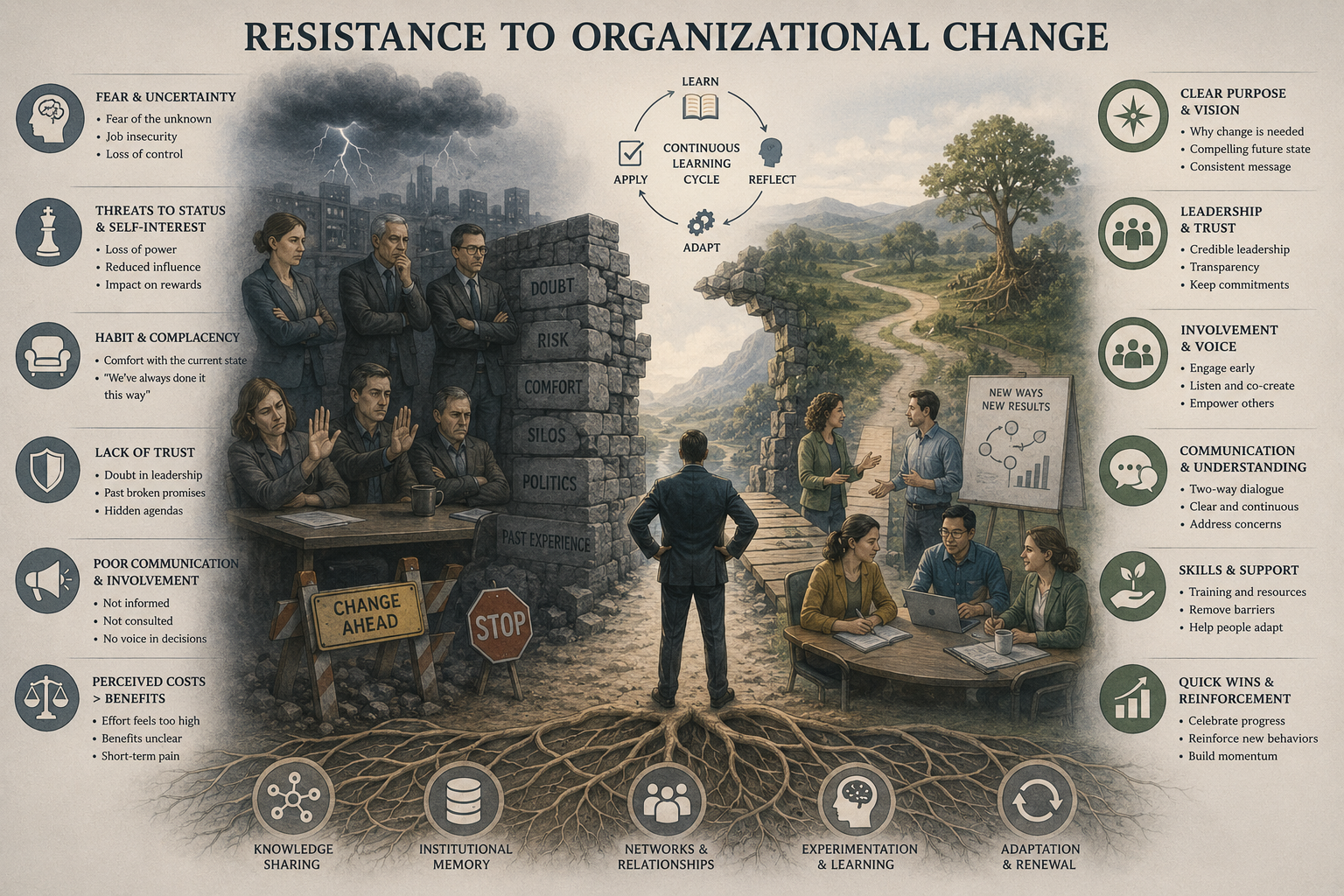
Change initiatives encounter resistance through the combined effects of psychological uncertainty, institutional inertia, cultural expectations, and internal power structures.
What Resistance to Change Really Is
Resistance to organizational change is often misunderstood because it is defined too narrowly from the standpoint of those attempting to lead transformation. If a senior team has already accepted the necessity of a proposed reform, then delay, skepticism, reinterpretation, or noncompliance may appear as needless obstruction. But from the standpoint of those asked to live inside the consequences of change, resistance may represent caution, role defense, identity protection, informed dissent, or concern about implementation risk. A serious analysis therefore begins by refusing the assumption that resistance is self-evidently irrational.
Resistance emerges when proposed change disturbs an existing equilibrium. That equilibrium may include routines, reporting lines, informal status arrangements, professional identities, trusted workflows, tacit norms, or stable expectations about competence and reward. Change threatens not only procedures but the meaning systems through which people understand their work and their place in the institution. Even beneficial change can therefore generate anxiety, defensiveness, or strategic hesitation if its implications are uncertain or if its burdens are likely to fall unevenly across the organization.
This is why resistance should be understood as an emergent property of institutional systems rather than a defect of individual attitude. Organizations are built to maintain coherence over time. They develop habits, infrastructures, symbols, incentive patterns, and boundary-maintaining mechanisms that preserve order. Change initiatives encounter resistance because they are pushing against a structure designed, in large part, to resist arbitrary destabilization. The question is not why resistance exists. The question is what kind of resistance is being expressed, what information it contains, and whether the proposed change has earned the legitimacy required to move through the institution successfully.
Resistance also has multiple forms. It may appear as open opposition, skeptical questioning, delay, symbolic compliance, quiet nonadoption, reinterpretation of the reform, selective implementation, coalition-building, emotional withdrawal, or the preservation of informal legacy practices. Some forms of resistance are visible and confrontational; others are hidden and procedural. A change initiative may appear successful on the surface while remaining weakly adopted in practice because people use the new vocabulary while preserving the old logic underneath.
This topic connects closely with Adaptive Organizations: Institutional Change and Strategic Transformation, Organizational Culture and Shared Norms, Authority, Power, and Institutional Leadership, Learning Organizations: Knowledge Systems and Institutional Learning, Cognitive Bias in Institutional Decisions, and Organizational Resilience in Complex Systems. Together these articles show that change is never merely technical. It is psychological, political, cultural, and structural at once.
| Type of resistance | What it may look like | What it may reveal |
|---|---|---|
| Cognitive resistance | Skepticism, questioning, reinterpretation, doubt about evidence | Uncertainty, weak rationale, conflicting assumptions, or inadequate sensemaking |
| Emotional resistance | Anxiety, anger, withdrawal, fatigue, defensive reaction | Threat to security, identity, belonging, status, or trust |
| Behavioral resistance | Delay, noncompliance, workarounds, symbolic adoption | Implementation friction, overload, unclear incentives, or low legitimacy |
| Political resistance | Coalitions, bargaining, framing contests, selective support | Redistribution of authority, resources, visibility, or professional advantage |
| Cultural resistance | Appeals to tradition, values, vocation, or institutional identity | Conflict between change logic and the organization’s self-understanding |
A serious approach does not romanticize resistance, but it does interpret it. Some resistance protects privilege or obsolete routines. Some resistance reveals that leadership has not understood operational reality. Some resistance expresses legitimate ethical concern. Some reflects accumulated distrust from prior failed reforms. The analytic task is to distinguish among these forms rather than collapse them into a single managerial category.
Psychological Sources of Resistance
At the individual level, resistance often emerges from uncertainty, perceived threat, and anticipated loss. Organizational change disrupts familiar routines and forces employees to reinterpret competence, role identity, performance expectations, and status position. Such disruption can activate predictable cognitive and affective mechanisms that make change difficult even when its stated goals appear reasonable.
One major source is status quo bias, the tendency to prefer existing arrangements over uncertain alternatives. People do not evaluate change in a vacuum; they evaluate it relative to a known pattern of work and expectation. Loss aversion, well established in behavioral economics, intensifies this effect because individuals often weigh potential losses more heavily than equivalent gains. A reorganization that promises long-term improvement may still provoke strong resistance if employees perceive immediate threats to autonomy, expertise, role clarity, or belonging.
Uncertainty avoidance is another central mechanism. Change often produces ambiguity about expectations, reporting lines, evaluation standards, and future viability. This ambiguity generates anxiety not simply because people dislike novelty, but because ambiguity makes it harder to anticipate how to remain effective and secure. In addition, change can threaten identity. Professionals build meaning around mastery, credibility, and role-based contribution. When a new system appears to devalue established expertise or redefine what counts as valued work, resistance may become a defense of professional selfhood rather than simple reluctance.
Resistance and the psychology of trust
Psychological resistance is shaped not only by the content of change but by the credibility of those proposing it. If leadership is trusted, employees may interpret disruption as difficult but necessary. If leadership is distrusted, the same initiative may be seen as opportunistic, politically motivated, or disconnected from operational reality. Resistance therefore often reflects cumulative organizational history rather than the present proposal alone.
These dynamics link directly to Cognitive Bias in Institutional Decisions and to broader questions of trust, legitimacy, and interpretive framing in organizational life.
Resistance is also shaped by control. People tend to respond differently to change that is done with them than to change that is done to them. Even when the final decision is not fully negotiable, the opportunity to understand the rationale, surface implementation concerns, influence sequencing, and receive credible support can reduce defensive reaction. This is not simply a matter of emotional comfort. It reflects a basic organizational fact: people asked to implement change often possess knowledge that designers of change lack.
| Psychological source | Typical experience | Organizational implication |
|---|---|---|
| Status quo bias | The known system feels safer than the uncertain alternative | Leaders must make the future state concrete without dismissing the value of existing routines |
| Loss aversion | Potential losses feel more salient than promised gains | Change design must address real and perceived costs, not only benefits |
| Identity threat | Established expertise, role meaning, or professional standing feels devalued | Implementation should preserve dignity and translate old competence into new contexts |
| Uncertainty avoidance | Ambiguous expectations create anxiety and defensive interpretation | Sequencing, role clarity, training, and communication must reduce unnecessary ambiguity |
| Low trust | Leadership intent is interpreted skeptically because of prior experience | Trust repair may be required before change messaging becomes credible |
These psychological sources do not make resistance irrational. They show that change is interpreted through human expectations about safety, fairness, meaning, competence, and trust. A psychologically informed change process does not merely persuade; it reduces avoidable threat while preserving the capacity for honest disagreement.
Organizational Routines, Path Dependence, and Institutional Inertia
Organizations do not begin each day from first principles. They rely on routines, templates, approval chains, technologies, and shared expectations that reduce complexity and make coordinated action possible. These arrangements are often highly functional. They preserve reliability, lower cognitive burden, and enable scale. But they also generate inertia. Once routines become embedded in technology, training, reporting systems, and cultural expectation, they acquire structural persistence that makes change difficult even when environmental conditions have shifted.
Institutional inertia is not the same as laziness. It is the result of path dependence. Earlier decisions create infrastructures and dependencies that constrain later options. A workflow may be tied to a software architecture; a compensation model may reinforce a particular reporting structure; a compliance system may depend on documentation practices that a new strategy would need to replace. Because these elements reinforce one another, changing any single component often requires a wider reconfiguration of the institution. Resistance in such settings is frequently the visible surface of a deeper structural entanglement.
This helps explain why change initiatives that appear straightforward in strategic documents often stall during implementation. Reformers may underestimate the density of routines surrounding the current state. They may treat legacy practices as bad habits when in fact those practices are held in place by infrastructure, incentives, risk management logic, professional training, and accumulated tacit knowledge. In such cases, organizational resistance reveals a mismatch between the imagined simplicity of reform and the actual complexity of institutional redesign.
Inertia as both problem and protection
Inertia can certainly become maladaptive. It may prevent institutions from responding to new conditions, preserve obsolete arrangements, and reward compliance over intelligence. Yet inertia also performs a protective function. It slows transformation sufficiently to expose hidden dependencies and implementation risks. A well-governed institution does not seek to abolish inertia altogether; it seeks to differentiate between prudent friction and destructive rigidity.
This distinction is essential. Some change leaders frame all friction as cultural resistance because they do not understand how many systems depend on the routines they want to replace. A seemingly outdated approval process may preserve compliance memory. A slow handoff may contain informal quality checks. A legacy expert may appear resistant because they understand risks that the new system has not yet modeled. Before leaders dismantle an existing routine, they must understand what function it has been performing.
| Embedded feature | Stabilizing function | Change risk | Better redesign question |
|---|---|---|---|
| Legacy workflow | Preserves reliability and familiar coordination | New process may remove tacit checks or create hidden failure points | Which parts of the old workflow still protect quality or legitimacy? |
| Existing authority chain | Clarifies decision rights and accountability | New structure may create confusion or informal power struggles | How will authority, escalation, and accountability be redistributed? |
| Established professional identity | Gives work meaning and standards of excellence | Change may be interpreted as devaluation of expertise | How can prior expertise be honored and translated into the new system? |
| Informal workaround | Compensates for a broken or incomplete formal process | Removing it may expose unresolved system gaps | What problem was the workaround solving? |
| Institutional memory | Preserves lessons from earlier failures | Change may repeat old mistakes if memory is ignored | What historical knowledge should guide redesign? |
Inertia therefore deserves careful interpretation. It may signal avoidance, but it may also signal the organization’s attempt to preserve coherence. The strongest change processes do not simply push harder. They map dependencies, identify protective functions, and redesign around the real architecture of work.
Power, Politics, and the Redistribution of Advantage
Change initiatives are also political events. They alter authority, redistribute resources, redefine expertise, and change the relative advantage of organizational actors. This means resistance cannot be understood solely through psychology or routine. It must also be analyzed in terms of who gains, who loses, and who has the power to shape implementation.
Individuals and groups who perceive themselves as disadvantaged by change may resist through overt or subtle means. They may question feasibility, reinterpret mandates, slow execution, build coalitions, preserve legacy practices, comply symbolically while withholding real support, or redirect the meaning of the reform during implementation. Such actions are not always cynical. They may reflect genuine disagreement about institutional priorities or concern that leadership has underestimated the human and operational costs of transformation. But they are still political, because they involve competing interests and rival definitions of organizational reality.
Resistance is especially intense when change threatens status systems. Formal titles matter, but so do informal authority, domain ownership, reputational capital, and access to strategic information. A digital transformation may not simply improve workflow; it may diminish the authority of legacy specialists. A governance reform may not merely clarify reporting; it may redistribute voice and legitimacy. A new performance system may not only improve measurement; it may alter which forms of labor become visible or rewarded. In all such cases, resistance reflects the deeper political structure of the institution.
These questions connect directly to Authority, Power, and Institutional Leadership. Change always intersects with power because institutions are not neutral systems of coordination. They are structured distributions of advantage, responsibility, and voice.
Power also shapes the naming of resistance. Senior leaders may describe employee skepticism as resistance while describing their own refusal to revise strategy as discipline. A dominant group may frame marginalized dissent as negativity while treating elite objections as legitimate governance concern. A change sponsor may call operational pushback emotional while ignoring the political motives embedded in the change itself. A serious organizational psychology of resistance must therefore examine not only who resists, but who has the authority to define resistance.
Resistance can also reveal inequity. Change often distributes costs unevenly. Frontline workers may absorb new workload while executives claim strategic success. Administrative teams may carry the burden of new systems without receiving recognition. Marginalized employees may be asked to adapt to reforms that do not address existing exclusion. Contractors or lower-status workers may experience change as increased monitoring rather than increased opportunity. When resistance arises under such conditions, it may be a rational response to asymmetric risk.
Culture, Identity, and the Moral Meaning of Change
Organizational culture influences resistance because culture defines what the institution believes itself to be. It shapes what counts as legitimate authority, proper behavior, professional excellence, and institutional purpose. When proposed reforms conflict with these deeper cultural patterns, resistance may arise even if the change appears strategically rational in abstract terms.
Culture matters because organizations do not merely operate; they narrate themselves. A university may see itself as collegial and deliberative rather than managerial. A public agency may define its legitimacy through procedural fairness rather than speed. A research institution may attach identity to intellectual autonomy rather than standardized performance metrics. A legacy industrial firm may define competence through reliability and procedural discipline rather than experimentation. In each case, change threatens not merely process but institutional self-understanding.
This is why culture is so often the hidden battlefield of transformation. Efforts to import new practices from other sectors—startup experimentation, data-driven performance systems, aggressive efficiency models, platform logics, compliance restructuring—may trigger resistance because they carry moral assumptions about what the organization should become. Resistance then expresses concern not only about feasibility, but about identity, vocation, and legitimacy. Organizations may resist a technically efficient change because they experience it as incompatible with who they are supposed to be.
These dynamics connect closely with Organizational Culture and Shared Norms. Resistance becomes intelligible when change is analyzed as an encounter between strategic design and cultural meaning.
The moral meaning of change is often underestimated. A new measurement system may be presented as neutral, but employees may experience it as mistrust. A new efficiency initiative may be presented as modernization, but workers may experience it as abandonment of care, craft, or professional judgment. A restructuring may be presented as agility, but affected groups may experience it as loss of dignity or collective memory. Culture gives these reactions their force because it connects work to value.
Leaders cannot resolve cultural resistance by insisting that change is rational. They must address the moral interpretation of the change. What does the reform imply about what the organization values? What does it preserve? What does it discard? Which identities are honored, and which are being displaced? Which traditions represent wisdom, and which represent inertia? These questions are not peripheral. They determine whether change can become legitimate inside the institution’s own story.
Leadership, Change Design, and the Interpretation of Resistance
Effective leadership does not assume that resistance can simply be overcome by stronger messaging or greater insistence. It begins by diagnosing what kind of resistance is present. Is the resistance driven primarily by uncertainty, mistrust, workload burden, role threat, moral objection, infrastructural incompatibility, or political contestation? Different sources require different responses. A leader who treats all resistance as defiance will often intensify it.
Change design matters here as much as leadership style. Poorly designed transformation efforts generate predictable resistance because they fail to explain tradeoffs, neglect capability development, overload existing systems, or ask employees to absorb risk without influence. In such cases, resistance is not a failure of the workforce but a failure of institutional design. By contrast, better-designed change efforts tend to clarify purpose, involve relevant actors early, preserve feedback channels, allocate transition resources, and create credible links between stated aims and lived implementation.
This does not mean all resistance should be indulged or all change processes democratized fully. Some decisions must be made under constraint and with clear authority. But even decisive leadership benefits from accurate interpretation. Resistance often contains information about overlooked dependencies, broken trust, hidden capability gaps, or strategic blind spots. Leaders who can distinguish destructive obstruction from informative friction are more likely to guide change without destroying institutional coherence.
These issues also intersect with Transformational Leadership and Organizational Change. The strongest change leadership is not merely persuasive; it is interpretive, structurally aware, and institutionally disciplined.
Change leadership is often weakened by overconfidence in communication. Leaders may assume that if they explain the rationale clearly enough, resistance will decline. Communication matters, but communication is not a substitute for participation, capability, trust, workload realism, or governance. People do not resist only because they misunderstand. They may resist because they understand the likely consequences more clearly than the designers do.
| Resistance diagnosis | Weak leadership response | Stronger leadership response |
|---|---|---|
| Uncertainty | Repeat the vision statement | Clarify sequencing, roles, support, decision rights, and transition expectations |
| Mistrust | Demand buy-in | Acknowledge history, repair credibility, and demonstrate accountability |
| Workload burden | Frame resistance as negativity | Resource the transition and reduce competing demands |
| Identity threat | Dismiss attachment to old practices | Honor prior expertise and create pathways for role translation |
| Political displacement | Deny that power is changing | Name changes in authority, accountability, and resource control honestly |
| Implementation risk | Treat concerns as obstruction | Use resistance as early warning and redesign the implementation architecture |
Leadership must also manage time. Change that is too slow may lose momentum and legitimacy. Change that is too fast may overwhelm sensemaking and capability. The strongest leaders understand pacing as an organizational psychology problem. People need enough time to understand, grieve, question, learn, practice, and adapt; institutions need enough movement to avoid stagnation. Managing that tension is part of the discipline of change leadership.
Participation, Trust, and the Legitimacy of Change
Participation is often treated as a tactic for reducing resistance, but its deeper function is legitimacy. When people have meaningful opportunities to shape implementation, surface concerns, identify risks, and influence practical decisions, they are more likely to experience change as institutionally fair. Participation does not require that every decision be made by consensus. It requires that those affected by change are not treated merely as recipients of decisions made elsewhere.
Trust operates similarly. Trust does not eliminate uncertainty, but it changes how uncertainty is interpreted. In high-trust environments, people may accept temporary disruption because they believe leadership is competent, honest, and accountable. In low-trust environments, the same disruption may be interpreted as manipulation, incompetence, or disregard. Trust therefore acts as a moderating condition in change. It does not guarantee adoption, but it shapes whether ambiguity becomes tolerable or threatening.
Trust is built through history, not slogans. Organizations that have repeatedly launched poorly supported initiatives, ignored feedback, punished dissent, or abandoned reforms without explanation cannot expect credibility during the next change effort. Resistance may reflect institutional memory. People remember whether leadership listened last time, whether promised support arrived, whether negative consequences were acknowledged, and whether accountability was shared or shifted downward.
Legitimate change therefore requires procedural seriousness. People need to know why change is necessary, what evidence supports it, who has been consulted, what alternatives were considered, how risks will be monitored, how burdens will be distributed, and how the organization will respond if the reform causes harm. This is not bureaucracy for its own sake. It is the architecture through which change becomes credible.
| Legitimacy condition | Practical question | Risk when absent |
|---|---|---|
| Clear rationale | Why is this change necessary now? | Employees infer hidden motives or strategic confusion |
| Meaningful participation | Who affected by the change can shape implementation? | Change is experienced as imposed and disconnected from real work |
| Resource realism | What time, training, staffing, and support will transition require? | Resistance grows because change intensifies overload |
| Transparent tradeoffs | What will be gained, lost, delayed, or redistributed? | People assume leadership is concealing costs |
| Feedback and repair | How will the organization respond when problems emerge? | Implementation failures erode trust and damage future change capacity |
Participation and trust do not make change easy. They make change more governable. They allow organizations to convert resistance into information, disagreement into design improvement, and uncertainty into a shared problem rather than a private burden carried by those least able to influence the outcome.
A Semi-Formal Model of Resistance Dynamics
Resistance to change cannot be reduced fully to equation, but semi-formal models can clarify how multiple forces combine. One useful conceptual expression treats resistance intensity as a function of perceived loss, uncertainty, identity threat, routine embeddedness, and power displacement, moderated by trust, participation, and implementation clarity.
We can write:
R = \frac{(L \cdot U \cdot I \cdot E \cdot P)}{(T + V + C)}
\]
Interpretation: Resistance intensity increases when perceived loss, uncertainty, identity threat, embedded routines, and power displacement reinforce one another. It decreases when trust, meaningful voice, and implementation clarity make the change more legitimate and practically navigable.
where:
- R = resistance intensity
- L = perceived loss exposure
- U = uncertainty about future expectations and outcomes
- I = identity or status threat
- E = embeddedness of existing routines and infrastructures
- P = perceived power displacement or resource redistribution
- T = trust in leadership and institutional intent
- V = meaningful voice or participation in the change process
- C = clarity of rationale, sequencing, and implementation support
This expression suggests that resistance grows when employees expect loss, face ambiguity, fear identity disruption, rely on deeply embedded routines, or anticipate political displacement. It declines, all else equal, when trust is credible, participation is meaningful, and implementation design is clear. Again, this is not a literal law, but a structured way of showing why communication alone rarely solves resistance if underlying trust, voice, and structural feasibility remain weak.
We can also model adoption dynamics over time:
A_{t+1} = A_t + \alpha S_t – \beta R_t + \gamma Q_t
\]
Interpretation: Adoption increases when support and implementation quality are strong enough to overcome resistance. Even well-supported reforms can stall when resistance remains high or implementation quality is weak.
where A is adoption of the change, S is support intensity, R is resistance intensity, and Q is implementation quality. This captures a familiar pattern: even highly supported reforms can stall if resistance remains high or if implementation quality is poor.
A related dynamic can represent trust erosion during failed change attempts:
T_{t+1} = T_t – \delta F_t + \lambda M_t
\]
Interpretation: Future trust declines when change is experienced as failure or breach, but it can be partially repaired through meaningful communication, demonstrated competence, and accountability.
where T is institutional trust, F is perceived failure or breach during change, and M is meaningful repair through transparent communication, competence, and accountability. This helps explain why repeated poorly managed transformations can make future change harder even when later initiatives are better designed.
These models are not predictive formulas in the strict sense. They are conceptual scaffolds. Their value lies in making visible that resistance is multi-causal. It cannot be managed by communication alone, incentives alone, authority alone, or training alone. It must be understood through the interaction of threat, trust, identity, routine, power, and implementation quality.
Resistance as Feedback, Constraint, and Organizational Learning
Recent scholarship has increasingly challenged the simplistic view of resistance as an impediment to be eliminated. Resistance can reveal operational risks, ethical concerns, hidden dependencies, missing capabilities, and failures of change design. Employees often understand aspects of the institutional system that formal leadership does not see clearly. What leaders experience as pushback may, in some cases, be a diagnostic signal indicating that the proposed reform is underdeveloped, mistimed, or misaligned with organizational reality.
This does not mean all resistance is wise. Some resistance protects privilege, preserves obsolete routines, or expresses fear that blocks necessary transformation. But a mature institution does not assume this in advance. It investigates. It asks what the resistance is protecting, what costs it anticipates, what knowledge it contains, and whether those concerns are local, systemic, or symbolic. In this respect, resistance can be a source of organizational learning if the institution is capable of hearing it without collapsing into defensiveness.
This perspective aligns closely with Learning Organizations: Knowledge Systems and Institutional Learning and with traditions of psychological safety that emphasize the value of dissent, candor, and structured challenge. Resistance becomes useful when organizations can convert it into inquiry rather than simply categorizing it as negativity.
Resistance can also reveal implementation gaps. A new system may be resisted because training is insufficient, workflows are unclear, data migration is incomplete, staffing is unrealistic, or accountability has not been defined. In such cases, resistance is not a cultural obstacle to be overcome; it is feedback that the change architecture is incomplete. Suppressing resistance may allow leaders to claim progress while allowing hidden failure to accumulate.
Learning from resistance requires disciplined interpretation. Organizations need forums where resistance can be voiced without turning every objection into veto power. They need methods for distinguishing evidence-based concern from status protection, and legitimate dissent from destructive sabotage. They need escalation channels, review protocols, and decision rules that allow resistance to inform design without freezing action entirely.
| Resistance signal | Possible meaning | Learning response |
|---|---|---|
| Repeated questions about rationale | The strategic case may be unclear, mistrusted, or disconnected from local reality | Clarify evidence, assumptions, and tradeoffs; invite challenge to the change logic |
| Slow adoption despite formal approval | Implementation may be under-resourced or routines may be more embedded than expected | Map workflow dependencies and identify missing transition support |
| Informal preservation of old practices | Legacy routines may still perform protective functions | Identify which functions should be preserved, redesigned, or retired |
| Strong emotional reaction | Change may threaten identity, status, belonging, or trust | Address meaning, not only procedure; create space for interpretation and repair |
| Coalition-based opposition | Power, resources, or professional jurisdiction may be shifting | Name political implications and govern redistribution transparently |
In this sense, resistance is part of organizational intelligence. It is not always correct, but it is rarely meaningless. Organizations that learn from resistance improve their ability to change responsibly.
Resistance, Stability, and Institutional Resilience
From a broader systems perspective, some degree of resistance may serve a stabilizing function. Institutions need mechanisms that slow abrupt change, test the seriousness of proposed reforms, and protect critical functions from impulsive redesign. A completely frictionless organization would not necessarily be adaptive. It might instead be highly vulnerable to fads, leader overconfidence, or politically motivated restructuring.
Moderate resistance can therefore contribute to institutional resilience by forcing change sponsors to refine their case, strengthen implementation architecture, and engage more seriously with operational realities. In this sense, resistance may act as a buffering mechanism between strategic imagination and institutional consequence. It protects continuity long enough for the organization to determine whether a proposed transformation is coherent, legitimate, and practically supportable.
Of course, the same protective function can become pathological if resistance hardens into blanket refusal or if the institution becomes incapable of adaptation. The challenge is balance. Resilient organizations preserve enough stability to avoid reckless transformation while remaining permeable enough to revise themselves when the environment demands it. This is why resistance belongs conceptually alongside Organizational Resilience in Complex Systems rather than outside the resilience conversation.
Resilience requires both continuity and change. If an organization changes constantly without preserving memory, identity, or coordination, it becomes unstable. If it preserves continuity so strongly that it cannot adapt, it becomes brittle. Resistance sits at the boundary between these two failures. Properly interpreted, it helps organizations ask whether a proposed change is necessary, legitimate, feasible, and aligned with institutional purpose.
The strongest organizations therefore do not seek frictionless change. They seek intelligent friction. Intelligent friction slows weak ideas, improves plausible ideas, protects institutional memory, and exposes hidden risk. Destructive resistance, by contrast, blocks learning and preserves dysfunction. The task of change governance is to distinguish the two.
Measurement, Diagnosis, and Change-Readiness Review
Measuring resistance is difficult because resistance is not a single attitude. It may involve cognition, emotion, behavior, politics, identity, workload, trust, and institutional history. A serious change-readiness review should therefore avoid reducing resistance to a simplistic score. It should use measurement as a way to structure inquiry into the conditions under which adoption, skepticism, friction, or nonadoption are likely to emerge.
Useful diagnostic domains include perceived loss, uncertainty, identity threat, routine embeddedness, power displacement, trust in leadership, participation quality, implementation clarity, workload strain, prior failed change history, and perceived fairness. These indicators can be explored through surveys, interviews, focus groups, communication audits, operational data, adoption metrics, issue logs, and post-implementation review. Quantitative measures should be interpreted alongside qualitative evidence because resistance often carries context that numbers cannot explain.
| Diagnostic domain | Possible evidence | Interpretive caution |
|---|---|---|
| Perceived loss | Survey items, interviews, role-impact analysis | Loss may be real even when leadership frames the change as beneficial |
| Uncertainty | Repeated questions, rumor patterns, unclear role maps | Employees may be reacting to ambiguity, not opposing the goal |
| Trust | Leadership credibility surveys, historical change review, participation patterns | Trust reflects cumulative history, not only current communication quality |
| Routine embeddedness | Workflow mapping, dependency analysis, system audits | Deep routines may preserve hidden quality or compliance functions |
| Participation quality | Consultation records, stakeholder mapping, feedback uptake | Participation is not meaningful if feedback has no effect on design |
| Adoption behavior | Usage data, process compliance, qualitative observation | Visible adoption may conceal symbolic compliance or workaround persistence |
Change-readiness review should also be ethically bounded. It should not be used to identify “resistant employees” for punishment or removal. The appropriate unit of analysis is the change system: its credibility, design quality, participation structure, resource adequacy, and institutional fit. When measurement becomes surveillance, it damages the trust needed for real adoption.
Good diagnosis asks better questions. What is the resistance protecting? What is the change threatening? What knowledge does the resistance contain? Which concerns are evidence-based? Which concerns reflect distrust from prior experience? Which groups are carrying the burden of transition? Which forms of labor, expertise, or identity are being made invisible? These questions move resistance analysis from blame to institutional understanding.
R: Modeling Resistance Risk Across Organizational Units
The following R workflow models resistance risk across organizational units by combining perceived loss, uncertainty, identity threat, routine embeddedness, power displacement, trust, participation, and implementation clarity. It also estimates which factors are associated with constructive adoption versus sustained resistance.
library(dplyr)
library(ggplot2)
library(lme4)
library(scales)
library(broom.mixed)

set.seed(777)

n_units <- 26
n_periods <- 16

change_data <- expand.grid(
  unit_id = factor(paste0("Unit_", seq_len(n_units))),
  period = seq_len(n_periods)
) %>%
  arrange(unit_id, period) %>%
  mutate(
    perceived_loss = pmin(pmax(rnorm(n(), 55, 14), 5), 95),
    uncertainty = pmin(pmax(rnorm(n(), 60, 13), 10), 98),
    identity_threat = pmin(pmax(rnorm(n(), 52, 15), 5), 95),
    routine_embeddedness = pmin(pmax(rnorm(n(), 68, 10), 20), 95),
    power_displacement = pmin(pmax(rnorm(n(), 46, 16), 5), 95),
    trust_in_leadership = pmin(pmax(rnorm(n(), 58, 14), 5), 95),
    participation_quality = pmin(pmax(rnorm(n(), 54, 15), 5), 95),
    implementation_clarity = pmin(pmax(rnorm(n(), 57, 14), 5), 95),
    workload_strain = pmin(pmax(rnorm(n(), 62, 13), 10), 98),
    change_history_failure = rbinom(n(), 1, 0.28)
  ) %>%
  group_by(unit_id) %>%
  mutate(unit_effect = rnorm(1, 0, 4)) %>%
  ungroup() %>%
  mutate(
    resistance_intensity =
      0.18 * perceived_loss +
      0.17 * uncertainty +
      0.15 * identity_threat +
      0.15 * routine_embeddedness +
      0.12 * power_displacement +
      0.08 * workload_strain -
      0.16 * trust_in_leadership -
      0.12 * participation_quality -
      0.14 * implementation_clarity +
      6.0  * change_history_failure +
      unit_effect +
      rnorm(n(), 0, 4),
    resistance_intensity = pmin(pmax(resistance_intensity, 0), 100),
    constructive_adoption_prob =
      plogis(
        1.8 -
        0.040 * resistance_intensity +
        0.018 * trust_in_leadership +
        0.020 * participation_quality +
        0.018 * implementation_clarity -
        0.015 * workload_strain
      ),
    constructive_adoption = rbinom(n(), 1, constructive_adoption_prob)
  )

resistance_model <- lmer(
  resistance_intensity ~
    perceived_loss +
    uncertainty +
    identity_threat +
    routine_embeddedness +
    power_displacement +
    trust_in_leadership +
    participation_quality +
    implementation_clarity +
    workload_strain +
    change_history_failure +
    (1 | unit_id),
  data = change_data
)

summary(resistance_model)

adoption_model <- glm(
  constructive_adoption ~
    resistance_intensity +
    trust_in_leadership +
    participation_quality +
    implementation_clarity +
    workload_strain,
  family = binomial(),
  data = change_data
)

summary(adoption_model)
exp(coef(adoption_model))

unit_dashboard <- change_data %>%
  group_by(unit_id) %>%
  summarise(
    avg_resistance = mean(resistance_intensity),
    avg_trust = mean(trust_in_leadership),
    avg_participation = mean(participation_quality),
    avg_clarity = mean(implementation_clarity),
    avg_workload = mean(workload_strain),
    constructive_adoption_rate = mean(constructive_adoption),
    .groups = "drop"
  ) %>%
  mutate(
    resistance_risk_index = rescale(
      avg_resistance * 0.40 +
      (100 - avg_trust) * 0.20 +
      (100 - avg_clarity) * 0.15 +
      avg_workload * 0.10 +
      (1 - constructive_adoption_rate) * 100 * 0.15,
      to = c(0, 100)
    )
  ) %>%
  arrange(desc(resistance_risk_index))

print(unit_dashboard)

ggplot(unit_dashboard, aes(x = reorder(unit_id, resistance_risk_index), y = resistance_risk_index)) +
  geom_col() +
  coord_flip() +
  labs(
    title = "Change Resistance Risk by Unit",
    x = "Unit",
    y = "Risk Index (0-100)"
  ) +
  theme_minimal()

ggplot(change_data, aes(x = trust_in_leadership, y = resistance_intensity)) +
  geom_point(alpha = 0.45) +
  geom_smooth(method = "lm", se = TRUE) +
  labs(
    title = "Trust in Leadership and Resistance Intensity",
    x = "Trust in Leadership",
    y = "Resistance Intensity"
  ) +
  theme_minimal()

review_table <- change_data %>%
  mutate(
    review_priority = case_when(
      resistance_intensity > 70 ~ "Immediate Review",
      resistance_intensity > 55 ~ "Structured Review",
      TRUE ~ "Routine Monitoring"
    )
  ) %>%
  select(
    unit_id,
    period,
    resistance_intensity,
    perceived_loss,
    uncertainty,
    identity_threat,
    routine_embeddedness,
    power_displacement,
    trust_in_leadership,
    participation_quality,
    implementation_clarity,
    workload_strain,
    constructive_adoption,
    review_priority
  ) %>%
  arrange(desc(resistance_intensity))

head(review_table, 20)
This framework is useful because it treats resistance as a measurable institutional pattern rather than a moralized judgment about employee attitude. In real organizations, these variables could be informed by change-readiness surveys, interview data, implementation reviews, turnover patterns, grievance trends, or communication audits.
The model also shows why resistance analysis should remain multi-level. Units differ in history, workload, leadership credibility, routine embeddedness, and exposure to change. A single organizational average may conceal units where adoption is fragile, trust is low, or workload strain is high. Mixed-effects modeling helps distinguish broad change-system patterns from local institutional conditions.
These examples are for synthetic-data research and methods demonstration. They should not be used to identify or punish supposedly resistant employees. Their appropriate use is institutional learning: understanding where the change system may require better design, support, participation, and governance.
Python: Simulating Change Friction, Trust, and Adoption Outcomes
The following Python example simulates change friction across organizations and estimates how trust, participation, implementation clarity, and routine embeddedness shape the probability of successful adoption.
import numpy as np
import pandas as pd
from sklearn.linear_model import LogisticRegression
from sklearn.model_selection import train_test_split
from sklearn.metrics import classification_report, roc_auc_score

np.random.seed(777)

n_obs = 2400

df = pd.DataFrame({
    "perceived_loss": np.clip(np.random.normal(0.56, 0.16, n_obs), 0.01, 0.99),
    "uncertainty": np.clip(np.random.normal(0.61, 0.15, n_obs), 0.05, 0.99),
    "identity_threat": np.clip(np.random.normal(0.52, 0.17, n_obs), 0.01, 0.99),
    "routine_embeddedness": np.clip(np.random.normal(0.69, 0.12, n_obs), 0.10, 0.99),
    "power_displacement": np.clip(np.random.normal(0.47, 0.18, n_obs), 0.01, 0.99),
    "trust_in_leadership": np.clip(np.random.normal(0.58, 0.16, n_obs), 0.01, 0.99),
    "participation_quality": np.clip(np.random.normal(0.54, 0.17, n_obs), 0.01, 0.99),
    "implementation_clarity": np.clip(np.random.normal(0.57, 0.16, n_obs), 0.01, 0.99),
    "workload_strain": np.clip(np.random.normal(0.63, 0.15, n_obs), 0.05, 0.99),
    "failed_change_history": np.random.binomial(1, 0.27, n_obs)
})

df["resistance_intensity"] = (
    1.8 * df["perceived_loss"] +
    1.7 * df["uncertainty"] +
    1.3 * df["identity_threat"] +
    1.4 * df["routine_embeddedness"] +
    1.0 * df["power_displacement"] +
    0.9 * df["workload_strain"] -
    1.6 * df["trust_in_leadership"] -
    1.1 * df["participation_quality"] -
    1.3 * df["implementation_clarity"] +
    0.7 * df["failed_change_history"] +
    np.random.normal(0, 0.30, n_obs)
)

df["change_adoption_score"] = (
    1.4 * df["trust_in_leadership"] +
    1.0 * df["participation_quality"] +
    1.1 * df["implementation_clarity"] -
    1.3 * df["resistance_intensity"] -
    0.7 * df["workload_strain"] +
    np.random.normal(0, 0.30, n_obs)
)

df["successful_change_adoption"] = (df["change_adoption_score"] > -0.15).astype(int)

features = [
    "perceived_loss",
    "uncertainty",
    "identity_threat",
    "routine_embeddedness",
    "power_displacement",
    "trust_in_leadership",
    "participation_quality",
    "implementation_clarity",
    "workload_strain",
    "failed_change_history"
]

X = df[features]
y = df["successful_change_adoption"]

X_train, X_test, y_train, y_test = train_test_split(
    X,
    y,
    test_size=0.25,
    random_state=777,
    stratify=y
)

model = LogisticRegression(max_iter=3000)
model.fit(X_train, y_train)

pred = model.predict(X_test)
proba = model.predict_proba(X_test)[:, 1]

print("AUC:", roc_auc_score(y_test, proba))
print(classification_report(y_test, pred))

coef_table = pd.DataFrame({
    "feature": features,
    "coefficient": model.coef_[0]
}).sort_values("coefficient", ascending=False)

print(coef_table)

scenarios = pd.DataFrame([
    {
        "perceived_loss": 0.24,
        "uncertainty": 0.30,
        "identity_threat": 0.22,
        "routine_embeddedness": 0.50,
        "power_displacement": 0.18,
        "trust_in_leadership": 0.82,
        "participation_quality": 0.79,
        "implementation_clarity": 0.84,
        "workload_strain": 0.40,
        "failed_change_history": 0
    },
    {
        "perceived_loss": 0.76,
        "uncertainty": 0.78,
        "identity_threat": 0.69,
        "routine_embeddedness": 0.82,
        "power_displacement": 0.61,
        "trust_in_leadership": 0.31,
        "participation_quality": 0.28,
        "implementation_clarity": 0.33,
        "workload_strain": 0.74,
        "failed_change_history": 1
    }
])

scenario_probs = model.predict_proba(scenarios[features])[:, 1]
scenarios["predicted_successful_change_adoption_probability"] = scenario_probs

print(scenarios)

df["change_friction_index"] = (
    0.18 * df["perceived_loss"] +
    0.16 * df["uncertainty"] +
    0.12 * df["identity_threat"] +
    0.13 * df["routine_embeddedness"] +
    0.09 * df["power_displacement"] +
    0.10 * df["workload_strain"] +
    0.10 * (1 - df["trust_in_leadership"]) +
    0.06 * (1 - df["participation_quality"]) +
    0.06 * (1 - df["implementation_clarity"])
)

risk_summary = df.groupby(pd.qcut(df["change_friction_index"], 5)).agg(
    adoption_rate=("successful_change_adoption", "mean"),
    avg_trust=("trust_in_leadership", "mean"),
    avg_clarity=("implementation_clarity", "mean"),
    avg_routine_embeddedness=("routine_embeddedness", "mean")
)

print(risk_summary)
This simulation is useful for change-readiness diagnostics, scenario planning, implementation risk analysis, and post-change review. It also reinforces a central insight: resistance is not simply attitude. It is the result of how people interpret loss, uncertainty, voice, trust, workload, and institutional credibility during transformation.
The scenario comparison illustrates how two change initiatives can differ dramatically even when the technical reform is similar. When trust, participation, and implementation clarity are high, friction may remain manageable. When perceived loss, uncertainty, identity threat, workload strain, and prior failure history are high, adoption may fail even if the strategic case is sound. Resistance analysis therefore helps leaders see that the social architecture of implementation matters as much as the technical design of the reform.
As with the R workflow, this example should remain ethically bounded. It should be used for synthetic-data research, methods demonstration, and institutional learning. It should not be used for employee screening, employment selection, promotion, compensation, discipline, termination, workplace surveillance, individual performance management, or psychological assessment.
GitHub Repository
The companion repository for this article organizes the computational materials for this topic, including synthetic datasets, reproducible workflows, documentation, validation notes, and responsible-use guidance for organizational psychology research.
Complete Code Repository
Access the full companion repository for this article, including reproducible analysis materials, synthetic datasets, R and Python workflows, multi-language examples, documentation, validation notes, and responsible interpretation materials.
Interpretive Cautions and Limits
Resistance to change is a valuable concept, but it is often used too casually. First, not all resistance is wise or principled. Some resistance protects privilege, preserves dysfunctional routines, or reflects fear that prevents necessary institutional revision. It would be naive to romanticize opposition simply because it is framed as bottom-up.
Second, not all compliance indicates genuine support. Employees may adopt the language of reform while disengaging operationally, withholding effort, or waiting for the initiative to fade. Low visible resistance can therefore coexist with high hidden nonadoption. Serious diagnosis requires attention to both behavior and institutional meaning.
Third, leaders may overattribute resistance to employee disposition when the deeper causes lie in poor sequencing, inadequate resourcing, incoherent incentives, lack of training, or distrust created by prior failed reforms. What looks like culture may be design failure. What looks like reluctance may be informed skepticism.
Finally, resistance is context-dependent. High-reliability institutions, public agencies, universities, startups, hospitals, and legacy firms do not face the same stakes or the same forms of fragility. The meaning of resistance varies with domain, risk profile, professional identity, and governance structure. It should therefore be interpreted within institutional context rather than abstracted into universal management doctrine.
A further caution concerns the managerial misuse of resistance language. Calling people resistant can become a way to avoid accountability for poor change design, unequal burden, or illegitimate power shifts. It can also pathologize dissent. In organizations with unequal status systems, marginalized voices may be especially vulnerable to being labeled resistant when they raise legitimate concerns. A responsible analysis therefore asks who is being described as resistant, by whom, and with what institutional consequences.
Resistance should also not be used as a reason to avoid necessary change. Some institutions preserve harmful routines by treating any reform as a threat to culture or tradition. Some forms of resistance defend exclusion, inefficiency, privilege, or ethical failure. Serious organizational psychology must hold both truths at once: resistance can be diagnostic and legitimate, and resistance can also preserve dysfunction.
Finally, models and diagnostics should not be mistaken for complete interpretation. Resistance involves meaning, history, power, and emotion. Quantitative tools can help reveal patterns, but they must be paired with qualitative inquiry, ethical review, and institutional judgment. The goal is not to eliminate resistance mechanically. The goal is to understand what resistance reveals about the relationship between change, legitimacy, and organizational life.
Conclusion
Resistance to organizational change is best understood as a systemic response to threatened routines, identities, incentives, and authority structures. It arises through the interaction of psychology, institutional inertia, culture, power, trust, and implementation design. Treating it merely as obstruction misses much of what it reveals about the organization itself.
At its most useful, the study of resistance shows that organizational change is never only a matter of announcing a better future state. It requires institutions to address uncertainty, redistribute risk credibly, preserve legitimacy, and engage the structures through which continuity has previously been maintained. Resistance is therefore not just the enemy of change. It is often the diagnostic surface on which the deeper realities of organizational life become visible.
The strongest organizations do not seek to silence resistance reflexively. They ask what kind of resistance they are facing, what information it contains, what institutional history it reflects, and whether the change itself has been designed with enough credibility, participation, support, and moral seriousness to deserve adoption. Resistance becomes destructive when it prevents necessary adaptation. But it becomes valuable when it helps the organization detect weak assumptions, surface hidden costs, protect institutional memory, and redesign change before failure becomes irreversible.
In this sense, resistance is part of the psychology of institutional transformation. It reveals that change is not simply movement from an old state to a new state. It is a contested process through which organizations renegotiate meaning, power, trust, identity, and the conditions of coordinated action.
Return to the Organizational Psychology knowledge series
Related Articles
- Adaptive Organizations: Institutional Change and Strategic Transformation
- Organizational Culture and Shared Norms
- Authority, Power, and Institutional Leadership
- Learning Organizations: Knowledge Systems and Institutional Learning
- Cognitive Bias in Institutional Decisions
- Organizational Resilience in Complex Systems
- Transformational Leadership and Organizational Change
- Decision-Making in Organizations
Further Reading
- Beer, M. and Nohria, N. (2000) ‘Cracking the code of change’, Harvard Business Review, 78(3), pp. 133–141. Available at: https://hbr.org/2000/05/cracking-the-code-of-change.
- Ford, J.D., Ford, L.W. and D’Amelio, A. (2008) ‘Resistance to change: The rest of the story’, Academy of Management Review, 33(2), pp. 362–377. Available at: https://journals.aom.org/doi/10.5465/amr.2008.31193235.
- Kotter, J.P. (1995) ‘Leading change: Why transformation efforts fail’, Harvard Business Review, 73(2), pp. 59–67. Available at: https://hbr.org/1995/05/leading-change-why-transformation-efforts-fail-2.
- Oreg, S. (2006) ‘Personality, context, and resistance to organizational change’, European Journal of Work and Organizational Psychology, 15(1), pp. 73–101. Available at: https://www.tandfonline.com/doi/abs/10.1080/13594320500451247.
- Piderit, S.K. (2000) ‘Rethinking resistance and recognizing ambivalence: A multidimensional view of attitudes toward an organizational change’, Academy of Management Review, 25(4), pp. 783–794. Available at: https://journals.aom.org/doi/10.5465/amr.2000.3707722.
- Sonenshein, S. (2010) ‘We’re changing—Or are we? Untangling the role of progressive, regressive, and stability narratives during strategic change implementation’, Academy of Management Journal, 53(3), pp. 477–512. Available at: https://doi.org/10.5465/AMJ.2010.51467638.
- Van de Ven, A.H. and Poole, M.S. (1995) ‘Explaining development and change in organizations’, Academy of Management Review, 20(3), pp. 510–540. Available at: https://doi.org/10.5465/amr.1995.9508080329.
- Weick, K.E. and Quinn, R.E. (1999) ‘Organizational change and development’, Annual Review of Psychology, 50, pp. 361–386. Available at: https://doi.org/10.1146/annurev.psych.50.1.361.
References
- Beer, M. and Nohria, N. (2000) ‘Cracking the code of change’, Harvard Business Review, 78(3), pp. 133–141. Available at: https://hbr.org/2000/05/cracking-the-code-of-change.
- DiMaggio, P.J. and Powell, W.W. (1983) ‘The iron cage revisited: Institutional isomorphism and collective rationality in organizational fields’, American Sociological Review, 48(2), pp. 147–160. Available at: https://doi.org/10.2307/2095101.
- Ford, J.D., Ford, L.W. and D’Amelio, A. (2008) ‘Resistance to change: The rest of the story’, Academy of Management Review, 33(2), pp. 362–377. Available at: https://journals.aom.org/doi/10.5465/amr.2008.31193235.
- Kahneman, D. and Tversky, A. (1979) ‘Prospect theory: An analysis of decision under risk’, Econometrica, 47(2), pp. 263–291. Available at: https://doi.org/10.2307/1914185.
- Kotter, J.P. (1995) ‘Leading change: Why transformation efforts fail’, Harvard Business Review, 73(2), pp. 59–67. Available at: https://hbr.org/1995/05/leading-change-why-transformation-efforts-fail-2.
- Lewin, K. (1947) ‘Frontiers in group dynamics’, Human Relations, 1(1), pp. 5–41. Available at: https://doi.org/10.1177/001872674700100103.
- Oreg, S. (2003) ‘Resistance to change: Developing an individual differences measure’, Journal of Applied Psychology, 88(4), pp. 680–693. Available at: https://doi.org/10.1037/0021-9010.88.4.680.
- Piderit, S.K. (2000) ‘Rethinking resistance and recognizing ambivalence: A multidimensional view of attitudes toward an organizational change’, Academy of Management Review, 25(4), pp. 783–794. Available at: https://journals.aom.org/doi/10.5465/amr.2000.3707722.
- Sonenshein, S. (2010) ‘We’re changing—Or are we? Untangling the role of progressive, regressive, and stability narratives during strategic change implementation’, Academy of Management Journal, 53(3), pp. 477–512. Available at: https://doi.org/10.5465/AMJ.2010.51467638.
- Van de Ven, A.H. and Poole, M.S. (1995) ‘Explaining development and change in organizations’, Academy of Management Review, 20(3), pp. 510–540. Available at: https://doi.org/10.5465/amr.1995.9508080329.
- Weick, K.E. and Quinn, R.E. (1999) ‘Organizational change and development’, Annual Review of Psychology, 50, pp. 361–386. Available at: https://doi.org/10.1146/annurev.psych.50.1.361.