
Last Updated June 24, 2026
The law of areas beyond national jurisdiction begins with the United Nations Convention on the Law of the Sea. UNCLOS preserves high-seas freedoms, prohibits sovereignty over the high seas, declares the deep seabed Area and its resources the common heritage of humankind, and creates institutional machinery for deep seabed governance through the International Seabed Authority. The field has now been reshaped by the BBNJ Agreement, which entered into force in 2026 and creates a modern framework for biodiversity beyond national jurisdiction.
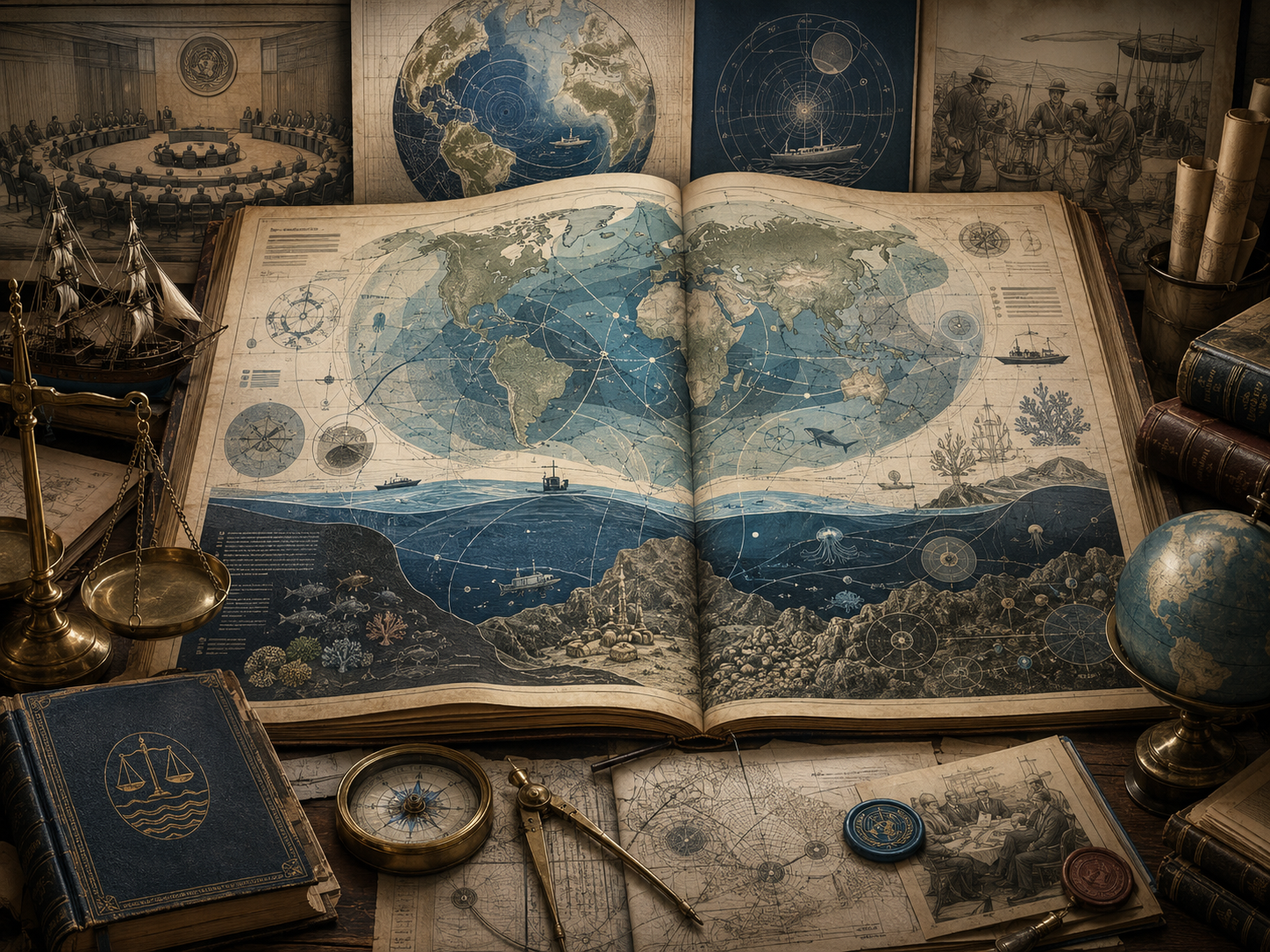
Areas beyond national jurisdiction are not empty spaces. They include ocean waters beyond exclusive economic zones, seabed areas beyond national continental shelves, living marine biodiversity, mineral deposits, migratory species, deep-sea ecosystems, genetic resources, scientific data, cable routes, navigation corridors, fisheries, and ecological processes that affect the whole planet. The legal question is not whether these spaces matter. It is whether international law can prevent freedom from becoming enclosure by the powerful, extraction by the technologically capable, or ecological loss disguised as open access.
The high seas and deep seabed also reveal two different legal imaginations. The high seas are traditionally organized around freedoms: navigation, overflight, fishing, cables, scientific research, and lawful use by all states. The deep seabed Area is organized around common heritage: no state may claim or appropriate it, and mineral activities are to be carried out for the benefit of humankind as a whole. The BBNJ Agreement adds a third layer: biodiversity governance through marine genetic-resource rules, area-based management tools, environmental impact assessment, capacity building, and technology transfer.
This article explains high-seas freedom, flag-state jurisdiction, due regard, piracy and enforcement, fisheries, submarine cables, marine genetic resources, the Area, common heritage, the International Seabed Authority, sponsoring-state responsibility, deep seabed mining, environmental protection, the BBNJ Agreement, global commons theory, equity, Indigenous and coastal community concerns, climate change, and future governance challenges. It treats the global commons not as a romantic phrase, but as a demanding legal problem: who decides, who benefits, who bears risk, who monitors harm, and who speaks for ecosystems and future generations?
Why the High Seas and Deep Seabed Matter
The high seas and the deep seabed matter because they are central to the future of ocean governance. The high seas support navigation, global trade, naval mobility, submarine cables, fisheries, scientific research, carbon cycling, migratory species, and marine biodiversity. The deep seabed contains fragile ecosystems and mineral resources that some actors view as strategically important for energy transition, electronics, batteries, and industrial supply chains. Both spaces are legally beyond national territorial sovereignty, but neither is beyond law.
They also matter because the world’s oceans connect apparently separate legal fields. A high-seas fishing dispute may involve fisheries law, labor abuse, flag-state responsibility, port-state control, food security, biodiversity, and organized crime. A deep seabed mining application may involve UNCLOS, ISA regulations, environmental impact assessment, sponsoring-state due diligence, corporate accountability, biodiversity science, Indigenous and Pacific regional concerns, and intergenerational justice. A marine genetic-resource project may involve scientific access, digital sequence information, intellectual property, open data, benefit sharing, and capacity building.
The high seas have long been described through freedom. But freedom can be double-edged. Freedom of navigation and communication enables international exchange. Freedom of fishing, without effective management, can produce depletion. Freedom of scientific research can advance knowledge, but it can also concentrate data and benefits in wealthy institutions. Freedom to lay submarine cables supports global connectivity, but it also creates strategic vulnerability. The legal problem is how to preserve legitimate uses while preventing open-access harm.
The deep seabed has a different legal starting point. UNCLOS does not simply leave the Area open to appropriation. It declares the Area and its resources the common heritage of humankind. This idea was meant to prevent a technological scramble in which wealthy states and corporations captured minerals from a space that belongs to humanity as a whole. The principle remains powerful, but its meaning is contested. Does common heritage primarily mean benefit sharing from extraction, or does it also require ecological restraint, precaution, transparency, and protection of unknown deep-sea life?
A Lawyer’s Global-Commons Analysis Checklist
Global-commons analysis requires careful separation of legal zones, actors, activities, and institutions. The same physical ocean region may involve the high seas water column, the seabed Area, migrating species, cable infrastructure, research data, vessel nationality, port-state enforcement, and global environmental duties.
1. Identify the legal space
Determine whether the issue concerns the high seas, the Area, an EEZ, an extended continental shelf, a maritime boundary zone, an area-based management tool, a marine protected area, or a migratory ecological system crossing several regimes.
2. Classify the activity
Specify whether the conduct involves navigation, fishing, marine scientific research, cable laying, seabed mineral exploration, exploitation, bioprospecting, dumping, pollution, surveillance, enforcement, military use, or environmental monitoring.
3. Identify the actor
Separate flag states, sponsoring states, port states, contractors, international organizations, coastal states, regional fisheries bodies, research institutions, cable operators, military vessels, and private companies.
4. Locate the authority
Ask whether UNCLOS, the BBNJ Agreement, ISA instruments, fisheries agreements, IMO conventions, regional bodies, customary law, human rights law, or environmental agreements supply the governing rule.
5. Test freedom against duty
High-seas freedoms are conditioned by due regard, peaceful use, environmental duties, conservation obligations, flag-state control, and other rules of international law.
6. Apply environmental safeguards
Determine whether the activity requires environmental impact assessment, strategic assessment, monitoring, reporting, adaptive management, precaution, transparency, or consultation.
7. Analyze equity and benefit sharing
Consider whether developing states, landlocked states, small island developing states, Indigenous peoples, coastal communities, and scientific institutions with limited capacity can participate and benefit.
8. Identify remedies and forums
Assess whether the dispute belongs before ITLOS, an Annex VII tribunal, the Seabed Disputes Chamber, ISA organs, BBNJ institutions, regional fisheries bodies, domestic courts, or political negotiation.
Authority Map for Areas Beyond National Jurisdiction
| Legal space or issue | Main authority | Core rule | Practice problem |
|---|---|---|---|
| High seas water column | UNCLOS Part VII | Freedoms of navigation, overflight, fishing, cables, installations, and scientific research, subject to Convention conditions and other international law | Preventing freedom from becoming open-access depletion or security confrontation |
| Deep seabed Area | UNCLOS Part XI and 1994 Agreement | The Area and its resources are the common heritage of humankind; activities are organized through ISA | Balancing benefit sharing, precaution, environmental protection, and pressure for mineral exploitation |
| Marine biodiversity beyond national jurisdiction | BBNJ Agreement | Conservation and sustainable use through marine genetic-resource rules, area-based tools, EIA, capacity building, and technology transfer | Turning treaty architecture into effective institutions, funding, compliance, and protected areas |
| High-seas fisheries | UNCLOS, UN Fish Stocks Agreement, regional fisheries bodies | Conservation, cooperation, flag-state responsibility, and management of straddling and highly migratory stocks | Illegal, unreported, and unregulated fishing, weak flag states, distant-water fleets, and ecological change |
| Submarine cables | UNCLOS, telecommunications practice, domestic and sectoral rules | Freedom to lay cables, duties not to break or injure them, and coastal-state rights where zones overlap | Cybersecurity, sabotage, repair access, critical infrastructure, and strategic vulnerability |
| Climate and ocean acidification | UNCLOS Part XII, climate law, ITLOS advisory practice | States have duties to protect and preserve the marine environment, including from climate-related harm | Attributing obligations across global emissions, adaptation, restoration, and marine environmental damage |
What Counts as a Global Commons?
The phrase “global commons” is often used to describe spaces or resources that lie beyond the territorial sovereignty of any single state and are legally or practically important to humanity as a whole. The high seas, the deep seabed, outer space, Antarctica, the atmosphere, and aspects of biodiversity and climate systems are commonly discussed through this language. But the concept is not a single legal rule. It is an organizing idea that must be translated into specific treaties, institutions, duties, and enforcement mechanisms.
In ocean law, the global commons appears in at least two different forms. The high seas are open to all states under a freedom-based model. The Area and its mineral resources are governed under a common-heritage model. These are not identical. High-seas freedom emphasizes non-appropriation and equal legal access. Common heritage adds stronger institutional and distributive elements: resources are not subject to national appropriation, and activities are to benefit humankind as a whole.
The BBNJ Agreement complicates this picture by focusing not on mineral resources but on marine biological diversity, marine genetic resources, environmental impact assessment, capacity building, and technology transfer. It does not simply replace high-seas freedoms or the ISA regime. Instead, it creates a new layer of governance for biodiversity beyond national jurisdiction. That layer reflects the growing realization that freedom alone cannot protect ecosystems.
Global commons governance therefore asks practical questions. Who has authority to adopt rules? Who monitors compliance? Who benefits from scientific discoveries? Who pays for capacity building? Who decides whether a deep-sea ecosystem may be disturbed? Who represents future generations? Who protects species that cannot vote, litigate, or negotiate? The phrase “commons” is meaningful only if these institutional and distributive questions are answered.
High-Seas Freedoms Under UNCLOS
UNCLOS provides that the high seas are open to all states, whether coastal or landlocked. The listed freedoms include navigation, overflight, the laying of submarine cables and pipelines, construction of artificial islands and installations permitted under international law, fishing, and scientific research. These freedoms have long been central to maritime commerce, communications, naval mobility, and scientific exploration.
But high-seas freedom is not an invitation to lawlessness. UNCLOS states that these freedoms are exercised under conditions laid down by the Convention and by other rules of international law. States must exercise due regard for the interests of other states. Fishing freedoms are conditioned by conservation duties. Scientific research must respect applicable treaty rules. Cable laying must account for continental shelf rights and other legal regimes. Military activities are shaped by peaceful-use obligations and broader international law.
High-seas freedoms are also enjoyed by states, not simply by private actors in a legal vacuum. Private vessels, fishing companies, research institutions, and cable operators typically operate through flag-state nationality, corporate nationality, licenses, sponsorship, contracts, port access, insurance, financing, and domestic law. The high seas may be beyond territorial sovereignty, but they remain connected to states and legal systems.
The modern challenge is that formal legal equality can coexist with practical inequality. All states legally enjoy high-seas freedoms, but not all states possess blue-water fleets, oceanographic vessels, satellite monitoring, cable-laying capacity, deep-sea research institutions, or enforcement resources. Freedom therefore requires institutional support if it is to mean more than opportunity for those already equipped to use the ocean.
Due Regard, Peaceful Use, and Limits on Freedom
The principle of due regard is central to high-seas governance. It requires states exercising high-seas freedoms to consider the interests and lawful uses of other states. Due regard is deliberately flexible. It does not create a simple hierarchy among uses. Instead, it requires contextual balancing, notice, cooperation, risk assessment, avoidance of unreasonable interference, and attention to the legal regime governing the activity.
Due regard matters because the high seas now host many overlapping uses. A research vessel may operate near a cable route. A military exercise may occur in a fishing area. A proposed marine protected area may overlap with shipping lanes. A seabed activity may affect the water column. Fisheries, conservation, cables, navigation, scientific research, autonomous vessels, and environmental monitoring increasingly compete for the same spaces.
UNCLOS also reserves the high seas for peaceful purposes. That does not remove all naval activity from the high seas, but it does place high-seas use within a broader framework of international peace and security. Threats or uses of force, coercive interference, unsafe maneuvers, and militarized gray-zone activity may implicate both the law of the sea and the UN Charter.
The legal meaning of due regard will become more important as area-based management tools and marine protected areas develop under the BBNJ Agreement. States and institutions will need to reconcile conservation measures with navigation, fishing, cable maintenance, marine scientific research, military uses, and existing regional bodies. Due regard may become one of the main legal techniques for making overlapping ocean governance workable.
Flag-State Jurisdiction and Enforcement Gaps
Flag-state jurisdiction is a central enforcement mechanism on the high seas. Ships generally fall under the jurisdiction of the state whose flag they fly. The flag state is responsible for exercising effective jurisdiction and control over administrative, technical, and social matters concerning ships flying its flag. This structure allows vessels to be governed even when they operate beyond the territorial jurisdiction of any coastal state.
The difficulty is that flag-state control is only as strong as the flag state’s willingness and capacity to regulate. Flags of convenience, weak enforcement, shell ownership, corporate opacity, poor labor conditions, unsafe vessels, illegal fishing, pollution, and evasive reflagging can undermine the legal regime. Where flag states fail, high-seas freedom may become a shield for abuse.
International law has responded through port-state measures, regional fisheries regimes, IMO conventions, labor instruments, market controls, vessel monitoring, inspection rules, and cooperation among enforcement authorities. Port states can sometimes exert leverage because vessels need ports for landing catch, refueling, repair, crew changes, and market access. Regional fisheries organizations may maintain vessel lists or impose conditions on fishing authorizations. But enforcement remains uneven.
Flag-state weakness is a recurring example of the gap between formal jurisdiction and practical accountability. The high seas are not unregulated because law is absent. They are underregulated when responsibility is fragmented, monitoring is weak, incentives favor evasion, and the states with formal authority do not act effectively.
High-Seas Fisheries and Open-Access Pressure
High-seas fisheries show how freedom can become ecological pressure. Fish stocks move across legal zones. Some species migrate between EEZs and the high seas. Others cross multiple regions or follow shifting ocean temperatures. Fishing fleets may exploit regulatory gaps, weak monitoring, flags of convenience, and uneven enforcement. The result can be overfishing, bycatch, habitat destruction, labor abuse, and conflict between distant-water fleets and coastal communities.
UNCLOS recognizes freedom of fishing on the high seas, but that freedom is subject to conservation obligations and cooperation duties. The UN Fish Stocks Agreement further develops rules for straddling and highly migratory fish stocks, including precautionary approaches, compatibility of measures, regional cooperation, and stronger enforcement. Regional fisheries management organizations play a key role, though their effectiveness varies.
The equity dimension is significant. Wealthy states and subsidized distant-water fleets often have far greater capacity to fish beyond national jurisdiction. Developing coastal states may suffer depleted stocks that migrate into or from their EEZs. Small-scale fishers may be affected by decisions made in distant institutional settings. Laborers on high-seas vessels may experience abuse without meaningful access to remedies.
High-seas fisheries also connect to biodiversity governance. Marine protected areas, ecosystem-based management, bycatch reduction, habitat protection, and climate adaptation all require coordination with fisheries bodies. The BBNJ Agreement is not a fisheries treaty in the narrow sense, but its area-based management tools and environmental assessment obligations will inevitably interact with fishing governance. The future question is whether sectoral bodies can cooperate rather than defend regulatory silos.
Submarine Cables, Navigation, and Maritime Security
Submarine cables are one of the least visible but most important features of the global commons. They carry most international data traffic and connect financial systems, communications, government networks, cloud infrastructure, research institutions, and everyday digital life. UNCLOS protects the freedom to lay submarine cables and pipelines, subject to relevant conditions. But cable governance now involves security, repair, cyber vulnerability, sabotage risk, and private infrastructure ownership.
The high seas also remain central to navigation and maritime mobility. Merchant shipping, naval operations, research vessels, fishing fleets, cable ships, and autonomous systems all rely on freedom of navigation. Navigation freedom is essential to global commerce and communication, but it can also become a site of geopolitical tension when military operations, surveillance, or strategic signaling occur in contested areas.
Maritime security concerns increasingly extend beyond piracy. They include attacks on shipping, gray-zone coast guard activity, unsafe encounters at sea, cable interference, sanctions evasion, smuggling, illegal fishing, environmental crime, and the use of maritime infrastructure in strategic competition. These issues often blur the line between law enforcement, national security, private commerce, and international peace.
A global-commons approach should not treat security as separate from environmental and economic governance. Cable protection, navigation safety, biodiversity conservation, fisheries enforcement, and deep seabed monitoring all require information, surveillance, coordination, and institutional trust. The ocean is a shared physical system, and governance failures in one sector may destabilize others.
The Area and the Deep Seabed
UNCLOS defines the Area as the seabed and ocean floor and subsoil thereof beyond the limits of national jurisdiction. This means the Area is distinct from a coastal state’s continental shelf, including any extended continental shelf recognized under Article 76. The water column above the Area may be high seas, but the seabed below is governed by Part XI and the common-heritage regime.
The deep seabed contains mineral deposits such as polymetallic nodules, cobalt-rich ferromanganese crusts, and seafloor massive sulfides. These deposits are commercially attractive to some states and companies because they contain minerals used in electronics, batteries, steelmaking, energy systems, and industrial supply chains. But they are also located in ecosystems that are poorly understood, slow to recover, and potentially vulnerable to long-term disturbance.
The Area is not governed through first possession. States cannot claim sovereignty or sovereign rights over it. Private actors cannot simply appropriate its resources. Activities in the Area are organized and controlled through the International Seabed Authority, which has authority under UNCLOS and the 1994 Agreement to administer the regime. Contractors operate through sponsorship by states and approval by ISA.
The deep seabed therefore represents one of international law’s most ambitious experiments in institutionalized commons governance. It attempts to regulate a space before large-scale exploitation occurs. That is rare. Many environmental regimes respond after damage has already accumulated. Deep seabed governance offers a chance to decide whether precaution and common heritage can prevent a new extractive frontier from repeating older patterns of ecological harm and unequal benefit.
Common Heritage of Humankind
The common heritage of humankind is one of the most important ideas in the law of the sea. UNCLOS declares that the Area and its resources are the common heritage of humankind. It also provides that no state shall claim or exercise sovereignty or sovereign rights over any part of the Area or its resources, and that rights in the resources are vested in humankind as a whole.
Common heritage is more than non-appropriation. It implies collective interest, institutional management, benefit sharing, special attention to developing states, peaceful use, and protection from unilateral capture. It emerged from concerns that technologically advanced states would otherwise dominate deep seabed minerals before newly independent and developing states could participate meaningfully.
The meaning of common heritage is now contested. Some actors emphasize regulated exploitation and financial benefit sharing. Others argue that common heritage must include precaution, environmental stewardship, scientific openness, intergenerational justice, and the possibility that some ecosystems should not be mined at all. The disagreement matters because a narrow extractive interpretation could convert common heritage into a license for globally administered depletion.
A robust interpretation treats common heritage as a governance principle, not merely a revenue rule. If the Area belongs to humankind as a whole, then decision-making must be transparent, inclusive, scientifically credible, precautionary, and attentive to those without technological or diplomatic power. Humankind includes future generations. It also includes communities that may be affected by ocean degradation even if they do not sit at negotiating tables.
The International Seabed Authority
The International Seabed Authority is the institution through which states parties organize and control mineral-resource activities in the Area. ISA is responsible for administering exploration and eventual exploitation regimes, developing regulations, protecting the marine environment from harmful effects of activities in the Area, and ensuring that activities are carried out for the benefit of humankind as a whole.
ISA’s institutional role is demanding. It must regulate contractors, develop technical standards, review environmental information, manage benefit-sharing issues, consider developing-state interests, protect marine ecosystems, and maintain legitimacy among states with very different incentives. Some states, contractors, and industry advocates want a pathway to exploitation. Many scientists, environmental organizations, Pacific actors, and states have called for precaution, pause, moratorium, or stronger environmental rules.
The Authority’s structure includes the Assembly, Council, Secretariat, Legal and Technical Commission, and Finance Committee. Its work is technical but politically significant. Decisions about environmental baselines, inspection, compliance, thresholds, financial terms, confidentiality, public participation, benefit sharing, liability, and adaptive management will shape whether deep seabed governance is credible.
ISA must also manage a legitimacy problem. Because deep seabed ecosystems are poorly understood, the institution cannot rely only on administrative procedure. It must demonstrate that its rules reflect independent science, transparency, precaution, and the interests of humankind as a whole. The deeper the uncertainty, the greater the burden on governance.
Sponsoring States, Due Diligence, and Liability
Private or state-linked contractors do not operate in the Area without state connection. Under the UNCLOS regime, contractors are sponsored by states. Sponsoring states have obligations to ensure that sponsored entities comply with the relevant rules. The Seabed Disputes Chamber of ITLOS addressed these obligations in its 2011 advisory opinion on responsibilities and obligations of sponsoring states.
The advisory opinion is important because it frames sponsoring-state obligations through due diligence. Due diligence is an obligation of conduct, not a guarantee that no harm will occur. But it is not empty. It requires states to adopt laws, regulations, administrative measures, monitoring systems, enforcement tools, and oversight adequate to the risk. Higher risk demands more demanding due diligence.
The opinion also emphasized precaution and environmental protection. In the deep seabed context, uncertainty is not a reason to ignore risk. It may be a reason to strengthen regulatory safeguards. Sponsoring states must not treat sponsorship as a paper formality that allows contractors to operate while public responsibility disappears.
Liability remains difficult. If environmental harm occurs in the Area, affected ecosystems may be far from any coastal state, scientific proof may be difficult, damage may be irreversible, and the victims may include humanity, future generations, and non-human life. These features make ordinary compensation models inadequate. The law must therefore focus strongly on prevention, monitoring, financial security, compliance, and institutional oversight before harm occurs.
The Mining Code and Exploitation Regulations
ISA has developed rules for exploration and has been negotiating regulations for exploitation of mineral resources in the Area. These regulations are often discussed as part of the “Mining Code.” Exploration is not the same as commercial exploitation. Exploration involves prospecting, data collection, environmental baselines, and preparatory work. Exploitation would involve extracting minerals at commercial scale, with potentially significant environmental impacts.
The exploitation regulations are one of the most consequential unfinished projects in ocean law. They must address environmental impact assessment, regional environmental management plans, inspection, compliance, adaptive management, financial terms, benefit sharing, environmental compensation, closure plans, emergency orders, contractor responsibility, confidentiality, public participation, and decision-making standards.
The difficulty is that law is being asked to regulate before science has fully answered foundational questions. Deep-sea ecosystems may recover slowly or not at all. Sediment plumes may affect habitats beyond the mined area. Noise, light, vibration, and toxic disturbance may have unknown effects. Biodiversity in some deep-sea regions remains underdescribed. Environmental baselines may be incomplete. This uncertainty makes ordinary permitting logic dangerous.
Some argue that seabed minerals are needed for energy transition. Others respond that the climate crisis should not justify opening a new frontier of irreversible biodiversity loss, especially when recycling, substitution, demand reduction, and terrestrial governance reforms remain available. International law does not resolve that policy debate automatically. But it does require that decisions be made through common heritage, precaution, environmental protection, transparency, and the benefit of humankind as a whole.
Precaution, Science, and Environmental Risk
Precaution is central to high-seas and deep seabed governance because uncertainty is pervasive. Deep-sea ecosystems are difficult to study. Long-term impacts are hard to predict. Baseline data may be limited. Cumulative impacts may emerge only after multiple activities interact. Climate change alters ocean conditions in ways that complicate environmental assessment. In such settings, waiting for perfect certainty can become a formula for irreversible harm.
Precaution does not mean paralysis in every case. It means that scientific uncertainty should not be used as a reason to postpone protective measures where there is risk of serious or irreversible damage. In deep seabed governance, precaution may require stronger baseline research, independent review, pilot testing, no-mining zones, adaptive management, environmental thresholds, transparent data, financial security, emergency suspension authority, and even a pause on exploitation where governance is not ready.
Science also raises equity questions. Who produces the data? Who owns it? Who has access to samples? Who interprets uncertainty? Who funds monitoring? Who can participate in technical meetings? A commons regime that depends on scientific evidence but concentrates scientific capacity in wealthy states and corporations risks reproducing inequality. Capacity building is therefore not merely charitable. It is part of legal legitimacy.
Environmental risk must also be understood beyond site-specific harm. The high seas and deep seabed are connected to global biodiversity, carbon cycling, food webs, migratory species, and climate systems. Harm in remote places may not remain remote. Commons governance requires legal tools capable of addressing cumulative, transboundary, long-term, and ecosystem-wide effects.
The BBNJ Agreement and High-Seas Biodiversity
The BBNJ Agreement is the most important recent development in the law of areas beyond national jurisdiction. It was adopted in 2023 and entered into force in 2026. Its objective is the conservation and sustainable use of marine biological diversity of areas beyond national jurisdiction. It operates under UNCLOS, but it fills important gaps in the governance of high-seas biodiversity and marine genetic resources.
The Agreement addresses four major pillars: marine genetic resources, including questions on benefit sharing; area-based management tools, including marine protected areas; environmental impact assessments; and capacity building and transfer of marine technology. Together, these pillars shift ocean governance away from a purely freedom-based model and toward a biodiversity-centered model.
The BBNJ Agreement does not abolish existing bodies. It must operate alongside regional fisheries management organizations, IMO processes, ISA, regional seas arrangements, scientific bodies, and other sectoral institutions. This creates coordination challenges. A marine protected area may affect fishing, shipping, scientific research, cable routes, and regional management bodies. Effective implementation will require cooperation rather than institutional defensiveness.
The Agreement’s entry into force changes the legal landscape. The question is no longer whether high-seas biodiversity needs a treaty. The question is whether states will fund, implement, comply with, and strengthen the treaty enough to make protection real. Paper conservation will not protect ecosystems if monitoring, enforcement, science, financing, and political will are missing.
Marine Genetic Resources and Benefit Sharing
Marine genetic resources are genetic material from marine organisms with actual or potential value. In areas beyond national jurisdiction, these resources raise difficult legal and equity questions. Research institutions and companies with advanced vessels, laboratories, sequencing capacity, databases, and intellectual-property strategies may be able to collect, analyze, and commercialize value from biodiversity that no state owns.
The BBNJ Agreement responds by creating rules on marine genetic resources and benefit sharing, including attention to digital sequence information. This is important because value may arise not only from physical samples but also from genetic data. If data are extracted, sequenced, stored, analyzed, and commercialized through global databases and private research pipelines, then benefit sharing must address informational as well as material flows.
Benefit sharing can include monetary and non-monetary forms. Non-monetary benefits may include access to samples, data, scientific cooperation, training, technology transfer, joint research, publication participation, and capacity building. These may be more immediately important for scientific equity than distant promises of revenue.
The deeper issue is whether ocean science becomes a shared project or another domain of enclosure. A legal regime that allows open access to biodiversity but private capture of knowledge and commercial value would reproduce inequality. A stronger regime treats marine genetic resources as part of a global research commons structured by fairness, transparency, traceability, and inclusion.
Marine Protected Areas and Area-Based Management
Area-based management tools are governance measures applied to defined geographic areas. Marine protected areas are one important example. In areas beyond national jurisdiction, such tools are essential because ecosystems cannot be protected only through flag-state rules or voluntary restraint. Some places require spatial protection from harmful activities.
The BBNJ Agreement creates a process for proposing, evaluating, adopting, and reviewing area-based management tools, including marine protected areas. This is a major development because high-seas conservation has historically been fragmented among sectoral bodies. A protected area that cannot affect fishing, shipping, seabed activities, or other uses may be ecologically inadequate. But a protected area that ignores existing bodies may face implementation problems.
The legal challenge is to make protected areas scientifically justified, procedurally legitimate, and practically enforceable. Proposals should identify ecological significance, vulnerability, connectivity, representativeness, climate resilience, cumulative impacts, and management objectives. They should also address monitoring, compliance, review, and coordination with affected institutions.
Marine protected areas also raise justice questions. Conservation should not become a new form of exclusion where developing states are asked to forgo future benefits while wealthy states retain historic advantages. Nor should conservation be designed without attention to Indigenous knowledge, coastal communities, scientific capacity, and equitable participation. Protection must be ecological and fair.
Environmental Impact Assessment Beyond National Jurisdiction
Environmental impact assessment is one of the key legal tools for preventing harm in areas beyond national jurisdiction. It requires actors to identify, evaluate, disclose, and respond to potential environmental effects before activities proceed. In remote ocean spaces, EIA is especially important because damage may be difficult to detect, attribute, stop, or repair after the fact.
The BBNJ Agreement strengthens EIA governance for activities that may affect marine biodiversity beyond national jurisdiction. It also includes attention to strategic environmental assessment, which can evaluate policies, plans, or programs rather than isolated projects. This matters because cumulative impacts may not be visible when each activity is assessed alone.
EIA should not be treated as paperwork. A meaningful assessment requires baseline data, alternatives analysis, cumulative-impact review, public notice, consultation, independent science, uncertainty analysis, mitigation measures, monitoring, reporting, and the possibility that an activity should not proceed. If the decision is predetermined, EIA becomes a ritual rather than a safeguard.
Deep seabed mining highlights the stakes. Environmental assessments must address not only the immediate mining site but also sediment plumes, noise, habitat destruction, species loss, connectivity, recovery time, cumulative impacts, and climate interactions. The difficulty of studying the deep ocean strengthens the case for precaution rather than lowering the evidentiary threshold for approval.
Climate Change, Ocean Acidification, and Commons Duties
Climate change is transforming the legal meaning of marine environmental protection. Ocean warming, acidification, deoxygenation, sea-level rise, coral bleaching, species migration, polar change, and extreme weather all affect the high seas and areas beyond national jurisdiction. The ocean absorbs heat and carbon, but that service comes at ecological cost.
ITLOS’s 2024 advisory opinion on climate change and international law confirmed that UNCLOS duties to protect and preserve the marine environment are relevant to greenhouse-gas pollution and climate-related marine harm. This matters for commons governance because high-seas and deep-ocean ecosystems are affected by emissions that originate within national jurisdictions but cause global marine damage.
Climate change also complicates fisheries, marine protected areas, environmental baselines, and impact assessment. A protected area designed around current species distributions may become less effective as species move. A fisheries allocation may become unstable as stocks shift. A deep seabed baseline may change as ocean chemistry and temperature change. Governance must become adaptive.
Commons duties therefore cannot be limited to activities physically conducted on the high seas. States’ conduct on land and within national jurisdiction can damage areas beyond national jurisdiction through emissions, pollution, plastics, and biodiversity loss. Ocean law increasingly requires integration with climate law, biodiversity law, environmental law, human rights, and development.
Equity, Capacity, and Technology Transfer
Equity is not an optional moral add-on to high-seas and deep seabed governance. It is built into the legal architecture. UNCLOS recognizes landlocked and geographically disadvantaged states, the interests of developing states, the common heritage of humankind, marine technology transfer, and cooperation. The BBNJ Agreement deepens this through capacity building, technology transfer, and benefit sharing.
Capacity matters because participation requires more than formal voting rights. States need lawyers, scientists, negotiators, vessels, laboratories, monitoring systems, data infrastructure, and funding to participate effectively. Without capacity, global negotiations may be formally inclusive but substantively unequal. Technical meetings can become inaccessible to states without specialized expertise.
Technology transfer is similarly important but politically sensitive. Marine science, environmental monitoring, genetic sequencing, deep-sea equipment, satellite data, and digital infrastructure are sources of power. A commons regime that depends on science but does not share scientific capacity will not be equitable. At the same time, technology transfer must be structured realistically, with funding, training, institutions, and respect for legitimate intellectual-property concerns where applicable.
Equity also requires attention to communities not always represented as treaty parties. Indigenous peoples, coastal communities, small-scale fishers, workers at sea, and small island societies may be affected by decisions about high-seas conservation, fisheries, seabed mining, climate change, and marine genetic resources. States remain the formal subjects of much international law, but global commons governance should not reduce affected communities to background scenery.
Case Studies in Commons Governance
The following case studies show how high-seas and deep seabed issues move from abstract doctrine into concrete legal and institutional disputes.
Deep seabed mining applications
Potential exploitation of polymetallic nodules tests whether ISA can apply common heritage, precaution, environmental protection, transparency, and benefit sharing before commercial mining begins. The central legal question is not only whether mining is technologically possible, but whether the governance system is ready.
High-seas marine protected areas
BBNJ area-based management tools test whether states can create ecologically meaningful protected areas beyond national jurisdiction while coordinating with fisheries bodies, shipping, scientific research, cable routes, and other sectoral regimes.
Marine genetic resources
Genetic sampling and digital sequence information test whether biodiversity beyond national jurisdiction can be researched without allowing unequal capture of scientific and commercial benefits by actors with advanced technological capacity.
Illegal, unreported, and unregulated fishing
IUU fishing exposes weaknesses in flag-state enforcement and regional cooperation. It links high-seas freedom to food security, labor rights, ecosystem protection, market regulation, and port-state control.
Submarine cable disruption
Cable damage or sabotage reveals how high-seas freedoms support global digital infrastructure while creating security risks that existing maritime law only partially addresses.
Climate harm to ocean commons
Climate-driven ocean warming and acidification show that activities within national jurisdiction can damage areas beyond national jurisdiction, requiring integration of UNCLOS environmental duties with climate obligations.
Lawyer-Facing Commons Governance Toolkit
| Step | Question | Evidence or authority | Common mistake |
|---|---|---|---|
| Zone | Where exactly is the activity? | Charts, coordinates, EEZ limits, continental shelf submissions, Area maps, high-seas classification | Confusing the high seas water column with the deep seabed Area |
| Actor | Who is legally responsible? | Flag registration, sponsorship, contracts, permits, corporate structure, port links, institutional approval | Treating private companies as if they operate without state connection |
| Activity | What legal category fits the conduct? | Fishing authorization, cable project, research plan, mining exploration contract, EIA documents | Using generic “ocean use” language instead of classifying the conduct |
| Freedom | Which high-seas freedom is invoked? | UNCLOS Part VII, related sectoral treaties, state practice | Assuming freedom means absence of duties |
| Duty | What limits, safeguards, or cooperation duties apply? | Due regard, conservation rules, EIA, Part XII duties, BBNJ rules, ISA regulations | Ignoring environmental and procedural obligations |
| Equity | Who participates and who benefits? | Benefit-sharing rules, capacity-building provisions, technology-transfer commitments, funding mechanisms | Reducing equity to aspirational language without implementation |
| Forum | Where can the issue be resolved? | ITLOS, Seabed Disputes Chamber, Annex VII arbitration, ISA organs, BBNJ institutions, domestic courts | Assuming every ocean dispute has the same forum |
GitHub Repository
The companion repository supports this article with structured research materials, source metadata, high-seas governance tables, deep seabed authority notes, BBNJ implementation references, and reproducible outputs for studying global commons governance within the International Law series.
Complete Code Repository
Use the companion repository for structured source tracking, UNCLOS and BBNJ metadata, ISA governance notes, common-heritage materials, environmental assessment references, benefit-sharing matrices, and lightweight research utilities for the International Law series.
Related Articles
- Law of the Sea and UNCLOS
- International Law Foundations
- Sources of International Law
- Treaty Law and the Vienna Convention
- Customary International Law
- International Organizations, Legal Authority, and Global Institutions
- International Courts and Tribunals
- International Environmental Law
- Sustainable Development
- Climate Change and International Law
Primary Authorities
- United Nations (1982) United Nations Convention on the Law of the Sea. Available at: https://www.un.org/depts/los/convention_agreements/texts/unclos/unclos_e.pdf.
- United Nations Division for Ocean Affairs and the Law of the Sea (n.d.) UNCLOS Part VII: High Seas. Available at: https://www.un.org/depts/los/convention_agreements/texts/unclos/part7.htm.
- United Nations Division for Ocean Affairs and the Law of the Sea (n.d.) UNCLOS Part XI, Section 2: Principles Governing the Area. Available at: https://www.un.org/Depts/los/convention_agreements/texts/unclos/part11-2.htm.
- United Nations (1994) Agreement relating to the Implementation of Part XI of UNCLOS. Available at: https://www.un.org/depts/los/convention_agreements/texts/unclos/closindxAgree.htm.
- United Nations (2023) Agreement under UNCLOS on Marine Biological Diversity of Areas beyond National Jurisdiction: Text of the Agreement. Available at: https://www.un.org/bbnjagreement/sites/default/files/2024-08/Text%20of%20the%20Agreement%20in%20English.pdf.
- United Nations (2026) Agreement on Marine Biological Diversity of Areas beyond National Jurisdiction. Available at: https://www.un.org/bbnjagreement/en.
- United Nations Treaty Collection (2026) BBNJ Agreement: Status. Available at: https://treaties.un.org/pages/ViewDetails.aspx?chapter=21&clang=_en&mtdsg_no=XXI-10&src=TREATY.
- International Seabed Authority (n.d.) About ISA. Available at: https://isa.org.jm/about-isa/.
- International Seabed Authority (n.d.) The Mining Code. Available at: https://isa.org.jm/the-mining-code/.
- International Seabed Authority (n.d.) The Mining Code: Draft Exploitation Regulations. Available at: https://isa.org.jm/the-mining-code/draft-exploitation-regulations-2/.
- International Seabed Authority (n.d.) Standards and Guidelines. Available at: https://isa.org.jm/the-mining-code/standards-and-guidelines/.
- International Tribunal for the Law of the Sea (2011) Responsibilities and obligations of States sponsoring persons and entities with respect to activities in the Area. Available at: https://www.itlos.org/en/main/cases/list-of-cases/case-no-17/.
- International Tribunal for the Law of the Sea (2024) Request for an Advisory Opinion submitted by the Commission of Small Island States on Climate Change and International Law. Available at: https://www.itlos.org/en/main/cases/list-of-cases/request-for-an-advisory-opinion-submitted-by-the-commission-of-small-island-states-on-climate-change-and-international-law-request-for-advisory-opinion-submitted-to-the-tribunal/.
- International Maritime Organization (n.d.) International Convention for the Prevention of Pollution from Ships (MARPOL). Available at: https://www.imo.org/en/about/Conventions/Pages/International-Convention-for-the-Prevention-of-Pollution-from-Ships-%28MARPOL%29.aspx.
- United Nations Food and Agriculture Organization (1995) Agreement for the Implementation of the Provisions of UNCLOS relating to the Conservation and Management of Straddling Fish Stocks and Highly Migratory Fish Stocks. Available at: https://www.un.org/depts/los/convention_agreements/convention_overview_fish_stocks.htm.
Further Reading
The following Harvard-style reading list provides a deeper research base for the high seas, deep seabed governance, common heritage, global commons theory, marine biodiversity, seabed mining, BBNJ implementation, and ocean environmental protection.
- Anton, D.K. (2011) ‘Seabed Mining: The ITLOS Advisory Opinion on Responsibility and Liability’, ASIL Insights, 15(7). Available at: https://asil.org/insights/volume-15-issue-7/.
- Churchill, R., Lowe, V. and Sander, A. (2022) The Law of the Sea. 4th edn. Manchester: Manchester University Press. Available at: https://manchesteruniversitypress.co.uk/9781526116281/.
- Freestone, D. (2019) ‘The Limits of Sectoral and Regional Efforts to Designate High Seas Marine Protected Areas’, AJIL Unbound, 112, pp. 129–133. Available at: https://www.cambridge.org/core/journals/american-journal-of-international-law/article/limits-of-sectoral-and-regional-efforts-to-designate-high-seas-marine-protected-areas/.
- Harrison, J. (2017) Saving the Oceans through Law: The International Legal Framework for the Protection of the Marine Environment. Oxford: Oxford University Press. Available at: https://global.oup.com/academic/product/saving-the-oceans-through-law-9780198707325.
- Klein, N. (2011) Maritime Security and the Law of the Sea. Oxford: Oxford University Press. Available at: https://global.oup.com/academic/product/maritime-security-and-the-law-of-the-sea-9780199566532.
- Leary, D. (2007) International Law and the Genetic Resources of the Deep Sea. Leiden: Brill/Nijhoff. Available at: https://brill.com/display/title/13501.
- Nordquist, M.H. (ed.) (1985–2012) United Nations Convention on the Law of the Sea 1982: A Commentary. Leiden: Brill/Nijhoff. Available at: https://brill.com/display/serial/UNCLOS.
- Rothwell, D.R. and Stephens, T. (2023) The International Law of the Sea. 3rd edn. Oxford: Hart Publishing. Available at: https://www.bloomsbury.com/us/international-law-of-the-sea-9781509958399/.
- Tanaka, Y. (2023) The International Law of the Sea. 4th edn. Cambridge: Cambridge University Press. Available at: https://www.cambridge.org/core/books/international-law-of-the-sea/0DE2FDC78EAA0C48B27E0D96FD6F6504.
- Warner, R. (2009) Protecting the Oceans Beyond National Jurisdiction: Strengthening the International Law Framework. Leiden: Brill/Nijhoff. Available at: https://brill.com/display/title/13905.
- Wolfrum, R. (1983) ‘The Principle of the Common Heritage of Mankind’, Zeitschrift für ausländisches öffentliches Recht und Völkerrecht, 43, pp. 312–337. Available at: https://www.zaoerv.de/43_1983/43_1983_2_a_312_337.pdf.
References
- International Seabed Authority (n.d.) The Mining Code. Available at: https://isa.org.jm/the-mining-code/.
- International Seabed Authority (n.d.) The Mining Code: Draft Exploitation Regulations. Available at: https://isa.org.jm/the-mining-code/draft-exploitation-regulations-2/.
- International Tribunal for the Law of the Sea (2011) Responsibilities and obligations of States sponsoring persons and entities with respect to activities in the Area. Available at: https://www.itlos.org/en/main/cases/list-of-cases/case-no-17/.
- International Tribunal for the Law of the Sea (2024) Request for an Advisory Opinion submitted by the Commission of Small Island States on Climate Change and International Law. Available at: https://www.itlos.org/en/main/cases/list-of-cases/request-for-an-advisory-opinion-submitted-by-the-commission-of-small-island-states-on-climate-change-and-international-law-request-for-advisory-opinion-submitted-to-the-tribunal/.
- United Nations (1982) United Nations Convention on the Law of the Sea. Available at: https://www.un.org/depts/los/convention_agreements/texts/unclos/unclos_e.pdf.
- United Nations (2023) Agreement under UNCLOS on Marine Biological Diversity of Areas beyond National Jurisdiction: Text of the Agreement. Available at: https://www.un.org/bbnjagreement/sites/default/files/2024-08/Text%20of%20the%20Agreement%20in%20English.pdf.
- United Nations (2026) Agreement on Marine Biological Diversity of Areas beyond National Jurisdiction. Available at: https://www.un.org/bbnjagreement/en.
- United Nations Division for Ocean Affairs and the Law of the Sea (n.d.) UNCLOS Part VII: High Seas. Available at: https://www.un.org/depts/los/convention_agreements/texts/unclos/part7.htm.
- United Nations Division for Ocean Affairs and the Law of the Sea (n.d.) UNCLOS Part XI, Section 2: Principles Governing the Area. Available at: https://www.un.org/Depts/los/convention_agreements/texts/unclos/part11-2.htm.
- United Nations Treaty Collection (2026) BBNJ Agreement: Status. Available at: https://treaties.un.org/pages/ViewDetails.aspx?chapter=21&clang=_en&mtdsg_no=XXI-10&src=TREATY.