
Last Updated June 21, 2026
Supervised, unsupervised, and reinforcement learning describe three major ways computational systems learn from data, structure, feedback, and experience. The distinction is not merely technical. Each learning paradigm defines a different relationship between evidence and action: supervised learning learns from labeled examples, unsupervised learning searches for structure without predefined labels, and reinforcement learning learns through interaction, reward, and sequential decision-making.
These differences matter because machine-learning systems are often discussed as if all learning were the same. A classifier trained on labeled records, a clustering workflow used to discover groups, and an agent trained to maximize reward in an environment raise different questions about data quality, objective design, evaluation, feedback, risk, and governance. The form of learning determines what the system can infer, what evidence it needs, what mistakes it tends to make, and how its outputs should be interpreted.
This article introduces supervised learning, unsupervised learning, and reinforcement learning as core paradigms of algorithmic inference. It explains labels, features, targets, clustering, dimensionality reduction, policies, rewards, exploration, exploitation, training data, feedback loops, evaluation, generalization, governance, and representation risk. It emphasizes that learning paradigms are not neutral categories. They are design choices that shape how algorithms transform data into computational judgment.
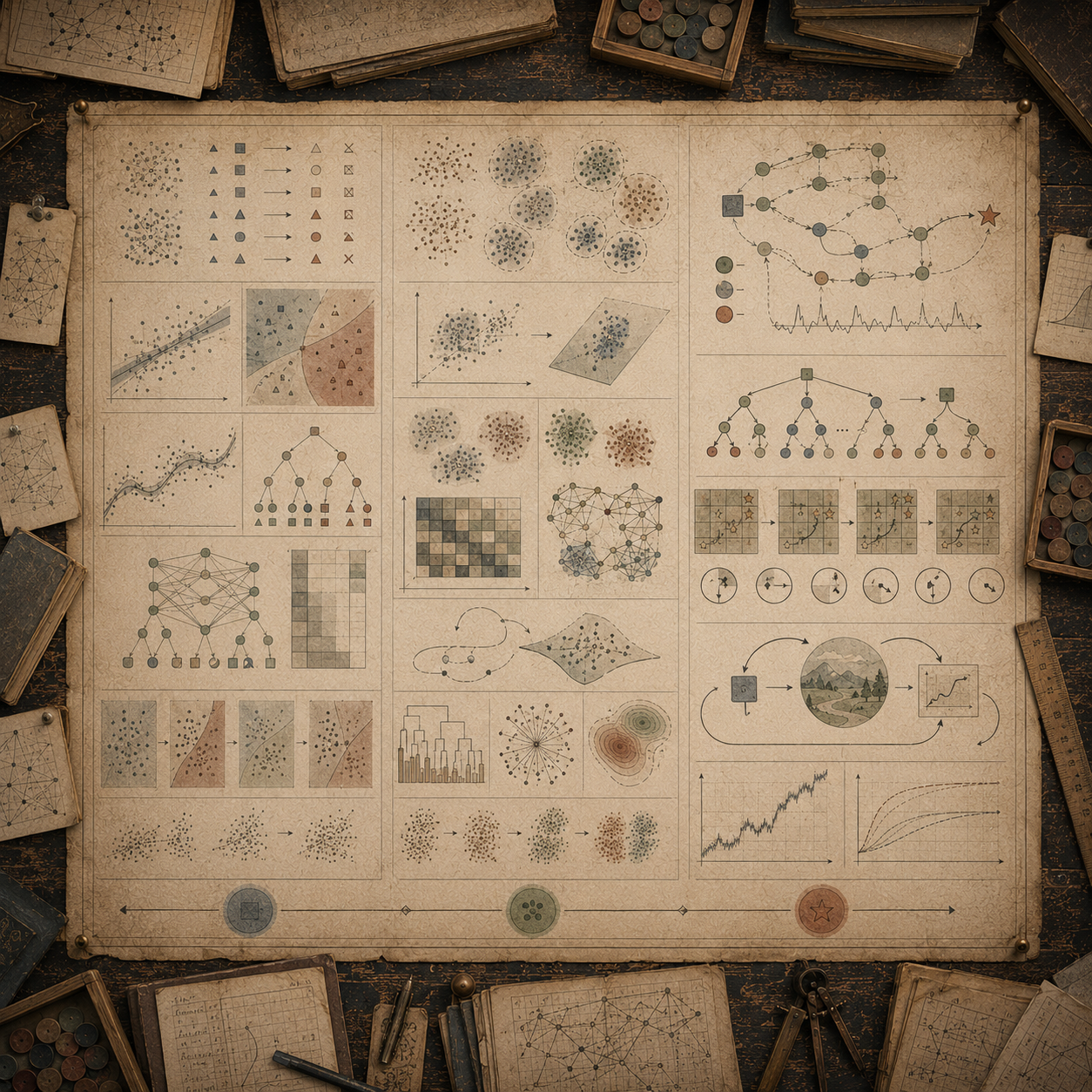
This article explains supervised learning, unsupervised learning, reinforcement learning, labels, targets, features, classification, regression, clustering, dimensionality reduction, anomaly detection, representation discovery, agents, environments, policies, rewards, exploration, exploitation, evaluation, generalization, model selection, feedback loops, governance, and responsible use. It treats learning paradigms as computational reasoning frameworks: each one defines what counts as evidence, what counts as success, and what kinds of error or harm require review.
Why Learning Paradigms Matter
Learning paradigms matter because they define the relationship between data, objective, feedback, and inference. A supervised model requires examples with known outputs. An unsupervised model tries to find structure when outputs are unknown or undefined. A reinforcement-learning system learns through sequences of action, observation, reward, and adjustment.
The same dataset can support different kinds of learning depending on the question. Customer records may be used to predict churn, discover segments, recommend interventions, or optimize a sequence of actions. The paradigm chosen determines the computational problem and the institutional responsibilities around it.
| Question | Likely paradigm | Reasoning concern |
|---|---|---|
| Which category does this case belong to? | Supervised classification. | Are labels reliable, meaningful, and fair? |
| What numerical outcome is likely? | Supervised regression. | Does prediction generalize beyond training data? |
| What hidden groups or patterns exist? | Unsupervised learning. | Are discovered clusters real, useful, or misleading? |
| Can high-dimensional data be represented more simply? | Dimensionality reduction. | What information is lost or emphasized? |
| Which action should be chosen over time? | Reinforcement learning. | Does the reward function represent the real goal? |
| How should a system learn from feedback? | Interactive or online learning. | Can feedback loops distort future behavior? |
Choosing a learning paradigm is therefore a reasoning decision, not just a software decision.
Three Learning Paradigms Defined
Supervised learning, unsupervised learning, and reinforcement learning are often introduced as textbook categories. They are useful because they separate three different kinds of computational evidence.
Supervised learning uses input-output examples. The model sees records with known labels or target values and learns a mapping from inputs to outputs. Unsupervised learning uses data without predefined labels and tries to discover structure, similarity, latent dimensions, anomalies, or compressed representations. Reinforcement learning uses interaction. An agent acts in an environment, receives feedback, and learns a policy for selecting actions.
| Paradigm | Learning signal | Common outputs |
|---|---|---|
| Supervised learning | Labeled examples or target values. | Classifications, scores, predictions, rankings. |
| Unsupervised learning | Unlabeled observations and structural patterns. | Clusters, embeddings, reduced dimensions, anomaly scores. |
| Reinforcement learning | Rewards or penalties from action over time. | Policies, strategies, action rules, value estimates. |
| Semi-supervised learning | Small labeled set plus larger unlabeled set. | Predictions assisted by unlabeled structure. |
| Self-supervised learning | Training signals derived from the data itself. | Representations useful for later tasks. |
| Active learning | Selective labeling or human feedback. | Models improved by targeted information requests. |
The categories are not rigid boxes. They are starting points for understanding how learning is organized.
Supervised Learning
Supervised learning is the most familiar machine-learning paradigm. It uses examples where the desired output is already known. A model is trained to map inputs to outputs, then evaluated on whether it can produce useful outputs for new cases.
Classification predicts categories. Regression predicts numerical values. Ranking orders items according to estimated relevance, risk, priority, preference, or value. Supervised learning can be powerful when labels are meaningful, examples are representative, and evaluation measures align with the purpose of use.
| Task | Output | Example |
|---|---|---|
| Binary classification | One of two classes. | Approve or flag; eligible or ineligible. |
| Multiclass classification | One class among several. | Topic category, diagnosis group, document type. |
| Regression | Numerical value. | Demand estimate, cost forecast, risk score. |
| Ranking | Ordered list. | Search results, recommendations, priority queues. |
| Sequence labeling | Label for each element in a sequence. | Token classification, event detection, time-series annotation. |
| Structured prediction | Complex output object. | Parsed text, image segmentation, path prediction. |
Supervised learning depends on the quality of supervision. A model trained on bad labels will often learn bad judgment efficiently.
Labels, Targets, and Training Pairs
A supervised dataset is usually organized as training pairs: inputs and outputs. The input may be a vector of features, an image, a document, a time series, or a structured record. The output may be a label, class, score, or target value. The model learns a function that maps the input to the output.
This sounds simple, but labels are often social, institutional, or historical artifacts. A fraud label may reflect what was previously detected, not all fraud. A performance label may reflect managerial judgment, not objective ability. A health label may reflect access to care and measurement practices. An education label may reflect test design rather than learning. Supervised learning inherits these histories.
| Label issue | How it appears | Review question |
|---|---|---|
| Label noise | Labels contain mistakes or inconsistent judgments. | How were labels produced and reviewed? |
| Historical bias | Past decisions become training targets. | Should the system reproduce past outcomes? |
| Proxy labels | Measurable substitutes stand in for real goals. | What important outcome is not directly measured? |
| Class imbalance | Some classes are rare or underrepresented. | Which errors become hidden by aggregate accuracy? |
| Temporal drift | Labels from one period no longer fit another. | How often should the model be revalidated? |
| Contestability | Affected people cannot challenge labels. | Is there a path to correct the record? |
A supervised model learns from examples, but the examples must be interpreted before they are trusted.
Unsupervised Learning
Unsupervised learning works with data that do not come with predefined target labels. The goal is not to reproduce known outputs, but to discover structure: clusters, latent dimensions, associations, anomalies, compressed representations, similarity relationships, or hidden patterns.
Unsupervised learning is useful when the analyst does not know the categories in advance or when the goal is exploratory. It can reveal useful structure, but it can also impose structure where none is meaningful. Clusters are not automatically natural kinds. Embeddings are not neutral maps. Anomalies are not automatically errors or threats.
| Task | Output | Review concern |
|---|---|---|
| Clustering | Groups of similar observations. | Are groups stable, meaningful, and useful? |
| Dimensionality reduction | Lower-dimensional representation. | What variation is preserved or discarded? |
| Anomaly detection | Cases that differ from learned patterns. | Does unusual mean harmful, important, or merely rare? |
| Association discovery | Co-occurring items or behaviors. | Are associations interpretable or spurious? |
| Topic modeling | Latent themes or document groups. | Do topics reflect interpretation or artifact? |
| Representation learning | Embeddings or latent features. | Can downstream users understand limitations? |
Unsupervised learning can support discovery, but discovery still requires interpretation.
Clustering and Representation Discovery
Clustering groups observations by similarity. Representation learning transforms data into new forms that may make patterns easier to analyze. Both are powerful because they can reveal structure that was not named in advance.
But clustering and representation discovery are sensitive to choices: distance measures, scaling, preprocessing, dimensionality, model family, number of clusters, outlier treatment, and evaluation criteria. A small change in assumptions can produce different groupings. A representation may preserve some relationships while flattening others.
| Design choice | Effect | Review question |
|---|---|---|
| Distance metric | Defines what counts as similar. | Is similarity meaningful for the domain? |
| Scaling | Changes feature influence. | Are large-scale variables dominating results? |
| Number of clusters | Determines how many groups appear. | Is this choice justified beyond convenience? |
| Dimensionality reduction | Compresses information. | What variation is lost in compression? |
| Outlier handling | Changes apparent structure. | Are rare cases noise, signal, or protected variation? |
| Interpretation layer | Names discovered groups. | Who decides what a cluster means? |
The output of unsupervised learning should be treated as a proposal for inquiry, not as automatic truth.
Reinforcement Learning
Reinforcement learning studies agents that learn through interaction. An agent observes a state, chooses an action, receives a reward or penalty, and updates its policy. The goal is often to maximize cumulative reward over time, not merely to make one isolated prediction.
This makes reinforcement learning especially important for sequential decision-making. It is also risky, because reward design can distort behavior. If the reward function is too narrow, the agent may learn strategies that optimize the metric while undermining the real purpose. In institutional settings, reinforcement learning requires particular caution because the system’s actions may change the environment that generates future data.
| Element | Meaning | Governance question |
|---|---|---|
| Agent | The system choosing actions. | What authority does the agent have? |
| Environment | The setting in which actions have consequences. | Who or what is affected by interaction? |
| State | Information available to the agent. | What important context is missing? |
| Action | A choice made by the agent. | Which actions should be disallowed? |
| Reward | Feedback signal used for learning. | Does reward represent the real purpose? |
| Policy | Rule for selecting actions. | Can the policy be audited and constrained? |
Reinforcement learning is not only about learning from feedback. It is about learning to act.
States, Actions, Policies, and Rewards
The core language of reinforcement learning is sequential. A state describes the current situation. An action changes or interacts with the situation. A reward evaluates the result. A policy selects actions based on states. A value function estimates how good a state or action is for future reward.
Because rewards are design choices, reinforcement learning makes value alignment unusually explicit. A system can learn exactly what it is rewarded to learn, even when that reward is a poor proxy for the true goal. This creates a direct link between reinforcement learning, Goodhart’s Law, metric design, and institutional accountability.
| RL concept | Computational role | Interpretive risk |
|---|---|---|
| State space | Defines what the agent can observe. | Invisible conditions may be ignored. |
| Action space | Defines possible interventions. | Unsafe or unfair actions may be available. |
| Reward function | Defines what counts as success. | Optimized reward may not equal public purpose. |
| Policy | Maps states to actions. | Action logic may be hard to contest. |
| Exploration | Tests actions to learn consequences. | Exploration may impose real costs on people. |
| Exploitation | Uses learned action patterns. | Early errors may become entrenched. |
Sequential learning should be reviewed not only for performance, but for the ethics of experimentation and control.
Comparison Across Paradigms
The three paradigms differ in the form of supervision they receive, the kind of output they produce, and the way they should be evaluated. The distinction helps analysts ask better questions before choosing a method.
| Dimension | Supervised learning | Unsupervised learning | Reinforcement learning |
|---|---|---|---|
| Learning signal | Labels or targets. | Structure in unlabeled data. | Reward from action. |
| Main question | Can we predict the output? | What structure is present? | Which action should be taken? |
| Typical output | Prediction, score, class, ranking. | Cluster, embedding, anomaly, component. | Policy, strategy, value estimate. |
| Evaluation challenge | Labels may be biased or incomplete. | Ground truth may be absent. | Reward may be misaligned. |
| Deployment risk | Errors affect classification or allocation. | Discovered categories may be reified. | Actions reshape the environment. |
| Governance need | Label audit and error review. | Interpretation and stability review. | Reward, constraint, and safety review. |
The paradigms are technical categories, but they also organize accountability.
Hybrid and Adjacent Forms
Many contemporary systems blend paradigms. Semi-supervised learning combines a small amount of labeled data with a larger amount of unlabeled data. Self-supervised learning creates training signals from the data itself. Active learning asks humans to label selected examples. Imitation learning learns from demonstrations. Online learning updates as new data arrive.
These hybrid forms are useful because real data rarely fit clean categories. Labels may be scarce, expensive, or contested. Feedback may arrive slowly. Systems may need to adapt over time. But hybrid methods can also blur accountability. It may become unclear where labels came from, how feedback shaped behavior, or whether the system is still valid under new conditions.
| Form | How it combines learning signals | Review concern |
|---|---|---|
| Semi-supervised learning | Uses labeled and unlabeled data together. | Does unlabeled structure reinforce label bias? |
| Self-supervised learning | Derives tasks from the data itself. | What representations are learned and reused? |
| Active learning | Requests labels for selected cases. | Whose judgment supplies the labels? |
| Imitation learning | Learns from demonstrations. | Should past behavior be copied? |
| Online learning | Updates as data arrive. | Can drift or manipulation change the model? |
| Bandit learning | Learns from partial feedback on chosen actions. | Who bears the cost of exploration? |
Hybrid learning requires hybrid governance: data review, objective review, feedback review, and deployment monitoring.
Evaluation and Generalization
Evaluation depends on the learning paradigm. Supervised learning can often compare predictions against held-out labels. Unsupervised learning may need internal validity checks, stability tests, downstream usefulness, and expert interpretation. Reinforcement learning may require simulation, off-policy evaluation, safety constraints, counterfactual review, and controlled deployment.
Generalization also differs. A supervised classifier may fail when new cases differ from training data. A clustering model may discover unstable groupings. A reinforcement-learning policy may perform well in simulation but fail when real-world environments behave differently.
| Paradigm | Evaluation method | Failure signal |
|---|---|---|
| Supervised learning | Train/test split, cross-validation, error metrics. | High error, biased errors, poor calibration. |
| Unsupervised learning | Stability, interpretability, cluster validity, downstream performance. | Unstable or meaningless structure. |
| Reinforcement learning | Simulation, policy evaluation, reward trajectories, safety tests. | Reward gaming, unsafe exploration, brittle policy. |
| Semi-supervised learning | Held-out labels plus structure review. | Unlabeled data reinforce bad boundaries. |
| Self-supervised learning | Transfer performance and representation audit. | Useful benchmark performance but opaque learned features. |
| Online learning | Continuous monitoring and drift detection. | Performance decay or manipulation vulnerability. |
Evaluation should test not only whether a model works, but whether it works for the right reason in the right context.
Feedback Loops and Deployment
Machine-learning systems often change the world they measure. A supervised model that prioritizes some cases may generate more data about those cases. An unsupervised segmentation system may cause institutions to treat groups as if they were natural categories. A reinforcement-learning agent may actively reshape the environment while learning from it.
Feedback loops are especially important because they can turn model outputs into future inputs. A risk score can change surveillance patterns. A recommendation system can change user behavior. A ranking system can change visibility. A policy-learning system can change the conditions under which future decisions are made.
| Feedback problem | How it appears | Review response |
|---|---|---|
| Selection feedback | Model determines which cases are observed. | Audit missing and unobserved outcomes. |
| Behavioral adaptation | People change behavior in response to the model. | Monitor gaming, incentives, and unintended effects. |
| Category reification | Clusters become treated as fixed identities. | Use cautious language and review consequences. |
| Reward gaming | Agent maximizes metric while violating purpose. | Constrain rewards and test edge cases. |
| Distribution shift | Deployment changes data patterns. | Revalidate and monitor drift. |
| Institutional lock-in | Outputs become hard to contest or revise. | Preserve appeal, override, and review mechanisms. |
Deployment turns learning into institutional action, so deployment must be part of the learning design.
Governance and Responsible Use
Governance begins by asking what kind of learning problem is being built. A supervised system needs label governance. An unsupervised system needs interpretation governance. A reinforcement-learning system needs reward and action governance. All three need documentation, testing, scope limits, monitoring, and accountable decision rules.
Responsible use also requires knowing when a paradigm is inappropriate. If labels are illegitimate, supervised learning can reproduce harm. If categories are politically or ethically sensitive, unsupervised clustering can create misleading typologies. If exploration imposes real-world costs, reinforcement learning may be unsafe outside tightly controlled settings.
| Governance question | Supervised | Unsupervised | Reinforcement |
|---|---|---|---|
| What is being learned? | Mapping from inputs to labels. | Structure in data. | Policy for action. |
| What must be documented? | Label provenance and error patterns. | Similarity assumptions and interpretations. | Reward design and action constraints. |
| Who can challenge outputs? | People affected by classifications. | People affected by group assignment. | People affected by agent actions. |
| What is the main misuse? | Treating labels as objective truth. | Treating clusters as natural categories. | Treating reward as social purpose. |
| What should be monitored? | Error rates, calibration, subgroup effects. | Stability, drift, interpretation impact. | Reward gaming, safety, environmental change. |
| What boundary matters? | Use only where labels are legitimate. | Use only as exploratory structure unless validated. | Use only where actions can be constrained and reviewed. |
Governance should be specific to the kind of learning being used.
Representation Risk
Representation risk appears when learning paradigms are described too loosely or too confidently. A supervised system may be presented as learning truth when it is learning labels. An unsupervised system may be presented as discovering natural groups when it is imposing a structure based on modeling choices. A reinforcement-learning system may be presented as learning optimal action when it is optimizing a reward proxy.
The danger is not only technical error. It is institutional overclaiming. When a learning paradigm is misunderstood, model outputs can appear more objective, scientific, or inevitable than they are.
| Representation risk | How it appears | Review response |
|---|---|---|
| Labels as truth | Supervised targets are treated as neutral facts. | Audit label creation and dispute pathways. |
| Clusters as reality | Unsupervised groups are treated as natural categories. | Test stability and communicate uncertainty. |
| Reward as purpose | RL reward is equated with institutional goal. | Review reward design and harmful shortcuts. |
| Metric overconfidence | One evaluation score hides distributional failure. | Report multiple metrics and subgroup outcomes. |
| Paradigm mismatch | A method is used for a question it cannot answer. | Align question, evidence, method, and use. |
| Opaque deployment | Learning system changes decisions without explanation. | Document, monitor, and preserve contestability. |
Good computational reasoning keeps the learning signal visible.
Examples of Learning Paradigms
The examples below show how supervised, unsupervised, and reinforcement learning appear across technical, scientific, institutional, and policy settings.
Credit scoring
A supervised model predicts repayment or default risk from historical records and labels.
Medical image classification
A supervised classifier learns from labeled images and predicts diagnostic categories.
Customer segmentation
An unsupervised clustering model groups cases based on behavioral or demographic similarity.
Document topic discovery
Unsupervised methods identify latent themes in text collections without predefined topic labels.
Anomaly detection
A system identifies unusual transactions, sensor readings, network behavior, or process deviations.
Recommendation optimization
A reinforcement-learning or bandit system learns which recommendations produce feedback over time.
Robotics control
An agent learns actions in response to states, rewards, and environmental feedback.
Adaptive learning systems
A platform adjusts educational content using predictions, clusters, or feedback from learner behavior.
Across these examples, the learning paradigm shapes the evidence, output, and accountability structure.
Mathematics, Computation, and Modeling
A supervised learning problem can be represented as learning a function from inputs to outputs:
\hat{y} = f_\theta(x)
\]
Interpretation: A model with parameters \(\theta\) maps an input \(x\) to a predicted output \(\hat{y}\).
A supervised training objective often minimizes loss over examples:
\min_\theta \frac{1}{n}\sum_{i=1}^{n} L(f_\theta(x_i), y_i)
\]
Interpretation: Training searches for parameters that reduce prediction error against known labels or target values.
A clustering objective such as k-means can be written as:
\min_{C_1,\ldots,C_k}\sum_{j=1}^{k}\sum_{x_i \in C_j}\|x_i – \mu_j\|^2
\]
Interpretation: Clustering groups observations by minimizing distance from each case to its cluster center.
A reinforcement-learning objective can be expressed as expected cumulative reward:
\max_\pi E\left[\sum_{t=0}^{T}\gamma^t r_t\right]
\]
Interpretation: A policy \(\pi\) is evaluated by the discounted rewards it produces over time.
A simple value update can be written as:
Q(s,a) \leftarrow Q(s,a) + \alpha\left[r + \gamma\max_{a’}Q(s’,a’) – Q(s,a)\right]
\]
Interpretation: The estimated value of an action is updated based on reward and the estimated value of future action.
These formulas show that each paradigm formalizes a different kind of learning signal.
Python Workflow: Learning-Paradigm Audit
The Python workflow below is intentionally dependency-light. It creates synthetic examples for three learning paradigms: supervised classification, unsupervised clustering, and reinforcement-style reward evaluation. The goal is not to replace specialized libraries, but to make the reasoning structure visible.
# learning_paradigm_audit.py
# Dependency-light illustration of supervised, unsupervised, and reinforcement learning review.

from __future__ import annotations

from dataclasses import asdict, dataclass
from pathlib import Path
from statistics import mean
import csv
import json
import math
import random

ARTICLE_ROOT = Path(__file__).resolve().parents[1]
TABLES = ARTICLE_ROOT / "outputs" / "tables"
JSON_DIR = ARTICLE_ROOT / "outputs" / "json"


@dataclass(frozen=True)
class ParadigmConfig:
    seed: int = 2026
    n: int = 240
    clusters: int = 3
    actions: int = 3


def sigmoid(value: float) -> float:
    return 1.0 / (1.0 + math.exp(-value))


def write_csv(path: Path, rows: list[dict[str, object]]) -> None:
    path.parent.mkdir(parents=True, exist_ok=True)
    fieldnames = sorted({key for row in rows for key in row}) if rows else []
    with path.open("w", newline="", encoding="utf-8") as handle:
        writer = csv.DictWriter(handle, fieldnames=fieldnames)
        writer.writeheader()
        writer.writerows(rows)


def write_json(path: Path, payload: object) -> None:
    path.parent.mkdir(parents=True, exist_ok=True)
    path.write_text(json.dumps(payload, indent=2, sort_keys=True), encoding="utf-8")


def synthetic_records(config: ParadigmConfig) -> list[dict[str, object]]:
    rng = random.Random(config.seed)
    rows: list[dict[str, object]] = []
    for i in range(config.n):
        x1 = rng.random()
        x2 = rng.random()
        score = -0.40 + 1.30 * x1 + 0.90 * x2
        probability = sigmoid(score)
        label = 1 if rng.random() < probability else 0
        rows.append({"unit_id": i + 1, "x1": round(x1, 6), "x2": round(x2, 6), "label": label})
    return rows


def supervised_rule(rows: list[dict[str, object]]) -> dict[str, object]:
    correct = 0
    positives = 0
    for row in rows:
        prediction = 1 if float(row["x1"]) + float(row["x2"]) > 1.05 else 0
        positives += prediction
        correct += int(prediction == int(row["label"]))
    return {
        "paradigm": "supervised_learning",
        "learning_signal": "labels",
        "example_task": "classification",
        "accuracy": round(correct / len(rows), 6),
        "positive_prediction_rate": round(positives / len(rows), 6),
        "review_question": "Are the labels valid and are errors acceptable across affected groups?",
    }


def simple_clusters(rows: list[dict[str, object]], k: int) -> tuple[list[dict[str, object]], dict[str, object]]:
    centers = [(0.20, 0.20), (0.80, 0.25), (0.55, 0.80)][:k]
    assignments: list[dict[str, object]] = []
    distances: list[float] = []
    for row in rows:
        x = (float(row["x1"]), float(row["x2"]))
        indexed = [(idx, math.dist(x, center)) for idx, center in enumerate(centers, start=1)]
        cluster, distance = min(indexed, key=lambda item: item[1])
        distances.append(distance)
        assignments.append({"unit_id": row["unit_id"], "cluster": cluster, "distance_to_center": round(distance, 6)})
    summary = {
        "paradigm": "unsupervised_learning",
        "learning_signal": "unlabeled_structure",
        "example_task": "clustering",
        "mean_distance_to_center": round(mean(distances), 6),
        "review_question": "Are discovered clusters stable, interpretable, and safe to use?",
    }
    return assignments, summary


def reward_policy_summary(config: ParadigmConfig) -> dict[str, object]:
    rewards = {"low_risk_action": 0.55, "medium_risk_action": 0.62, "high_risk_action": 0.70}
    best_action = max(rewards, key=rewards.get)
    return {
        "paradigm": "reinforcement_learning",
        "learning_signal": "reward_feedback",
        "example_task": "policy_choice",
        "best_action_by_reward_proxy": best_action,
        "proxy_reward": rewards[best_action],
        "review_question": "Does the reward proxy represent the true purpose, and are unsafe actions constrained?",
    }


def main() -> None:
    config = ParadigmConfig()
    rows = synthetic_records(config)
    supervised = supervised_rule(rows)
    assignments, unsupervised = simple_clusters(rows, config.clusters)
    reinforcement = reward_policy_summary(config)
    audit = [supervised, unsupervised, reinforcement]

    write_csv(TABLES / "synthetic_learning_records.csv", rows)
    write_csv(TABLES / "cluster_assignments.csv", assignments)
    write_csv(TABLES / "learning_paradigm_audit.csv", audit)
    write_json(JSON_DIR / "learning_paradigm_audit.json", audit)
    write_json(JSON_DIR / "learning_paradigm_config.json", asdict(config))

    print("Learning-paradigm audit complete.")
    print(TABLES / "learning_paradigm_audit.csv")


if __name__ == "__main__":
    main()
This small workflow makes the learning signal visible: labels, unlabeled structure, and reward feedback require different reviews.
R Workflow: Paradigm Summary and Diagnostics
The R workflow reads the generated audit tables and creates basic diagnostic summaries. In a full repository workflow, this layer can be extended for plots, model comparisons, cluster stability checks, and governance reports.
# learning_paradigm_summary.R
args <- commandArgs(trailingOnly = FALSE)
file_arg <- grep("^--file=", args, value = TRUE)

if (length(file_arg) > 0) {
  script_path <- normalizePath(sub("^--file=", "", file_arg[1]), mustWork = TRUE)
  article_root <- normalizePath(file.path(dirname(script_path), ".."), mustWork = TRUE)
} else {
  article_root <- getwd()
}

setwd(article_root)
tables_dir <- file.path(article_root, "outputs", "tables")
figures_dir <- file.path(article_root, "outputs", "figures")
dir.create(tables_dir, recursive = TRUE, showWarnings = FALSE)
dir.create(figures_dir, recursive = TRUE, showWarnings = FALSE)

audit_path <- file.path(tables_dir, "learning_paradigm_audit.csv")
if (!file.exists(audit_path)) {
  stop(paste("Missing", audit_path, "Run the Python workflow first."))
}

audit <- read.csv(audit_path, stringsAsFactors = FALSE)
summary_table <- data.frame(
  paradigms_reviewed = nrow(audit),
  learning_signals = paste(audit$learning_signal, collapse = "; "),
  review_questions_recorded = sum(nchar(audit$review_question) > 0)
)

write.csv(summary_table, file.path(tables_dir, "r_learning_paradigm_summary.csv"), row.names = FALSE)

png(file.path(figures_dir, "learning_paradigm_review_counts.png"), width = 1000, height = 750)
barplot(rep(1, nrow(audit)), names.arg = audit$paradigm, las = 2,
        main = "Learning Paradigms Reviewed", ylab = "Review record")
grid()
dev.off()

print(summary_table)
The R layer reinforces the article’s core claim: each paradigm should leave an auditable record of learning signal, task, output, and review question.
GitHub Repository
The companion repository contains reproducible workflows, synthetic data, audit outputs, calculators, documentation, and multilingual examples for this article.
Complete Code Repository
Companion article folder with Python, R, Julia, SQL, Haskell, C, C++, Fortran, Rust, Go, Java, TypeScript, Prolog, Racket, notebooks, documentation, synthetic teaching data, generated outputs, schemas, calculators, and Canvas-ready workflow artifacts for supervised learning, unsupervised learning, reinforcement learning, label review, clustering diagnostics, reward-function review, model evaluation, learning-paradigm governance, and responsible algorithmic interpretation.
A Practical Method for Reviewing Learning Paradigms
A practical review should begin before model training. The analyst should identify the learning signal, the intended use, the evidence source, the output type, and the deployment setting. The review should then ask whether the chosen paradigm fits the problem.
| Step | Question | Review artifact |
|---|---|---|
| Define the task | Is the system predicting, discovering, or acting? | Learning-problem statement. |
| Identify the learning signal | Are labels, structure, rewards, or feedback being used? | Learning-signal register. |
| Audit data provenance | Where did examples, labels, or feedback come from? | Data and label provenance note. |
| Review objectives | What does the model optimize? | Objective and metric register. |
| Evaluate fit | Does the paradigm match the institutional question? | Paradigm-fit assessment. |
| Set boundaries | Where should outputs not be used? | Use-boundary statement. |
| Monitor deployment | Does performance, behavior, or feedback shift over time? | Monitoring and review schedule. |
The review should make clear what kind of learning is happening and what kind of claim the output supports.
Common Pitfalls
The most common pitfall is treating the three paradigms as mere labels for software libraries. They are deeper than that. Each paradigm carries assumptions about evidence, feedback, and success.
| Pitfall | Why it matters | Correction |
|---|---|---|
| Using supervised learning with bad labels. | The model learns institutional noise or historical bias. | Audit labels before training. |
| Treating clusters as objective groups. | Unsupervised structure may be fragile or artificial. | Test stability and communicate uncertainty. |
| Designing narrow rewards. | RL agents may optimize proxies rather than purpose. | Review reward design and constraints. |
| Ignoring distribution shift. | Performance can decay after deployment. | Monitor data, outcomes, and feedback loops. |
| Using one metric for all paradigms. | Different paradigms require different evaluation logic. | Match evaluation to task and use. |
| Confusing prediction with causation. | Learning patterns does not prove intervention effects. | Separate predictive, structural, and causal claims. |
The method should be chosen because it fits the reasoning problem, not because it is fashionable.
Why Learning Paradigms Are Computational Reasoning
Supervised, unsupervised, and reinforcement learning are not just machine-learning categories. They are ways of organizing evidence. Supervised learning reasons from labeled examples. Unsupervised learning reasons from hidden structure. Reinforcement learning reasons from feedback, reward, and action over time.
Each paradigm can support powerful computational systems. Each can also mislead when its learning signal is treated as objective, complete, or self-justifying. Labels can encode history. Clusters can reify patterns. Rewards can distort purpose. Evaluation can hide failures. Deployment can reshape the environment.
Learning paradigms belong inside computational reasoning because they determine what the algorithm is allowed to learn, what it can claim, and how its outputs should be governed.
Related Articles
- Machine Learning as Algorithmic Inference
- Features, Labels, and the Politics of Measurement
- Training, Testing, and Generalization
- Overfitting, Underfitting, and Model Error
- Algorithmic Fairness and Computational Justice
Further Reading
- Bishop, C.M. (2006) Pattern Recognition and Machine Learning. New York: Springer. Available at: Springer.
- Hastie, T., Tibshirani, R. and Friedman, J. (2009) The Elements of Statistical Learning: Data Mining, Inference, and Prediction. 2nd edn. New York: Springer. Available at: Stanford author site.
- James, G., Witten, D., Hastie, T., Tibshirani, R. and Taylor, J. (2023) An Introduction to Statistical Learning. Cham: Springer. Available at: StatLearning.
- Sutton, R.S. and Barto, A.G. (2018) Reinforcement Learning: An Introduction. 2nd edn. Cambridge, MA: MIT Press. Available at: MIT Press.
- Russell, S. and Norvig, P. (2021) Artificial Intelligence: A Modern Approach. 4th edn. Hoboken: Pearson. Available at: AIMA official site.
References
- Bishop, C.M. (2006) Pattern Recognition and Machine Learning. New York: Springer. Available at: https://link.springer.com/book/9780387310732.
- Hastie, T., Tibshirani, R. and Friedman, J. (2009) The Elements of Statistical Learning: Data Mining, Inference, and Prediction. 2nd edn. New York: Springer. Available at: https://hastie.su.domains/ElemStatLearn/.
- James, G., Witten, D., Hastie, T., Tibshirani, R. and Taylor, J. (2023) An Introduction to Statistical Learning: with Applications in Python. Cham: Springer. Available at: https://www.statlearning.com/.
- Pedregosa, F. et al. (2011) ‘Scikit-learn: Machine Learning in Python’, Journal of Machine Learning Research, 12, pp. 2825–2830. Available at: https://scikit-learn.org/.
- Scikit-learn developers (2026) User Guide: Supervised Learning and Unsupervised Learning. Available at: https://scikit-learn.org/stable/user_guide.html.
- Sutton, R.S. and Barto, A.G. (2018) Reinforcement Learning: An Introduction. 2nd edn. Cambridge, MA: MIT Press. Available at: https://incompleteideas.net/book/the-book-2nd.html.
- Russell, S. and Norvig, P. (2021) Artificial Intelligence: A Modern Approach. 4th edn. Hoboken: Pearson. Available at: https://aima.cs.berkeley.edu/.