
Last Updated June 18, 2026
Ancient Near Eastern law preserves some of the earliest surviving evidence for how societies used writing, kingship, courts, contracts, debt regulation, family rules, punishment, land administration, and public authority to organize social order. Long before modern states, legislatures, constitutional courts, or international institutions, ancient Mesopotamian, Egyptian, Hittite, Assyrian, Babylonian, and Israelite legal materials show rulers, scribes, judges, elders, temples, palaces, households, merchants, and local communities negotiating the meaning of justice, obligation, status, property, injury, and responsibility.
This article map treats ancient legal collections not as simple ancestors of modern statutory codes, but as complex artifacts of governance, memory, ideology, administration, and legal practice. The Laws of Ur-Nammu, the Laws of Lipit-Ishtar, the Laws of Eshnunna, the Code of Hammurabi, Hittite legal texts, Middle Assyrian materials, Egyptian legal-administrative practice, and biblical law all reveal different ways that ancient societies linked law to kingship, divine order, social hierarchy, economic exchange, family continuity, debt, labor, violence, and public legitimacy.
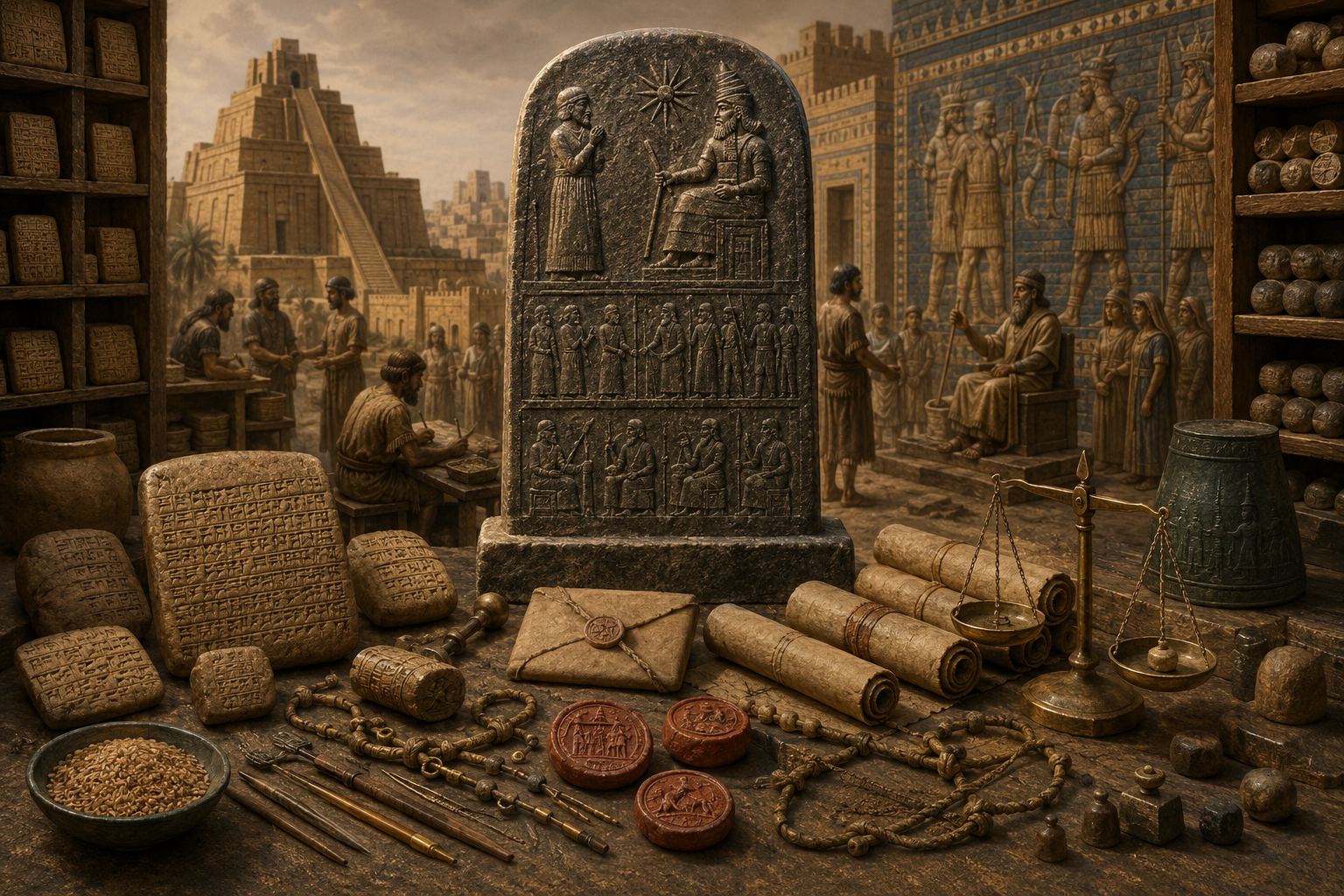
Ancient Near Eastern law matters because it shows that law did not begin as a detached set of abstract rules. It emerged from household economies, palace administration, temple institutions, landholding systems, debt relations, labor obligations, commercial exchange, oath-taking, judicial practice, divine kingship, and the public performance of justice. These legal materials reveal how early societies made authority visible, how rulers justified power, how scribes preserved legal memory, and how communities managed conflict before the modern separation of law, religion, economy, and politics.
The series also complicates familiar assumptions about legal history. Famous monuments such as the Code of Hammurabi are often described as “law codes,” but they should not be read as modern statutory codes in the contemporary sense. They were legal collections, royal inscriptions, teaching texts, public monuments, ideological declarations, and records of legal reasoning. Their significance lies not only in the individual provisions they preserve, but in the way they display a world where law, kingship, writing, administration, justice, and hierarchy were inseparable.
The aim of this article map is to build a serious, research-grade foundation for studying early law as a form of comparative governance. Some entries focus on individual legal collections. Others examine legal practice beyond the famous codes: contracts, court records, debt documents, scribal archives, family agreements, treaty forms, royal edicts, temple economies, and the legal status of persons. Together, they show why ancient legal materials remain essential for understanding codification, legal pluralism, public authority, legal memory, and the long history of governance.
Ancient Near Eastern Law Research Repository
The companion repository for this knowledge series contains SQL schemas, seed data, article-roadmap tables, source hierarchy notes, legal collection metadata, historical-period records, comparative concept tables, citation guidance, and lightweight research utilities for maintaining the Ancient Near Eastern Law and Early Legal Codes article map over time.
Ancient Law as Early Governance
Ancient Near Eastern law belongs to the earliest documented history of governance. It shows how rulers, households, temples, palaces, merchants, judges, elders, and scribes used legal language to stabilize social order, record obligations, settle disputes, regulate property, define status, and express public ideals of justice. These legal materials were not produced in societies with modern legislatures, professionalized state courts, codified constitutional systems, or uniform citizenship. They belonged to worlds organized through kingship, household authority, divine order, city life, agricultural production, labor dependency, debt relationships, and local communities.
The surviving evidence includes famous legal collections, but also thousands of practical documents: contracts, receipts, loan records, adoption tablets, marriage agreements, property transfers, court records, letters, royal edicts, administrative lists, and treaty texts. This matters because the law of the ancient Near East cannot be understood only by reading royal monuments. Everyday legal practice was preserved in the documents through which people borrowed grain, pledged labor, bought land, arranged marriages, adopted heirs, settled disputes, entered partnerships, and appealed to authorities.
Ancient law is therefore best understood as a system of governance embedded in social life. It did not separate economics from family, religion from political authority, or law from administration in the way modern categories often do. It organized obligations among persons, households, institutions, and rulers while also projecting an image of royal justice. This makes ancient Near Eastern law foundational for understanding how law becomes public authority, how writing preserves power, and how legal order can be both practical and ideological.
Law, Kingship, and Public Order
Ancient Near Eastern legal collections often present law as part of royal responsibility. Kings claim to establish justice, protect the vulnerable, punish wrongdoing, maintain order, regulate economic life, and restore balance when debt, violence, or disorder threaten society. Legal inscriptions therefore do more than announce rules. They place the ruler inside a moral and political drama in which kingship is justified by the ability to secure right order.
This connection between law and kingship appears clearly in the public character of major monuments. The Code of Hammurabi, for example, is not simply a list of provisions. It is also a royal inscription that frames Hammurabi as a ruler appointed to establish justice, protect the weak, discipline wrongdoing, and maintain the land. The legal material is embedded in a larger statement about authority, legitimacy, and divine sanction. That combination of legal reasoning and royal ideology is central to the meaning of ancient law.
For Global Governance, this matters because early legal texts show how law can legitimate authority while also constraining expectations of rule. A ruler who claims to establish justice also invites judgment against that claim. Ancient legal collections therefore belong to the long history of public authority: they show how law helps define the proper exercise of power, how legal memory supports institutions, and how governance depends on shared expectations about order, fairness, punishment, and repair.
Writing, Scribes, and Legal Memory
Writing transformed legal order by making obligations durable. Clay tablets, inscriptions, seals, archives, and scribal practices allowed legal relationships to survive beyond oral memory, immediate witnesses, or local authority. Written records made it possible to track loans, transfers, marriages, adoptions, partnerships, labor obligations, land boundaries, and court decisions. They also allowed ruling institutions to preserve administrative memory across time.
Scribes were therefore central legal actors. They did not merely copy texts mechanically. They preserved formulas, categories, contracts, lists, precedents, and institutional knowledge. Legal collections may have served not only as royal monuments but also as educational and intellectual materials within scribal culture. The ability to classify disputes, formulate obligations, and organize social life through written categories became one of the earliest technologies of governance.
This makes ancient law especially important for a knowledge-centered account of governance. Legal systems depend on memory, classification, records, and interpretive authority. Ancient Near Eastern materials show those processes at an early stage: law becomes portable through writing, authoritative through inscription, administrative through archives, and intellectually durable through scribal education. Legal memory is not only a record of past rules; it is part of the infrastructure through which institutions reproduce authority.
What Ancient Near Eastern Law Studies
Ancient Near Eastern law studies the legal collections, documents, institutions, practices, and concepts through which ancient societies organized obligation and authority. It includes Mesopotamian materials from Sumerian, Akkadian, Old Babylonian, Middle Assyrian, Neo-Babylonian, and related traditions, as well as Hittite legal materials, Egyptian legal-administrative practices, biblical law in ancient Near Eastern context, and treaty traditions that shaped relations between rulers and peoples.
At the level of subject matter, the field studies property, land, contracts, inheritance, marriage, adoption, debt, slavery, labor, wages, injury, theft, commercial exchange, status hierarchy, punishment, oaths, witnesses, ordeals, judicial authority, and royal edicts. It also studies institutions: temples, palaces, households, courts, elders, judges, merchants, scribes, local communities, and royal administrations. Ancient law is therefore not confined to criminal rules or famous monuments; it includes the legal infrastructure of everyday life.
At the interpretive level, the field asks what legal collections were for. Were they binding law, royal ideology, jurisprudence, teaching texts, monuments of justice, scribal exercises, collections of case wisdom, or practical legal references? The answer may differ across texts, contexts, and periods. A serious article map should therefore avoid flattening ancient law into modern categories and instead study the full range of legal evidence through which early societies expressed and administered order.
What This Pillar Covers
This pillar begins with foundations: law before the modern state, kingship and justice, writing and administration, legal memory, custom, royal authority, and the difficult question of whether ancient legal collections should be called “codes.” It then moves into specific collections, including the Laws of Ur-Nammu, the Laws of Lipit-Ishtar, the Laws of Eshnunna, the Code of Hammurabi, Hittite legal texts, Middle Assyrian legal materials, and later Babylonian legal traditions.
The pillar also studies legal practice beyond famous collections. Contracts, loan tablets, court records, adoption agreements, marriage documents, land transfers, commercial records, debt instruments, letters, and archives show how law operated in ordinary life. These documents reveal the everyday legal world of merchants, creditors, debtors, families, landholders, laborers, dependents, slaves, officials, and institutions.
Finally, the pillar places ancient law into wider regional and comparative context. It covers Egyptian law and ma’at, biblical law in ancient Near Eastern context, Hittite treaties, diplomacy, oaths, vassalage, social equity decrees, temple and palace economies, status hierarchy, punishment, dispute resolution, and the modern reception of early legal texts. The goal is to understand ancient law as an early archive of governance, not simply as a prelude to later legal traditions.
Legal Collections and Legal Practice
Legal collections such as the Code of Hammurabi have often dominated modern imagination because they are monumental, organized, and rhetorically powerful. They give the impression of a ruler publicly proclaiming justice through written law. Yet ancient legal order cannot be reconstructed from these collections alone. The practical documents of daily life often show a more complex relationship between legal ideals, local authority, economic necessity, and social hierarchy.
A legal collection may preserve paradigmatic cases, model judgments, legal principles, scribal learning, royal ideology, or remembered jurisprudence. A court record may show how actual parties presented claims, offered witnesses, swore oaths, negotiated settlement, or received judgment. A contract may show how people structured obligations long before any dispute arose. A royal edict may show a ruler intervening to cancel debts, restore social balance, or reassert authority during crisis.
This distinction between collection and practice is one of the central methodological lessons of the series. Ancient law must be read through multiple kinds of evidence. Monumental texts show how authority wanted justice to be remembered. Administrative records show how institutions tracked obligation. Contracts show how ordinary actors planned legal relationships. Court documents show how disputes moved through institutions. Together, these materials reveal law as a living governance system rather than a static set of ancient rules.
Status, Property, Debt, and Household Order
Ancient Near Eastern legal materials often organize society through status. Legal consequences could differ depending on whether a person was free, enslaved, dependent, elite, common, male, female, adult, child, creditor, debtor, household head, wife, widow, heir, laborer, merchant, priest, official, or foreigner. This makes ancient law a key archive for understanding legal personhood before modern equality.
Property and household order were central legal domains. Land, fields, houses, livestock, tools, silver, grain, dowries, inheritances, slaves, and family claims all appear in legal documents. Households were economic, legal, and social institutions. Marriage, adoption, inheritance, guardianship, and succession were not only private matters; they maintained labor, property, lineage, status, and institutional continuity.
Debt was especially important. Ancient economies depended on credit, grain loans, silver loans, labor obligations, pledges, and dependency relationships. Debt could lead to loss of land, forced labor, family separation, or enslavement. Royal debt relief and equity decrees therefore had governance significance. They were not merely acts of generosity; they were tools for restoring social stability, preventing collapse, and presenting the ruler as guardian of justice.
Courts, Evidence, and Dispute Resolution
Ancient legal order depended on dispute resolution. Judges, elders, officials, local authorities, palace representatives, temple institutions, and royal power all appear in different settings. Legal procedure could involve witnesses, written documents, oaths, ordeals, seals, boundary evidence, contracts, and community knowledge. The process of proving a claim was therefore inseparable from social trust, institutional authority, and religious obligation.
Evidence was not limited to documents. Witness testimony, oath-taking, public reputation, divine judgment, and physical possession could all matter. Ordeals, especially river ordeals, show how legal systems sometimes placed disputed truth under divine or cosmic judgment. To modern readers, such procedures may seem strange, but they reveal an important legal problem: how a society resolves uncertainty when documentary evidence, witnesses, or institutional investigation are insufficient.
Punishment and remedy also varied. Ancient legal materials include compensation, restitution, retaliation, fines, death penalties, mutilation, status-based sanctions, and forms of public discipline. These responses were tied to social hierarchy, economic restoration, deterrence, and royal order. A serious treatment must therefore ask not only what punishments existed, but what they reveal about the relationship among injury, status, property, public order, and authority.
Why Ancient Near Eastern Law Matters
Ancient Near Eastern law matters because it shows the early relationship between law, writing, administration, economy, religion, and public authority. It reveals that law was never only a set of prohibitions. It was also a way of preserving memory, classifying persons, defining obligations, managing land, regulating exchange, protecting hierarchy, resolving disputes, and legitimating rule.
It also matters because many later legal traditions developed in conversation with ancient Near Eastern legal worlds. Biblical law, treaty forms, covenant language, debt relief traditions, royal justice ideology, household law, and ideas of written public order cannot be fully understood without this wider regional background. Ancient legal collections provide essential comparative material for later legal traditions, including religious law, codification, public authority, and legal pluralism.
Most importantly, ancient Near Eastern law matters for Global Governance because it shows that the foundations of legal order are deeply historical. Questions that remain central today already appear in early form: Who has authority to judge? How should debt be regulated? How should violence be repaired? Who counts as a legal person? How does law protect or reproduce hierarchy? How does written law legitimate power? How does public authority claim to serve justice? These questions make ancient law more than antiquarian history. They make it part of the long human struggle to organize power through rules, memory, and responsibility.
Ancient Near Eastern Law and Early Legal Codes Article Map
The map below organizes the Ancient Near Eastern Law and Early Legal Codes knowledge series into conceptual domains, moving from foundations and early legal collections into legal practice, social status, courts, evidence, punishment, temple and palace governance, regional comparison, biblical law, treaties, and the legacy of early codification.
The Ancient Near Eastern Law and Early Legal Codes pillar is organized to move from early foundations of legal order into specific legal collections, everyday documents, courts, contracts, debt, property, family, status, scribal archives, Egyptian law, biblical law in ancient Near Eastern context, treaty traditions, royal justice, and the long afterlife of early legal memory. The series treats ancient law as both practical governance and symbolic authority: a field shaped by rulers, scribes, temples, palaces, households, merchants, elders, judges, debtors, creditors, and communities. The goal is to understand early legal systems without reducing them either to modern statutory codes or to isolated museum artifacts.
Foundations of Early Legal Order
- What Is Ancient Near Eastern Law? (Planned) A foundational article defining ancient Near Eastern law through Mesopotamian, Egyptian, Hittite, Assyrian, Babylonian, and related legal materials, with attention to collections, contracts, courts, scribes, kingship, and social order.
- Law Before the Modern State (Planned) An article on how law operated before modern legislatures, centralized bureaucratic states, constitutional courts, and uniform citizenship, emphasizing household, temple, palace, local, and royal authority.
- Kingship, Justice, and Public Order in the Ancient Near East (Planned) A study of how rulers used legal language to claim legitimacy, protect order, restore balance, discipline wrongdoing, and present kingship as the guardian of justice.
- Writing, Administration, and the Birth of Legal Memory (Planned) An article on clay tablets, inscriptions, seals, scribes, archives, recordkeeping, and the administrative technologies that made legal obligations durable.
- Law, Custom, and Royal Authority (Planned) A treatment of how written legal collections interacted with local practice, customary norms, royal commands, social expectations, and institutional administration.
- Were Ancient Law Codes Really Codes? (Planned) A critical article on whether early legal collections functioned as legislation, jurisprudence, scribal learning, royal ideology, public monument, case wisdom, or practical legal reference.
Early Legal Collections
- The Code of Ur-Nammu and Early Sumerian Legal Order (Planned) An article on one of the earliest known legal collections, its Sumerian context, compensation provisions, royal justice language, and significance for the history of written law.
- The Laws of Lipit-Ishtar (Planned) A study of kingship, social order, family, property, labor, and royal legal memory in the Laws of Lipit-Ishtar.
- The Laws of Eshnunna (Planned) An article on the legal collection from Eshnunna, including price regulation, injury, property, slaves, debt, and the relationship between market order and public authority.
- The Code of Hammurabi (Planned) A major article on the Hammurabi stele, royal justice, legal categories, family, property, trade, labor, injury, punishment, and the limits of reading the text as a modern code.
- Hittite Laws and Anatolian Legal Order (Planned) A study of Hittite legal materials, compensation, status, property, violence, family, animals, agriculture, and the distinctive features of Hittite legal reasoning.
- Middle Assyrian Laws and Imperial Social Order (Planned) An article on Assyrian legal materials, status hierarchy, household authority, gendered rules, punishment, violence, and imperial social discipline.
- Babylonian Legal Texts After Hammurabi (Planned) A treatment of later Babylonian legal materials, legal continuity, scribal memory, court practice, commercial documentation, and the long life of Mesopotamian legal forms.
Legal Practice Beyond the Codes
- Contracts, Tablets, and Everyday Legal Practice (Planned) An article on how contracts, receipts, sealed tablets, witnesses, and written formulas structured ordinary legal relationships.
- Court Records and Dispute Resolution in Mesopotamia (Planned) A study of lawsuits, claims, testimony, judgments, settlement, local authorities, and the evidence preserved in legal records.
- Loans, Debt, and Commercial Documentation (Planned) An article on grain loans, silver loans, interest, pledges, sureties, debt dependency, commercial records, and the legal infrastructure of credit.
- Marriage, Adoption, and Household Agreements (Planned) A treatment of family documents, dowry, inheritance, adoption, guardianship, household continuity, and legal status inside family structures.
- Scribes, Archives, and Legal Education (Planned) An article on scribal training, formulaic writing, tablet archives, legal classification, record preservation, and law as learned institutional knowledge.
Society, Status, and Obligation
- Status, Class, and Legal Inequality (Planned) A comparative article on free persons, dependents, slaves, elites, commoners, officials, household heads, women, children, foreigners, and the unequal structure of legal personhood.
- Slavery, Dependency, and Legal Personhood (Planned) An article on enslavement, debt dependency, labor pledges, household service, legal capacity, vulnerability, and the limits of personhood in ancient legal systems.
- Family, Marriage, and Inheritance (Planned) A study of marriage contracts, divorce, dowry, inheritance, adoption, widowhood, household authority, lineage, and property transmission.
- Property, Land, and Agricultural Order (Planned) An article on fields, houses, irrigation, livestock, boundaries, land transfers, agricultural production, and the legal organization of agrarian life.
- Debt Relief, Royal Edicts, and Social Stability (Planned) A governance-focused article on debt cancellation, equity decrees, social crisis, royal intervention, and the political function of restoring order.
Courts, Evidence, and Punishment
- Judges, Elders, and Local Legal Authority (Planned) An article on the institutional actors who heard disputes, mediated conflict, issued judgments, and linked local communities to royal or administrative authority.
- Oaths, Witnesses, Ordeals, and Proof (Planned) A study of evidentiary practices, witness testimony, oath-taking, divine judgment, river ordeals, documents, and the problem of legal uncertainty.
- Restitution, Retaliation, and Proportional Punishment (Planned) An article on compensation, fines, retaliation formulas, proportionality, status-based penalties, and the relationship between repair and discipline.
- Violence, Injury, and Compensation (Planned) A treatment of bodily injury, assault, negligence, animals, construction failures, medical harm, and the legal classification of damage.
- Law as Royal Ideology and Social Discipline (Planned) A critical article on how legal texts projected justice, hierarchy, obedience, punishment, social order, and royal legitimacy.
Temples, Palaces, and Economic Governance
- Temple, Palace, and Economic Administration (Planned) An article on how temples and palaces organized land, labor, storage, distribution, archives, production, and legal authority.
- Land, Taxation, and Recordkeeping (Planned) A study of land administration, fields, assessments, obligations, scribal records, resource control, and administrative memory.
- Labor, Corvée, and Dependency (Planned) An article on compulsory labor, wage labor, household labor, debt labor, institutional service, and the legal governance of work.
- Merchants, Trade, and Legal Protection (Planned) A treatment of merchants, agents, caravans, shipping, partnerships, trade documents, credit, risk, and commercial dispute resolution.
- Law, Economy, and State Formation (Planned) A synthetic article on how legal records, economic administration, public authority, and institutional control contributed to early state formation.
Egypt, Biblical Law, and Regional Comparison
- Egyptian Law, Ma’at, and Royal Justice (Planned) An article on Egyptian legal-administrative practice, ma’at, royal justice, courts, scribes, land, labor, and the relationship between cosmic order and governance.
- Biblical Law in Ancient Near Eastern Context (Planned) A comparative article on Israelite legal traditions, covenant, debt, slavery, injury, family, social protection, and the wider ancient Near Eastern legal world.
- Covenant, Kingship, and Legal Obligation (Planned) A study of covenant language, oath, divine authority, kingship, political obligation, legal memory, and the formation of communal identity.
- Hittite Treaties and Political Order (Planned) An article on treaties, vassal obligations, loyalty oaths, diplomacy, hierarchy, and legal relations between rulers and polities.
- Regional Comparison and Legal Borrowing (Planned) A comparative article on similarities, differences, influence, adaptation, and shared legal problems across Mesopotamian, Egyptian, Hittite, Assyrian, Babylonian, and Israelite contexts.
Legacy and Global Governance Significance
- Hammurabi and the Myth of the First Law Code (Planned) A critical article on Hammurabi’s modern reputation, the discovery and display of the stele, the language of “first codes,” and the limits of legal origin myths.
- Early Codification and the Governance Imagination (Planned) An article on how written legal collections shaped later ideas of public law, codification, order, authority, and legal certainty.
- Ancient Law and the Origins of Public Authority (Planned) A study of how early legal texts reveal the connection between law, legitimacy, hierarchy, administration, and institutional power.
- What Ancient Legal Texts Reveal About Power (Planned) A critical article on status, inequality, punishment, household control, debt, royal ideology, and the political structure embedded in legal materials.
- Why Early Legal Codes Matter for Global Governance (Planned) A capstone article on the relevance of early legal collections for comparative governance, legal memory, codification, pluralism, and the long history of public order.
Methodological Orientation
This series approaches ancient Near Eastern law as legal history, institutional practice, social evidence, and comparative governance. Famous legal collections are central, but they are not treated as the only evidence for law. Contracts, tablets, court records, letters, royal decrees, administrative archives, seals, treaty texts, family agreements, loan documents, and archaeological context are equally important for understanding how law operated.
The series therefore avoids two errors. First, it does not treat ancient legal collections as modern statutory codes. Second, it does not treat them as merely symbolic monuments with no relationship to practice. Their meaning lies in the interaction among legal reasoning, scribal education, royal ideology, administrative recordkeeping, court practice, economic life, family order, and public authority. The question is not simply whether a text was “law” in the modern sense, but how it participated in the organization of obligation, memory, and governance.
Because many sources survive unevenly, interpretation must remain cautious. Mesopotamia is much better documented in certain legal genres than ancient Egypt. Monumental inscriptions preserve elite and royal voices more readily than the perspectives of vulnerable persons. Legal collections may project ideals that everyday practice did not fully realize. This series therefore treats ancient law as a field requiring careful source comparison, historical context, philological humility, and attention to power.
Ancient Law in a Wider Intellectual Context
Ancient Near Eastern law occupies a distinctive place in human knowledge because it sits at the beginning of several long intellectual histories: written law, public authority, royal justice, legal memory, debt regulation, contract, property, family order, punishment, treaty obligation, and administrative governance. It shows that law has always been more than a technical system. It is also a language of legitimacy, hierarchy, obligation, and social imagination.
This field also connects legal traditions that are often studied separately. Mesopotamian law helps contextualize biblical law. Hittite treaties illuminate early forms of interstate obligation and political hierarchy. Egyptian ma’at links justice to cosmic and royal order. Babylonian legal texts show the relationship between scribal culture and legal memory. Ancient debt relief traditions connect economy, social crisis, and public legitimacy. Together, these materials provide a foundation for comparing later traditions of codification, covenant, sovereignty, religious law, and state administration.
In a wider intellectual context, ancient law reminds us that governance depends on memory. Societies must remember obligations, record transfers, classify persons, preserve judgments, legitimate authority, and explain why power should be obeyed. Ancient Near Eastern legal materials reveal some of the earliest surviving attempts to do that work. They remain important because the questions they preserve are still recognizable: How should power be justified? How should harm be repaired? How should debt be restrained? Who is protected by law? Who is excluded? What does justice require from those who govern?
Related Reading
- Legal Traditions & Comparative Governance
- Roman Law and the Civil Law Tradition
- Common Law and Precedent
- Islamic Law and Governance
- Religious Legal Traditions
- Customary and Indigenous Legal Orders
- Mixed Legal Systems and Legal Pluralism
- International Law
- Institutions & Governance
- Geopolitics & Global Order
- Ethics and Moral Philosophy
- Political Philosophy and Justice
Further Reading
- Barmash, P. (2019) The Laws of Hammurabi: At the Confluence of Royal and Scribal Traditions. Oxford: Oxford University Press. Available at: https://global.oup.com/academic/product/the-laws-of-hammurabi-9780197525401
- Bottéro, J. (1992) Mesopotamia: Writing, Reasoning, and the Gods. Chicago: University of Chicago Press. Available at: https://press.uchicago.edu/ucp/books/book/chicago/M/bo3633139.html
- Driver, G.R. and Miles, J.C. (1952–1955) The Babylonian Laws. 2 vols. Oxford: Clarendon Press.
- Finkelstein, J.J. (1961) ‘Ammisaduqa’s Edict and the Babylonian “Law Codes”’, Journal of Cuneiform Studies, 15(3), pp. 91–104. Available at: https://www.jstor.org/stable/1359543
- Jackson, B.S. (2000) Studies in the Semiotics of Biblical Law. Sheffield: Sheffield Academic Press.
- Lafont, S. (2003) ‘Middle Assyrian Period’, in Westbrook, R. (ed.) A History of Ancient Near Eastern Law. Leiden: Brill, pp. 521–563. Available at: https://brill.com/display/title/9786
- Levinson, B.M. (1997) Deuteronomy and the Hermeneutics of Legal Innovation. Oxford: Oxford University Press. Available at: https://global.oup.com/academic/product/deuteronomy-and-the-hermeneutics-of-legal-innovation-9780195112801
- Levinson, B.M. (2008) ‘The Birth of the Lemma: The Restrictive Reinterpretation of the Covenant Code’s Manumission Law by the Holiness Code’, Journal of Biblical Literature, 124(4), pp. 617–639. Available at: https://www.jstor.org/stable/30040993
- Mieroop, M. van de (2015) A History of the Ancient Near East, ca. 3000–323 BC. 3rd edn. Chichester: Wiley Blackwell. Available at: https://www.wiley.com/en-us/A+History+of+the+Ancient+Near+East%2C+ca.+3000+323+BC%2C+3rd+Edition-p-9781118718162
- Roth, M.T. (1997) Law Collections from Mesopotamia and Asia Minor. 2nd edn. Atlanta: Scholars Press.
- Westbrook, R. (ed.) (2003) A History of Ancient Near Eastern Law. Leiden: Brill. Available at: https://brill.com/display/title/9786
- Westbrook, R. and Wells, B. (2009) Everyday Law in Biblical Israel: An Introduction. Louisville: Westminster John Knox Press. Available at: https://www.wjkbooks.com/Products/0664234976/everyday-law-in-biblical-israel.aspx
- Wright, D.P. (2009) Inventing God’s Law: How the Covenant Code of the Bible Used and Revised the Laws of Hammurabi. Oxford: Oxford University Press. Available at: https://global.oup.com/academic/product/inventing-gods-law-9780195304756
References
- Avalon Project, Yale Law School (n.d.) The Code of Hammurabi. Available at: https://avalon.law.yale.edu/subject_menus/hammenu.asp
- British Museum (n.d.) Mesopotamia. Available at: https://www.britishmuseum.org/collection/galleries/mesopotamia
- eHammurabi (n.d.) Digital Version of the Law Code of Hammurabi. Available at: https://ehammurabi.org/
- Encyclopaedia Britannica (n.d.) Code of Hammurabi. Available at: https://www.britannica.com/topic/Code-of-Hammurabi
- Louvre Museum (n.d.) The Code of Hammurabi. Available at: https://www.louvre.fr/en/the-code-of-hammurabi
- Louvre Collections (n.d.) Code de Hammurabi. Available at: https://collections.louvre.fr/en/ark:/53355/cl010174436
- Open Richly Annotated Cuneiform Corpus (ORACC) (n.d.) The Open Richly Annotated Cuneiform Corpus. Available at: https://oracc.museum.upenn.edu/
- Oxford Bibliographies (n.d.) Ancient Near Eastern Law. Available at: https://www.oxfordbibliographies.com/abstract/document/obo-9780195393361/obo-9780195393361-0295.xml
- University of Pennsylvania Museum (n.d.) Babylonian Section. Available at: https://www.penn.museum/collections/highlights/babylonian/
- Wikimedia Commons (n.d.) Code of Hammurabi. Available at: https://commons.wikimedia.org/wiki/Category:Code_of_Hammurabi