
Last Updated June 18, 2026
Symbolism, Style, and Cultural Meaning examines how signs, images, motifs, visual traditions, rituals, genres, public symbols, and stylistic forms carry meaning across cultures. This article map studies how symbols become powerful, how style communicates identity, how images organize memory, and how cultural forms invite interpretation.
Symbols are not merely decorative signs. They can condense memory, emotion, belief, authority, conflict, belonging, aspiration, grief, sacred presence, institutional legitimacy, and resistance. Style is not merely appearance. It is a way of recognizing worlds of meaning: sacred and secular, local and global, traditional and modern, official and countercultural, inherited and invented.
This article map sits within the broader Meaning category. Its focus is interpretive and cultural: how symbols, styles, images, icons, motifs, gestures, artifacts, monuments, media forms, and public signs become meaningful within historical contexts, cultural traditions, institutions, communities, and contested spaces.
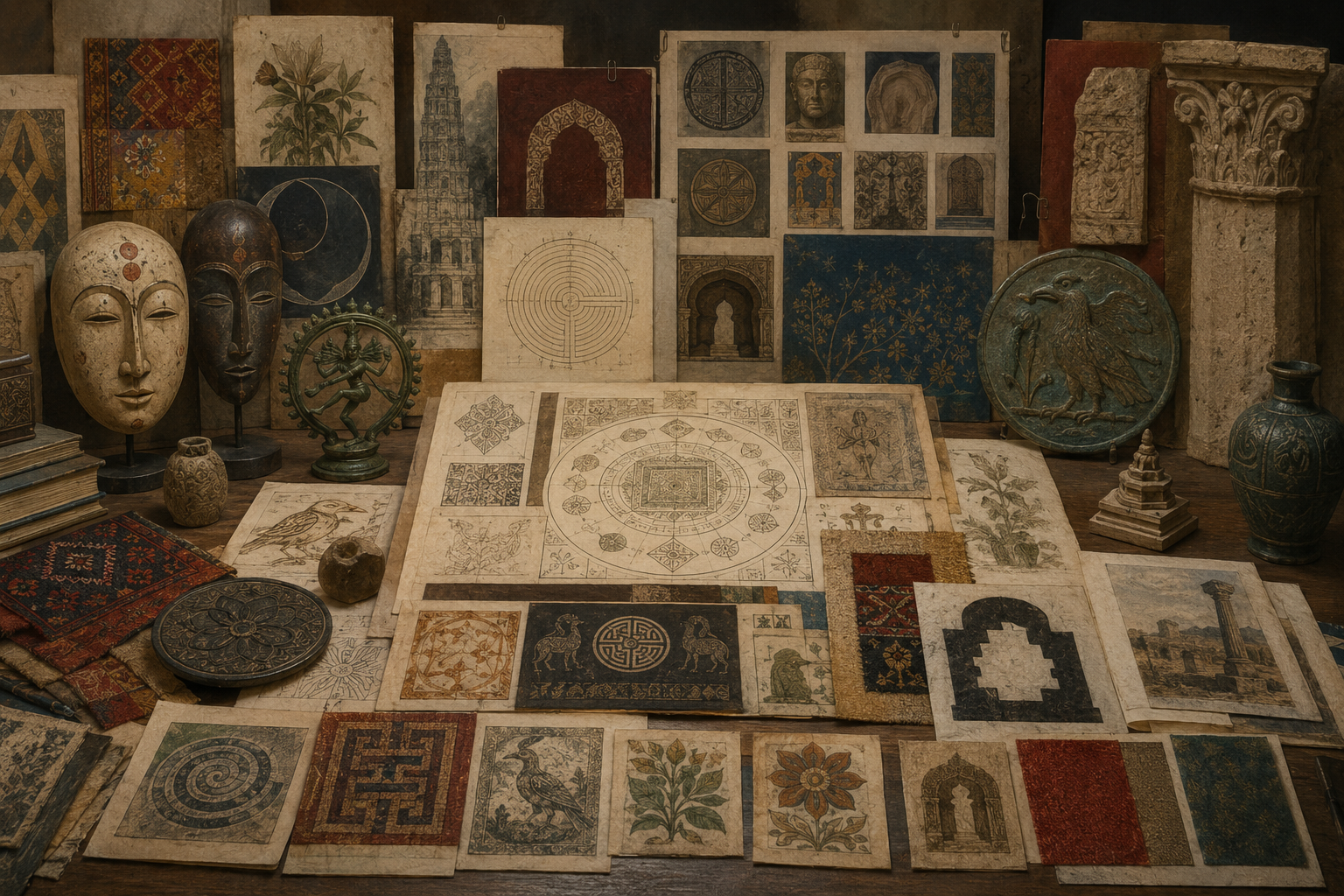
Symbolism, Style, and Cultural Meaning provides a cultural and interpretive layer within the Meaning category. It asks how images, objects, colors, gestures, motifs, icons, styles, genres, monuments, ritual forms, and digital signs become meaningful within human worlds. Symbols can communicate what ordinary explanation cannot easily hold: sacredness, loss, authority, belonging, danger, transformation, aspiration, resistance, and collective memory.
This map treats symbolism as both powerful and unstable. A symbol can unify one community and wound another. A style can preserve cultural memory or become detached from its origins. A monument can honor, dominate, mourn, conceal, or provoke. A motif can travel across media, institutions, rituals, fashion, propaganda, art, architecture, and digital culture while changing its meaning along the way.
The articles in this map move from foundations of symbolic meaning into iconography, visual interpretation, archetypes, motifs, style, genre, cultural recognition, public symbols, symbolic power, digital symbolic life, cultural context, appropriation, ambiguity, and responsible interpretation. Together, they provide a framework for reading symbols without reducing them to simple definitions or treating culture as a fixed code.
GitHub Repository
This article map is supported by companion research scaffolding for symbolic inventories, iconographic studies, motif maps, cultural context notes, style comparison tables, public-symbol archives, interpretive matrices, visual-source metadata, and reproducible research workflows.
Complete Code Repository
The Symbolism, Style, and Cultural Meaning companion repository includes article-level folders, symbolic interpretation notes, iconography datasets, motif inventories, public-symbol examples, cultural context matrices, style comparison tables, documentation, Python workflows, R summaries, SQL catalogs, notebooks, calculators, Canvas cards, and reproducible studio-lab scaffolding for responsible symbolic interpretation.
Symbolism, Style, and Cultural Meaning as a Field of Inquiry
Symbolism, style, and cultural meaning belong together because human beings do not communicate only through literal statements. They communicate through images, objects, rituals, gestures, clothing, buildings, emblems, patterns, icons, colors, monuments, media forms, and inherited styles. These forms often carry meanings that are emotional, historical, religious, political, aesthetic, social, or institutional.
A symbol condenses meaning. It can gather a story, a memory, a value, a wound, a hope, or a claim into a visible form. A style organizes recognition. It tells viewers that something belongs to a tradition, period, community, genre, institution, movement, ritual setting, or cultural world. Cultural meaning emerges when symbols and styles are interpreted within shared histories, practices, conflicts, and expectations.
This field asks how symbols become legible, how styles become recognizable, how motifs travel, how public signs gain authority, how images become contested, how cultural forms change through time, and how interpretation can remain careful when meanings are layered, unstable, or disputed.
The field also asks why symbols matter so deeply. People defend, destroy, reinterpret, preserve, display, wear, remix, and fight over symbols because symbols are not only signs. They participate in identity, belonging, power, grief, memory, resistance, sacredness, and public life.
Why Symbolism and Style Belong Under Meaning
Symbolism and style belong under Meaning because they show how human understanding exceeds ordinary explanation. Many of the most important human experiences are carried by forms that cannot be reduced to simple statements. A flag, mask, icon, garment, monument, ritual object, family photograph, public memorial, sacred image, architectural style, or digital meme can carry meanings that are historical, emotional, political, and communal at once.
Style also belongs under Meaning because style gives form to recognition. A style tells us how to read something before we have interpreted its details. It may signal elegance, authority, rebellion, sacredness, tradition, modernity, mourning, celebration, intimacy, hierarchy, or institutional power. Style is not superficial when it shapes how meaning is encountered.
Symbols and styles also reveal that meaning is cultural. The same form may carry different meanings across communities or historical periods. A color, animal, gesture, pattern, emblem, or architectural form may be sacred in one context, decorative in another, political in a third, and offensive in a fourth. Interpretation must therefore attend to context.
This article map belongs in the Meaning category because it studies how cultural worlds become visible. It connects aesthetics, anthropology, art history, religion, media, politics, memory, design, and public interpretation.
What This Article Map Studies
This article map studies symbols, signs, images, iconography, allegory, emblems, sacred art, mythic imagery, color symbolism, gesture, objects, relics, material symbols, archetypes, motifs, dream images, masks, monsters, journeys, labyrinths, style, genre, ornament, fashion, dress, visual traditions, flags, monuments, public symbols, counter-symbols, digital icons, memes, public memory, cultural context, appropriation, ambiguity, and symbolic misreading.
At the interpretive level, it studies how symbols are read, how meanings are layered, how signs operate, and how images become culturally intelligible. At the aesthetic level, it studies style, genre, ornament, pattern, visual tradition, sacred style, secular style, and the recognition of historical forms. At the cultural level, it studies ritual, memory, authority, identity, belonging, resistance, and public conflict.
At the ethical level, it studies context, appropriation, sacred forms, symbolic harm, ambiguity, public controversy, propaganda, visual persuasion, and the responsibilities of interpretation. Symbols are powerful partly because they can simplify, intensify, mobilize, or distort. Responsible symbolic interpretation must therefore resist both naive literalism and careless over-reading.
The goal is not to create a fixed dictionary of symbols. Symbols do not have universal meanings detached from context. The goal is to build a disciplined way of asking what a symbol does, where it comes from, how it is used, who recognizes it, who contests it, and how its meanings change across time.
Major Themes in Symbolism, Style, and Cultural Meaning
One major theme is symbolic condensation. Symbols can compress complex meanings into compact forms. A sign, image, object, or motif may carry memory, authority, grief, hope, danger, sacredness, or identity without explaining itself verbally.
A second theme is context. Symbols cannot be responsibly interpreted apart from the cultural, historical, ritual, institutional, or political settings in which they operate. A symbol’s meaning depends on use, audience, tradition, conflict, and time.
A third theme is style. Style is a system of recognition. It organizes how forms belong to traditions, genres, communities, institutions, periods, movements, and practices. Style carries meaning through material choices, composition, ornament, color, rhythm, proportion, and convention.
A fourth theme is power. Symbols can authorize, exclude, unify, persuade, memorialize, legitimate, resist, and contest. Public symbols often become sites where communities struggle over memory, identity, justice, and authority.
A fifth theme is ambiguity. Symbols often hold multiple meanings at once. They may invite interpretation rather than deliver a single message. Ambiguity can deepen meaning, but it can also create misunderstanding, appropriation, manipulation, or conflict.
A sixth theme is responsibility. Symbolic interpretation requires humility because symbols may be sacred, wounded, contested, inherited, or culturally specific. Responsible interpretation asks who has authority to interpret, display, borrow, transform, or reuse symbolic forms.
Symbolism, Style, and Cultural Meaning Article Map
The map below organizes the Symbolism, Style, and Cultural Meaning series into six parts, moving from foundations of symbolic meaning into iconography, archetypes, style, genre, public symbols, cultural power, digital symbolic life, and responsible interpretation.
Part I — Foundations of Symbolic Meaning
- What Is a Symbol? (planned) — A foundational article on symbols as signs, images, objects, gestures, motifs, or forms that carry layered cultural meaning.
- Symbolism and Human Interpretation (planned) — An article on why human beings interpret symbolic forms and how symbols shape memory, belief, value, and identity.
- Signs, Images, and Cultural Meaning (planned) — A study of signs, images, semiotic systems, visual communication, and the cultural conditions of meaning.
- Style as Cultural Communication (planned) — An article on style as a system of recognition, belonging, historical memory, institutional identity, and aesthetic communication.
- Symbolic Forms and Shared Memory (planned) — A study of how symbols preserve, organize, transmit, and contest collective memory.
- How Symbols Become Powerful (planned) — An article on emotional charge, repetition, ritual use, authority, conflict, visibility, and public recognition.
Part II — Iconography and Visual Interpretation
- Iconography and the Reading of Images (planned) — An article on interpreting images through motifs, attributes, traditions, contexts, and visual conventions.
- Allegory, Emblem, and Visual Code (planned) — A study of symbolic systems where images, figures, objects, and compositions carry layered meanings.
- Sacred Art and Symbolic Presence (planned) — An article on icons, ritual images, sacred forms, devotional objects, and the presence of meaning in religious art.
- Mythic Imagery and Cultural Memory (planned) — A study of mythic figures, narrative images, archetypal scenes, ritual memory, and cultural transmission.
- Color, Gesture, and Visual Symbolism (planned) — An article on how color, posture, gesture, orientation, scale, and placement participate in symbolic meaning.
- Objects, Relics, and Material Symbols (planned) — A focused article on how objects become meaningful through use, memory, ritual, inheritance, display, and preservation.
Part III — Archetypes, Motifs, and Depth Symbolism
- Archetypes and Symbolic Form (planned) — An article on recurring symbolic patterns, cultural memory, depth psychology, myth, image, and interpretation.
- The Hero, the Shadow, and the Threshold (planned) — A study of transformational symbolic figures and boundary moments in myth, art, ritual, and narrative culture.
- Animals, Plants, and Natural Symbols (planned) — An article on how natural forms become symbolic carriers of life, death, fertility, danger, wisdom, renewal, and belonging.
- Dream Images and Artistic Symbolism (planned) — A focused article on dreamlike images, surreal forms, unconscious association, artistic imagination, and symbolic ambiguity.
- Monsters, Masks, and Boundary Figures (planned) — An article on liminal beings, disguise, threat, transformation, otherness, ritual role, and cultural boundary-making.
- Journeys, Labyrinths, and Transformational Symbols (planned) — A study of path, descent, trial, maze, return, initiation, and transformation as symbolic forms.
Part IV — Style, Genre, and Cultural Recognition
- What Is Style? (planned) — A foundational article on style as recognizable form, cultural signal, historical pattern, and interpretive structure.
- Genre and Expectation (planned) — An article on how genre organizes recognition, anticipation, interpretation, convention, variation, and audience response.
- Ornament, Pattern, and Cultural Identity (planned) — A study of decorative systems, surface, craft, repetition, identity, ritual, and cultural memory.
- Fashion, Dress, and Public Meaning (planned) — An article on clothing, style, status, gender presentation, identity, belonging, authority, and public self-expression.
- Sacred Style, Secular Style, and Cultural Boundary (planned) — A study of how forms mark sacredness, everyday life, institutional authority, cultural distinction, and boundary maintenance.
- Visual Traditions and Historical Recognition (planned) — An article on how visual traditions become legible through repetition, education, archives, institutions, and cultural memory.
Part V — Symbolism, Power, and Public Life
- Flags, Monuments, and Public Symbols (planned) — An article on civic signs, public memory, national identity, memorialization, controversy, and public authority.
- Symbolic Power and Cultural Authority (planned) — A study of how symbols legitimate institutions, organize belonging, express authority, and define public meaning.
- Counter-Symbols and Cultural Resistance (planned) — An article on how communities reinterpret, subvert, reclaim, remix, or replace dominant symbolic forms.
- Propaganda, Myth, and Visual Persuasion (planned) — A critical article on symbolic simplification, emotional intensity, public persuasion, mythic framing, and institutional distortion.
- Memes, Icons, and Digital Symbolic Life (planned) — A study of how digital symbols circulate, mutate, condense meaning, build communities, and reshape public interpretation.
- Public Memory and the Struggle Over Symbols (planned) — An article on contested monuments, archives, ceremonies, naming, public space, collective memory, and cultural conflict.
Part VI — Interpretation and Responsibility
- Cultural Context and Symbolic Interpretation (planned) — A foundational article on why symbols must be interpreted through historical, cultural, ritual, institutional, and community contexts.
- Appropriation, Sacred Forms, and Symbolic Harm (planned) — A study of borrowing, misuse, commodification, sacred forms, cultural authority, and the ethics of symbolic exchange.
- Ambiguity and Multiple Meanings in Symbols (planned) — An article on layered meanings, contested readings, uncertainty, symbolic richness, and the limits of simple interpretation.
- Symbolic Misreading and Cultural Reduction (planned) — A critical article on overgeneralization, decontextualization, exoticism, projection, and interpretive harm.
- Research Tools for Symbolic Interpretation (planned) — A practical article on archives, image databases, source notes, motif inventories, comparison tables, context matrices, and reproducible workflows.
- Responsible Symbolic Interpretation: A Capstone (planned) — A capstone article on humility, evidence, context, cultural authority, ambiguity, public meaning, and interpretive care.
Python Workflow: Symbolic Inventories, Motif Maps, and Context Matrices
A useful Python workflow for this article map is a symbolic inventory and motif-mapping workflow. The workflow can begin with structured records for symbols, motifs, objects, colors, gestures, styles, cultural contexts, source notes, interpretive cautions, and related article sections. Python can then generate CSV tables, JSON records, Markdown summaries, motif indexes, and lightweight visual maps for research planning.
This workflow belongs naturally with articles on iconography, sacred art, mythic imagery, natural symbols, masks, journeys, public symbols, memes, and symbolic misreading. For example, a Python script can help organize a set of motifs by context, medium, source tradition, possible meanings, cautions, and related works. It can also help distinguish between a symbol’s general association and its specific function in a particular artwork, ritual, institution, or public setting.
The workflow should not imply that symbols can be decoded mechanically. Its purpose is documentation and comparison. Python can support careful research by making assumptions visible, preserving context notes, and preventing symbolic interpretation from becoming a loose list of disconnected claims.
R Workflow: Symbolic Themes, Style Comparisons, and Cultural Context
A useful R workflow for this article map is a symbolic-theme and style-comparison workflow. A structured teaching dataset can include article titles, symbol categories, media types, cultural contexts, style traditions, interpretive risks, ethical questions, and research sources. R can summarize recurring themes, compare symbolic domains, generate tables, and support article planning.
This workflow belongs naturally with articles on style, genre, ornament, fashion, public symbols, cultural authority, appropriation, ambiguity, and responsible interpretation. For example, R can help summarize which articles focus on sacred forms, which focus on public memory, which focus on digital culture, which focus on style, and which focus on ethical caution.
As with the Python workflow, the goal is not to reduce symbols to data. The goal is to make symbolic research more transparent, organized, and responsible. Interpretation still requires context, source judgment, historical knowledge, cultural humility, and attention to ambiguity.
Ethics, Context, and Responsible Symbolic Interpretation
Responsible symbolic interpretation begins with context. A symbol does not mean the same thing everywhere. It may be sacred in one tradition, political in another, decorative in another, commercialized in another, and contested in another. Interpretation must ask where a symbol appears, who uses it, who recognizes it, who has authority over it, and how its meaning has changed over time.
This is especially important when symbols belong to sacred traditions, Indigenous communities, marginalized groups, ritual practices, public memory, or histories of trauma. A symbol may be visually available but culturally restricted. It may be widely circulated but still ethically sensitive. It may be aesthetically attractive but harmful when detached from its meaning.
Symbolic interpretation also requires caution about reduction. It is tempting to say that a color, animal, object, mask, gesture, or shape “means” one thing. But symbols often work by layering meanings, holding tensions, and gathering histories. They may be intentionally ambiguous. They may invite multiple readings. They may change through ritual use, political conflict, artistic transformation, or digital circulation.
The ethical goal is not to avoid symbolic interpretation. The goal is to interpret with care: honoring context, avoiding false universals, naming uncertainty, respecting cultural authority, and recognizing that symbols participate in real social worlds.
Symbolism, Style, and Cultural Meaning in a Wider Intellectual Context
Symbolism, Style, and Cultural Meaning belongs within a wider knowledge architecture because symbols and styles connect art, culture, psychology, religion, politics, media, design, anthropology, and public memory. It sits under Meaning because it studies how visible and material forms become culturally intelligible.
This map connects to aesthetics and the philosophy of art through iconography, style, interpretation, form, and artistic value. It connects to color theory and design through visual communication, public signs, branding, typography, style systems, and interface symbols. It connects to music and performance through ritual, genre, rhythm, embodied meaning, and collective emotion. It connects to storytelling through mythic imagery, archetypes, motifs, narrative symbols, and cultural memory.
It also connects to ethics and governance through public symbols, monuments, institutional authority, propaganda, cultural appropriation, and contested memory. Symbols do not merely represent public life. They can shape it.
By giving symbolism, style, and cultural meaning their own article map, the site treats symbolic interpretation as a serious discipline. Symbols are not ornaments added to culture. They are among the ways culture becomes visible, memorable, contested, and meaningful.
Related Reading
- Meaning
- Beauty, Aesthetics, and Meaning
- Aesthetics and the Philosophy of Art
- Color Theory, Typography, and Design
- Music Theory, Form, and Meaning
- Mathematics, Art, Music, and Pattern
- Creative Form, Composition, and Interpretation
- Culture, Ritual, and Symbolic Life
Further Reading
- Barthes, R. (1972). Mythologies. Translated by A. Lavers. New York: Hill and Wang.
- Cassirer, E. (1944). An Essay on Man: An Introduction to a Philosophy of Human Culture. New Haven: Yale University Press.
- Douglas, M. (1966). Purity and Danger: An Analysis of Concepts of Pollution and Taboo. London: Routledge.
- Eco, U. (1976). A Theory of Semiotics. Bloomington: Indiana University Press.
- Freedberg, D. (1989). The Power of Images: Studies in the History and Theory of Response. Chicago: University of Chicago Press.
- Geertz, C. (1973). The Interpretation of Cultures. New York: Basic Books.
- Hall, S. (ed.) (1997). Representation: Cultural Representations and Signifying Practices. London: Sage/Open University.
- Jung, C.G. (1964). Man and His Symbols. Garden City, NY: Doubleday.
- Langer, S.K. (1953). Feeling and Form: A Theory of Art. New York: Charles Scribner’s Sons.
- Mitchell, W.J.T. (1986). Iconology: Image, Text, Ideology. Chicago: University of Chicago Press.
- Panofsky, E. (1939). Studies in Iconology: Humanistic Themes in the Art of the Renaissance. New York: Oxford University Press.
- Turner, V. (1967). The Forest of Symbols: Aspects of Ndembu Ritual. Ithaca: Cornell University Press.
References
- Barthes, R. (1972). Mythologies. Translated by A. Lavers. New York: Hill and Wang.
- Cassirer, E. (1944). An Essay on Man: An Introduction to a Philosophy of Human Culture. New Haven: Yale University Press.
- Douglas, M. (1966). Purity and Danger: An Analysis of Concepts of Pollution and Taboo. London: Routledge.
- Eco, U. (1976). A Theory of Semiotics. Bloomington: Indiana University Press.
- Freedberg, D. (1989). The Power of Images: Studies in the History and Theory of Response. Chicago: University of Chicago Press.
- Geertz, C. (1973). The Interpretation of Cultures. New York: Basic Books.
- Gombrich, E.H. (1972). Symbolic Images: Studies in the Art of the Renaissance. London: Phaidon.
- Hall, S. (ed.) (1997). Representation: Cultural Representations and Signifying Practices. London: Sage/Open University.
- Jung, C.G. (1964). Man and His Symbols. Garden City, NY: Doubleday.
- Langer, S.K. (1953). Feeling and Form: A Theory of Art. New York: Charles Scribner’s Sons.
- Mitchell, W.J.T. (1986). Iconology: Image, Text, Ideology. Chicago: University of Chicago Press.
- Panofsky, E. (1939). Studies in Iconology: Humanistic Themes in the Art of the Renaissance. New York: Oxford University Press.
- Peirce, C.S. (1998). The Essential Peirce: Selected Philosophical Writings, Volume 2, 1893–1913. Edited by the Peirce Edition Project. Bloomington: Indiana University Press.
- Ricoeur, P. (1976). Interpretation Theory: Discourse and the Surplus of Meaning. Fort Worth: Texas Christian University Press.
- Saussure, F. de. (2011). Course in General Linguistics. Translated by W. Baskin. Edited by P. Meisel and H. Saussy. New York: Columbia University Press.
- Turner, V. (1967). The Forest of Symbols: Aspects of Ndembu Ritual. Ithaca: Cornell University Press.
- Warburg, A. (1999). The Renewal of Pagan Antiquity: Contributions to the Cultural History of the European Renaissance. Los Angeles: Getty Research Institute.