
Last Updated June 18, 2026
Aesthetics and the Philosophy of Art explores beauty, taste, judgment, artistic value, interpretation, and the nature of art itself. This article map examines how human beings experience works of art, why certain forms move us, and how aesthetic judgment relates to perception, emotion, reason, culture, and meaning.
Aesthetics asks not only whether something is beautiful, but how beauty becomes intelligible. It studies form, expression, imitation, representation, the sublime, artistic experience, interpretation, medium, style, and the question of what makes something a work of art. It also asks how art helps human beings see, feel, question, remember, imagine, and understand.
This article map sits within the broader Meaning category and provides a philosophical foundation for the study of beauty, art, design, music, symbolism, pattern, and creative form. Its focus is conceptual and interpretive: the arguments, traditions, distinctions, and problems that shape how art and beauty are understood.
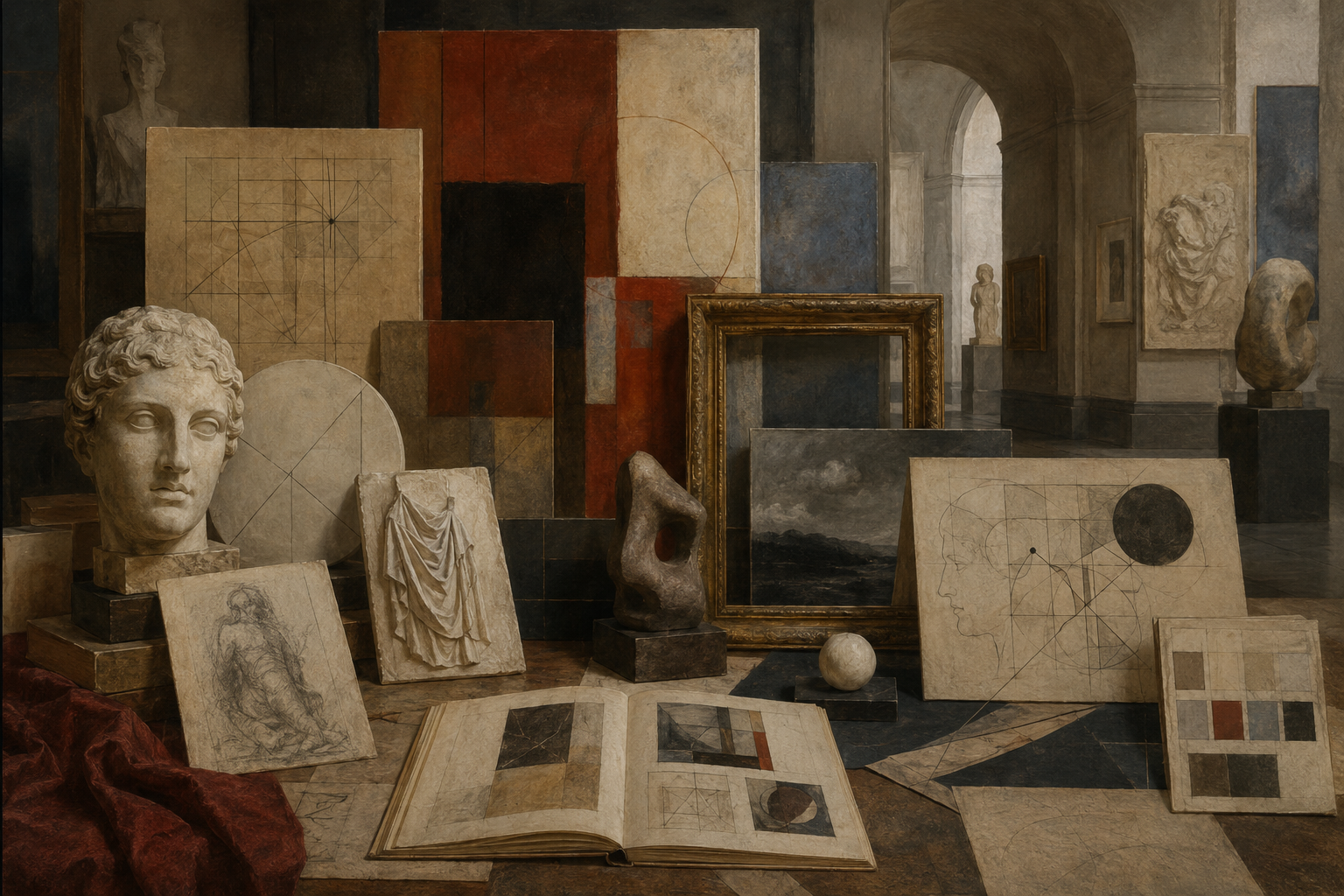
Aesthetics and the Philosophy of Art provides the conceptual foundation for the Meaning category’s work on beauty, art, design, music, symbolism, pattern, and creative form. It asks why art matters, how beauty is judged, how form carries meaning, how works invite interpretation, and why aesthetic experience is central to human understanding.
This map approaches art as more than decoration, taste, entertainment, or cultural prestige. Art can disclose forms of attention, make emotions shareable, stage conflicts of value, preserve memory, reveal hidden structures, unsettle habits of perception, and give form to what ordinary language cannot easily express. Aesthetic experience therefore belongs within a serious research library because it shapes how people interpret worlds of meaning.
The articles in this map move from foundational questions into classical theories, modern aesthetic judgment, theories of art, beauty and the sublime, expression and emotion, interpretation and meaning, medium and form, art and culture, ethics, and research workflows. Together, they provide a philosophical framework for understanding how art becomes meaningful and how aesthetic judgment participates in human life.
GitHub Repository
This article map is supported by companion research scaffolding for organizing aesthetic concepts, philosophical sources, interpretive matrices, theory comparisons, artwork metadata, teaching datasets, and reproducible research workflows.
Complete Code Repository
The Aesthetics and the Philosophy of Art companion repository includes article-level folders, research notes, concept maps, philosopher and theory comparison tables, interpretive matrices, visual-source metadata, synthetic teaching datasets, documentation, Python workflows, R summaries, SQL catalogs, notebooks, calculators, Canvas cards, and reproducible research scaffolding where appropriate.
Aesthetics and the Philosophy of Art as a Field of Inquiry
Aesthetics is the philosophical study of beauty, taste, art, perception, form, aesthetic experience, and judgment. It asks why certain forms appear beautiful, moving, powerful, disturbing, elegant, sublime, expressive, or meaningful. It also asks how aesthetic judgments can feel deeply personal while also being shaped by shared practices, cultural traditions, education, historical context, and public standards of interpretation.
The philosophy of art overlaps with aesthetics but focuses more directly on art itself: what art is, how works represent or express, how form and medium shape meaning, how audiences interpret works, how art relates to truth, emotion, morality, politics, institutions, and cultural memory, and why some objects, performances, sounds, texts, images, or actions are received as art while others are not.
This field is important because human beings do not encounter the world only as data, utility, or problem. They encounter it through appearance, rhythm, symbol, atmosphere, image, sound, gesture, material, composition, and style. Art intensifies this condition. It makes form available for reflection. It gives perception a structure, emotion a shape, memory an image, thought a surface, and meaning a medium.
Aesthetics and the philosophy of art therefore belong at the center of any serious inquiry into meaning. They show how human understanding is not only analytical or practical, but also perceptual, imaginative, affective, symbolic, and interpretive.
Why Aesthetics Belongs Under Meaning
Aesthetics belongs under Meaning because beauty and art are not simply matters of preference. They are ways human beings interpret the world. A painting, song, poem, building, sculpture, film, garden, ritual object, or designed space may reveal how a culture organizes attention, memory, value, power, grief, aspiration, sacredness, or belonging.
Meaning also helps clarify why aesthetics cannot be reduced to decoration. Aesthetic form shapes how something is understood. The same idea may feel solemn, playful, trustworthy, sacred, violent, intimate, institutional, or fragile depending on its form. Color, rhythm, proportion, texture, scale, sound, arrangement, material, and genre all participate in interpretation.
The philosophy of art gives the Meaning category a rigorous conceptual foundation by asking precise questions: What is beauty? What is art? Are aesthetic judgments subjective, objective, cultural, or something in between? Can art express emotion? Can art teach? Can art be immoral? Does interpretation belong to the artist, the work, the audience, the tradition, or the historical moment?
By placing aesthetics under Meaning, the site creates a bridge between thinking and problem solving. Thinking helps explain perception and judgment. Meaning explains interpretation and value. Problem solving explains design, action, governance, and intervention. Aesthetics sits in the middle because form is one of the ways interpretation becomes visible.
What This Article Map Studies
This article map studies the philosophical foundations of beauty, art, taste, judgment, form, expression, representation, interpretation, and aesthetic experience. It moves across classical, modern, and contemporary questions while keeping the focus on how art and beauty participate in human understanding.
At the foundational level, it studies the basic questions of aesthetics: what beauty is, how taste works, whether aesthetic judgment can be justified, what makes experience aesthetic, and why art matters. At the historical level, it examines classical ideas of imitation, form, proportion, catharsis, craft, tragedy, and beauty; modern debates over taste, judgment, genius, disinterestedness, the sublime, and aesthetic autonomy; and contemporary debates over institutions, interpretation, culture, identity, power, and public meaning.
At the level of art theory, the map studies imitation, representation, expression, formalism, institutional theories, artworld theories, aesthetic experience, medium, genre, and the status of conceptual and contemporary art. At the interpretive level, it studies meaning, ambiguity, intention, reception, context, symbolism, hermeneutics, and the life of works across time.
At the ethical and cultural level, it studies questions about beauty and exclusion, art and morality, cultural appropriation, representation, propaganda, public art, memorials, museums, and aesthetic responsibility. The aim is to give readers a philosophical framework for approaching art with seriousness, clarity, humility, and interpretive depth.
Major Themes in Aesthetics and the Philosophy of Art
One major theme is beauty. Beauty has been understood as harmony, proportion, radiance, order, pleasure, fittingness, intensity, grace, formal unity, perceptual satisfaction, or a special kind of value. Different traditions disagree about whether beauty belongs to objects, subjects, relationships, cultural practices, divine order, natural forms, or human judgment.
A second theme is taste and judgment. Aesthetic judgment often feels personal, but it also invites agreement, argument, refinement, education, and shared standards. People argue about art because aesthetic experience is not merely private sensation. It is connected to attention, discrimination, comparison, cultural formation, and the desire to make value communicable.
A third theme is art. The philosophy of art asks what art is and why it matters. Is art imitation, expression, form, experience, symbol, institution, practice, worldmaking, critique, or something else? The difficulty of defining art is not a weakness of the field. It reflects the complexity of art as a changing human practice.
A fourth theme is expression. Art often seems to express emotion, but the nature of that expression is difficult to explain. A piece of music can sound mournful without being sad in the way a person is sad. A painting can feel violent, serene, joyful, or sacred without literally possessing emotion. Aesthetic expression therefore raises deep questions about form, perception, imagination, embodiment, and interpretation.
A fifth theme is interpretation. Works of art do not carry meaning in the same way instructions do. They may invite multiple readings, depend on context, resist paraphrase, and change across time. Interpretation involves the artist, the work, the audience, the tradition, the medium, the historical context, and the language used to describe aesthetic experience.
A sixth theme is ethics. Art can illuminate moral life, challenge perception, dignify experience, preserve memory, or expose injustice. It can also manipulate, stereotype, aestheticize violence, appropriate sacred forms, or reinforce exclusion. Aesthetics and ethics are not identical, but they cannot be fully separated.
Aesthetics and the Philosophy of Art Article Map
The map below organizes the Aesthetics and the Philosophy of Art series into conceptual domains, moving from foundations and first questions into classical aesthetics, modern judgment, theories of art, beauty and the sublime, expression, interpretation, medium, institutions, ethics, and research practice.
Part I — Foundations of Aesthetics
- What Is Aesthetics? (planned) — A foundational article introducing aesthetics as the philosophical study of beauty, taste, art, perception, form, judgment, and aesthetic experience.
- What Is Beauty? (planned) — An article on competing views of beauty as harmony, pleasure, value, form, perception, or meaning.
- What Is Art? (planned) — A philosophical introduction to the problem of defining art across objects, performances, institutions, practices, and experiences.
- What Is Aesthetic Experience? (planned) — A study of how aesthetic attention differs from ordinary perception, practical use, or simple preference.
- Taste, Judgment, and Aesthetic Disagreement (planned) — An article on why people argue about beauty, how taste develops, and whether aesthetic judgments can be supported by reasons.
- Artistic Value and the Problem of Standards (planned) — A study of whether artistic value is subjective, objective, cultural, historical, formal, moral, institutional, or relational.
Part II — Classical and Historical Foundations
- Plato on Art, Imitation, and Truth (planned) — An article on mimesis, illusion, education, poetry, moral danger, and the philosophical suspicion of art.
- Aristotle on Tragedy, Catharsis, and Form (planned) — A study of tragedy, plot, recognition, reversal, pity, fear, catharsis, and the ordering power of artistic form.
- Art, Craft, and Techne (planned) — An article on making, skill, craft, knowledge, and the relationship between artistic practice and technique.
- Beauty, Proportion, and Classical Order (planned) — A focused article on harmony, proportion, symmetry, measure, and the classical search for ordered beauty.
- Tragedy, Emotion, and Moral Understanding (planned) — An article on how dramatic art organizes suffering, conflict, recognition, and ethical insight.
- Representation and the Image of Reality (planned) — A study of depiction, resemblance, imitation, realism, illusion, abstraction, and the philosophical problem of representation.
Part III — Modern Aesthetic Judgment
- Hume on Taste and Critical Judgment (planned) — An article on taste, refinement, comparison, prejudice, delicacy, and the search for standards in aesthetic judgment.
- Kant on Beauty and Reflective Judgment (planned) — A focused article on disinterested pleasure, purposiveness without purpose, universality, imagination, understanding, and judgment.
- The Sublime from Burke to Kant (planned) — A study of awe, terror, vastness, power, distance, imagination, and aesthetic experiences that exceed ordinary beauty.
- Genius, Originality, and Artistic Creation (planned) — An article on artistic genius, rule-making, inspiration, tradition, originality, and the limits of teachable technique.
- Aesthetic Autonomy and the Value of Art (planned) — A study of the idea that art has its own value, logic, experience, and standards beyond utility or morality alone.
- Romanticism, Expression, and Inner Life (planned) — An article on imagination, individuality, nature, emotion, creativity, inwardness, and the Romantic transformation of aesthetics.
Part IV — Major Theories of Art
- Art as Imitation (planned) — An article on mimetic theories of art, representation, likeness, realism, illusion, and the artistic imitation of action or world.
- Art as Expression (planned) — A study of art as the expression, clarification, embodiment, or communication of emotion and inner life.
- Art as Form (planned) — An article on formalism, significant form, composition, structure, visual relations, musical relations, and the autonomy of form.
- Art as Experience (planned) — A study of art as lived encounter, perception, rhythm, environment, practice, and continuity with ordinary experience.
- Art as Symbolic Form (planned) — An article on symbols, notation, exemplification, metaphor, representation, and art as a system of meaning.
- Art as Institution and Practice (planned) — A focused article on artworlds, museums, critics, conventions, recognition, authority, and the institutional conditions of art.
Part V — Interpretation, Medium, and Meaning
- Artist Intention and the Meaning of Works (planned) — An article on intentionalism, anti-intentionalism, biography, statements, context, and the limits of authorial control.
- Audience, Reception, and the Afterlife of Art (planned) — A study of how works change through audiences, institutions, historical periods, reinterpretation, canonization, and controversy.
- Ambiguity and Multiple Meanings in Art (planned) — An article on why works may invite more than one interpretation without becoming meaningless or arbitrary.
- Medium, Material, and Artistic Form (planned) — An article on how painting, sculpture, music, film, literature, architecture, performance, and digital media shape what can be expressed.
- Style, Genre, and Artistic Recognition (planned) — An article on how styles and genres create expectations, organize traditions, and help audiences recognize artistic worlds.
- Hermeneutics and Art Interpretation (planned) — A study of context, tradition, historical distance, dialogue, and the philosophical problem of understanding works across time.
Part VI — Ethics, Culture, and Contemporary Art
- Art and Morality (planned) — A foundational article on whether moral flaws can affect artistic value and whether art can cultivate or corrupt moral perception.
- Beauty, Harm, and Representation (planned) — A critical article on stereotype, visual harm, idealization, exclusion, cultural power, and the ethics of depiction.
- Museums, Canons, and Cultural Authority (planned) — An article on institutions, collections, display, preservation, taste-making, authority, exclusion, and public memory.
- Censorship, Offense, and Artistic Freedom (planned) — An article on contested works, public standards, institutional responsibility, offense, harm, freedom, and cultural conflict.
- Modern, Contemporary, and Conceptual Art (planned) — A study of abstraction, readymades, conceptual art, performance, installation, dematerialization, and challenges to traditional definitions of art.
- Responsible Interpretation Across Cultures (planned) — A capstone article on context, humility, appropriation, sacred forms, cultural authority, and interpretive care.
Python Workflow: Aesthetic Concepts, Interpretive Matrices, and Source Maps
A useful Python workflow for this article map is an aesthetic concepts and interpretive matrix workflow. The workflow can begin with a structured set of concepts such as beauty, taste, judgment, form, imitation, expression, representation, aesthetic experience, the sublime, intention, interpretation, medium, style, and artistic value. Python can be used to organize these concepts, connect them to philosophers, artworks, article drafts, source notes, and interpretive questions, then export tables, diagrams, and Markdown summaries.
This workflow belongs naturally with articles on theories of art, aesthetic judgment, interpretation, and art-historical comparison. It can help readers see how different theories answer similar questions. For example, an imitation theory, expression theory, formalist theory, symbolic theory, and institutional theory may all answer the question “What makes this art?” in different ways. A structured comparison can make those differences easier to teach and review.
The workflow should not imply that aesthetic interpretation can be automated. Its purpose is to support conceptual clarity. Python can help organize sources, concepts, examples, and interpretive claims, but philosophical judgment still requires reading, context, argument, and aesthetic attention.
R Workflow: Aesthetic Themes, Comparison Tables, and Reading Notes
A useful R workflow for this article map is a comparison and theme-summary workflow. The workflow can begin with a synthetic teaching dataset containing article titles, philosophers, key concepts, art forms, interpretive questions, aesthetic values, and reading notes. R can then be used to summarize recurring themes, produce comparison tables, visualize conceptual clusters, and generate reproducible outputs for teaching or article drafting.
This workflow belongs naturally with articles on taste, judgment, theories of art, beauty, the sublime, art and morality, and cultural interpretation. For example, R can summarize which articles deal primarily with beauty, which deal with interpretation, which deal with medium, and which deal with ethics. It can also help organize reading lists, source categories, and concept relationships across a large article map.
As with the Python workflow, the goal is not to turn art into numbers. The goal is to make research organization more transparent. Aesthetic judgment remains interpretive, historical, philosophical, and experiential. R simply helps maintain clearer tables, reproducible summaries, and visible relationships among sources and concepts.
Ethics, Interpretation, and Aesthetic Responsibility
The philosophy of art cannot avoid ethical questions. Art can deepen perception, dignify experience, preserve memory, cultivate attention, and reveal forms of suffering or beauty that might otherwise remain unseen. But art can also aestheticize violence, naturalize hierarchy, stereotype people, appropriate sacred forms, manipulate emotion, or turn suffering into spectacle.
Aesthetic responsibility begins with interpretation. To interpret a work responsibly is to attend to form, context, medium, history, cultural setting, audience, and power. It means resisting the temptation to treat works as mere examples for theory, mere expressions of personal feeling, or isolated objects detached from the communities, institutions, and histories that shape them.
This does not mean art should be reduced to moral instruction. Aesthetic value and ethical value are not identical. A serious philosophy of art should preserve the complexity of aesthetic experience while also recognizing that beauty, form, and representation have consequences. The challenge is to hold artistic freedom, interpretive rigor, cultural care, and moral seriousness together.
Aesthetics and the Philosophy of Art in a Wider Intellectual Context
Aesthetics and the Philosophy of Art belongs within a wider knowledge architecture because beauty and art connect perception, meaning, culture, and action. This map sits under Meaning because it studies how aesthetic forms become intelligible and valuable. It also connects backward to Thinking, where perception, judgment, imagination, and attention are studied, and forward to Problem Solving, where design, communication, public space, institutional meaning, and ethical action become practical concerns.
The map also connects to philosophy, psychology, cultural anthropology, design, music theory, mathematics, symbolism, media studies, religious studies, and ethics. Art is never only one thing. It can be a perceptual object, a symbolic system, a cultural practice, an institution, an emotional form, a historical artifact, a spiritual medium, a political force, or a way of knowing.
By giving aesthetics a focused article map, the site treats beauty and art as serious forms of inquiry. Human beings do not only solve problems through tools and models. They also understand through images, sounds, gestures, rituals, spaces, styles, and compositions. Aesthetics gives those forms philosophical depth.
Related Reading
- Meaning
- Beauty, Aesthetics, and Meaning
- Color Theory, Typography, and Design
- Music Theory, Form, and Meaning
- Mathematics, Art, Music, and Pattern
- Symbolism, Style, and Cultural Meaning
- Creative Form, Composition, and Interpretation
- Culture, Ritual, and Symbolic Life
Further Reading
- Adajian, T. (2022). ‘The Definition of Art’, Stanford Encyclopedia of Philosophy. Available at: https://plato.stanford.edu/entries/art-definition/.
- Carroll, N. (1999). Philosophy of Art: A Contemporary Introduction. London: Routledge.
- Danto, A.C. (1981). The Transfiguration of the Commonplace: A Philosophy of Art. Cambridge, MA: Harvard University Press.
- Dewey, J. (1934). Art as Experience. New York: Minton, Balch & Company.
- Gombrich, E.H. (1960). Art and Illusion: A Study in the Psychology of Pictorial Representation. London: Phaidon.
- Guyer, P. (2014). ‘18th Century German Aesthetics’, Stanford Encyclopedia of Philosophy. Available at: https://plato.stanford.edu/entries/aesthetics-18th-german/.
- Kant, I. ([1790] 2000). Critique of the Power of Judgment. Translated by P. Guyer and E. Matthews. Cambridge: Cambridge University Press.
- Kivy, P. (2002). Introduction to a Philosophy of Music. Oxford: Clarendon Press.
- Langer, S.K. (1953). Feeling and Form: A Theory of Art. New York: Charles Scribner’s Sons.
- Lopes, D.M. (2018). Being for Beauty: Aesthetic Agency and Value. Oxford: Oxford University Press.
- Shelley, J. (2022). ‘The Concept of the Aesthetic’, Stanford Encyclopedia of Philosophy. Available at: https://plato.stanford.edu/entries/aesthetic-concept/.
- Zangwill, N. (2023). ‘Aesthetic Judgment’, Stanford Encyclopedia of Philosophy. Available at: https://plato.stanford.edu/entries/aesthetic-judgment/.
References
- Adajian, T. (2022). ‘The Definition of Art’, Stanford Encyclopedia of Philosophy. Available at: https://plato.stanford.edu/entries/art-definition/.
- Aristotle. (1996). Poetics. Translated by M. Heath. London: Penguin.
- Beardsley, M.C. (1958). Aesthetics: Problems in the Philosophy of Criticism. New York: Harcourt, Brace.
- Bell, C. (1914). Art. London: Chatto & Windus.
- Carroll, N. (1999). Philosophy of Art: A Contemporary Introduction. London: Routledge.
- Collingwood, R.G. (1938). The Principles of Art. Oxford: Clarendon Press.
- Danto, A.C. (1964). ‘The Artworld’, The Journal of Philosophy, 61(19), pp. 571–584.
- Danto, A.C. (1981). The Transfiguration of the Commonplace: A Philosophy of Art. Cambridge, MA: Harvard University Press.
- Dewey, J. (1934). Art as Experience. New York: Minton, Balch & Company.
- Dickie, G. (1974). Art and the Aesthetic: An Institutional Analysis. Ithaca: Cornell University Press.
- Gombrich, E.H. (1960). Art and Illusion: A Study in the Psychology of Pictorial Representation. London: Phaidon.
- Goodman, N. (1976). Languages of Art: An Approach to a Theory of Symbols, 2nd edn. Indianapolis: Hackett.
- Guyer, P. (2014). ‘18th Century German Aesthetics’, Stanford Encyclopedia of Philosophy. Available at: https://plato.stanford.edu/entries/aesthetics-18th-german/.
- Hume, D. ([1757] 1987). ‘Of the Standard of Taste’. In Essays, Moral, Political, and Literary. Indianapolis: Liberty Fund.
- Kant, I. ([1790] 2000). Critique of the Power of Judgment. Translated by P. Guyer and E. Matthews. Cambridge: Cambridge University Press.
- Kivy, P. (2002). Introduction to a Philosophy of Music. Oxford: Clarendon Press.
- Langer, S.K. (1953). Feeling and Form: A Theory of Art. New York: Charles Scribner’s Sons.
- Lopes, D.M. (2018). Being for Beauty: Aesthetic Agency and Value. Oxford: Oxford University Press.
- Plato. (1992). Republic. Translated by G.M.A. Grube and revised by C.D.C. Reeve. Indianapolis: Hackett.
- Shelley, J. (2022). ‘The Concept of the Aesthetic’, Stanford Encyclopedia of Philosophy. Available at: https://plato.stanford.edu/entries/aesthetic-concept/.
- Zangwill, N. (2023). ‘Aesthetic Judgment’, Stanford Encyclopedia of Philosophy. Available at: https://plato.stanford.edu/entries/aesthetic-judgment/.