
Last Updated June 15, 2026
Green’s theorem connects circulation and flux around a closed plane curve to local field behavior across the region it encloses. It gives systems modelers a bridge between boundary measurements, planar flow, rotation, source-sink structure, and regional accumulation.
In systems modeling, many important questions are planar before they become fully three-dimensional. Traffic circulates around districts. Water moves through mapped regions. Air or pollution crosses boundaries. Ecological movement occurs across landscape patches. Green’s theorem helps explain how what happens along a boundary relates to what is happening across the interior of a planar system.
This article introduces Green’s theorem for planar systems, including circulation form, flux form, orientation, region boundaries, divergence, curl, computational approximation, and responsible interpretation in systems modeling.
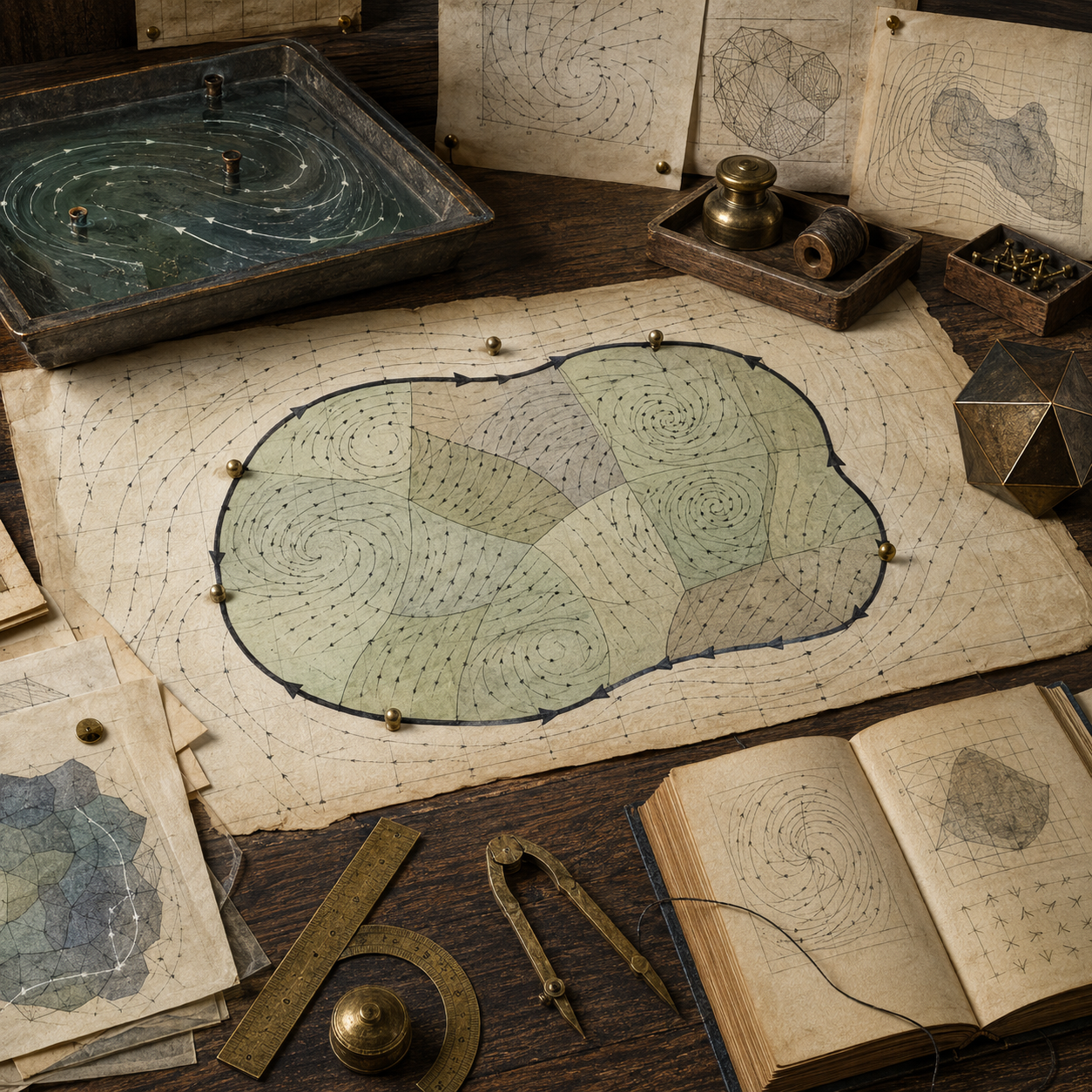
Green’s theorem is a bridge theorem. It links an integral around the boundary of a region to an integral over the region itself. In circulation form, it connects boundary circulation to interior curl. In flux form, it connects boundary flux to interior divergence. This makes it one of the most important tools for moving between local field diagnostics and regional systems interpretation.
Why Green’s Theorem Matters
Green’s theorem matters because it connects two ways of studying a planar system. A modeler can study behavior along the boundary of a region, or study local field behavior across the region’s interior. Green’s theorem tells when those perspectives are mathematically linked.
\oint_C P\,dx+Q\,dy
=
\iint_R
\left(
\frac{\partial Q}{\partial x}
–
\frac{\partial P}{\partial y}
\right)dA
\]
Interpretation: Boundary circulation around a positively oriented closed curve equals the accumulated curl-like rotation across the enclosed region.
This is the circulation form. It says that movement around a boundary can be explained by accumulated local rotation inside the boundary.
\oint_C P\,dy-Q\,dx
=
\iint_R
\left(
\frac{\partial P}{\partial x}
+
\frac{\partial Q}{\partial y}
\right)dA
\]
Interpretation: Boundary flux across a closed curve equals the accumulated divergence across the enclosed region.
This is the flux form. It says that net crossing through a boundary can be explained by accumulated local source-sink behavior inside the boundary.
| Form | Boundary quantity | Interior quantity | Systems meaning |
|---|---|---|---|
| Circulation form. | Movement around a closed curve. | Accumulated curl. | Loop movement, rotation, planar circulation. |
| Flux form. | Crossing through a closed boundary. | Accumulated divergence. | Net outflow, inflow, source-sink balance. |
| Both forms. | Boundary evidence. | Interior field structure. | Boundary-to-region reasoning. |
Green’s theorem prepares the way for Stokes’ theorem and the divergence theorem by showing how boundary integrals and regional integrals can express the same system behavior from different perspectives.
Planar Vector Fields
Green’s theorem applies to planar vector fields. A two-dimensional vector field is often written as:
\mathbf{F}(x,y)=\langle P(x,y),Q(x,y)\rangle
\]
Interpretation: Each point in the plane receives a vector with horizontal and vertical components.
The same vector field can support different interpretations depending on the modeled system. It might represent water velocity, air movement, traffic flow, material transport, force, migration tendency, or movement through a state-space diagram.
| Vector-field component | Formal meaning | Systems interpretation |
|---|---|---|
| \(P(x,y)\). | Horizontal component. | East-west flow, first-coordinate tendency, or x-direction force. |
| \(Q(x,y)\). | Vertical component. | North-south flow, second-coordinate tendency, or y-direction force. |
| \(\frac{\partial Q}{\partial x}-\frac{\partial P}{\partial y}\). | Planar curl-like scalar. | Local rotational tendency. |
| \(\frac{\partial P}{\partial x}+\frac{\partial Q}{\partial y}\). | Planar divergence. | Local source-sink or spreading behavior. |
The theorem is only as meaningful as the field definition. A vector field must have coherent components, units, coordinate conventions, and system meaning before boundary circulation or flux can support interpretation.
Closed Curves and Regions
Green’s theorem links a closed boundary curve \(C\) and the planar region \(R\) it encloses. The curve should be positively oriented, which usually means counterclockwise orientation around the region.
C=\partial R
\]
Interpretation: The curve \(C\) is the boundary of the region \(R\).
This boundary-region relationship matters. Green’s theorem does not compare an arbitrary curve to an unrelated area. It connects a boundary to its enclosed region.
| Object | Role in Green’s theorem | Modeling question |
|---|---|---|
| Closed curve \(C\). | Boundary of the planar region. | What happens around or across the system boundary? |
| Region \(R\). | Interior enclosed by \(C\). | What local field behavior accumulates across the system interior? |
| Orientation. | Determines sign convention. | Which direction counts as positive? |
| Field \(\mathbf{F}\). | Defines flow, force, or movement tendency. | What kind of system behavior is being integrated? |
For systems modeling, the boundary should correspond to a meaningful system distinction: a district, watershed, threshold, habitat patch, boundary layer, policy region, or state-space regime.
Circulation Form
The circulation form of Green’s theorem is:
\oint_C \mathbf{F}\cdot d\mathbf{r}
=
\oint_C P\,dx+Q\,dy
=
\iint_R
\left(
\frac{\partial Q}{\partial x}
–
\frac{\partial P}{\partial y}
\right)dA
\]
Interpretation: Circulation around the boundary equals accumulated local rotation across the enclosed region.
The left side is a line integral around the boundary. The right side is a double integral across the region. The theorem says these two calculations agree when the field and region satisfy the required conditions.
| Boundary view | Interior view | Systems interpretation |
|---|---|---|
| Field aligns with the boundary path. | Curl accumulates across the region. | Loop movement, rotational structure, circulation. |
| Boundary circulation is positive. | Interior rotation accumulates positively. | Counterclockwise tendency under standard orientation. |
| Boundary circulation is near zero. | Interior rotations may cancel or be weak. | No strong net loop effect at that boundary scale. |
| Boundary circulation is negative. | Interior rotation accumulates negatively. | Opposite orientation or rotational tendency. |
The circulation form is especially useful for interpreting looped motion, eddies, rotation, feedback patterns, traffic circulation, and cyclic dynamics in planar systems.
Flux Form
The flux form of Green’s theorem is:
\oint_C \mathbf{F}\cdot\mathbf{n}\,ds
=
\oint_C P\,dy-Q\,dx
=
\iint_R
\left(
\frac{\partial P}{\partial x}
+
\frac{\partial Q}{\partial y}
\right)dA
\]
Interpretation: Net outward flux through the boundary equals accumulated divergence across the enclosed region.
The flux form shifts attention from movement around a boundary to crossing through a boundary. It connects net boundary crossing with local source-sink behavior inside the region.
| Boundary view | Interior view | Systems interpretation |
|---|---|---|
| Positive outward flux. | Positive accumulated divergence. | Net source-like behavior or export. |
| Negative outward flux. | Negative accumulated divergence. | Net sink-like behavior or import. |
| Near-zero net flux. | Divergence may cancel or be weak. | Local balance, conservation, or offsetting sources and sinks. |
| Mixed boundary crossing. | Interior divergence varies across the region. | Some areas export while others absorb. |
The flux form is useful for boundary accounting: water leaving a region, heat crossing an envelope, air moving through a control boundary, people crossing a district line, or trajectories crossing a threshold.
Orientation and Sign
Orientation determines sign. In the circulation form, positive orientation usually means moving counterclockwise around the boundary. In the flux form, the outward normal defines positive outward crossing.
\oint_{-C} P\,dx+Q\,dy
=
-\oint_C P\,dx+Q\,dy
\]
Interpretation: Reversing the curve orientation reverses circulation sign.
For a positively oriented planar curve, the region remains on the left as one traverses the boundary. This convention aligns the circulation form with positive area orientation.
| Choice | Affects | Review question |
|---|---|---|
| Counterclockwise boundary direction. | Circulation sign. | Is the boundary positively oriented? |
| Outward normal. | Flux sign. | Does positive mean leaving the region? |
| Region orientation. | The theorem’s sign convention. | Does the boundary match the chosen region? |
| Parameterization. | Traversal direction and sampling. | Does the parameterization walk the boundary correctly? |
| Coordinate convention. | Derivative and orientation meaning. | Are axes, units, and orientation documented? |
In applied modeling, sign convention is not cosmetic. It determines whether a result is interpreted as clockwise or counterclockwise circulation, export or import, source or sink, outward flow or inward flow.
Curl, Divergence, and Boundary Behavior
Green’s theorem has two complementary messages. Boundary circulation is tied to interior curl. Boundary flux is tied to interior divergence.
\text{boundary circulation}
\longleftrightarrow
\text{interior curl}
\]
Interpretation: Loop movement around the boundary reflects accumulated local rotation inside the region.
\text{boundary flux}
\longleftrightarrow
\text{interior divergence}
\]
Interpretation: Net boundary crossing reflects accumulated local source-sink behavior inside the region.
| Local field property | Boundary quantity | Modeling implication |
|---|---|---|
| Positive curl across region. | Positive circulation around boundary. | Region supports net rotational movement. |
| Negative curl across region. | Negative circulation around boundary. | Region supports opposite rotation. |
| Positive divergence across region. | Positive outward flux. | Region behaves as net source or exporter. |
| Negative divergence across region. | Negative outward flux. | Region behaves as net sink or importer. |
This connection is powerful because it allows modelers to compare boundary evidence with interior diagnostics. A boundary measurement can imply something about interior field structure, and an interior field model can predict boundary behavior.
Systems Modeling Interpretation
Green’s theorem is useful in systems modeling because many systems are organized around regions and boundaries. A boundary may define a policy zone, watershed, neighborhood, habitat patch, infrastructure service area, market region, or state-space regime.
When a modeler calculates circulation around a boundary, the question is whether the field supports looped motion around that region. When a modeler calculates flux across a boundary, the question is whether the region is exporting, importing, absorbing, or generating flow.
| System | Circulation question | Flux question |
|---|---|---|
| Urban district. | Does movement circulate around the district? | Does traffic enter or leave the district on net? |
| Watershed region. | Are there rotational or recirculating flow patterns? | How much water or material crosses the boundary? |
| Atmospheric region. | Is rotation present around the region? | Is air converging into or diverging out of the region? |
| Ecological patch. | Is movement looping around habitat structure? | Is population or material crossing the patch boundary? |
| State-space regime. | Do trajectories cycle around a region? | Do trajectories cross thresholds into or out of the regime? |
The theorem does not remove the need for judgment. It sharpens the questions. What is the region? What is the boundary? What does the vector field represent? What does crossing mean? What does looping mean? What units and scales are appropriate?
Computational Approximation
Computational use of Green’s theorem usually approximates both boundary and area quantities. Boundary integrals are approximated by sampled line segments. Area integrals are approximated over grid cells, mesh elements, or quadrature points.
\oint_C P\,dx+Q\,dy
\approx
\sum_j
P_j\Delta x_j+Q_j\Delta y_j
\]
Interpretation: Boundary circulation is approximated by summing vector-field alignment with boundary segments.
\iint_R
\left(
\frac{\partial Q}{\partial x}
–
\frac{\partial P}{\partial y}
\right)dA
\approx
\sum_i
\left(
\frac{\partial Q}{\partial x}
–
\frac{\partial P}{\partial y}
\right)_i
\Delta A_i
\]
Interpretation: Interior curl accumulation is approximated across area cells.
| Computational issue | Effect | Review question |
|---|---|---|
| Boundary sampling. | Circulation or flux estimate may miss local variation. | Are boundary segments sufficiently dense? |
| Interior grid resolution. | Curl or divergence estimates may be unstable. | Is the area mesh fine enough? |
| Derivative approximation. | Finite differences can amplify noise. | How are partial derivatives estimated? |
| Boundary-region mismatch. | The theorem may be applied to the wrong region. | Does the boundary exactly enclose the area used? |
| Orientation error. | Signs may reverse. | Is curve orientation documented? |
A responsible workflow should compare boundary-side and interior-side estimates when possible. Disagreement can reveal sampling error, field discontinuity, orientation mistakes, boundary mismatch, or model assumptions that need review.
Mathematical Deepening
This section adds a more formal layer for mathematically advanced readers. Green’s theorem is a planar bridge between differential and integral descriptions of a vector field.
Theorem Structure
Boundary Curve
The closed curve \(C\) defines the region boundary.
Planar Region
The region \(R\) is the area enclosed by the boundary.
Vector Field
The field \(\mathbf{F}=\langle P,Q\rangle\) supplies movement, force, or flow components.
Orientation
Positive orientation links the boundary direction to the region’s area orientation.
Two Forms
Circulation Form
Boundary circulation equals accumulated planar curl.
Flux Form
Boundary flux equals accumulated planar divergence.
Curl Connection
Local rotation explains loop movement around the boundary.
Divergence Connection
Local source-sink behavior explains net boundary crossing.
Diagnostic Structure
Field Check
Define \(P\), \(Q\), units, coordinate system, and field meaning.
Boundary Check
Verify that the curve is closed, oriented, and matched to the region.
Smoothness Check
Review continuity and differentiability assumptions across the region.
Numerical Check
Compare boundary and interior estimates under resolution refinement.
Advanced Modeling Implications
Stokes’ Theorem
Green’s circulation form is a planar gateway to Stokes’ theorem.
Divergence Theorem
Green’s flux form foreshadows higher-dimensional conservation laws.
Conservation
Flux form supports accounting for transport across regional boundaries.
Rotation
Circulation form supports reasoning about loop movement and planar rotational structure.
Examples from Systems Modeling
Green’s theorem appears whenever a planar boundary and enclosed region are both meaningful to the system being modeled.
Urban District Flow
Boundary circulation can describe loop movement around a district, while flux can describe net movement into or out of it.
Watershed Mapping
Flux form supports boundary-crossing accounts of water, sediment, or pollutant movement across a mapped region.
Atmospheric Regions
Circulation form connects boundary wind circulation with interior rotational tendency in a planar approximation.
Ecological Movement
Green’s theorem helps separate movement around habitat boundaries from net crossing into or out of patches.
Infrastructure Service Areas
Flux across boundaries can help represent inflow, outflow, demand transfer, or load exchange across service regions.
State-Space Regimes
Boundary integrals can help interpret whether trajectories circulate around or cross out of a modeled planar regime.
Across these examples, the key is not merely computing the theorem. The key is choosing a meaningful boundary, defining the field clearly, and interpreting boundary and interior quantities in the same system language.
Computation and Reproducible Workflows
Computational workflows for Green’s theorem should record the vector field, boundary curve, region definition, orientation, grid resolution, boundary sampling, derivative method, area approximation, units, and theorem form being tested.
A strong workflow should compute both sides of the theorem when possible: the boundary integral and the interior integral. The comparison becomes an audit tool. When the two sides disagree, the problem may be sampling, orientation, field discontinuity, boundary mismatch, derivative error, or an implementation mistake.
Python Workflow: Green’s Theorem Audit
The Python workflow below compares boundary circulation around a square with the interior curl integral for a synthetic vector field.
from __future__ import annotations

from dataclasses import dataclass, asdict
from pathlib import Path
import csv
import json


@dataclass(frozen=True)
class GreensTheoremAuditRecord:
    scenario: str
    boundary_segments_per_side: int
    interior_grid_step: float
    boundary_circulation: float
    interior_curl_integral: float
    absolute_gap: float
    field_description: str
    region_description: str
    warning: str


def vector_field(x: float, y: float) -> tuple[float, float]:
    return (-y, x)


def planar_curl(x: float, y: float) -> float:
    return 2.0


def boundary_circulation_square(segments_per_side: int) -> float:
    points = []

    for i in range(segments_per_side):
        t = -1.0 + 2.0 * i / segments_per_side
        points.append((t, -1.0))

    for i in range(segments_per_side):
        t = -1.0 + 2.0 * i / segments_per_side
        points.append((1.0, t))

    for i in range(segments_per_side):
        t = 1.0 - 2.0 * i / segments_per_side
        points.append((t, 1.0))

    for i in range(segments_per_side):
        t = 1.0 - 2.0 * i / segments_per_side
        points.append((-1.0, t))

    points.append(points[0])

    total = 0.0
    for index in range(len(points) - 1):
        x0, y0 = points[index]
        x1, y1 = points[index + 1]
        xm = 0.5 * (x0 + x1)
        ym = 0.5 * (y0 + y1)
        dx = x1 - x0
        dy = y1 - y0
        p, q = vector_field(xm, ym)
        total += p * dx + q * dy

    return total


def interior_curl_square(step: float) -> float:
    values = [round(-1.0 + i * step, 10) for i in range(int(2.0 / step))]
    total = 0.0

    for x in values:
        for y in values:
            xm = x + 0.5 * step
            ym = y + 0.5 * step
            total += planar_curl(xm, ym) * step * step

    return total


def audit_greens_theorem(segments: int, step: float, scenario: str) -> GreensTheoremAuditRecord:
    boundary_value = boundary_circulation_square(segments)
    interior_value = interior_curl_square(step)
    gap = abs(boundary_value - interior_value)

    warning = (
        "Coarse boundary or interior sampling; refine before interpreting the theorem comparison."
        if segments < 16 or step > 0.25
        else "Synthetic Green's theorem audit; document field, region, orientation, units, and numerical method."
    )

    return GreensTheoremAuditRecord(
        scenario=scenario,
        boundary_segments_per_side=segments,
        interior_grid_step=step,
        boundary_circulation=boundary_value,
        interior_curl_integral=interior_value,
        absolute_gap=gap,
        field_description="F=<-y,x>; planar curl = 2",
        region_description="positively oriented square [-1,1] x [-1,1]",
        warning=warning
    )


records = [
    audit_greens_theorem(8, 0.5, "coarse_audit"),
    audit_greens_theorem(32, 0.25, "medium_audit"),
    audit_greens_theorem(128, 0.125, "fine_audit")
]

output_dir = Path("outputs")
(output_dir / "tables").mkdir(parents=True, exist_ok=True)
(output_dir / "json").mkdir(parents=True, exist_ok=True)

with (output_dir / "tables" / "greens_theorem_audit.csv").open("w", newline="", encoding="utf-8") as handle:
    writer = csv.DictWriter(handle, fieldnames=asdict(records[0]).keys())
    writer.writeheader()
    for record in records:
        writer.writerow(asdict(record))

(output_dir / "json" / "greens_theorem_audit.json").write_text(
    json.dumps([asdict(record) for record in records], indent=2),
    encoding="utf-8"
)

print("Wrote Green's theorem audit.")
This workflow turns Green’s theorem into a reproducible audit: compare the boundary circulation estimate with the interior curl estimate and document the numerical assumptions.
R Workflow: Planar Boundary Diagnostics
The R workflow below performs a matching boundary-interior comparison for the same planar field.
vector_field <- function(x, y) {
  c(-y, x)
}

planar_curl <- function(x, y) {
  2
}

boundary_circulation_square <- function(segments_per_side) {
  points <- data.frame(x = numeric(), y = numeric())

  for (i in 0:(segments_per_side - 1)) {
    t <- -1 + 2 * i / segments_per_side
    points <- rbind(points, data.frame(x = t, y = -1))
  }

  for (i in 0:(segments_per_side - 1)) {
    t <- -1 + 2 * i / segments_per_side
    points <- rbind(points, data.frame(x = 1, y = t))
  }

  for (i in 0:(segments_per_side - 1)) {
    t <- 1 - 2 * i / segments_per_side
    points <- rbind(points, data.frame(x = t, y = 1))
  }

  for (i in 0:(segments_per_side - 1)) {
    t <- 1 - 2 * i / segments_per_side
    points <- rbind(points, data.frame(x = -1, y = t))
  }

  points <- rbind(points, points[1, ])

  total <- 0
  for (i in 1:(nrow(points) - 1)) {
    x0 <- points$x[i]
    y0 <- points$y[i]
    x1 <- points$x[i + 1]
    y1 <- points$y[i + 1]

    xm <- 0.5 * (x0 + x1)
    ym <- 0.5 * (y0 + y1)
    dx <- x1 - x0
    dy <- y1 - y0

    field <- vector_field(xm, ym)
    total <- total + field[1] * dx + field[2] * dy
  }

  total
}

interior_curl_square <- function(step) {
  values <- seq(-1, 1 - step, by = step)
  total <- 0

  for (x in values) {
    for (y in values) {
      xm <- x + 0.5 * step
      ym <- y + 0.5 * step
      total <- total + planar_curl(xm, ym) * step * step
    }
  }

  total
}

audit_greens_theorem <- function(segments, step, scenario) {
  boundary_value <- boundary_circulation_square(segments)
  interior_value <- interior_curl_square(step)

  warning <- ifelse(
    segments < 16 || step > 0.25,
    "Coarse boundary or interior sampling; refine before interpreting the theorem comparison.",
    "Synthetic Green's theorem audit; document field, region, orientation, units, and numerical method."
  )

  data.frame(
    scenario = scenario,
    boundary_segments_per_side = segments,
    interior_grid_step = step,
    boundary_circulation = boundary_value,
    interior_curl_integral = interior_value,
    absolute_gap = abs(boundary_value - interior_value),
    field_description = "F=<-y,x>; planar curl = 2",
    region_description = "positively oriented square [-1,1] x [-1,1]",
    warning = warning
  )
}

results <- rbind(
  audit_greens_theorem(8, 0.5, "coarse_audit"),
  audit_greens_theorem(32, 0.25, "medium_audit"),
  audit_greens_theorem(128, 0.125, "fine_audit")
)

dir.create("outputs/tables", recursive = TRUE, showWarnings = FALSE)
write.csv(results, "outputs/tables/r_greens_theorem_audit.csv", row.names = FALSE)

print(results)
This workflow supports reproducible comparison of boundary-side and area-side calculations under resolution refinement.
Haskell Workflow: Typed Planar Records
Haskell can represent Green’s theorem workflows with explicit records for fields, regions, boundary sampling, interior sampling, and theorem comparisons.
module Main where

data Vec2 = Vec2 Double Double deriving (Show)

data GreensAudit = GreensAudit
  { scenario :: String
  , boundarySegmentsPerSide :: Int
  , interiorGridStep :: Double
  , boundaryCirculation :: Double
  , interiorCurlIntegral :: Double
  , absoluteGap :: Double
  , fieldDescription :: String
  , regionDescription :: String
  , warning :: String
  } deriving (Show)

vectorField :: Double -> Double -> Vec2
vectorField x y =
  Vec2 (-y) x

planarCurl :: Double -> Double -> Double
planarCurl _ _ =
  2.0

boundaryPoints :: Int -> [Vec2]
boundaryPoints n =
  let bottom = [Vec2 (-1 + 2 * fromIntegral i / fromIntegral n) (-1) | i <- [0..n-1]]
      rightSide = [Vec2 1 (-1 + 2 * fromIntegral i / fromIntegral n) | i <- [0..n-1]]
      topSide = [Vec2 (1 - 2 * fromIntegral i / fromIntegral n) 1 | i <- [0..n-1]]
      leftSide = [Vec2 (-1) (1 - 2 * fromIntegral i / fromIntegral n) | i <- [0..n-1]]
      pts = bottom ++ rightSide ++ topSide ++ leftSide
  in pts ++ [head pts]

boundaryCirculationSquare :: Int -> Double
boundaryCirculationSquare n =
  let pts = boundaryPoints n
      pairs = zip pts (tail pts)
      contribution (Vec2 x0 y0, Vec2 x1 y1) =
        let xm = 0.5 * (x0 + x1)
            ym = 0.5 * (y0 + y1)
            dx = x1 - x0
            dy = y1 - y0
            Vec2 p q = vectorField xm ym
        in p * dx + q * dy
  in sum (map contribution pairs)

interiorCurlSquare :: Double -> Double
interiorCurlSquare step =
  let values = [ -1.0 + fromIntegral i * step | i <- [0 .. floor (2.0 / step) - 1] ]
      cells = [ (x + 0.5 * step, y + 0.5 * step) | x <- values, y <- values ]
  in sum [ planarCurl x y * step * step | (x,y) <- cells ]

auditGreensTheorem :: Int -> Double -> String -> GreensAudit
auditGreensTheorem segments step label =
  let boundaryValue = boundaryCirculationSquare segments
      interiorValue = interiorCurlSquare step
      gap = abs (boundaryValue - interiorValue)
      warningText =
        if segments < 16 || step > 0.25
        then "Coarse boundary or interior sampling; refine before interpreting the theorem comparison."
        else "Synthetic Green's theorem audit; document field, region, orientation, units, and numerical method."
  in GreensAudit
      label
      segments
      step
      boundaryValue
      interiorValue
      gap
      "F=<-y,x>; planar curl = 2"
      "positively oriented square [-1,1] x [-1,1]"
      warningText

main :: IO ()
main = do
  print (auditGreensTheorem 8 0.5 "coarse_audit")
  print (auditGreensTheorem 32 0.25 "medium_audit")
  print (auditGreensTheorem 128 0.125 "fine_audit")
The typed workflow separates vector-field definition, boundary sampling, interior sampling, theorem comparison, and interpretation warnings.
SQL Workflow: Green’s Theorem Assumption Registry
SQL can document assumptions when Green’s theorem workflows support reports, dashboards, model cards, or governance review.
CREATE TABLE greens_theorem_assumption_registry (
    assumption_key TEXT PRIMARY KEY,
    assumption_name TEXT NOT NULL,
    mathematical_role TEXT NOT NULL,
    systems_modeling_role TEXT NOT NULL,
    review_warning TEXT NOT NULL
);

INSERT INTO greens_theorem_assumption_registry VALUES
(
  'vector_field_definition',
  'Vector field definition',
  'Defines P and Q in the planar vector field.',
  'Determines what flow, movement, force, or tendency means.',
  'Green’s theorem is not interpretable without a meaningful vector field.'
);

INSERT INTO greens_theorem_assumption_registry VALUES
(
  'closed_boundary',
  'Closed boundary',
  'Defines the curve C that encloses the region R.',
  'Represents the system boundary, threshold, district, patch, or region edge.',
  'The boundary must match the region used in the area integral.'
);

INSERT INTO greens_theorem_assumption_registry VALUES
(
  'positive_orientation',
  'Positive orientation',
  'Defines the sign convention for circulation.',
  'Determines whether boundary movement is counted as positive or negative.',
  'Reversing orientation reverses circulation sign.'
);

INSERT INTO greens_theorem_assumption_registry VALUES
(
  'curl_or_divergence_form',
  'Curl or divergence form',
  'Specifies whether circulation form or flux form is being used.',
  'Separates loop movement from boundary crossing.',
  'Flux and circulation forms answer different modeling questions.'
);

INSERT INTO greens_theorem_assumption_registry VALUES
(
  'sampling_resolution',
  'Sampling resolution',
  'Defines boundary segments and interior grid cells.',
  'Shapes numerical comparison between boundary and interior estimates.',
  'Coarse sampling can make theorem-side comparisons misleading.'
);

SELECT
    assumption_name,
    mathematical_role,
    systems_modeling_role,
    review_warning
FROM greens_theorem_assumption_registry
ORDER BY assumption_key;
This registry keeps Green’s theorem interpretation tied to field definition, closed boundary, region match, positive orientation, theorem form, sampling resolution, and modeled system meaning.
GitHub Repository
The companion repository for this article is designed as a reproducible mathematical-modeling workspace. It supports Green’s theorem audits, circulation-form diagnostics, flux-form diagnostics, boundary-interior comparisons, orientation checks, resolution review, SQL governance tables, generated outputs, advanced mathematical audit reports, and reusable calculator scripts.
Complete Code Repository
Companion article folder with Python, R, Julia, SQL, Haskell, C, C++, Fortran, Rust, Go, notebooks, documentation, synthetic teaching data, generated outputs, schemas, Canvas-ready workflow artifacts, and reusable calculator scripts for Green’s theorem, planar vector fields, boundary circulation, planar flux, interior curl, interior divergence, orientation checks, sampling diagnostics, and responsible mathematical modeling.
Interpretive Limits and Responsible Use
Green’s theorem is powerful because it connects boundary measurements with interior field structure. It is risky when the boundary is arbitrary, the vector field lacks clear meaning, orientation is undocumented, the region and boundary do not match, or numerical estimates are treated as exact despite coarse sampling.
Responsible use requires several checks. Define the vector field and units. State whether the circulation or flux form is being used. Confirm the curve is closed and matched to the region. Document orientation. Report boundary sampling and interior grid resolution. Explain what curl or divergence means in the modeled system. Compare boundary and interior estimates under refinement when possible.
The central modeling question is not only “Does Green’s theorem apply?” It is “What boundary and region are being linked, what field is being interpreted, and what system claim does the boundary-interior equivalence support?”
Related Articles
- Calculus for Systems Modeling
- Vectors, Fields, and Continuous Space
- Line Integrals and Paths Through Space
- Surface Integrals and Distributed Accumulation
- Gradient, Divergence, and Curl
- Flux, Circulation, and Spatial Flow
- Stokes’ Theorem and Rotational Structure
- Divergence Theorem and Conservation Across Boundaries
- Diffusion, Transport, and Spatial Dynamics
- Systems Modeling
Further Reading
- Apostol, T.M. (1969) Calculus, Volume 2: Multi-Variable Calculus and Linear Algebra, with Applications to Differential Equations and Probability. 2nd edn. New York: Wiley.
- Marsden, J.E. and Tromba, A.J. (2012) Vector Calculus. 6th edn. New York: W.H. Freeman.
- Hubbard, J.H. and Hubbard, B.B. (2015) Vector Calculus, Linear Algebra, and Differential Forms: A Unified Approach. 5th edn. Ithaca, NY: Matrix Editions.
- Schey, H.M. (2005) Div, Grad, Curl, and All That: An Informal Text on Vector Calculus. 4th edn. New York: W.W. Norton.
- Spivak, M. (1965) Calculus on Manifolds: A Modern Approach to Classical Theorems of Advanced Calculus. New York: W.A. Benjamin.
- Strang, G. (2019) Introduction to Linear Algebra. 5th edn. Wellesley, MA: Wellesley-Cambridge Press.
- Massachusetts Institute of Technology (MIT) OpenCourseWare (2010) Multivariable Calculus. Cambridge, MA: MIT OpenCourseWare.
- OpenStax (2016) Calculus Volume 3. Houston, TX: OpenStax, Rice University.
- Logan, J.D. (2015) Applied Partial Differential Equations. 3rd edn. Cham: Springer.
- Strogatz, S.H. (2018) Nonlinear Dynamics and Chaos: With Applications to Physics, Biology, Chemistry, and Engineering. 2nd edn. Boca Raton, FL: CRC Press.
References
- Apostol, T.M. (1969) Calculus, Volume 2: Multi-Variable Calculus and Linear Algebra, with Applications to Differential Equations and Probability. 2nd edn. New York: Wiley.
- Hubbard, J.H. and Hubbard, B.B. (2015) Vector Calculus, Linear Algebra, and Differential Forms: A Unified Approach. 5th edn. Ithaca, NY: Matrix Editions.
- Logan, J.D. (2015) Applied Partial Differential Equations. 3rd edn. Cham: Springer.
- Marsden, J.E. and Tromba, A.J. (2012) Vector Calculus. 6th edn. New York: W.H. Freeman.
- Massachusetts Institute of Technology (MIT) OpenCourseWare (2010) Multivariable Calculus. Cambridge, MA: MIT OpenCourseWare.
- OpenStax (2016) Calculus Volume 3. Houston, TX: OpenStax, Rice University.
- Schey, H.M. (2005) Div, Grad, Curl, and All That: An Informal Text on Vector Calculus. 4th edn. New York: W.W. Norton.
- Spivak, M. (1965) Calculus on Manifolds: A Modern Approach to Classical Theorems of Advanced Calculus. New York: W.A. Benjamin.
- Strang, G. (2019) Introduction to Linear Algebra. 5th edn. Wellesley, MA: Wellesley-Cambridge Press.
- Strogatz, S.H. (2018) Nonlinear Dynamics and Chaos: With Applications to Physics, Biology, Chemistry, and Engineering. 2nd edn. Boca Raton, FL: CRC Press.