
Last Updated June 15, 2026
Gradient, divergence, and curl are local operators that reveal how fields change, spread, converge, rotate, or organize movement through continuous space. They help systems modelers interpret scalar fields, vector fields, spatial pressure, flow, accumulation, direction, circulation, and conservation.
In systems modeling, fields are rarely static decoration. Temperature varies across a landscape. Pressure changes across a fluid. Risk intensifies near boundaries. Wind moves through space. Water flows through terrain. Institutional pressure may be represented as a directional field in state space. Gradient, divergence, and curl provide a compact calculus language for asking how these fields behave locally.
This article introduces gradient, divergence, and curl as core vector-calculus operators, including their mathematical definitions, systems meanings, computational approximation, relationship to flux and circulation, and responsible interpretation in spatial and state-space models.
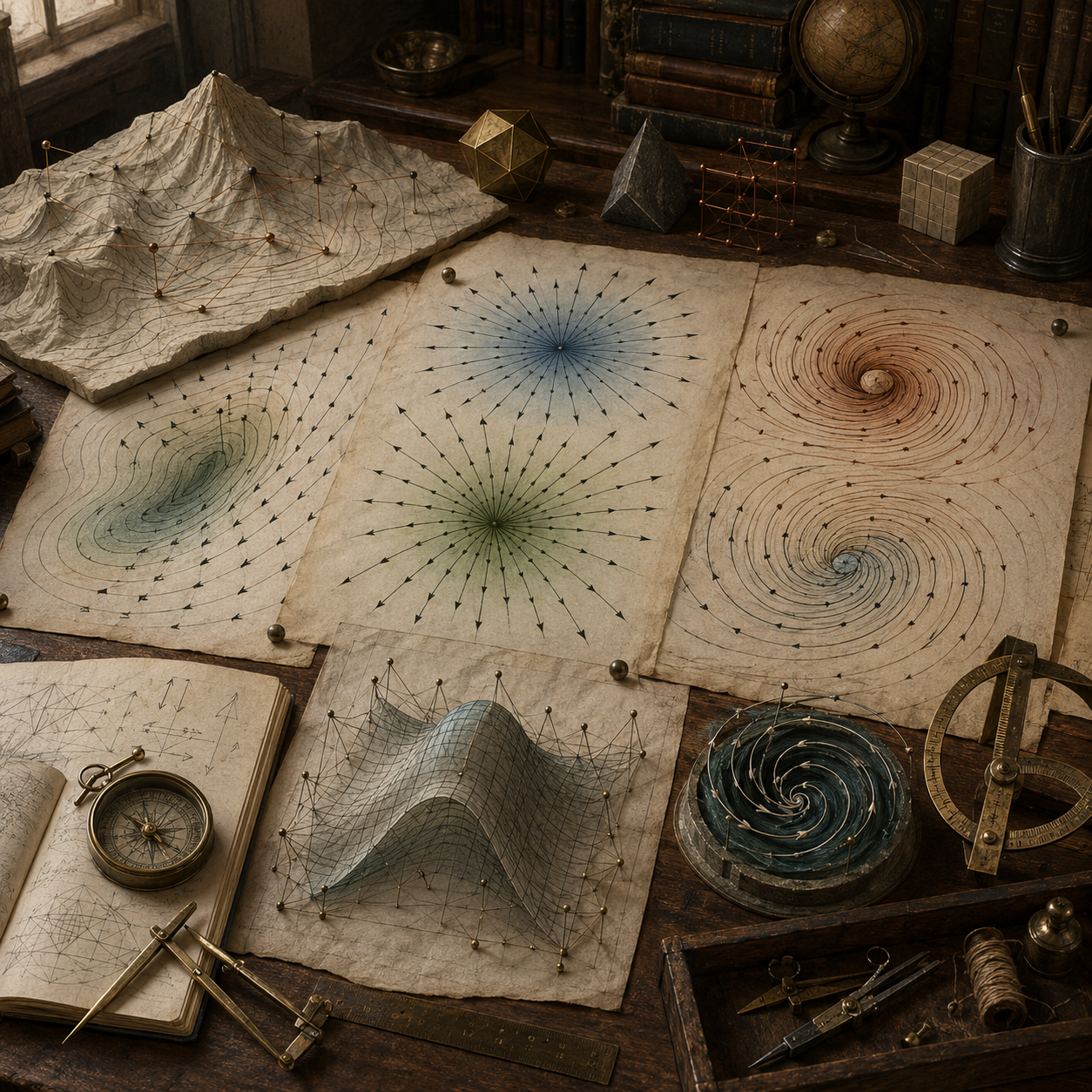
Gradient, divergence, and curl do not describe entire systems at once. They describe local field behavior. The gradient points toward steepest increase. Divergence measures local source-like or sink-like behavior. Curl measures local rotational tendency. Together, they help explain how spatial systems change, where flow concentrates, where fields rotate, and how local structure may shape larger patterns.
Why Gradient, Divergence, and Curl Matter
Gradient, divergence, and curl matter because they translate spatial variation into interpretable structure. They tell modelers where a scalar field increases most rapidly, where a vector field behaves like a source or sink, and where a field tends to rotate.
\nabla f
\]
Interpretation: The gradient of a scalar field points in the direction of steepest increase.
\nabla\cdot \mathbf{F}
\]
Interpretation: The divergence of a vector field measures local spreading, outflow, convergence, or source-sink behavior.
\nabla\times \mathbf{F}
\]
Interpretation: The curl of a vector field measures local rotational tendency.
| Operator | Input | Output | Systems meaning |
|---|---|---|---|
| Gradient | Scalar field. | Vector field. | Direction and rate of steepest increase. |
| Divergence | Vector field. | Scalar field. | Local spreading, convergence, source, or sink behavior. |
| Curl | Vector field. | Vector field in 3D; scalar-like rotation measure in 2D. | Local rotation, circulation tendency, or swirling structure. |
| All three | Fields over space or state space. | Local diagnostic structure. | How systems change, flow, spread, or rotate. |
These operators prepare the ground for flux, circulation, Green’s theorem, Stokes’ theorem, the divergence theorem, conservation laws, and spatial dynamic models.
Fields and Local Operators
A field assigns a value to each point in a domain. A scalar field assigns a number. A vector field assigns a vector. Gradient, divergence, and curl are local operators because they describe how field values change near a point.
A scalar field might be written as:
f(x,y,z)
\]
Interpretation: Each point in space receives one scalar value, such as temperature, elevation, concentration, risk, or cost.
A vector field might be written as:
\mathbf{F}(x,y,z)=\langle P(x,y,z),Q(x,y,z),R(x,y,z)\rangle
\]
Interpretation: Each point in space receives a vector, such as velocity, force, flow, pressure direction, or movement tendency.
The symbol \(\nabla\), often read as “del,” packages partial derivatives into a spatial operator:
\nabla=\left\langle \frac{\partial}{\partial x},\frac{\partial}{\partial y},\frac{\partial}{\partial z}\right\rangle
\]
Interpretation: The del operator organizes partial derivatives with respect to spatial coordinates.
Because these operators use derivatives, they require assumptions about smoothness, scale, coordinate systems, measurement resolution, and field continuity.
Gradient
The gradient applies to a scalar field and produces a vector field. For a scalar field \(f(x,y,z)\):
\nabla f=\left\langle \frac{\partial f}{\partial x},\frac{\partial f}{\partial y},\frac{\partial f}{\partial z}\right\rangle
\]
Interpretation: The gradient records how the scalar field changes in each coordinate direction.
The gradient points toward steepest increase. Its magnitude tells how steep that increase is:
\|\nabla f\|
\]
Interpretation: The gradient magnitude measures the local steepness of the scalar field.
| Scalar field | Gradient interpretation | Systems example |
|---|---|---|
| Elevation. | Direction of steepest uphill change. | Terrain, drainage, erosion, accessibility. |
| Temperature. | Direction of fastest warming. | Heat islands, diffusion, building envelopes. |
| Concentration. | Direction of fastest concentration increase. | Pollution, chemical gradients, ecological exposure. |
| Cost surface. | Direction of rising cost or resistance. | Mobility, routing, infrastructure planning. |
| Risk surface. | Direction of increasing modeled risk. | Hazard analysis, public-health mapping, boundary decisions. |
In systems modeling, the gradient is often interpreted as a directional signal. It can suggest where movement is easiest or hardest, where pressure is intensifying, or where a field changes sharply. But the gradient is only as meaningful as the scalar field and coordinate system used to compute it.
Divergence
Divergence applies to a vector field and produces a scalar field. For:
\mathbf{F}=\langle P,Q,R\rangle
\]
Interpretation: The vector field has one component in each coordinate direction.
The divergence is:
\nabla\cdot\mathbf{F}=\frac{\partial P}{\partial x}+\frac{\partial Q}{\partial y}+\frac{\partial R}{\partial z}
\]
Interpretation: Divergence measures local net spreading or convergence of the field.
Positive divergence suggests local source-like behavior. Negative divergence suggests local sink-like behavior. Divergence near zero suggests that local inflow and outflow may balance, though interpretation depends on units, coordinates, and field meaning.
| Divergence sign | Local field behavior | Systems interpretation |
|---|---|---|
| Positive. | Field spreads outward locally. | Source, expansion, generation, outward flow. |
| Negative. | Field converges inward locally. | Sink, depletion, absorption, compression. |
| Near zero. | Local outflow and inflow balance. | Possible conservation, incompressibility, or local balance. |
| Highly variable. | Source and sink behavior changes across space. | Heterogeneous production, removal, transport, or pressure. |
Divergence is central to conservation reasoning. It connects local source-sink structure to flux across boundaries, especially through the divergence theorem.
Curl
Curl applies to a vector field and measures local rotational tendency. For \(\mathbf{F}=\langle P,Q,R\rangle\), the three-dimensional curl is:
\nabla\times\mathbf{F}
=
\left\langle
\frac{\partial R}{\partial y}-\frac{\partial Q}{\partial z},
\frac{\partial P}{\partial z}-\frac{\partial R}{\partial x},
\frac{\partial Q}{\partial x}-\frac{\partial P}{\partial y}
\right\rangle
\]
Interpretation: Curl measures the axis and strength of local rotational tendency in a vector field.
In two-dimensional fields \(\mathbf{F}(x,y)=\langle P(x,y),Q(x,y)\rangle\), the relevant curl-like scalar is often:
\frac{\partial Q}{\partial x}-\frac{\partial P}{\partial y}
\]
Interpretation: This measures local counterclockwise rotational tendency in the plane.
| Curl behavior | Local field structure | Systems interpretation |
|---|---|---|
| Large curl. | Strong local rotation. | Vortex, circulation, swirl, cyclic movement, rotational feedback. |
| Curl near zero. | Little local rotational tendency. | Possibly potential-like or irrotational behavior. |
| Changing curl sign. | Rotation direction varies across space. | Competing vortices, shear, complex flow structure. |
| Localized curl hotspots. | Rotation concentrated in specific regions. | Boundary layers, eddies, traffic loops, feedback zones. |
Curl prepares the ground for circulation reasoning, Green’s theorem, and Stokes’ theorem. It explains how local rotation relates to line integrals around boundaries.
Comparing the Three Operators
Gradient, divergence, and curl answer different questions. Confusing them can lead to weak or misleading model interpretation.
| Question | Operator | Input | Output |
|---|---|---|---|
| Which direction does a scalar field increase fastest? | Gradient. | Scalar field. | Vector field. |
| Where is a vector field locally spreading or converging? | Divergence. | Vector field. | Scalar field. |
| Where is a vector field locally rotating? | Curl. | Vector field. | Vector field in 3D; scalar-like in 2D. |
| How does a scalar potential produce a directional field? | Gradient. | Potential function. | Direction and steepness. |
| How does local flow relate to boundary crossing? | Divergence. | Flow field. | Source-sink density. |
| How does local rotation relate to circulation? | Curl. | Vector field. | Rotational density. |
A useful shorthand is: gradient points uphill, divergence measures spreading, and curl measures spinning. But responsible modeling requires more than shorthand. It requires units, domain, coordinate conventions, smoothness assumptions, and field meaning.
Physical and Systems Interpretation
Gradient, divergence, and curl are often introduced through physics, but their usefulness extends across many systems domains. They describe local structure in fields, whether those fields represent physical quantities, computational abstractions, spatial risks, or state-space tendencies.
| Domain | Gradient use | Divergence use | Curl use |
|---|---|---|---|
| Hydrology. | Terrain slope and flow direction. | Sources and sinks of water movement. | Circulation, eddies, or rotational flow. |
| Climate and atmosphere. | Temperature or pressure gradients. | Air convergence and divergence. | Vorticity and storm rotation. |
| Urban systems. | Accessibility or cost gradients. | Movement concentration or dispersal. | Circulatory traffic patterns. |
| Ecology. | Habitat suitability gradients. | Population flow sources and sinks. | Rotational movement or corridor loops. |
| State-space modeling. | Potential, risk, or objective-function gradients. | Expansion or contraction of trajectories. | Rotational dynamics or cyclic behavior. |
These interpretations are useful, but they should not be applied automatically. A vector field must have a meaningful direction and scale before divergence or curl can support interpretation. A scalar field must represent a coherent quantity before its gradient can be treated as a signal.
Coordinate, Units, and Scale
Gradient, divergence, and curl depend on coordinates and units. A derivative with respect to meters is not the same as a derivative with respect to kilometers. A field measured on a coarse grid may produce different operator values than the same field measured on a fine grid. A projection can distort distances and directions.
| Issue | Why it matters | Review question |
|---|---|---|
| Coordinate system. | Distances, directions, and derivatives depend on coordinates. | Are coordinates appropriate for the domain? |
| Units. | Operator values inherit units from fields and spatial variables. | Are derivative units documented? |
| Grid resolution. | Numerical derivatives depend on spacing and smoothing. | Is the grid fine enough for the interpretation? |
| Smoothing. | Noise can dominate derivative estimates. | Was smoothing applied and documented? |
| Boundary behavior. | Finite differences near edges may be unstable. | How are boundaries handled? |
The operators are local, but their interpretation is shaped by scale. A curl hotspot at one resolution may disappear after smoothing. A divergence estimate may change when measured on a different grid. A gradient may point in a misleading direction if coordinates are distorted.
Computational Approximation
Computers estimate gradient, divergence, and curl using discrete samples. A common central-difference approximation for a partial derivative is:
\frac{\partial f}{\partial x}(x_i,y_j)\approx \frac{f(x_{i+1},y_j)-f(x_{i-1},y_j)}{2\Delta x}
\]
Interpretation: The derivative is estimated from neighboring grid values.
For a two-dimensional vector field \(\mathbf{F}=\langle P,Q\rangle\), discrete divergence may be approximated by:
\nabla\cdot\mathbf{F}\approx \frac{P_{i+1,j}-P_{i-1,j}}{2\Delta x}+\frac{Q_{i,j+1}-Q_{i,j-1}}{2\Delta y}
\]
Interpretation: Divergence is estimated from directional changes in vector-field components.
The two-dimensional curl-like scalar may be approximated by:
\frac{\partial Q}{\partial x}-\frac{\partial P}{\partial y}
\approx
\frac{Q_{i+1,j}-Q_{i-1,j}}{2\Delta x}
–
\frac{P_{i,j+1}-P_{i,j-1}}{2\Delta y}
\]
Interpretation: Local rotational tendency is estimated from cross-component variation.
Numerical derivatives can amplify noise. Field-operator workflows should report grid spacing, smoothing, interpolation, boundary rules, and whether results are interpreted qualitatively or quantitatively.
Systems Modeling Interpretation
Gradient, divergence, and curl help systems modelers interpret local field structure. Gradient identifies directional pressure in scalar fields. Divergence identifies local source-like or sink-like behavior in vector fields. Curl identifies rotational tendency and circulation structure. These local signals can support hypotheses about transport, accumulation, feedback, conservation, and spatial organization.
A simple scalar field might be:
f(x,y)=x^2+y^2
\]
Interpretation: The scalar field increases away from the origin.
Its gradient is:
\nabla f=\langle 2x,2y\rangle
\]
Interpretation: The direction of steepest increase points outward from the origin.
A simple vector field might be:
\mathbf{F}(x,y)=\langle -y,x\rangle
\]
Interpretation: The field rotates around the origin.
Its two-dimensional curl-like scalar is:
\frac{\partial Q}{\partial x}-\frac{\partial P}{\partial y}=1-(-1)=2
\]
Interpretation: The field has positive rotational tendency in the plane.
These examples are simple, but the same logic applies to field diagnostics in environmental modeling, urban systems, infrastructure networks, climate dynamics, state-space trajectories, and policy simulations.
Mathematical Deepening
This section adds a more formal layer for mathematically advanced readers. Gradient, divergence, and curl connect local derivatives to global integral theorems and systems interpretation.
Operator Structure
Gradient
The gradient maps a scalar field to a vector field of steepest local increase.
Divergence
Divergence maps a vector field to a scalar field of local source-sink behavior.
Curl
Curl maps a vector field to local rotational structure.
Del Operator
The operator \(\nabla\) packages partial derivatives into a coordinate-dependent structure.
Integral Theorem Structure
Gradient and Potentials
Gradient fields connect scalar potentials to directional motion and path-independent work.
Divergence and Flux
Divergence connects local source-sink behavior to flux across boundaries.
Curl and Circulation
Curl connects local rotation to circulation around curves.
Boundary Reasoning
These operators prepare the ground for Green’s theorem, Stokes’ theorem, and the divergence theorem.
Diagnostic Structure
Field Check
State whether the input is a scalar field or vector field and define its units.
Grid Check
Report spacing, interpolation, smoothing, and boundary rules for numerical derivatives.
Coordinate Check
Document coordinate conventions and whether distances are distorted by projection.
Meaning Check
Explain what gradient, divergence, or curl means in the modeled system.
Advanced Modeling Implications
Flux
Divergence helps explain where flux is generated, absorbed, or balanced.
Circulation
Curl helps interpret rotational fields and closed-path line integrals.
Conservation
Divergence supports conservation-law reasoning across boundaries and volumes.
State-Space Dynamics
Operators can help diagnose gradients, expansion, contraction, and rotation in modeled state spaces.
Examples from Systems Modeling
Gradient, divergence, and curl appear wherever fields are used to represent spatial or state-space structure.
Terrain and Drainage
Gradient identifies steepest elevation increase, helping interpret slope, runoff, and flow direction.
Atmospheric Flow
Divergence and curl help describe convergence, spreading, rotation, and circulation in air movement.
Urban Mobility
Cost gradients, movement divergence, and circulatory flow patterns can support route and congestion analysis.
Environmental Exposure
Gradients reveal sharp transitions in exposure fields, while divergence can indicate spreading or concentration.
Hydrological Boundaries
Divergence supports source-sink reasoning and flux interpretation across watershed surfaces.
State-Space Dynamics
Gradient-like pressure, divergence-like expansion, and curl-like cycles can help interpret dynamic trajectories.
Across these examples, field operators should be interpreted with explicit attention to input field meaning, coordinate system, units, smoothing, grid resolution, and local-versus-global scope.
Computation and Reproducible Workflows
Computational workflows for gradient, divergence, and curl should record the scalar field or vector field, coordinate system, grid spacing, finite-difference method, smoothing, interpolation, boundary handling, output units, operator definitions, and warnings about noisy derivatives or unstable edges.
Good workflows separate the three operators clearly. Gradient requires a scalar field. Divergence and curl require vector fields. A field-operator audit should not treat these as interchangeable diagnostics.
Python Workflow: Field Operator Audit
The Python workflow below samples a scalar field and vector field on a grid, approximates gradient, divergence, and curl, then writes reproducible audit outputs.
from __future__ import annotations

from dataclasses import dataclass, asdict
from pathlib import Path
import csv
import json
import math


@dataclass(frozen=True)
class FieldOperatorAuditRecord:
    scenario: str
    grid_step: float
    point_count: int
    mean_gradient_magnitude: float
    maximum_gradient_magnitude: float
    mean_divergence: float
    mean_curl: float
    maximum_abs_curl: float
    field_description: str
    warning: str


def scalar_field(x: float, y: float) -> float:
    return x * x + y * y


def vector_field(x: float, y: float) -> tuple[float, float]:
    return (-y, x)


def gradient(x: float, y: float) -> tuple[float, float]:
    return (2.0 * x, 2.0 * y)


def divergence(x: float, y: float) -> float:
    return 0.0


def curl_2d(x: float, y: float) -> float:
    return 2.0


def grid_values(step: float) -> list[float]:
    return [round(-1.0 + i * step, 10) for i in range(int(2.0 / step) + 1)]


def audit_field_operators(step: float, scenario: str) -> FieldOperatorAuditRecord:
    values = grid_values(step)
    grad_magnitudes = []
    divergences = []
    curls = []

    for x in values:
        for y in values:
            gx, gy = gradient(x, y)
            grad_magnitudes.append(math.sqrt(gx * gx + gy * gy))
            divergences.append(divergence(x, y))
            curls.append(curl_2d(x, y))

    warning = ""
    if step > 0.5:
        warning = "Grid step is coarse; local derivative structure may be undersampled."
    else:
        warning = "Synthetic field-operator audit; document field definitions, units, grid, and boundary rules."

    return FieldOperatorAuditRecord(
        scenario=scenario,
        grid_step=step,
        point_count=len(values) * len(values),
        mean_gradient_magnitude=sum(grad_magnitudes) / len(grad_magnitudes),
        maximum_gradient_magnitude=max(grad_magnitudes),
        mean_divergence=sum(divergences) / len(divergences),
        mean_curl=sum(curls) / len(curls),
        maximum_abs_curl=max(abs(value) for value in curls),
        field_description="scalar f=x^2+y^2; vector F=<-y,x>",
        warning=warning
    )


records = [
    audit_field_operators(1.0, "coarse_grid"),
    audit_field_operators(0.5, "medium_grid"),
    audit_field_operators(0.25, "fine_grid")
]

output_dir = Path("outputs")
(output_dir / "tables").mkdir(parents=True, exist_ok=True)
(output_dir / "json").mkdir(parents=True, exist_ok=True)

with (output_dir / "tables" / "field_operator_audit.csv").open("w", newline="", encoding="utf-8") as handle:
    writer = csv.DictWriter(handle, fieldnames=asdict(records[0]).keys())
    writer.writeheader()
    for record in records:
        writer.writerow(asdict(record))

(output_dir / "json" / "field_operator_audit.json").write_text(
    json.dumps([asdict(record) for record in records], indent=2),
    encoding="utf-8"
)

print("Wrote field-operator audit.")
This workflow keeps gradient magnitude, divergence, curl, grid spacing, field definitions, and warnings explicit.
R Workflow: Gradient, Divergence, and Curl Diagnostics
The R workflow below performs the same field-operator audit using base R.
scalar_field <- function(x, y) {
  x^2 + y^2
}

vector_field <- function(x, y) {
  c(-y, x)
}

gradient_field <- function(x, y) {
  c(2 * x, 2 * y)
}

divergence_field <- function(x, y) {
  0
}

curl_2d <- function(x, y) {
  2
}

grid_values <- function(step) {
  seq(-1, 1, by = step)
}

audit_field_operators <- function(step, scenario) {
  values <- grid_values(step)
  grad_magnitudes <- c()
  divergences <- c()
  curls <- c()

  for (x in values) {
    for (y in values) {
      grad <- gradient_field(x, y)
      grad_magnitudes <- c(grad_magnitudes, sqrt(sum(grad^2)))
      divergences <- c(divergences, divergence_field(x, y))
      curls <- c(curls, curl_2d(x, y))
    }
  }

  warning <- ifelse(
    step > 0.5,
    "Grid step is coarse; local derivative structure may be undersampled.",
    "Synthetic field-operator audit; document field definitions, units, grid, and boundary rules."
  )

  data.frame(
    scenario = scenario,
    grid_step = step,
    point_count = length(values)^2,
    mean_gradient_magnitude = mean(grad_magnitudes),
    maximum_gradient_magnitude = max(grad_magnitudes),
    mean_divergence = mean(divergences),
    mean_curl = mean(curls),
    maximum_abs_curl = max(abs(curls)),
    field_description = "scalar f=x^2+y^2; vector F=<-y,x>",
    warning = warning
  )
}

results <- rbind(
  audit_field_operators(1.0, "coarse_grid"),
  audit_field_operators(0.5, "medium_grid"),
  audit_field_operators(0.25, "fine_grid")
)

dir.create("outputs/tables", recursive = TRUE, showWarnings = FALSE)
write.csv(results, "outputs/tables/r_field_operator_audit.csv", row.names = FALSE)

print(results)
This workflow supports reproducible field-operator diagnostics and derivative-interpretation review.
Haskell Workflow: Typed Field Records
Haskell can represent field-operator workflows with explicit types for scalar fields, vector fields, gradient records, divergence values, curl values, and audit outputs.
module Main where

data Vec2 = Vec2 Double Double deriving (Show)

data FieldOperatorAudit = FieldOperatorAudit
  { scenario :: String
  , gridStep :: Double
  , pointCount :: Int
  , meanGradientMagnitude :: Double
  , maximumGradientMagnitude :: Double
  , meanDivergence :: Double
  , meanCurl :: Double
  , maximumAbsCurl :: Double
  , fieldDescription :: String
  , warning :: String
  } deriving (Show)

scalarField :: Double -> Double -> Double
scalarField x y =
  x*x + y*y

vectorField :: Double -> Double -> Vec2
vectorField x y =
  Vec2 (-y) x

gradientField :: Double -> Double -> Vec2
gradientField x y =
  Vec2 (2*x) (2*y)

divergenceField :: Double -> Double -> Double
divergenceField _ _ =
  0.0

curl2D :: Double -> Double -> Double
curl2D _ _ =
  2.0

vecNorm :: Vec2 -> Double
vecNorm (Vec2 a b) =
  sqrt (a*a + b*b)

gridValues :: Double -> [Double]
gridValues step =
  [ -1.0 + fromIntegral i * step | i <- [0 .. floor (2.0 / step)] ]

auditFieldOperators :: Double -> String -> FieldOperatorAudit
auditFieldOperators step label =
  let values = gridValues step
      points = [ (x,y) | x <- values, y <- values ]
      gradMagnitudes = [ vecNorm (gradientField x y) | (x,y) <- points ]
      divergences = [ divergenceField x y | (x,y) <- points ]
      curls = [ curl2D x y | (x,y) <- points ]
      warningText =
        if step > 0.5
        then "Grid step is coarse; local derivative structure may be undersampled."
        else "Synthetic field-operator audit; document field definitions, units, grid, and boundary rules."
  in FieldOperatorAudit
      label
      step
      (length points)
      (sum gradMagnitudes / fromIntegral (length gradMagnitudes))
      (maximum gradMagnitudes)
      (sum divergences / fromIntegral (length divergences))
      (sum curls / fromIntegral (length curls))
      (maximum (map abs curls))
      "scalar f=x^2+y^2; vector F=<-y,x>"
      warningText

main :: IO ()
main = do
  print (auditFieldOperators 1.0 "coarse_grid")
  print (auditFieldOperators 0.5 "medium_grid")
  print (auditFieldOperators 0.25 "fine_grid")
The typed workflow keeps scalar fields, vector fields, gradient magnitude, divergence, curl, and interpretation warnings separate.
SQL Workflow: Field Operator Assumption Registry
SQL can document assumptions when gradient, divergence, and curl workflows support reports, dashboards, model cards, or governance review.
CREATE TABLE field_operator_assumption_registry (
    assumption_key TEXT PRIMARY KEY,
    assumption_name TEXT NOT NULL,
    mathematical_role TEXT NOT NULL,
    systems_modeling_role TEXT NOT NULL,
    review_warning TEXT NOT NULL
);

INSERT INTO field_operator_assumption_registry VALUES
(
  'scalar_field_definition',
  'Scalar field definition',
  'Defines the field to which the gradient is applied.',
  'Determines what steepest increase means in the modeled system.',
  'A gradient is not interpretable without a meaningful scalar field.'
);

INSERT INTO field_operator_assumption_registry VALUES
(
  'vector_field_definition',
  'Vector field definition',
  'Defines the field to which divergence and curl are applied.',
  'Determines what spreading, convergence, or rotation means.',
  'Divergence and curl require meaningful vector components and units.'
);

INSERT INTO field_operator_assumption_registry VALUES
(
  'grid_spacing',
  'Grid spacing',
  'Defines numerical derivative resolution.',
  'Shapes computed gradient, divergence, and curl values.',
  'Coarse grids can miss local derivative structure.'
);

INSERT INTO field_operator_assumption_registry VALUES
(
  'coordinate_system',
  'Coordinate system',
  'Defines derivative directions and spatial units.',
  'Controls distance, direction, and operator interpretation.',
  'Coordinate distortion can mislead derivative-based interpretation.'
);

INSERT INTO field_operator_assumption_registry VALUES
(
  'boundary_handling',
  'Boundary handling',
  'Defines how derivatives are estimated near domain edges.',
  'Shapes edge behavior and operator summaries.',
  'Boundary estimates may be unstable or method-dependent.'
);

SELECT
    assumption_name,
    mathematical_role,
    systems_modeling_role,
    review_warning
FROM field_operator_assumption_registry
ORDER BY assumption_key;
This registry keeps field-operator interpretation tied to scalar-field definition, vector-field definition, grid spacing, coordinate system, boundary handling, units, and derivative method.
GitHub Repository
The companion repository for this article is designed as a reproducible mathematical-modeling workspace. It supports gradient audits, divergence diagnostics, curl diagnostics, field-operator comparison, grid-resolution review, SQL assumption tables, generated outputs, advanced mathematical audit reports, and reusable calculator scripts.
Complete Code Repository
Companion article folder with Python, R, Julia, SQL, Haskell, C, C++, Fortran, Rust, Go, notebooks, documentation, synthetic teaching data, generated outputs, schemas, Canvas-ready workflow artifacts, and reusable calculator scripts for gradient, divergence, curl, scalar fields, vector fields, grid-based derivatives, source-sink structure, rotational diagnostics, and responsible mathematical modeling.
Interpretive Limits and Responsible Use
Gradient, divergence, and curl are powerful because they condense local field behavior into interpretable mathematical diagnostics. They are risky when field meaning is vague, units are ignored, derivatives are computed from noisy data, coordinate systems are distorted, or local diagnostics are treated as full-system explanations.
Responsible use requires several checks. Define the scalar or vector field. Document coordinate systems and units. State the derivative method. Report grid spacing, smoothing, interpolation, and boundary handling. Distinguish gradient from divergence and curl. Avoid interpreting divergence as literal creation or destruction unless the field and conservation context support that claim. Avoid interpreting curl as full circulation without considering boundaries and scale.
The central modeling question is not only “What are the gradient, divergence, and curl?” It is “What field is being differentiated, what do the operators mean in this system, and what assumptions make the local diagnostic meaningful?”
Related Articles
- Calculus for Systems Modeling
- Vectors, Fields, and Continuous Space
- Line Integrals and Paths Through Space
- Surface Integrals and Distributed Accumulation
- Flux, Circulation, and Spatial Flow
- Green’s Theorem and Planar Systems
- Stokes’ Theorem and Rotational Structure
- Divergence Theorem and Conservation Across Boundaries
- Diffusion, Transport, and Spatial Dynamics
- Systems Modeling
Further Reading
- Apostol, T.M. (1969) Calculus, Volume 2: Multi-Variable Calculus and Linear Algebra, with Applications to Differential Equations and Probability. 2nd edn. New York: Wiley.
- Marsden, J.E. and Tromba, A.J. (2012) Vector Calculus. 6th edn. New York: W.H. Freeman.
- Hubbard, J.H. and Hubbard, B.B. (2015) Vector Calculus, Linear Algebra, and Differential Forms: A Unified Approach. 5th edn. Ithaca, NY: Matrix Editions.
- Schey, H.M. (2005) Div, Grad, Curl, and All That: An Informal Text on Vector Calculus. 4th edn. New York: W.W. Norton.
- Spivak, M. (1965) Calculus on Manifolds: A Modern Approach to Classical Theorems of Advanced Calculus. New York: W.A. Benjamin.
- Strang, G. (2019) Introduction to Linear Algebra. 5th edn. Wellesley, MA: Wellesley-Cambridge Press.
- Massachusetts Institute of Technology (MIT) OpenCourseWare (2010) Multivariable Calculus. Cambridge, MA: MIT OpenCourseWare.
- OpenStax (2016) Calculus Volume 3. Houston, TX: OpenStax, Rice University.
- Logan, J.D. (2015) Applied Partial Differential Equations. 3rd edn. Cham: Springer.
- Strogatz, S.H. (2018) Nonlinear Dynamics and Chaos: With Applications to Physics, Biology, Chemistry, and Engineering. 2nd edn. Boca Raton, FL: CRC Press.
References
- Apostol, T.M. (1969) Calculus, Volume 2: Multi-Variable Calculus and Linear Algebra, with Applications to Differential Equations and Probability. 2nd edn. New York: Wiley.
- Hubbard, J.H. and Hubbard, B.B. (2015) Vector Calculus, Linear Algebra, and Differential Forms: A Unified Approach. 5th edn. Ithaca, NY: Matrix Editions.
- Logan, J.D. (2015) Applied Partial Differential Equations. 3rd edn. Cham: Springer.
- Marsden, J.E. and Tromba, A.J. (2012) Vector Calculus. 6th edn. New York: W.H. Freeman.
- Massachusetts Institute of Technology (MIT) OpenCourseWare (2010) Multivariable Calculus. Cambridge, MA: MIT OpenCourseWare.
- OpenStax (2016) Calculus Volume 3. Houston, TX: OpenStax, Rice University.
- Schey, H.M. (2005) Div, Grad, Curl, and All That: An Informal Text on Vector Calculus. 4th edn. New York: W.W. Norton.
- Spivak, M. (1965) Calculus on Manifolds: A Modern Approach to Classical Theorems of Advanced Calculus. New York: W.A. Benjamin.
- Strang, G. (2019) Introduction to Linear Algebra. 5th edn. Wellesley, MA: Wellesley-Cambridge Press.
- Strogatz, S.H. (2018) Nonlinear Dynamics and Chaos: With Applications to Physics, Biology, Chemistry, and Engineering. 2nd edn. Boca Raton, FL: CRC Press.