
Last Updated June 15, 2026
Change of variables in multidimensional systems explains how quantities, regions, coordinates, densities, and accumulated totals transform when a model is rewritten in a different coordinate system. A change of variables can simplify geometry, expose structure, make computation easier, or align a model with the natural shape of a system. But it also changes how area, volume, density, and local scaling must be interpreted.
In systems modeling, this matters whenever space, state variables, parameters, or flows are transformed. A circular region may be easier in polar coordinates. A spatial process may be easier in cylindrical or spherical coordinates. A model may be reparameterized to improve computation. A density may need to be integrated over a transformed region. In each case, the transformation must preserve the meaning of accumulated quantities.
This article introduces change of variables as a tool for multidimensional integration, coordinate transformation, Jacobian scaling, density conversion, region mapping, computational simplification, and responsible interpretation of transformed systems.
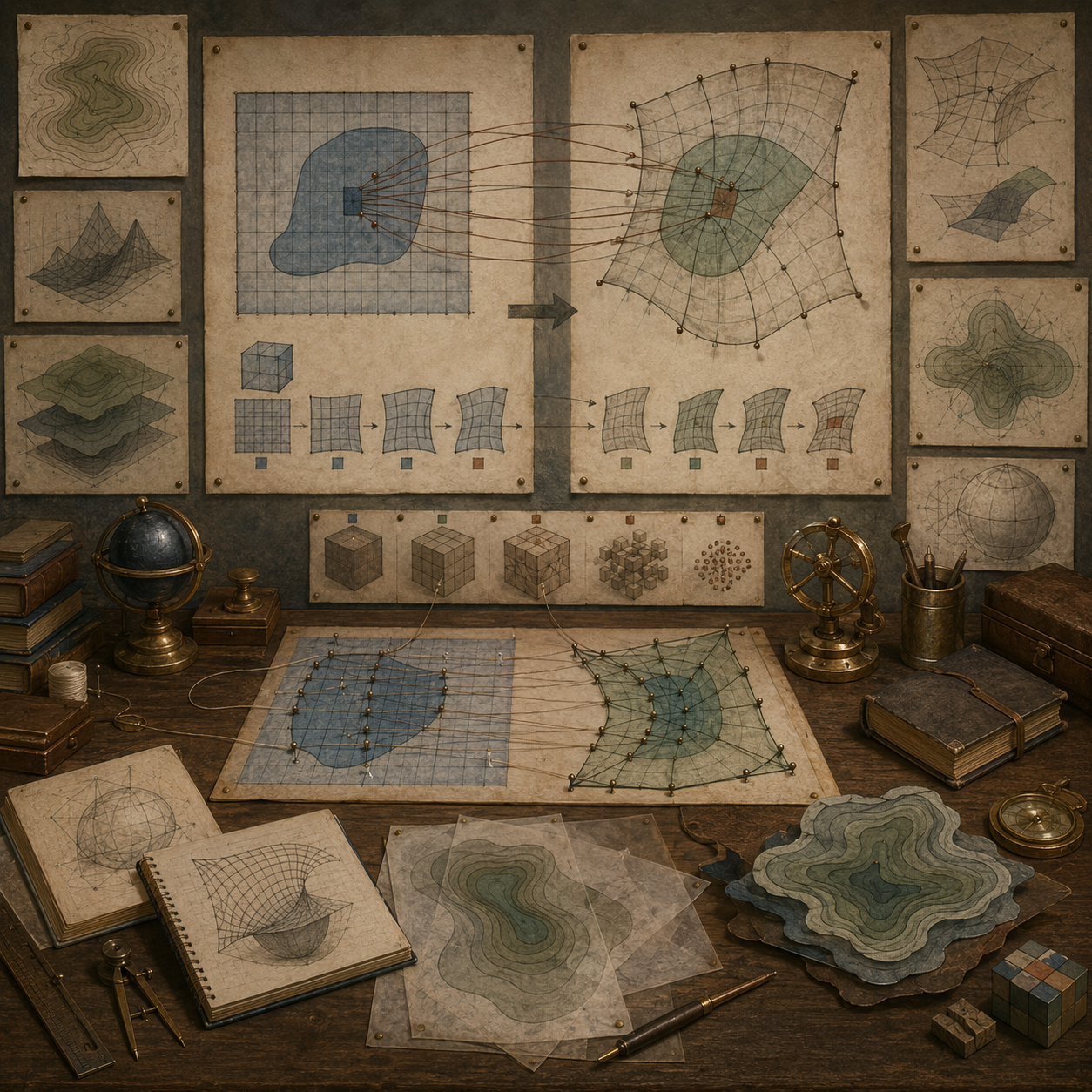
A change of variables is not merely a change in notation. It changes how small pieces of area or volume are measured. If a transformation stretches space, compresses space, rotates coordinates, curves a grid, or maps one region into another, the integral must account for that local scaling. The Jacobian determinant is the central correction factor.
Why Change of Variables Matters
Change of variables matters because many systems are easier to understand when described in coordinates that fit their structure. A radial process may be awkward in rectangular coordinates but natural in polar coordinates. A flow through a pipe may be simpler in cylindrical coordinates. A diffusion process around a source may be clearer in spherical coordinates. A model with skewed parameters may become more stable after reparameterization.
The mathematical issue is that coordinate changes reshape small pieces of space. If a region is stretched, compressed, folded, or curved by a transformation, the integral must account for that distortion.
\iint_R f(x,y)\,dA
=
\iint_S f(x(u,v),y(u,v))\left|\frac{\partial(x,y)}{\partial(u,v)}\right|\,du\,dv
\]
Interpretation: The original integral over \(R\) is rewritten over a new parameter region \(S\), with the Jacobian determinant correcting local area scaling.
| Modeling need | Transformation role | Interpretive caution |
|---|---|---|
| Simplify geometry | Map a complicated region into a simpler domain. | The Jacobian must preserve area or volume scaling. |
| Use natural coordinates | Represent circular, radial, cylindrical, or spherical systems naturally. | Coordinate singularities may appear. |
| Improve computation | Reparameterize variables for numerical stability. | Transformed parameters must remain interpretable. |
| Transform densities | Convert density from one coordinate system to another. | Total mass, probability, or burden should be conserved. |
| Analyze state space | Move between model variables and derived variables. | Invertibility and domain restrictions must be documented. |
Change of variables is therefore a bridge between geometry, computation, and interpretation.
What Is a Change of Variables?
A change of variables replaces one set of coordinates with another. In two dimensions, we might write:
x=x(u,v),\qquad y=y(u,v)
\]
Interpretation: The original coordinates \(x,y\) are expressed as functions of new coordinates \(u,v\).
This defines a transformation:
T(u,v)=(x(u,v),y(u,v))
\]
Interpretation: The transformation maps points from the \(u,v\)-domain into the \(x,y\)-domain.
In three dimensions, the same idea becomes:
x=x(u,v,w),\qquad y=y(u,v,w),\qquad z=z(u,v,w)
\]
Interpretation: A three-dimensional coordinate system is rewritten in terms of new variables.
The purpose may be geometric, computational, conceptual, or all three. But every transformation raises the same core questions: What region maps to what region? Is the transformation one-to-one where needed? What is the local scaling factor? Are units preserved? Does the transformed integral still represent the intended quantity?
| Component | Mathematical role | Systems interpretation |
|---|---|---|
| Original variables | Coordinates used in the original model. | Observed or conceptual quantities in the first representation. |
| New variables | Coordinates used after transformation. | Alternative representation that may simplify structure. |
| Transformation map | Function connecting coordinate systems. | Rule for translating states, regions, or parameters. |
| Mapped region | Image of a domain under the transformation. | New boundary description of the same modeled space. |
| Jacobian factor | Local scaling correction. | Preserves area, volume, mass, probability, or accumulated burden. |
A change of variables is successful only when the transformed representation remains mathematically correct and systemically meaningful.
Regions and Mapped Domains
Changing variables changes how the region of integration is described. A region \(R\) in \(x,y\)-space may correspond to a simpler region \(S\) in \(u,v\)-space:
R=T(S)
\]
Interpretation: The original region \(R\) is the image of the parameter region \(S\) under the transformation \(T\).
This is one of the main reasons change of variables is useful. A circular region in Cartesian coordinates may require curved boundaries, while in polar coordinates it may become a rectangle in \(r,\theta\)-space.
x^2+y^2\leq a^2
\quad \Longleftrightarrow \quad
0\leq r\leq a,\quad 0\leq \theta\leq 2\pi
\]
Interpretation: A disk becomes a simple rectangular parameter region in polar coordinates.
However, mapped domains require care. A transformation may cover a region more than once, exclude part of a region, collapse boundaries, or become singular. These issues affect accumulation.
| Domain issue | Mathematical effect | Modeling risk |
|---|---|---|
| Region not mapped completely | Some original points are excluded. | Total accumulation is underestimated. |
| Region covered more than once | Some points are counted repeatedly. | Total accumulation is overestimated. |
| Boundary collapsed | Area or volume may shrink locally. | Singularity or degeneracy can distort interpretation. |
| Transformation not one-to-one | Multiple parameter points map to one original point. | Density or probability claims may be invalid without correction. |
| Region boundary misdescribed | Limits do not match the intended system. | Results reflect the wrong spatial or state domain. |
Responsible change-of-variables work begins with a domain map, not only an algebraic substitution.
The Jacobian Determinant
The Jacobian matrix records how the transformation changes locally. In two dimensions:
J_T(u,v)=
\begin{bmatrix}
\frac{\partial x}{\partial u} & \frac{\partial x}{\partial v}\\
\frac{\partial y}{\partial u} & \frac{\partial y}{\partial v}
\end{bmatrix}
\]
Interpretation: The Jacobian matrix describes the local linear behavior of the transformation.
The determinant of this matrix gives the local area scaling factor:
\left|\det J_T(u,v)\right|
=
\left|\frac{\partial(x,y)}{\partial(u,v)}\right|
\]
Interpretation: The absolute Jacobian determinant tells how much a small \(du\,dv\) patch expands or contracts in \(x,y\)-space.
The change-of-variables formula then becomes:
\iint_R f(x,y)\,dx\,dy
=
\iint_S f(x(u,v),y(u,v))|\det J_T(u,v)|\,du\,dv
\]
Interpretation: The Jacobian determinant corrects for local area distortion under the coordinate transformation.
Without the Jacobian factor, the transformed integral generally does not preserve the original total.
| Jacobian determinant value | Local meaning | Modeling implication |
|---|---|---|
| \(|\det J|>1\) | Local expansion. | Small parameter patches represent larger original-area or volume patches. |
| \(|\det J|<1\) | Local compression. | Small parameter patches represent smaller original-area or volume patches. |
| \(|\det J|=1\) | Local area or volume preserved. | The transformation preserves measure locally. |
| \(\det J=0\) | Local collapse or singularity. | The transformation may not be locally invertible. |
| \(\det J<0\) | Orientation reversal. | Use absolute value for area or volume accumulation. |
The Jacobian determinant is therefore the scaling bridge between transformed coordinates and meaningful accumulated quantities.
Area and Volume Scaling
In one dimension, substitution uses a derivative factor. In multiple dimensions, change of variables uses a determinant. This determinant generalizes the idea of local stretching.
For a two-dimensional transformation:
dA = |\det J_T(u,v)|\,du\,dv
\]
Interpretation: The original area element is equal to the transformed parameter area multiplied by the local scaling factor.
For a three-dimensional transformation:
dV = |\det J_T(u,v,w)|\,du\,dv\,dw
\]
Interpretation: The original volume element is equal to the transformed parameter volume multiplied by the local scaling factor.
This scaling is especially important when integrating density. If density is measured per unit area or per unit volume, the area or volume element determines the total.
\text{total mass}
=
\iiint_V \rho(x,y,z)\,dV
\]
Interpretation: Density becomes total mass only after multiplication by the appropriate volume element.
After changing variables:
\text{total mass}
=
\iiint_S \rho(T(u,v,w))|\det J_T(u,v,w)|\,du\,dv\,dw
\]
Interpretation: The transformed density calculation must include the local volume scaling factor.
Area and volume scaling are not optional. They are the mechanism by which the transformed integral preserves the modeled quantity.
Polar, Cylindrical, and Spherical Coordinates
The most familiar changes of variables are standard coordinate transformations. In polar coordinates:
x=r\cos\theta,\qquad y=r\sin\theta
\]
Interpretation: A point is represented by distance from the origin and angle from a reference direction.
The area element is:
dA=r\,dr\,d\theta
\]
Interpretation: The factor \(r\) accounts for the widening of angular sectors as distance from the origin increases.
In cylindrical coordinates:
x=r\cos\theta,\qquad y=r\sin\theta,\qquad z=z
\]
Interpretation: A three-dimensional point is represented by radial distance, angle, and height.
The volume element is:
dV=r\,dr\,d\theta\,dz
\]
Interpretation: Cylindrical volume elements expand with radius.
In spherical coordinates, one common convention is:
x=\rho\sin\phi\cos\theta,\quad
y=\rho\sin\phi\sin\theta,\quad
z=\rho\cos\phi
\]
Interpretation: A point is represented by radial distance, polar angle, and azimuthal angle.
The volume element is:
dV=\rho^2\sin\phi\,d\rho\,d\phi\,d\theta
\]
Interpretation: Spherical volume elements expand with radius and vary with polar angle.
| Coordinate system | Transformation use | Scaling factor |
|---|---|---|
| Polar | Disks, rings, radial fields, circular symmetry. | \(r\) |
| Cylindrical | Pipes, columns, reservoirs, radial-height systems. | \(r\) |
| Spherical | Balls, radial diffusion, atmosphere shells, source-centered fields. | \(\rho^2\sin\phi\) |
| Linear transformation | Shearing, rotation, scaling, parameter reorientation. | \(|\det A|\) |
| Custom transformation | Model-specific geometry or reparameterization. | \(|\det J_T|\) |
Standard coordinate systems are useful because their scaling factors are well understood, but they still require careful domain limits and unit interpretation.
Density and Conservation
Change of variables is closely tied to conservation. If a quantity such as mass, probability, population, or burden is redistributed across coordinates, the total should remain consistent. The density may change, but the accumulated total should be preserved.
\rho_x(x,y)\,dx\,dy
=
\rho_u(u,v)\,du\,dv
\]
Interpretation: Density in one coordinate system must transform so that the same small amount of quantity is represented.
If \(x,y=T(u,v)\), then:
\rho_u(u,v)=\rho_x(T(u,v))|\det J_T(u,v)|
\]
Interpretation: The transformed density includes the local area-scaling factor.
This matters whenever the integral represents a conserved quantity. If the Jacobian factor is omitted, the total may no longer represent the same mass, probability, exposure burden, or resource stock.
| Quantity | Conserved total | Transformation concern |
|---|---|---|
| Mass | Total material amount. | Density must transform with area or volume scaling. |
| Probability | Total probability equals one. | Probability density changes under variable transformation. |
| Population | Total people over a region. | Spatial density must align with mapped area. |
| Exposure burden | Total weighted burden. | Weights and density must transform consistently. |
| Resource stock | Total available stock. | Coordinate transformation must preserve measured units. |
Conservation is the practical test: after transformation, does the integral still measure the same total quantity?
Probability and State-Space Transformations
Change of variables also appears in probability, statistics, and state-space modeling. If random variables are transformed, probability density must be adjusted by a Jacobian factor so that total probability remains one.
For a one-to-one transformation \(Y=T(X)\), probability density changes according to the inverse transformation and derivative or Jacobian scaling. In multiple dimensions, if \(\mathbf{x}=T(\mathbf{u})\), then:
p_{\mathbf{u}}(\mathbf{u})
=
p_{\mathbf{x}}(T(\mathbf{u}))|\det J_T(\mathbf{u})|
\]
Interpretation: Probability density in transformed coordinates must account for local volume scaling.
In systems modeling, similar transformations appear when moving from raw parameters to derived parameters, from component variables to aggregate variables, or from physical coordinates to normalized state variables.
| Transformation type | Example | Review issue |
|---|---|---|
| Parameter transformation | Raw rates to normalized rates. | Prior, density, or sensitivity interpretation may change. |
| State-space transformation | Component values to total and share variables. | Domains and constraints may change shape. |
| Probability transformation | Random inputs to derived outcomes. | Density must preserve total probability. |
| Scale transformation | Log variables, ratios, nondimensional variables. | Units and interpretation shift. |
| Coordinate transformation | Physical space to model space. | Area or volume measure must be preserved. |
State transformations can improve modeling, but they can also hide assumptions. The new variables may be easier to compute with while harder to explain.
Orientation, Singularity, and Invertibility
Not every transformation is safe for change-of-variables reasoning. A transformation may reverse orientation, collapse dimensions, fail to be one-to-one, or become singular at particular points.
The determinant helps identify these issues. If \(\det J=0\), the transformation locally collapses area or volume. Near such points, the inverse may fail or become unstable.
\det J_T(\mathbf{u})=0
\]
Interpretation: The transformation is locally singular and may not preserve dimensional structure.
If the determinant is negative, orientation is reversed. For area and volume accumulation, the absolute value is used:
dA=|\det J_T|\,du\,dv
\]
Interpretation: Area is nonnegative, so orientation reversal is handled by the absolute value.
Invertibility is also essential. If a transformation maps two different parameter points to the same original point, totals may be double-counted unless the domain is restricted or the formula is adjusted.
| Transformation problem | Mathematical signal | Modeling consequence |
|---|---|---|
| Singularity | \(\det J=0\) | Local collapse; inverse may fail. |
| Near singularity | \(|\det J|\approx 0\) | Numerical instability and sensitivity amplification. |
| Orientation reversal | \(\det J<0\) | Use absolute determinant for measure. |
| Non-invertibility | Multiple preimages. | Potential double counting or ambiguous density transformation. |
| Domain mismatch | Mapped region differs from intended region. | Accumulation result refers to the wrong system boundary. |
Transformation diagnostics should check determinant behavior, domain coverage, and invertibility before interpreting results.
Numerical and Computational Uses
Change of variables is often used to make numerical integration, simulation, estimation, or optimization more stable. A difficult integral over an irregular region may become easier after transformation. A parameter with a restricted domain may be mapped to an unrestricted variable. A skewed computational landscape may become easier to sample or optimize after reparameterization.
For example, a positive parameter \(k>0\) may be represented as:
k=e^\eta
\]
Interpretation: The transformed variable \(\eta\) can range over all real numbers while ensuring \(k\) remains positive.
This can improve computation, but it changes sensitivity interpretation. A unit change in \(\eta\) is not a unit change in \(k\). The transformation is multiplicative.
| Computational use | Transformation example | Interpretive caution |
|---|---|---|
| Positive parameter | \(k=e^\eta\) | Effects become multiplicative in the original parameter. |
| Bounded share | \(p=\frac{1}{1+e^{-\eta}}\) | Changes near boundaries are compressed. |
| Circular region | Cartesian to polar. | Area scaling requires the \(r\) factor. |
| Irregular domain | Map from reference square to physical region. | Jacobian varies across the region. |
| Correlated parameters | Rotate or whiten coordinates. | Transformed axes may be less interpretable. |
Computational convenience should not erase interpretive clarity. A transformed model should explain both the new variables and how they map back to the original system.
Systems Modeling Interpretation
Change of variables helps systems modelers describe the same system from a more useful viewpoint. A spatial process can be centered on a source. A region can be parameterized by natural coordinates. A model can be nondimensionalized. A density can be transformed for integration. A constrained state space can be rewritten using variables that make its structure visible.
A simplified radial exposure model might begin with an exposure field \(E(x,y)\) over a circular region. In Cartesian coordinates, the region is:
x^2+y^2\leq R^2
\]
Interpretation: The region is a disk of radius \(R\).
In polar coordinates, the same region becomes:
0\leq r\leq R,\qquad 0\leq \theta\leq 2\pi
\]
Interpretation: The disk becomes a simple parameter rectangle in radial and angular coordinates.
The accumulated exposure becomes:
\int_0^{2\pi}\int_0^R E(r,\theta)\,r\,dr\,d\theta
\]
Interpretation: The \(r\) factor ensures that outer rings contribute more area than inner rings.
This example shows the central lesson. Change of variables can simplify the region, but the Jacobian scaling preserves the meaning of accumulation.
Mathematical Deepening
This section adds a more formal layer for mathematically advanced readers. The change-of-variables theorem generalizes substitution to transformations between multidimensional domains. Its core objects are a transformation map, a domain relation, an integrand composition, and a Jacobian determinant.
Formal Structure
Original Domain
The region \(R\) is where the original integral is defined.
Parameter Domain
The region \(S\) is where the transformed integral is evaluated.
Transformation Map
The function \(T:S\to R\) maps new coordinates into original coordinates.
Jacobian Determinant
The determinant \(|\det J_T|\) supplies local measure scaling.
Geometric Structure
Local Linearization
The Jacobian matrix approximates the transformation near each point.
Area and Volume Scaling
The determinant measures local expansion, compression, or collapse.
Orientation
The sign of the determinant records orientation, while measure uses absolute value.
Invertibility
Transformations should avoid double counting or omitted regions.
Diagnostic Structure
Domain Check
Confirm that the parameter domain maps to the intended original domain.
Jacobian Check
Compute and inspect the determinant across the region.
Unit Check
Confirm that transformed density and measure units produce the intended total.
Conservation Check
Compare totals before and after transformation when possible.
Advanced Modeling Implications
State the Map
The transformation should be explicit enough to audit.
State the Domain
Region limits should be stated in both original and transformed coordinates.
State the Scaling
The Jacobian determinant should be reported or justified.
State the Interpretation
Explain how transformed variables map back to the original system.
Examples from Systems Modeling
Change of variables appears throughout systems modeling whenever a different coordinate system or parameterization clarifies the structure of a problem.
Radial Exposure
Transform a circular exposure region into polar coordinates so radial decay can be integrated more naturally.
Watershed Geometry
Map irregular spatial regions into computational domains for numerical accumulation and simulation.
Atmospheric Volumes
Use cylindrical or spherical coordinates to integrate concentration over layers, plumes, or shells.
Probability Transformations
Transform random variables while preserving total probability through density adjustment.
Parameter Reparameterization
Use log or logistic transformations to enforce positivity, boundedness, or numerical stability.
State-Space Analysis
Move from component variables to totals, ratios, shares, or normalized states for interpretation.
Across these examples, transformation is useful only when the mapping, domain, Jacobian, units, and interpretation remain transparent.
Computation and Reproducible Workflows
Computational workflows for change of variables should record the original variables, transformed variables, transformation map, inverse map where available, original domain, transformed domain, Jacobian matrix, Jacobian determinant, determinant warnings, unit interpretation, transformed integrand, and comparison checks when analytic or numerical totals can be compared.
Good workflows test conservation. If a transformed integral is intended to represent the same mass, probability, exposure, or spatial burden, the workflow should compare the original and transformed totals whenever possible.
Python Workflow: Change-of-Variables Audit
The Python workflow below computes a polar-coordinate change-of-variables audit for a radial exposure field, compares Cartesian-style grid approximation with transformed polar accumulation, and writes reproducible outputs.
from __future__ import annotations

from dataclasses import dataclass, asdict
from pathlib import Path
import csv
import json
import math


@dataclass(frozen=True)
class ChangeOfVariablesAuditRecord:
    scenario: str
    radius: float
    radial_step: float
    angular_step: float
    polar_total: float
    cartesian_grid_total: float
    absolute_difference: float
    relative_difference: float
    jacobian_rule: str
    warning: str


def exposure_cartesian(x: float, y: float) -> float:
    r = math.sqrt(x * x + y * y)
    return 20.0 * math.exp(-0.4 * r)


def exposure_polar(r: float, theta: float) -> float:
    return 20.0 * math.exp(-0.4 * r)


def polar_total(radius: float, radial_step: float, angular_step: float) -> float:
    total = 0.0
    r = radial_step / 2.0

    while r < radius:
        theta = angular_step / 2.0
        while theta < 2.0 * math.pi:
            total += exposure_polar(r, theta) * r * radial_step * angular_step
            theta += angular_step
        r += radial_step

    return total


def cartesian_grid_total(radius: float, step: float) -> float:
    total = 0.0
    n = int((2.0 * radius) / step)

    for i in range(n + 1):
        x = -radius + i * step
        for j in range(n + 1):
            y = -radius + j * step
            if x * x + y * y <= radius * radius:
                total += exposure_cartesian(x, y) * step * step

    return total


def audit_change_of_variables(
    radius: float,
    radial_step: float,
    angular_step: float,
    scenario: str
) -> ChangeOfVariablesAuditRecord:
    p_total = polar_total(radius, radial_step, angular_step)
    c_total = cartesian_grid_total(radius, radial_step)
    absolute_difference = abs(p_total - c_total)
    relative_difference = absolute_difference / max(abs(p_total), 1e-12)

    warning = ""
    if radial_step > 0.5:
        warning = "Resolution is coarse; transformed and Cartesian approximations may differ."
    else:
        warning = "Polar Jacobian factor r included; compare domain and resolution assumptions."

    return ChangeOfVariablesAuditRecord(
        scenario=scenario,
        radius=radius,
        radial_step=radial_step,
        angular_step=angular_step,
        polar_total=p_total,
        cartesian_grid_total=c_total,
        absolute_difference=absolute_difference,
        relative_difference=relative_difference,
        jacobian_rule="dA = r dr dtheta",
        warning=warning
    )


records = [
    audit_change_of_variables(3.0, 0.5, math.pi / 24.0, "medium_polar_grid"),
    audit_change_of_variables(3.0, 0.25, math.pi / 48.0, "fine_polar_grid"),
    audit_change_of_variables(3.0, 0.125, math.pi / 96.0, "very_fine_polar_grid")
]

output_dir = Path("outputs")
(output_dir / "tables").mkdir(parents=True, exist_ok=True)
(output_dir / "json").mkdir(parents=True, exist_ok=True)

with (output_dir / "tables" / "change_of_variables_audit.csv").open("w", newline="", encoding="utf-8") as handle:
    writer = csv.DictWriter(handle, fieldnames=asdict(records[0]).keys())
    writer.writeheader()
    for record in records:
        writer.writerow(asdict(record))

(output_dir / "json" / "change_of_variables_audit.json").write_text(
    json.dumps([asdict(record) for record in records], indent=2),
    encoding="utf-8"
)

print("Wrote change-of-variables audit.")
This workflow makes the transformation rule, Jacobian factor, transformed total, Cartesian comparison, approximation difference, and resolution warning explicit.
R Workflow: Coordinate Transformation Diagnostics
The R workflow below performs the same polar change-of-variables audit using base R.
exposure_cartesian <- function(x, y) {
  r <- sqrt(x^2 + y^2)
  20 * exp(-0.4 * r)
}

exposure_polar <- function(r, theta) {
  20 * exp(-0.4 * r)
}

polar_total <- function(radius, radial_step, angular_step) {
  total <- 0
  r_values <- seq(radial_step / 2, radius, by = radial_step)
  theta_values <- seq(angular_step / 2, 2 * pi, by = angular_step)

  for (r in r_values) {
    for (theta in theta_values) {
      total <- total + exposure_polar(r, theta) * r * radial_step * angular_step
    }
  }

  total
}

cartesian_grid_total <- function(radius, step) {
  total <- 0
  xs <- seq(-radius, radius, by = step)
  ys <- seq(-radius, radius, by = step)

  for (x in xs) {
    for (y in ys) {
      if (x^2 + y^2 <= radius^2) {
        total <- total + exposure_cartesian(x, y) * step^2
      }
    }
  }

  total
}

audit_change_of_variables <- function(radius, radial_step, angular_step, scenario) {
  p_total <- polar_total(radius, radial_step, angular_step)
  c_total <- cartesian_grid_total(radius, radial_step)
  absolute_difference <- abs(p_total - c_total)
  relative_difference <- absolute_difference / max(abs(p_total), 1e-12)

  warning <- ifelse(
    radial_step > 0.5,
    "Resolution is coarse; transformed and Cartesian approximations may differ.",
    "Polar Jacobian factor r included; compare domain and resolution assumptions."
  )

  data.frame(
    scenario = scenario,
    radius = radius,
    radial_step = radial_step,
    angular_step = angular_step,
    polar_total = p_total,
    cartesian_grid_total = c_total,
    absolute_difference = absolute_difference,
    relative_difference = relative_difference,
    jacobian_rule = "dA = r dr dtheta",
    warning = warning
  )
}

results <- rbind(
  audit_change_of_variables(3.0, 0.5, pi / 24, "medium_polar_grid"),
  audit_change_of_variables(3.0, 0.25, pi / 48, "fine_polar_grid"),
  audit_change_of_variables(3.0, 0.125, pi / 96, "very_fine_polar_grid")
)

dir.create("outputs/tables", recursive = TRUE, showWarnings = FALSE)
write.csv(results, "outputs/tables/r_change_of_variables_audit.csv", row.names = FALSE)

print(results)
This workflow supports reproducible coordinate transformation diagnostics and comparison checks.
Haskell Workflow: Typed Transformation Records
Haskell can represent transformation workflows with explicit types for radius, resolution, Jacobian rule, transformed totals, comparison totals, and warnings.
module Main where

data PolarSpec = PolarSpec Double Double Double deriving (Show)
data Audit = Audit
  { scenario :: String
  , radius :: Double
  , radialStep :: Double
  , angularStep :: Double
  , polarTotalValue :: Double
  , cartesianTotalValue :: Double
  , absoluteDifference :: Double
  , relativeDifference :: Double
  , jacobianRule :: String
  , warning :: String
  } deriving (Show)

exposureCartesian :: Double -> Double -> Double
exposureCartesian x y =
  let r = sqrt (x * x + y * y)
  in 20.0 * exp (-0.4 * r)

exposurePolar :: Double -> Double -> Double
exposurePolar r _ =
  20.0 * exp (-0.4 * r)

values :: Double -> Double -> [Double]
values start step =
  takeWhile (<= start + 6.0 + 1.0e-9) [start, start + step ..]

polarTotal :: PolarSpec -> Double
polarTotal (PolarSpec radius dr dtheta) =
  let rs = takeWhile (< radius) [dr / 2.0, dr / 2.0 + dr ..]
      thetas = takeWhile (< 2.0 * pi) [dtheta / 2.0, dtheta / 2.0 + dtheta ..]
  in sum [ exposurePolar r theta * r * dr * dtheta | r <- rs, theta <- thetas ]

cartesianGridTotal :: Double -> Double -> Double
cartesianGridTotal radius step =
  let coords = [ -radius, -radius + step .. radius ]
      inside x y = x * x + y * y <= radius * radius
  in sum [ exposureCartesian x y * step * step | x <- coords, y <- coords, inside x y ]

audit :: PolarSpec -> String -> Audit
audit spec@(PolarSpec radius dr dtheta) label =
  let pTotal = polarTotal spec
      cTotal = cartesianGridTotal radius dr
      diff = abs (pTotal - cTotal)
      relDiff = diff / max (abs pTotal) 1.0e-12
      warningText =
        if dr > 0.5
        then "Resolution is coarse; transformed and Cartesian approximations may differ."
        else "Polar Jacobian factor r included; compare domain and resolution assumptions."
  in Audit label radius dr dtheta pTotal cTotal diff relDiff "dA = r dr dtheta" warningText

main :: IO ()
main = do
  print (audit (PolarSpec 3.0 0.5 (pi / 24.0)) "medium_polar_grid")
  print (audit (PolarSpec 3.0 0.25 (pi / 48.0)) "fine_polar_grid")
  print (audit (PolarSpec 3.0 0.125 (pi / 96.0)) "very_fine_polar_grid")
The typed workflow keeps transformation parameters, scaling rules, comparison totals, and warnings separate.
SQL Workflow: Transformation Assumption Registry
SQL can document assumptions when change-of-variables workflows support reports, dashboards, model cards, or governance review.
CREATE TABLE change_of_variables_assumption_registry (
    assumption_key TEXT PRIMARY KEY,
    assumption_name TEXT NOT NULL,
    mathematical_role TEXT NOT NULL,
    systems_modeling_role TEXT NOT NULL,
    review_warning TEXT NOT NULL
);

INSERT INTO change_of_variables_assumption_registry VALUES
(
  'transformation_map',
  'Transformation map',
  'Defines how new variables map into original variables.',
  'Specifies how model states, coordinates, or parameters are translated.',
  'A transformation cannot be audited if the map is unclear.'
);

INSERT INTO change_of_variables_assumption_registry VALUES
(
  'domain_mapping',
  'Domain mapping',
  'Relates the transformed domain to the original region.',
  'Determines what spatial or state-space region is included.',
  'Incorrect domain mapping can omit or double-count parts of the system.'
);

INSERT INTO change_of_variables_assumption_registry VALUES
(
  'jacobian_determinant',
  'Jacobian determinant',
  'Provides local area or volume scaling.',
  'Preserves accumulated quantities under transformation.',
  'Omitting the Jacobian factor usually changes the modeled total.'
);

INSERT INTO change_of_variables_assumption_registry VALUES
(
  'invertibility',
  'Invertibility',
  'Determines whether parameter points map uniquely to original points.',
  'Prevents double counting or ambiguous density transformation.',
  'Non-invertible transformations require domain restrictions or special handling.'
);

INSERT INTO change_of_variables_assumption_registry VALUES
(
  'density_conservation',
  'Density conservation',
  'Ensures transformed density preserves total mass probability or burden.',
  'Supports meaningful comparison before and after transformation.',
  'Density claims should include units and measure elements.'
);

SELECT
    assumption_name,
    mathematical_role,
    systems_modeling_role,
    review_warning
FROM change_of_variables_assumption_registry
ORDER BY assumption_key;
This registry keeps transformation interpretation tied to the map, domain, Jacobian determinant, invertibility, and density conservation.
GitHub Repository
The companion repository for this article is designed as a reproducible mathematical-modeling workspace. It supports change-of-variables audits, Jacobian determinant checks, polar-coordinate integration examples, Cartesian versus transformed approximation comparisons, domain-mapping diagnostics, density-conservation checks, SQL assumption tables, generated outputs, advanced mathematical audit reports, and reusable calculator scripts.
Complete Code Repository
Companion article folder with Python, R, Julia, SQL, Haskell, C, C++, Fortran, Rust, Go, notebooks, documentation, synthetic teaching data, generated outputs, schemas, Canvas-ready workflow artifacts, and reusable calculator scripts for change of variables, multidimensional transformations, Jacobian scaling, density conservation, polar and spherical coordinates, transformed-region diagnostics, and responsible mathematical modeling.
Interpretive Limits and Responsible Use
Change of variables is powerful because it can simplify regions, reveal structure, and make computation more tractable. It is risky when the transformation is treated as a harmless relabeling. A changed coordinate system can alter density values, variable interpretation, numerical conditioning, boundary descriptions, and sensitivity claims.
Responsible use requires several checks. State the original variables and transformed variables. Define the transformation map. Define the original and transformed domains. Compute the Jacobian determinant. Document where the determinant is zero, near zero, negative, or highly variable. Explain whether the transformation is one-to-one over the domain. Preserve units. Include the measure element. Check conservation of totals when possible. Explain how transformed variables map back to the original system.
The central modeling question is not only “Can this integral or model be rewritten?” It is “Does the rewritten model preserve the same quantity, region, density, units, and interpretation?”
Related Articles
- Calculus for Systems Modeling
- Jacobians and Multivariable Transformation
- Multiple Integrals and Spatial Accumulation
- Vectors, Fields, and Continuous Space
- Surface Integrals and Distributed Accumulation
- Gradient, Divergence, and Curl
- Flux, Circulation, and Spatial Flow
- Scaling, Units, and Nondimensionalization
- Visualization of Continuous Models
- Mathematical Modeling
Further Reading
- Apostol, T.M. (1969) Calculus, Volume 2: Multi-Variable Calculus and Linear Algebra, with Applications to Differential Equations and Probability. 2nd edn. New York: Wiley.
- Marsden, J.E. and Tromba, A.J. (2012) Vector Calculus. 6th edn. New York: W.H. Freeman.
- Hubbard, J.H. and Hubbard, B.B. (2015) Vector Calculus, Linear Algebra, and Differential Forms: A Unified Approach. 5th edn. Ithaca, NY: Matrix Editions.
- Spivak, M. (1965) Calculus on Manifolds: A Modern Approach to Classical Theorems of Advanced Calculus. New York: W.A. Benjamin.
- Folland, G.B. (1999) Real Analysis: Modern Techniques and Their Applications. 2nd edn. New York: Wiley.
- Rudin, W. (1976) Principles of Mathematical Analysis. 3rd edn. New York: McGraw-Hill.
- Strang, G. (2019) Introduction to Linear Algebra. 5th edn. Wellesley, MA: Wellesley-Cambridge Press.
- Massachusetts Institute of Technology (MIT) OpenCourseWare (2010) Multivariable Calculus. Cambridge, MA: MIT OpenCourseWare.
- OpenStax (2016) Calculus Volume 3. Houston, TX: OpenStax, Rice University.
- Burrough, P.A., McDonnell, R.A. and Lloyd, C.D. (2015) Principles of Geographical Information Systems. 3rd edn. Oxford: Oxford University Press.
References
- Apostol, T.M. (1969) Calculus, Volume 2: Multi-Variable Calculus and Linear Algebra, with Applications to Differential Equations and Probability. 2nd edn. New York: Wiley.
- Burrough, P.A., McDonnell, R.A. and Lloyd, C.D. (2015) Principles of Geographical Information Systems. 3rd edn. Oxford: Oxford University Press.
- Folland, G.B. (1999) Real Analysis: Modern Techniques and Their Applications. 2nd edn. New York: Wiley.
- Hubbard, J.H. and Hubbard, B.B. (2015) Vector Calculus, Linear Algebra, and Differential Forms: A Unified Approach. 5th edn. Ithaca, NY: Matrix Editions.
- Marsden, J.E. and Tromba, A.J. (2012) Vector Calculus. 6th edn. New York: W.H. Freeman.
- Massachusetts Institute of Technology (MIT) OpenCourseWare (2010) Multivariable Calculus. Cambridge, MA: MIT OpenCourseWare.
- OpenStax (2016) Calculus Volume 3. Houston, TX: OpenStax, Rice University.
- Rudin, W. (1976) Principles of Mathematical Analysis. 3rd edn. New York: McGraw-Hill.
- Spivak, M. (1965) Calculus on Manifolds: A Modern Approach to Classical Theorems of Advanced Calculus. New York: W.A. Benjamin.
- Strang, G. (2019) Introduction to Linear Algebra. 5th edn. Wellesley, MA: Wellesley-Cambridge Press.