
Last Updated June 6, 2026
Path Dependence, Lock-In, and Decision Timing examines how earlier choices shape later possibilities, how systems become difficult to redirect, and why the timing of decisions can matter as much as the content of the decision itself. In decision science, path dependence matters because decisions rarely occur on a blank slate. They enter histories of investment, habit, infrastructure, law, technology, incentives, organizational memory, public expectation, and institutional commitment.
Path Dependence, Lock-In, and Decision Timing connects decision science, systems thinking, strategic choice, institutional design, infrastructure planning, technology governance, climate transition, organizational strategy, public policy, behavioral economics, and complex systems. Its central argument is that some decisions become more consequential over time because they change the future choice set. A decision that looks modest at the moment of adoption can later become expensive, politically difficult, technically embedded, or institutionally normalized.
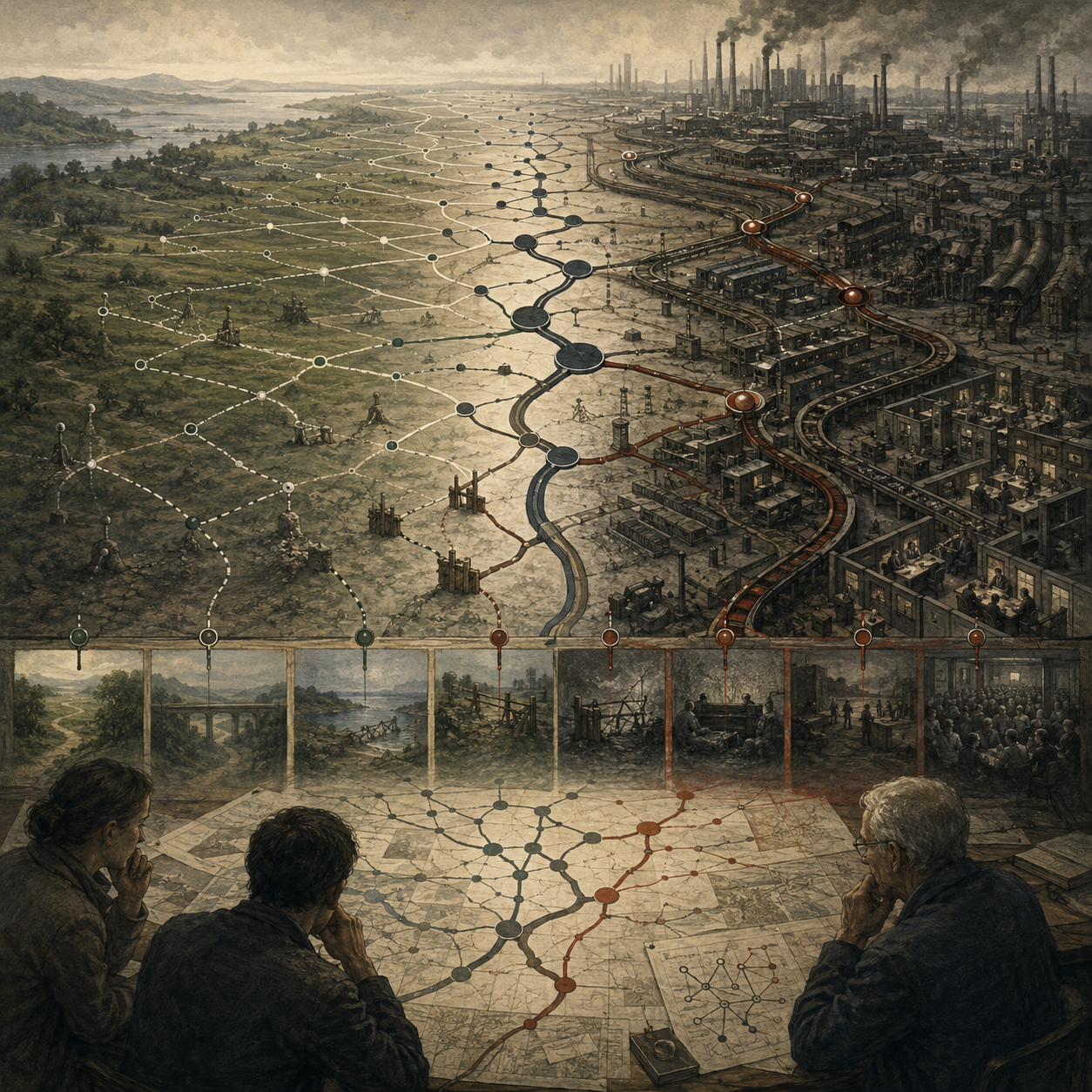
Why Path Dependence Matters
Path dependence matters because decisions accumulate. A choice made today can change the costs, incentives, expectations, relationships, and constraints that govern tomorrow’s choices. The result is that future options are not independent of past action. They are shaped by infrastructure already built, contracts already signed, skills already developed, institutions already organized, and habits already normalized.
This is especially important in complex systems. A decision can produce feedback effects that make the original path easier to continue and harder to abandon. Once investments, routines, standards, stakeholder expectations, and political commitments form around a path, alternatives may remain theoretically possible but practically difficult.
Decision science often asks which option is best. Path dependence adds another question: which option changes the future choice set in ways that will be difficult to reverse?
| Decision concern | Path-dependent risk |
|---|---|
| A decision appears low-cost now. | Future switching costs may become large. |
| A temporary solution becomes convenient. | The workaround may become embedded as standard practice. |
| Early infrastructure is built around one model. | Future alternatives must fit the original architecture. |
| Stakeholders adapt to current incentives. | Changing the system later creates resistance and losses. |
| A dominant technology or standard emerges. | Network effects can lock out superior alternatives. |
| Institutions invest in specialized capacity. | Capabilities become aligned with one path and weak elsewhere. |
Path dependence is not only a historical concept. It is a forward-looking decision problem.
What Is Path Dependence?
Path dependence describes situations where the sequence of earlier events influences later outcomes. In a path-dependent system, history matters. The same decision made at a different time, after different investments or expectations have formed, may have a different cost, effect, or feasibility.
Path dependence does not mean that the past mechanically determines the future. It means that earlier choices create conditions that make some later paths easier, more attractive, more legitimate, or more likely than others. The system develops momentum.
Path dependence becomes especially important when early choices produce self-reinforcing effects. These effects may come from learning, coordination, network effects, sunk costs, stakeholder expectations, specialized infrastructure, legal rules, habits, or institutional identity. Over time, the path becomes less like a choice and more like the environment within which future choices are made.
| Path-dependence source | How it works | Decision implication |
|---|---|---|
| Learning effects | Users and institutions improve at using the existing path. | Alternatives face adoption barriers even if technically better. |
| Coordination effects | People align behavior around shared standards. | Changing paths requires collective movement, not individual choice alone. |
| Network effects | The value of a path rises as more actors use it. | Dominant systems can become hard to displace. |
| Sunk costs | Past investments make abandonment psychologically or politically difficult. | Decision-makers may continue a poor path to justify earlier costs. |
| Institutional routines | Rules, roles, and workflows reinforce current practice. | Change requires redesigning governance, not only selecting a new option. |
| Expectations | Stakeholders plan around the existing path. | Reversal can create legitimacy, fairness, or compensation issues. |
A path-dependent decision is therefore not only a choice among options. It is a choice about which future constraints to create.
Lock-In and Irreversibility
Lock-in occurs when a system becomes difficult to redirect because costs, dependencies, incentives, or expectations have accumulated around one path. Lock-in can be technical, economic, institutional, behavioral, political, or cultural. It does not always mean change is impossible. It means change has become costly, contested, slow, or risky.
Irreversibility is related but stronger. Some decisions cannot be fully undone. A destroyed ecosystem, built environment, long-lived infrastructure asset, legal precedent, displaced community, specialized platform dependency, or accumulated emissions burden may continue shaping future conditions even if decision-makers later regret the original choice.
Decision timing matters because lock-in is often easiest to prevent early and hardest to correct late. Once the system has reorganized around a path, the decision problem shifts from selection to escape.
| Lock-in type | Example mechanism | Decision risk |
|---|---|---|
| Technical lock-in | Systems are built around one architecture, platform, or standard. | Later integration or migration becomes expensive. |
| Economic lock-in | Capital investment, contracts, and supply chains favor continuation. | Poor options persist because exit costs are high. |
| Institutional lock-in | Rules, budgets, roles, and authority structures reinforce a path. | Reform requires changing governance, not only policy language. |
| Behavioral lock-in | Habits, expectations, identity, and convenience shape behavior. | People resist alternatives even when benefits are plausible. |
| Political lock-in | Coalitions form around existing benefits and entitlements. | Changing course creates visible losses and organized resistance. |
| Infrastructure lock-in | Long-lived assets shape land use, mobility, energy, or service delivery. | Future choices must operate within physical constraints already built. |
Lock-in is dangerous because it can make the easiest decision later the continuation of a poor decision earlier.
Decision Timing
Decision timing concerns when to act, wait, reverse, accelerate, scale, pause, or preserve options. Timing is not secondary to decision quality. In path-dependent systems, the same action can have different consequences depending on whether it occurs before or after commitments, investments, expectations, and feedback loops have formed.
Acting early can preserve strategic advantage, prevent lock-in, reduce future switching costs, and shape standards before they harden. But acting too early can also commit resources before uncertainty has clarified. Waiting can preserve information value, but waiting can also allow default paths to become entrenched.
The timing problem is therefore a balance between information value and commitment risk. Decision-makers must ask whether additional information is worth the cost of delay and whether delay itself is changing the future choice set.
| Timing choice | Potential value | Potential risk |
|---|---|---|
| Act early | Shapes future standards, prevents lock-in, captures opportunity. | May commit before uncertainty is understood. |
| Wait | Preserves information value and avoids premature commitment. | May allow default systems to harden and options to close. |
| Pilot | Creates learning without full commitment. | May become permanent without review. |
| Stage investment | Combines action with future revision. | Requires governance discipline and trigger points. |
| Build modularly | Preserves future substitution and expansion. | May cost more upfront than narrow optimization. |
| Reverse course | Stops deepening a poor path. | May generate transition costs, political resistance, and sunk-cost conflict. |
Timing is a decision variable. Choosing when to decide is itself a decision that can create or reduce lock-in.
Increasing Returns and Self-Reinforcing Dynamics
Increasing returns occur when the benefits of continuing a path grow as the path is used more. This is one of the strongest sources of path dependence. The more actors invest in a standard, technology, route, institution, platform, or routine, the more valuable that path becomes relative to alternatives.
Increasing returns can come from learning curves, scale economies, network effects, coordination benefits, complementary investments, data accumulation, political coalitions, and institutional familiarity. These effects can be useful when the chosen path is desirable. They can be harmful when they reinforce a path that is inefficient, unjust, fragile, or outdated.
Decision-makers should therefore distinguish between beneficial commitment and dangerous lock-in. Commitment can create focus, capability, and coordination. Lock-in becomes dangerous when the system keeps reinforcing a path even after better alternatives or changing conditions appear.
| Increasing-return mechanism | How it reinforces the path | Decision warning |
|---|---|---|
| Learning curve | Users and organizations become more skilled with the current path. | Competence with the old system may be mistaken for superiority. |
| Network effect | More users increase the value of the existing platform or standard. | Alternatives struggle even when technically promising. |
| Complementary investment | Other systems are built around the current path. | Switching requires replacing an ecosystem, not one component. |
| Political coalition | Beneficiaries organize to preserve the path. | Change creates visible losers and institutional resistance. |
| Data accumulation | Existing systems improve because they collect more data. | Early adoption advantages can compound into dominance. |
| Standardization | Processes and rules align around one approach. | Alternatives are judged as deviations rather than possibilities. |
Increasing returns are powerful because they turn time into momentum.
Sunk Costs and Switching Costs
Sunk costs are past investments that cannot be recovered. Rationally, sunk costs should not determine future decisions. But psychologically, institutionally, and politically, they often do. Decision-makers continue a path because abandoning it would expose earlier mistakes, waste, or overcommitment.
Switching costs are different. They are the real costs of moving from one path to another. They may include retraining, migration, redesign, compensation, contract renegotiation, transition risk, interoperability problems, political conflict, lost productivity, or temporary service disruption.
Good decision-making separates sunk-cost bias from genuine switching costs. The fact that money has already been spent is not a reason to continue a failing path. But the cost and risk of switching must still be evaluated honestly.
| Cost type | Meaning | Decision treatment |
|---|---|---|
| Sunk cost | Past investment that cannot be recovered. | Should not justify continuing a poor option. |
| Switching cost | Future cost of changing paths. | Should be included in transition analysis. |
| Opportunity cost | Value of options lost by staying on the current path. | Should be compared against switching cost. |
| Transition cost | Temporary disruption during migration or reform. | Should be managed through staging and fallback options. |
| Lock-in cost | Future burden created by continuing the path. | Should be modeled over time, not treated as static. |
| Reputational cost | Loss of credibility from reversal or admitted error. | Should be weighed against the cost of denial and delay. |
The sunk-cost problem is emotional and political. The switching-cost problem is strategic. Confusing them leads to poor decisions.
Institutional Lock-In
Institutional lock-in occurs when rules, budgets, authority structures, metrics, norms, professional identities, procurement systems, and organizational routines reinforce a path. The institution becomes organized around the current decision architecture.
This type of lock-in is often harder to see than technical lock-in because it appears as normal procedure. People say, “This is how we do things,” “the budget line already exists,” “the reporting system requires it,” “the contract is already written,” or “the policy does not allow that.” These statements may describe real constraints, but they may also reveal accumulated path dependence.
Institutional lock-in matters because even a technically superior alternative may fail if the institution lacks authority, skills, incentives, or legitimacy to adopt it.
| Institutional mechanism | How it locks in decisions | Reform requirement |
|---|---|---|
| Budget structure | Funding categories preserve old priorities. | Redesign allocation rules and long-term funding logic. |
| Procurement rules | Approved vendors or standards favor existing systems. | Allow modular procurement and interoperability criteria. |
| Performance metrics | Staff optimize for indicators tied to the current path. | Change measures before expecting behavior to change. |
| Professional identity | Expertise and status are tied to existing methods. | Support retraining, role redesign, and transition legitimacy. |
| Governance authority | No actor has authority to change the whole system. | Create cross-boundary decision rights and escalation paths. |
| Legal commitments | Contracts, regulations, or mandates preserve the path. | Review legal exit, amendment, and transition options. |
Institutional lock-in shows why changing a decision often requires changing the decision system.
Technology and Infrastructure Lock-In
Technology and infrastructure decisions are especially prone to lock-in because they create physical, digital, operational, and financial dependencies. Once roads, energy systems, platforms, data architectures, buildings, ports, pipelines, software systems, or standards are built, future decisions must work around them.
Infrastructure lock-in is powerful because assets last. A decision made for current conditions may shape land use, emissions, accessibility, maintenance burdens, service patterns, and fiscal obligations for decades. Technology lock-in is powerful because standards, data, integration, training, and vendor ecosystems can make migration difficult.
Decision-makers should therefore evaluate not only immediate functionality, but lifecycle flexibility, interoperability, modularity, exit paths, upgrade paths, maintenance obligations, and future compatibility.
| Design feature | Lock-in risk if ignored | Better decision practice |
|---|---|---|
| Interoperability | Systems cannot connect with future alternatives. | Use open standards and integration requirements. |
| Modularity | One component failure requires full replacement. | Design components that can be replaced or upgraded. |
| Exit path | Vendor, platform, or asset dependency becomes permanent. | Define migration rights, data portability, and contract exits. |
| Lifecycle cost | Short-term savings create long-term maintenance burdens. | Evaluate total cost across the asset life. |
| Scenario compatibility | Assets perform poorly under future conditions. | Test against demand, climate, technology, and policy scenarios. |
| Upgrade path | The system cannot adapt without major disruption. | Plan staged renewal and future compatibility from the start. |
Infrastructure and technology choices should be judged partly by how much future freedom they preserve.
Behavioral Lock-In
Behavioral lock-in occurs when habits, routines, identity, convenience, attention, loss aversion, status quo bias, and social norms make change difficult. People may remain with an existing path not because it is best, but because changing requires effort, uncertainty, coordination, or psychological discomfort.
Behavioral lock-in can reinforce technical and institutional lock-in. Once users learn a system, build routines around it, and identify with it, alternatives face resistance. Even when a new path is better in principle, adoption can fail if it requires too much friction or if people experience the change as loss rather than improvement.
Decision science must therefore account for the human side of timing. Early adoption support, communication, transition design, training, participation, and visible fairness can reduce behavioral lock-in. Ignoring these factors can turn a technically sound decision into an implementation failure.
| Behavioral factor | Lock-in effect | Decision response |
|---|---|---|
| Status quo bias | Existing arrangements feel safer than alternatives. | Frame change around concrete gains and protected functions. |
| Loss aversion | Potential losses loom larger than future benefits. | Identify losses, compensation, transition support, and fairness. |
| Habit formation | Repeated behavior becomes difficult to replace. | Design low-friction transition steps. |
| Identity attachment | Existing practices become tied to professional or group identity. | Respect identity while redesigning roles and narratives. |
| Coordination difficulty | Individuals hesitate unless others move too. | Use standards, shared timelines, and collective transition plans. |
| Uncertainty avoidance | Unknown alternatives feel riskier than known problems. | Use pilots, demonstrations, and staged commitments. |
Behavioral lock-in shows why decision timing is also a communication and transition problem.
Strategic Windows and Critical Junctures
Strategic windows are periods when a system is more open to change than usual. Critical junctures are moments when choices have unusually large long-term consequences because the system has not yet settled into a stable path or because disruption has weakened existing lock-in.
These moments can emerge after crises, technological shifts, policy reforms, leadership transitions, budget changes, public attention, litigation, market disruption, infrastructure renewal cycles, or social mobilization. During such windows, decisions that would normally be impossible may become feasible.
The challenge is that windows can close. If decision-makers do not recognize the timing opportunity, default paths may reassert themselves. If they act without preparation, they may waste the window on symbolic action. Strategic timing requires readiness before the window appears.
| Strategic window source | Why it opens change | Decision requirement |
|---|---|---|
| Crisis | Existing assumptions lose legitimacy. | Have credible alternatives ready before urgency peaks. |
| Technology transition | Old standards become unstable or incomplete. | Shape interoperability, governance, and adoption rules early. |
| Infrastructure renewal | Replacement cycles create rare redesign opportunities. | Evaluate future scenarios before rebuilding the old path. |
| Policy reform | Rules and incentives are open for revision. | Align legal change with implementation capacity. |
| Leadership transition | New authority can question inherited commitments. | Use decision records and path-dependence audits. |
| Public attention | Previously invisible problems become contestable. | Connect attention to durable governance change. |
Critical timing moments matter because systems do not remain equally changeable over time.
Path Creation and Strategic Agency
Path dependence can sound deterministic, but decision-makers are not powerless. Paths can be created, redirected, weakened, widened, or escaped. Strategic agency lies in understanding when the system is flexible, where lock-in is forming, which investments create future options, and which commitments should be avoided until uncertainty clarifies.
Path creation means deliberately shaping future possibilities. This may involve creating new standards, investing in alternative capabilities, building coalitions, piloting modular systems, preserving interoperability, changing incentives, or designing institutions that can revise themselves.
The goal is not to avoid commitment altogether. No strategy can remain completely flexible forever. The goal is to commit wisely: deepen paths that are robust and desirable, avoid paths that create fragile dependency, and preserve options where uncertainty is high.
| Path-creation practice | Purpose |
|---|---|
| Build option value. | Preserve future alternatives while uncertainty remains high. |
| Invest modularly. | Allow future components to be replaced, expanded, or redirected. |
| Create competing pilots. | Prevent premature convergence around one untested path. |
| Set review triggers. | Define when the path should be reassessed before lock-in deepens. |
| Design exit rights. | Reduce the cost of changing vendors, standards, contracts, or policies. |
| Preserve institutional memory. | Ensure future decision-makers understand why the path was chosen. |
Strategic agency depends on recognizing that present decisions are also designs for future decision freedom.
Governance and Accountability
Path-dependent decisions require governance because their consequences may unfold long after the original decision-makers have left. Without documentation, institutions may forget why a path was chosen, which alternatives were rejected, what risks were accepted, and what conditions should trigger reassessment.
Accountable governance should include path-dependence audits, lock-in risk assessments, decision records, switching-cost estimates, exit-path design, stakeholder impact review, and scheduled reassessment. These practices make it harder for institutions to drift into lock-in without noticing.
Governance should also distinguish commitment from entrenchment. Some commitments are necessary for strategy. But commitments should be explicit, justified, and revisable when assumptions fail.
| Governance practice | Accountability value |
|---|---|
| Path-dependence audit | Identifies how past decisions constrain present options. |
| Lock-in risk register | Documents technical, institutional, economic, political, and behavioral lock-in risks. |
| Switching-cost analysis | Separates real transition costs from sunk-cost bias. |
| Exit-path design | Preserves the ability to change course later. |
| Decision record | Preserves assumptions, alternatives, dissent, and rationale. |
| Review trigger | Defines when commitment should be reassessed. |
| Stakeholder transition plan | Accounts for those who depend on the current path. |
Path-dependent accountability means documenting not only what was chosen, but what future constraints the choice creates.
Applications Across Decision Contexts
Path dependence, lock-in, and decision timing appear across technology, infrastructure, public policy, climate strategy, organizational design, healthcare, finance, education, energy systems, and AI governance. In each domain, early choices can shape later constraints.
| Domain | Path-dependent issue | Decision response |
|---|---|---|
| Infrastructure planning | Long-lived assets shape land use, mobility, maintenance, and emissions. | Use lifecycle analysis, modular design, and scenario stress testing. |
| Climate transition | Fossil fuel systems, buildings, transport, and industrial assets create carbon lock-in. | Evaluate stranded asset risk, transition timing, and future compatibility. |
| AI governance | Early automation decisions shape data, oversight, user behavior, and dependency. | Use staged deployment, audit rights, fallback rules, and exit paths. |
| Organizational strategy | Capabilities, incentives, culture, and metrics reinforce existing strategy. | Review strategic drift, capability lock-in, and path-creation opportunities. |
| Healthcare systems | Payment models, capacity investments, and workflows shape future care pathways. | Analyze patient-flow lock-in, workforce capacity, and transition costs. |
| Public policy | Programs create constituencies, expectations, administrative routines, and legal constraints. | Use sunset reviews, adaptive legislation, and equity transition planning. |
| Technology procurement | Vendor ecosystems and data formats create migration barriers. | Require portability, interoperability, and contract exit provisions. |
Across contexts, the key question is whether today’s decision preserves, narrows, or closes future options.
Limitations and Challenges
Path dependence is a powerful concept, but it can be overused. Not every historical influence is lock-in. Not every continuation is irrational. Sometimes staying on a path is wise because it is effective, legitimate, stable, or less risky than transition. The challenge is to distinguish beneficial continuity from harmful entrenchment.
Path dependence can also encourage fatalism. If decision-makers believe the system is locked in, they may stop looking for strategic windows, modular alternatives, coalition shifts, or staged transitions. But lock-in is often partial. Even deeply entrenched systems may have points of leverage.
Another challenge is evidence. Lock-in costs may be hidden until alternatives are attempted. Switching costs can be overstated by incumbents or understated by reformers. Decision-makers need careful analysis that separates real constraints from strategic exaggeration.
| Limitation | Why it matters | Better practice |
|---|---|---|
| Overdiagnosing lock-in | Normal continuity is mistaken for harmful entrenchment. | Compare performance, exit costs, and future risk explicitly. |
| Fatalism | Decision-makers assume change is impossible. | Identify strategic windows, modular transitions, and partial exits. |
| Sunk-cost confusion | Past spending is treated as a reason to continue. | Separate sunk costs from real future switching costs. |
| Underestimated transition cost | Reform appears easier than it is. | Model migration, retraining, disruption, and stakeholder losses. |
| Ignoring affected stakeholders | Path changes create concentrated losses and legitimacy problems. | Include transition support, participation, and fairness review. |
| No timing analysis | Decisions are evaluated without considering when action is feasible. | Assess windows, thresholds, delay costs, and option value. |
The purpose of path-dependence analysis is not to prove that history controls everything. It is to improve judgment about when history matters enough to change the decision.
Summary Table: Path Dependence, Lock-In, and Decision Timing
The table below summarizes the major concepts involved in path-dependent decision-making.
| Concept | Core question | Decision value |
|---|---|---|
| Path dependence | How do past choices shape present and future options? | Reveals historical constraints on current decision-making. |
| Lock-in | Which paths are becoming difficult to reverse? | Identifies technical, economic, institutional, and behavioral entrenchment. |
| Decision timing | When should decision-makers act, wait, stage, or reverse? | Balances information value against commitment risk. |
| Increasing returns | Which paths become stronger as they are used? | Identifies self-reinforcing dynamics. |
| Switching costs | What would it cost to change paths later? | Clarifies transition feasibility and future flexibility. |
| Critical juncture | When is the system unusually open to change? | Helps decision-makers act during windows of opportunity. |
| Path creation | How can present action shape future options? | Turns strategy into deliberate future-option design. |
| Decision record | What assumptions, constraints, and exit paths were documented? | Supports accountability when consequences unfold later. |
Path-dependent decision-making turns attention from isolated choice to the future constraints created by the sequence of choices.
Examples Across Decision Contexts
Path dependence becomes visible when early commitments shape future feasibility, incentives, and cost.
Technology procurement
A public agency chooses a proprietary platform because it is fast to deploy. Over time, data formats, staff training, vendor integrations, and reporting workflows make switching costly.
Infrastructure expansion
A region builds transportation infrastructure around one mobility pattern. Land use, housing, commuting, maintenance, and emissions then reinforce the original design.
Climate transition
Long-lived fossil fuel assets create future dependence through capital investment, workforce skills, contracts, political coalitions, and complementary infrastructure.
AI deployment
An organization automates a workflow before governance is mature. Later, data pipelines, staff roles, user expectations, and performance metrics assume the automated process.
Organizational strategy
A company builds capabilities around one market thesis. Hiring, incentives, partnerships, culture, and reporting systems then make alternative strategies harder to pursue.
Public policy programs
A temporary program becomes permanent as beneficiaries, administrators, contractors, and political constituencies organize around its continuation.
These examples show that lock-in is rarely caused by one factor. It emerges from the accumulation of reinforcing commitments.
Mathematical Lens: Path Dependence, Switching Costs, and Timing
The mathematical lens helps clarify why path-dependent decisions cannot be evaluated only by present utility. A choice changes the future state of the decision system.
x_{t+1}=f(x_t,a_t)
\]
Path-dependent state update: The future state \(x_{t+1}\) depends on the current state \(x_t\) and the action \(a_t\).
A choice can also change future switching costs:
C_{\text{switch}}(t+1)=C_{\text{switch}}(t)+\alpha I_t+\beta N_t+\gamma R_t
\]
Switching-cost accumulation: Switching costs rise with investment \(I_t\), network dependence \(N_t\), and institutional routine \(R_t\).
Lock-in can be represented by comparing the value of staying with the value of switching after transition costs:
\text{LockIn}(t)=\mathbb{1}\{V_{\text{stay}}(t) \geq V_{\text{switch}}(t)-C_{\text{switch}}(t)\}
\]
Lock-in condition: A system tends to remain on the current path when staying appears better than switching after transition costs are included.
Decision timing can be represented as a trade-off between information value and delay cost:
\text{WaitValue}=E[V(a|I_{t+1})]-E[V(a|I_t)]-C_{\text{delay}}
\]
Value of waiting: Waiting is valuable when the expected value of additional information exceeds the cost of delay.
But delay can also deepen lock-in:
C_{\text{delay}}=C_{\text{opportunity}}+C_{\text{lock-in growth}}+C_{\text{threshold risk}}
\]
Delay cost: Delay may create opportunity loss, deeper lock-in, or rising threshold risk.
A staged decision can be represented as:
a_t =
\begin{cases}
a_1, & x_t < \tau_1 \\
a_2, & \tau_1 \leq x_t < \tau_2 \\
a_3, & x_t \geq \tau_2
\end{cases}
\]
Staged timing rule: The chosen action changes when the system crosses defined thresholds.
| Mathematical object | Meaning | Decision interpretation |
|---|---|---|
| \(x_t\) | System state at time \(t\). | The current condition shaped by earlier decisions. |
| \(a_t\) | Action at time \(t\). | The decision that changes the future state. |
| \(C_{\text{switch}}\) | Cost of changing paths. | The transition burden created by accumulated commitments. |
| \(I_t\) | Investment level. | Capital, training, infrastructure, or capability committed to the path. |
| \(N_t\) | Network dependence. | The degree to which other actors or systems rely on the current path. |
| \(R_t\) | Institutional routine. | The degree to which rules and workflows reinforce the path. |
| \(\tau\) | Threshold. | A trigger point for switching, review, or escalation. |
The mathematical lesson is that timing changes the decision problem because waiting, investing, and continuing can alter future switching costs and available options.
R Workflow: Comparing Timing, Lock-In, and Switching Costs
The R workflow below compares stylized decision paths using initial value, future flexibility, switching cost, lock-in risk, reversibility, and timing sensitivity. It uses base R so it can run without additional package installation.
# path_dependence_lock_in_decision_timing_workflow.R
# Base R workflow for path dependence, lock-in, and decision timing:
# strategy comparison, switching costs, lock-in risk,
# timing sensitivity, and generated outputs.

args <- commandArgs(trailingOnly = FALSE)
file_arg <- grep("^--file=", args, value = TRUE)

if (length(file_arg) > 0) {
  script_path <- normalizePath(sub("^--file=", "", file_arg[1]), mustWork = TRUE)
  article_root <- normalizePath(file.path(dirname(script_path), ".."), mustWork = TRUE)
} else {
  article_root <- getwd()
}

setwd(article_root)

tables_dir <- file.path(article_root, "outputs", "tables")
figures_dir <- file.path(article_root, "outputs", "figures")
dir.create(tables_dir, recursive = TRUE, showWarnings = FALSE)
dir.create(figures_dir, recursive = TRUE, showWarnings = FALSE)

paths <- data.frame(
  path = c(
    "Fast Commitment Path",
    "Wait-and-Learn Path",
    "Modular Staged Path",
    "Legacy Continuation Path",
    "Transformative Switch Path",
    "Dual-Track Option Path"
  ),
  initial_value = c(0.78, 0.62, 0.74, 0.66, 0.70, 0.72),
  future_flexibility = c(0.32, 0.84, 0.82, 0.28, 0.58, 0.88),
  switching_cost = c(0.74, 0.30, 0.42, 0.68, 0.61, 0.36),
  lock_in_risk = c(0.81, 0.34, 0.38, 0.76, 0.58, 0.29),
  reversibility = c(0.26, 0.80, 0.78, 0.24, 0.52, 0.86),
  timing_sensitivity = c(0.69, 0.72, 0.48, 0.57, 0.81, 0.45),
  stringsAsFactors = FALSE
)

paths$path_quality_score <- (
  0.24 * paths$initial_value +
    0.24 * paths$future_flexibility -
    0.16 * paths$switching_cost -
    0.18 * paths$lock_in_risk +
    0.14 * paths$reversibility -
    0.04 * paths$timing_sensitivity
)

paths$review_flag <- ifelse(
  paths$switching_cost > 0.65 |
    paths$lock_in_risk > 0.70 |
    paths$reversibility < 0.35,
  "review",
  "acceptable"
)

scenario_performance <- data.frame(
  path = rep(paths$path, each = 5),
  scenario = rep(
    c("stable_future", "technology_shift", "policy_change", "demand_shock", "late_switch_required"),
    times = nrow(paths)
  ),
  performance = c(
    0.82, 0.44, 0.46, 0.50, 0.32,
    0.66, 0.76, 0.72, 0.70, 0.74,
    0.78, 0.80, 0.76, 0.74, 0.78,
    0.70, 0.42, 0.40, 0.46, 0.30,
    0.72, 0.78, 0.70, 0.68, 0.64,
    0.74, 0.82, 0.80, 0.76, 0.84
  ),
  stringsAsFactors = FALSE
)

scenario_split <- split(scenario_performance$performance, scenario_performance$path)

scenario_summary <- data.frame(
  path = names(scenario_split),
  average_scenario_performance = as.numeric(sapply(scenario_split, mean)),
  worst_case_performance = as.numeric(sapply(scenario_split, min)),
  performance_range = as.numeric(sapply(scenario_split, function(x) max(x) - min(x))),
  threshold_pass_rate = as.numeric(sapply(scenario_split, function(x) mean(x >= 0.70))),
  stringsAsFactors = FALSE
)

results <- merge(paths, scenario_summary, by = "path")

results$timing_adjusted_score <- (
  0.30 * results$path_quality_score +
    0.24 * results$average_scenario_performance +
    0.22 * results$worst_case_performance +
    0.18 * results$threshold_pass_rate -
    0.06 * results$performance_range
)

results$review_flag <- ifelse(
  results$review_flag == "review" |
    results$worst_case_performance < 0.55 |
    results$threshold_pass_rate < 0.60,
  "review",
  "acceptable"
)

results$rank <- rank(-results$timing_adjusted_score, ties.method = "min")
results <- results[order(results$rank), ]

write.csv(paths, file.path(tables_dir, "path_dependence_profiles.csv"), row.names = FALSE)
write.csv(scenario_performance, file.path(tables_dir, "path_dependence_scenario_performance.csv"), row.names = FALSE)
write.csv(scenario_summary, file.path(tables_dir, "path_dependence_scenario_summary.csv"), row.names = FALSE)
write.csv(results, file.path(tables_dir, "path_dependence_decision_results.csv"), row.names = FALSE)

png(file.path(figures_dir, "path_dependence_timing_adjusted_scores.png"), width = 1200, height = 800)
barplot(
  results$timing_adjusted_score,
  names.arg = results$path,
  las = 2,
  main = "Timing-Adjusted Path Decision Score",
  ylab = "Score"
)
grid()
dev.off()

png(file.path(figures_dir, "lock_in_risk_by_path.png"), width = 1200, height = 800)
barplot(
  results$lock_in_risk,
  names.arg = results$path,
  las = 2,
  main = "Lock-In Risk by Path",
  ylab = "Lock-in risk"
)
grid()
dev.off()

print(results)
This workflow shows why the best-looking immediate path may not be the best strategic path. A decision with strong early value can become fragile if it creates high lock-in risk, weak reversibility, and poor performance when late switching becomes necessary.
Python Workflow: Simulating Path Dependence and Lock-In
The Python workflow below uses only the standard library. It simulates how investment, network dependence, institutional routine, and switching costs accumulate over time. It exports time-series results, summary metrics, and a decision record.
# path_dependence_lock_in_decision_timing_simulation.py
# Standard-library workflow for path dependence, lock-in, and decision timing:
# switching-cost accumulation, lock-in risk, timing review,
# and decision-record export.

from __future__ import annotations

from pathlib import Path
import csv
import json
import random
from statistics import mean

ARTICLE_ROOT = Path(__file__).resolve().parents[1]
TABLES = ARTICLE_ROOT / "outputs" / "tables"
RECORDS = ARTICLE_ROOT / "outputs" / "decision_records"

RANDOM_SEED = 42
TIME_STEPS = 50
LOCK_IN_THRESHOLD = 0.72


def simulate_path_dependence() -> list[dict[str, object]]:
    random.seed(RANDOM_SEED)

    investment = 0.20
    network_dependence = 0.18
    institutional_routine = 0.22
    option_value = 0.84
    rows: list[dict[str, object]] = []

    for time in range(1, TIME_STEPS + 1):
        investment_growth = max(0.0, random.gauss(0.018, 0.006))
        network_growth = max(0.0, random.gauss(0.016, 0.007))
        routine_growth = max(0.0, random.gauss(0.014, 0.005))
        option_decay = max(0.0, random.gauss(0.010, 0.004))

        investment = min(1.0, investment + investment_growth)
        network_dependence = min(1.0, network_dependence + network_growth + 0.015 * investment)
        institutional_routine = min(1.0, institutional_routine + routine_growth + 0.010 * network_dependence)
        option_value = max(0.0, option_value - option_decay - 0.006 * institutional_routine)

        switching_cost = (
            0.36 * investment +
            0.34 * network_dependence +
            0.30 * institutional_routine
        )

        lock_in_risk = (
            0.42 * switching_cost +
            0.28 * institutional_routine +
            0.20 * network_dependence -
            0.10 * option_value
        )

        review_trigger = lock_in_risk >= LOCK_IN_THRESHOLD or option_value <= 0.35

        rows.append({
            "time": time,
            "investment": round(investment, 6),
            "network_dependence": round(network_dependence, 6),
            "institutional_routine": round(institutional_routine, 6),
            "option_value": round(option_value, 6),
            "switching_cost": round(switching_cost, 6),
            "lock_in_risk": round(lock_in_risk, 6),
            "review_trigger": review_trigger,
        })

    return rows


def summarize(rows: list[dict[str, object]]) -> list[dict[str, object]]:
    switching_costs = [float(row["switching_cost"]) for row in rows]
    lock_in_risks = [float(row["lock_in_risk"]) for row in rows]
    option_values = [float(row["option_value"]) for row in rows]
    review_rows = [row for row in rows if bool(row["review_trigger"])]

    return [
        {"metric": "final_switching_cost", "value": round(switching_costs[-1], 6)},
        {"metric": "peak_switching_cost", "value": round(max(switching_costs), 6)},
        {"metric": "average_switching_cost", "value": round(mean(switching_costs), 6)},
        {"metric": "final_lock_in_risk", "value": round(lock_in_risks[-1], 6)},
        {"metric": "peak_lock_in_risk", "value": round(max(lock_in_risks), 6)},
        {"metric": "final_option_value", "value": round(option_values[-1], 6)},
        {"metric": "minimum_option_value", "value": round(min(option_values), 6)},
        {"metric": "review_trigger_count", "value": len(review_rows)},
        {"metric": "review_trigger_rate", "value": round(len(review_rows) / len(rows), 6)},
    ]


def interpret(summary_rows: list[dict[str, object]]) -> str:
    metrics = {str(row["metric"]): float(row["value"]) for row in summary_rows}

    if metrics["review_trigger_rate"] > 0.25:
        return "redesign_path_before_lock_in_deepens"
    if metrics["final_option_value"] < 0.35:
        return "restore_option_value_and_define_exit_path"
    if metrics["final_switching_cost"] > 0.70:
        return "audit_switching_costs_and_stage_transition"
    return "continue_with_monitoring_and_timing_review"


def write_csv(path: Path, rows: list[dict[str, object]]) -> None:
    path.parent.mkdir(parents=True, exist_ok=True)
    if not rows:
        raise ValueError(f"No rows to write: {path}")
    with path.open("w", encoding="utf-8", newline="") as handle:
        writer = csv.DictWriter(handle, fieldnames=list(rows[0].keys()))
        writer.writeheader()
        writer.writerows(rows)


def write_json(path: Path, payload: dict[str, object]) -> None:
    path.parent.mkdir(parents=True, exist_ok=True)
    path.write_text(json.dumps(payload, indent=2), encoding="utf-8")


def main() -> None:
    rows = simulate_path_dependence()
    summary_rows = summarize(rows)
    recommendation = interpret(summary_rows)

    write_csv(TABLES / "path_dependence_lock_in_timeseries.csv", rows)
    write_csv(TABLES / "path_dependence_lock_in_summary.csv", summary_rows)

    write_json(
        RECORDS / "path_dependence_decision_record.json",
        {
            "article": "Path Dependence, Lock-In, and Decision Timing",
            "decision_context": "Simulating switching-cost accumulation, lock-in risk, option-value decline, and timing review.",
            "random_seed": RANDOM_SEED,
            "time_steps": TIME_STEPS,
            "lock_in_threshold": LOCK_IN_THRESHOLD,
            "summary_metrics": summary_rows,
            "recommendation": recommendation,
            "modeling_principles": [
                "Earlier choices can change the future choice set.",
                "Switching costs can accumulate through investment, network dependence, and institutional routine.",
                "Delay can reduce option value even when no formal decision is made.",
                "Lock-in risk should trigger review before escape becomes prohibitively costly.",
                "Decision records should preserve timing assumptions, exit paths, and lock-in risks."
            ],
        },
    )

    print("Path dependence, lock-in, and decision timing simulation complete.")
    print(TABLES / "path_dependence_lock_in_timeseries.csv")
    print(TABLES / "path_dependence_lock_in_summary.csv")
    print(RECORDS / "path_dependence_decision_record.json")


if __name__ == "__main__":
    main()
This workflow illustrates the article’s central point: lock-in can emerge gradually from ordinary investments, routines, dependencies, and delays. By the time the problem is obvious, the cost of changing course may already be high.
GitHub Repository
The companion repository for this article supports reproducible exploration of path dependence, lock-in, decision timing, switching costs, option value, institutional routine, network dependence, timing review, scenario comparison, and decision-record documentation.
Complete Code Repository
Companion repository for the article, including Python, R, Julia, SQL, Rust, Go, C++, Fortran, C, documentation, synthetic datasets, generated outputs, notebook placeholders, switching-cost simulations, path-dependence tables, lock-in risk summaries, timing-review outputs, and decision-record scaffolds.
articles/path-dependence-lock-in-and-decision-timing/
├── python/
│   ├── path_dependence_lock_in_decision_timing_simulation.py
│   ├── switching_cost_model.py
│   ├── lock_in_risk_model.py
│   ├── option_value_decay_model.py
│   ├── timing_review_model.py
│   ├── path_strategy_comparison.py
│   ├── decision_record_exporter.py
│   └── run_all_path_dependence_workflows.py
├── r/
│   ├── path_dependence_lock_in_decision_timing_workflow.R
│   ├── path_profiles.R
│   ├── scenario_performance.R
│   ├── lock_in_review_tables.R
│   ├── timing_summary.R
│   └── run_all_path_dependence_workflows.R
├── julia/
│   ├── high_performance_path_dependence_scan.jl
│   ├── switching_cost_model.jl
│   └── lock_in_risk_model.jl
├── sql/
│   ├── schema_path_dependence_lock_in_decision_timing.sql
│   ├── paths.sql
│   ├── scenarios.sql
│   ├── path_scores.sql
│   ├── scenario_performance.sql
│   ├── decision_records.sql
│   └── sample_queries.sql
├── rust/
│   └── path_dependence_cli.rs
├── go/
│   └── path_dependence_runner.go
├── cpp/
│   ├── switching_cost_core.cpp
│   └── lock_in_risk_core.cpp
├── fortran/
│   └── numerical_path_dependence_model.f90
├── c/
│   └── path_dependence_core.c
├── docs/
│   ├── article_notes.md
│   ├── modeling_principles.md
│   ├── path_dependence.md
│   ├── lock_in.md
│   ├── decision_timing.md
│   ├── switching_costs.md
│   ├── critical_junctures.md
│   ├── governance_and_accountability.md
│   ├── responsible_use.md
│   └── assumptions_and_limitations.md
├── data/
│   ├── synthetic_path_profiles.csv
│   ├── synthetic_scenarios.csv
│   ├── synthetic_scenario_performance.csv
│   ├── synthetic_thresholds.csv
│   ├── synthetic_system_parameters.csv
│   └── synthetic_decision_records.csv
├── outputs/
│   ├── README.md
│   ├── figures/
│   ├── tables/
│   └── decision_records/
└── notebooks/
    ├── python_path_dependence_lock_in_decision_timing_walkthrough.ipynb
    └── r_path_dependence_lock_in_decision_timing_placeholder.ipynb
This repository structure reflects the article’s central argument: path-dependent decision-making becomes actionable when switching costs, lock-in risks, timing thresholds, option value, scenario performance, and decision records are explicit enough to inspect, rerun, and revise.
A Practical Method for Path-Dependent Decision-Making
The following method translates path dependence, lock-in, and decision timing into a practical workflow for public policy, infrastructure planning, technology procurement, AI governance, climate transition, organizational strategy, and institutional reform.
1. Define the decision path
State the decision question, current path, available alternatives, time horizon, decision owner, and affected stakeholders.
2. Map historical commitments
Identify past investments, contracts, standards, policies, infrastructure, workflows, capabilities, and expectations that shape present options.
3. Identify lock-in mechanisms
Assess technical, economic, institutional, behavioral, political, legal, and infrastructure lock-in risks.
4. Separate sunk costs from switching costs
Distinguish unrecoverable past investment from real future costs of transition, migration, retraining, disruption, or compensation.
5. Evaluate option value
Ask which decisions preserve future alternatives and which decisions narrow the future choice set.
6. Analyze timing
Compare the value of acting now, waiting, piloting, staging, reversing, or preserving multiple paths.
7. Test scenarios
Evaluate each path under stable future, technology shift, policy change, demand shock, and late-switch scenarios.
8. Identify strategic windows
Look for critical junctures, renewal cycles, policy openings, leadership transitions, crises, or technology shifts that make change more feasible.
9. Design exit and transition pathways
Define migration plans, modular transitions, fallback options, interoperability requirements, stakeholder support, and review triggers.
10. Preserve a decision record
Document assumptions, lock-in risks, alternatives, switching costs, timing logic, dissent, thresholds, exit paths, and revision authority.
Common Pitfalls
Path-dependent decisions can fail when institutions treat today’s options as independent of yesterday’s commitments, ignore the future constraints created by action, or allow temporary decisions to harden into permanent systems without review.
| Pitfall | Why it weakens decisions | Better practice |
|---|---|---|
| Ignoring history | Present options are analyzed as if past commitments do not matter. | Conduct a path-dependence audit before selecting options. |
| Confusing sunk costs with switching costs | Past spending becomes a false reason to continue. | Separate unrecoverable costs from real transition costs. |
| Overvaluing early convenience | Fast implementation creates future dependency. | Evaluate lifecycle flexibility and exit paths. |
| Waiting without tracking delay costs | The default path becomes more entrenched while the decision is deferred. | Estimate lock-in growth and option-value decay. |
| No exit strategy | Contracts, platforms, or policies become difficult to leave. | Build portability, modularity, and termination rights into the decision. |
| Missing critical junctures | Rare opportunities for change pass unused. | Prepare alternatives before windows open. |
| Calling all continuity lock-in | Useful stability is mistaken for harmful entrenchment. | Compare performance, resilience, flexibility, and future risk. |
The most common mistake is asking only whether a decision works now, instead of asking what future decisions it makes harder.
Why Path Dependence, Lock-In, and Decision Timing Matter
Path Dependence, Lock-In, and Decision Timing matter because decisions shape the future conditions under which later decisions will be made. The cost of a choice is not only its immediate price, risk, or benefit. It is also the future flexibility it preserves or destroys.
Path dependence shows why history matters. Lock-in shows why some paths become difficult to leave. Decision timing shows why acting, waiting, staging, or reversing can change the decision problem itself. Together, these concepts help decision-makers see how infrastructure, technology, institutions, behavior, and political expectations accumulate around choices.
The goal is not to avoid commitment. Strategy requires commitment. The goal is to understand which commitments are worth deepening, which should remain reversible, and which should be redesigned before they become too costly to escape. In decision science, timing is not merely a scheduling issue. It is one of the ways power, cost, risk, and possibility move through time.
Related Articles
- Decision Science
- Resilience, Adaptation, and Long-Horizon Decisions
- Cascading Risk and Systemic Decision Failure
- Adaptive Decision Pathways
- Decision-Making in Complex Systems
- Decision Science and Systems Modeling
- Feedback Loops, Delays, and Policy Resistance
- Scenario Evaluation and Strategic Choice
- Value of Information and When to Wait
- Systems Thinking
- Complex Systems and Strategic Uncertainty
- Strategic Ideation
Further Reading
- Arthur, W.B. (1989) “Competing Technologies, Increasing Returns, and Lock-In by Historical Events,” The Economic Journal, 99(394), pp. 116–131. Available at: Oxford Academic.
- David, P.A. (1985) “Clio and the Economics of QWERTY,” The American Economic Review, 75(2), pp. 332–337. Available at: JSTOR.
- Kahneman, D. (2011) Thinking, Fast and Slow. New York: Farrar, Straus and Giroux. Available at: Macmillan.
- Mahoney, J. (2000) “Path Dependence in Historical Sociology,” Theory and Society, 29, pp. 507–548. Available at: Springer.
- North, D.C. (1990) Institutions, Institutional Change and Economic Performance. Cambridge: Cambridge University Press. Available at: Cambridge University Press.
- Pierson, P. (2000) “Increasing Returns, Path Dependence, and the Study of Politics,” American Political Science Review, 94(2), pp. 251–267. Available at: Cambridge University Press.
- Sydow, J., Schreyögg, G. and Koch, J. (2009) “Organizational Path Dependence: Opening the Black Box,” Academy of Management Review, 34(4), pp. 689–709. Available at: Academy of Management.
References
- Arthur, W.B. (1989) “Competing Technologies, Increasing Returns, and Lock-In by Historical Events,” The Economic Journal, 99(394), pp. 116–131. Available at: Oxford Academic.
- David, P.A. (1985) “Clio and the Economics of QWERTY,” The American Economic Review, 75(2), pp. 332–337. Available at: JSTOR.
- Kahneman, D. (2011) Thinking, Fast and Slow. New York: Farrar, Straus and Giroux. Available at: Macmillan.
- Liebowitz, S.J. and Margolis, S.E. (1995) “Path Dependence, Lock-In, and History,” Journal of Law, Economics, and Organization, 11(1), pp. 205–226. Available at: Oxford Academic.
- Mahoney, J. (2000) “Path Dependence in Historical Sociology,” Theory and Society, 29, pp. 507–548. Available at: Springer.
- North, D.C. (1990) Institutions, Institutional Change and Economic Performance. Cambridge: Cambridge University Press. Available at: Cambridge University Press.
- Pierson, P. (2000) “Increasing Returns, Path Dependence, and the Study of Politics,” American Political Science Review, 94(2), pp. 251–267. Available at: Cambridge University Press.
- Sydow, J., Schreyögg, G. and Koch, J. (2009) “Organizational Path Dependence: Opening the Black Box,” Academy of Management Review, 34(4), pp. 689–709. Available at: Academy of Management.