
Last Updated May 6, 2026
International law is often discussed as though it were a single unified field. In reality, the term covers several related but distinct bodies of law. One of the most important distinctions is between public international law and private international law. Public international law governs relations among states, international organizations, peoples, and other subjects of international law. Private international law, often called conflict of laws, governs cross-border disputes between private actors by asking which court may hear a case, which legal system applies, and whether a judgment from one country will be recognized or enforced in another.
This distinction matters because the two fields solve different legal problems. Public international law asks how states make treaties, form custom, resolve disputes, use force, protect human rights, regulate the sea, establish international organizations, and bear responsibility for wrongful acts. Private international law asks how legal systems interact when private relationships cross borders: a contract between companies in different states, a family dispute spanning multiple jurisdictions, a tort committed abroad, a foreign judgment needing enforcement, or a commercial dispute governed by a choice-of-court or arbitration clause.
Series context: This article is part of the International Law series within the Global Governance library.
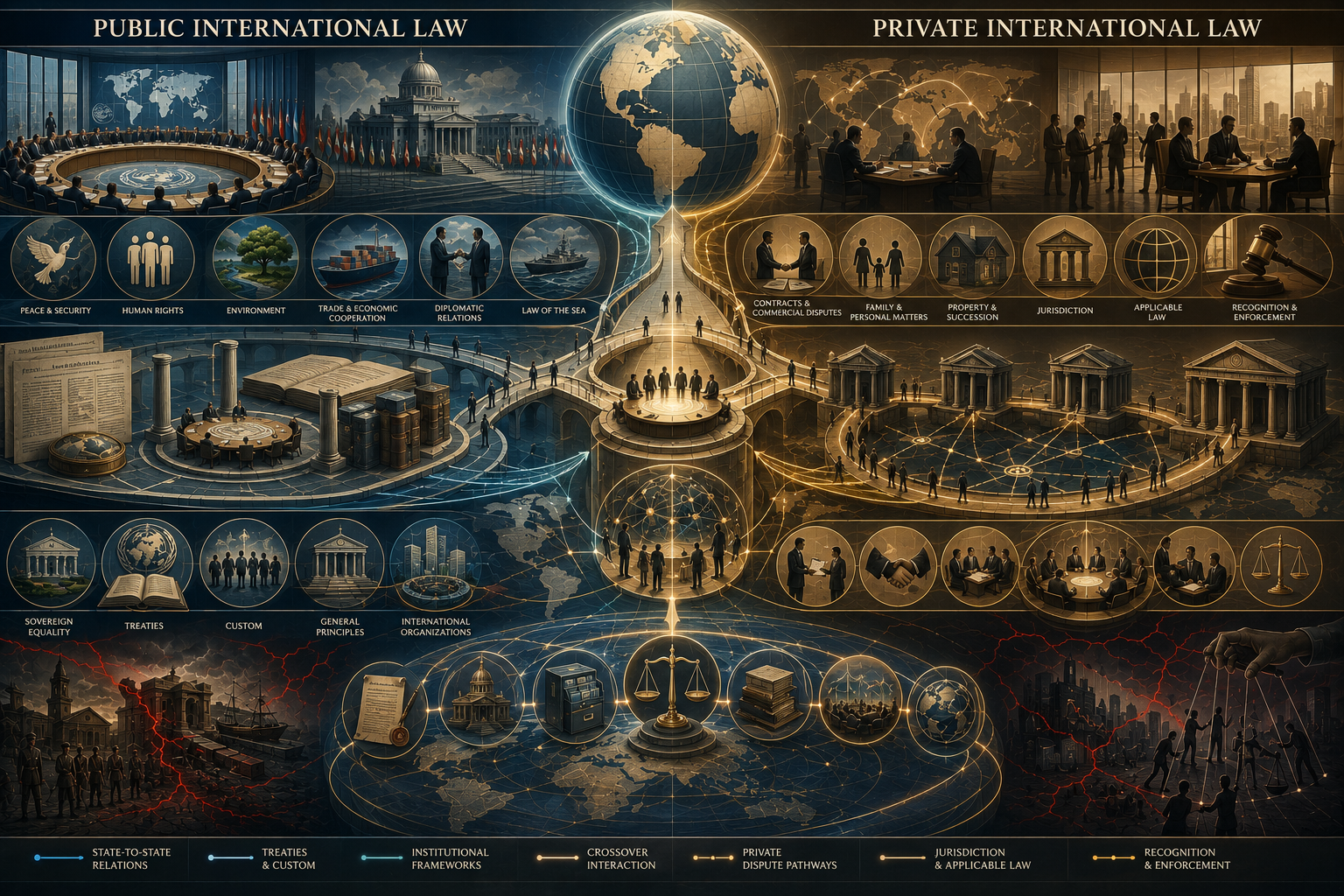
The difference is not simply academic. It affects where cases are filed, what law governs, whether a judgment travels across borders, how contracts are drafted, how families navigate cross-border legal systems, how corporations structure risk, and how private actors encounter public authority. It also affects the way power operates. Public international law is often associated with sovereign equality and interstate obligations, but it is shaped by unequal enforcement. Private international law is often presented as technical and neutral, but it can determine whether people and companies can access justice at all.
The two fields increasingly overlap. International investment arbitration allows private investors to bring claims against states under treaties. Global supply chains connect corporate contracts to labor rights, environmental harm, and human-rights obligations. Digital platforms operate across jurisdictions and force courts to decide where data, speech, harm, and responsibility are located. Recognition and enforcement of judgments determine whether legal victories can become practical remedies. Public and private international law remain distinct, but globalization has made their boundary more porous.
Why the Distinction Matters
The distinction between public and private international law matters because the word “international” can refer to very different legal relationships. A treaty between states, a war-crimes prosecution, a maritime boundary dispute, a human-rights complaint, a cross-border divorce, an international sales contract, and the enforcement of a foreign judgment are all international in some sense, but they do not belong to the same doctrinal category.
Public international law is concerned primarily with the legal order among states and other international legal subjects. It asks how public authority is structured beyond the domestic legal system. It is the field of treaties, custom, international organizations, state responsibility, sovereignty, jurisdiction, human rights, law of the sea, diplomatic law, international criminal law, and the regulation of force.
Private international law is concerned primarily with legal relationships involving private actors across national boundaries. It does not usually create a world code of contract, family, tort, or property law. Instead, it answers coordinating questions: which court may hear the dispute, which legal system governs the dispute, and whether a decision rendered in one jurisdiction will be recognized elsewhere.
The distinction is essential for readers because the remedies, institutions, sources, and legal questions differ. A state responsibility claim before the International Court of Justice is not the same as a contract dispute between companies in different countries. A human-rights treaty obligation is not the same as a choice-of-law rule in a commercial contract. A foreign judgment enforcement issue is not the same as a breach of the UN Charter. Each field requires its own legal vocabulary.
Yet the distinction should not be overstated. Private international law can affect public values, and public international law can shape private disputes. A cross-border family case may implicate child protection and human rights. A commercial arbitration may involve state-owned enterprises. An investment treaty may allow a private corporation to challenge public regulation. A foreign judgment may involve labor rights, environmental harm, or corporate accountability. The boundary is real, but it is increasingly interactive.
Public International Law
Public international law governs the legal relations of states and other subjects of international law. It provides the framework through which states create treaties, recognize legal obligations, resolve disputes, establish organizations, regulate war and peace, protect diplomats, cooperate on environmental problems, define maritime zones, protect human rights, and assign responsibility for internationally wrongful acts.
The central actor in public international law remains the state. States possess international legal personality, treaty-making capacity, territorial authority, and responsibility for breaches of international obligations. But states are not the only relevant actors. International organizations, peoples, individuals, national liberation movements, corporations, armed groups, and civil society may appear in public international law in different ways depending on the field. Individuals may be rights-holders under human-rights law and bearers of responsibility under international criminal law. Peoples may possess rights of self-determination. International organizations may conclude treaties and bear responsibility.
Public international law is therefore broader than diplomacy alone. It includes the law of treaties, sources of law, statehood, recognition, jurisdiction, sovereignty, non-intervention, state responsibility, diplomatic and consular law, international courts, human rights, humanitarian law, international criminal law, environmental law, trade law, investment law, the law of the sea, air and space law, collective security, and peremptory norms.
The public character of the field comes from the fact that it concerns public authority in the international legal order. It asks what states and institutions may do, what they must not do, what they owe one another, and what legal consequences follow when obligations are breached. It is therefore closely connected to governance, legitimacy, power, accountability, and global order.
But public international law should not be described as neutral machinery detached from history. Its doctrines were shaped by empire, decolonization, war, diplomacy, economic inequality, racial hierarchy, and unequal enforcement. Sovereign equality is a foundational principle, but sovereign equality has never been applied with perfect consistency. Public international law must therefore be studied both as doctrine and as a contested legal field shaped by power.
Sources of Public International Law
The classic statement of the sources of public international law appears in Article 38(1) of the Statute of the International Court of Justice. The provision identifies international conventions, international custom, general principles of law, and, as subsidiary means, judicial decisions and scholarly writings. Although Article 38 is formally a provision directing the ICJ in deciding disputes submitted to it, it has become the standard reference point for describing the sources of public international law.
Statute excerpt
“international conventions, whether general or particular”
Statute of the International Court of Justice, Article 38(1)(a).
Treaties are one of the central sources of public international law. They express written obligations accepted by states and, in some cases, international organizations.
Statute excerpt
“international custom, as evidence of a general practice accepted as law”
Statute of the International Court of Justice, Article 38(1)(b).
Customary international law arises from state practice accompanied by opinio juris: the belief that the practice is carried out as a matter of legal obligation.
Treaties are written agreements governed by international law. They may be bilateral, regional, or multilateral. They can regulate matters as varied as borders, trade, human rights, the environment, diplomatic relations, oceans, weapons, aviation, investment, and criminal cooperation. Treaty law itself is governed by doctrines such as consent, interpretation, reservations, amendment, invalidity, termination, and good-faith performance.
Customary international law arises from general practice accepted as law. It does not require every state to behave identically, but it does require evidence of sufficiently general practice and legal conviction. Custom is especially important where no treaty applies, where treaties codify or influence broader norms, or where obligations are said to bind states beyond treaty membership.
General principles of law help fill gaps and support reasoning across legal systems. Judicial decisions and scholarly writings are not primary sources in the same way as treaties and custom, but they serve as subsidiary means for identifying and clarifying rules. International legal reasoning therefore depends on a layered source structure: treaty text, practice, legal conviction, principles, adjudication, scholarship, and institutional interpretation.
The source structure matters because public international law is decentralized. There is no ordinary world legislature. Law emerges through consent, practice, institutional development, adjudication, and the recognition of certain fundamental norms. This makes the identification of sources one of the most important tasks in the field.
The UN Charter and the Public International Legal Order
The Charter of the United Nations is the central constitutional instrument of the modern public international legal order. It establishes the purposes and principles of the United Nations, including sovereign equality, peaceful settlement of disputes, the prohibition on the threat or use of force, the limits of domestic jurisdiction, and the collective-security role of the Security Council.
Charter excerpt
“sovereign equality of all its Members”
United Nations Charter, Article 2(1).
Sovereign equality is one of the foundational premises of public international law. It affirms juridical equality even in a world of unequal power.
The Charter framework demonstrates the public character of public international law. It regulates relations among states, defines institutional authority, limits unilateral force, establishes collective mechanisms, and creates obligations binding on member states. It also places human rights within the purposes of the United Nations and creates institutions through which states pursue cooperation on economic, social, cultural, humanitarian, and security matters.
The Charter does not eliminate sovereignty. It restructures it. States remain sovereign, but they are bound by Charter obligations. They may not use force except within the legal framework of self-defense and collective security. They must settle disputes peacefully. They must respect the purposes and principles of the Organization. Sovereignty in the Charter system is therefore not isolation; it is lawful membership in an international legal order.
The Charter also reveals the tension between formal equality and institutional hierarchy. All member states are formally sovereign equals, but the Security Council gives permanent members special authority and veto power. Public international law therefore combines universal principles with unequal institutional power. This tension runs through much of the modern international legal system.
Understanding public international law requires understanding this Charter architecture. It is the legal background against which statehood, recognition, use of force, non-intervention, human rights, collective security, and international institutional authority are interpreted.
Private International Law
Private international law, often called conflict of laws, governs cross-border legal disputes involving private actors. It does not usually regulate relations among states as public international law does. Instead, it helps domestic legal systems interact when a dispute contains foreign elements: parties in different countries, contracts performed across borders, property located abroad, family relationships spanning jurisdictions, injuries occurring outside the forum, or judgments needing recognition in another state.
The three classic questions of private international law are jurisdiction, applicable law, and recognition or enforcement. First, which court has authority to hear the case? Second, which legal system governs the dispute? Third, if a court gives judgment, will that judgment be recognized or enforced in another jurisdiction?
Private international law is therefore deeply practical. It matters when a company sues a foreign supplier, when a worker seeks compensation from a multinational employer, when a child custody dispute crosses borders, when a marriage or divorce must be recognized, when a tort occurs abroad, when a foreign judgment must be enforced against assets, or when parties choose a forum in a commercial contract.
The field is called “private” not because it lacks public importance, but because it typically concerns private legal relationships. These relationships are governed primarily by domestic law, but the cross-border character of the dispute requires rules for coordinating legal systems. A national court hearing a private international law case may apply its own procedural law, apply foreign substantive law, respect a choice-of-court agreement, stay proceedings in favor of another forum, or enforce a judgment from another country.
Private international law therefore sits at the boundary between national legal systems. It allows legal systems to communicate. Without it, cross-border life would be far more uncertain: contracts would be harder to enforce, families would face conflicting legal statuses, judgments might stop at the border, and private actors would struggle to know which rules govern their relationships.
Jurisdiction, Applicable Law, and Choice of Law
The first central question in private international law is jurisdiction: which court may hear the dispute? Jurisdiction in this context differs from the broader public international law doctrine of state authority. A domestic court must decide whether the defendant, dispute, property, contract, injury, or legal relationship is sufficiently connected to the forum. The answer may depend on domicile, residence, place of performance, place of injury, contractual forum selection, presence of assets, submission to jurisdiction, or statutory rules.
The second question is applicable law, often called choice of law. Even if a court has jurisdiction, it may not apply its own substantive law. A court in one state may hear a contract dispute governed by the law of another state. It may apply foreign tort law, foreign family law, or foreign property law depending on the conflict rules of the forum. Private international law therefore separates the forum from the applicable legal system.
The third question is party autonomy. In many commercial contexts, parties may choose the law governing their contract and the court or arbitral tribunal that will resolve disputes. This is especially important in international commerce because legal predictability lowers transaction costs and allows parties to plan. But party autonomy is not unlimited. Mandatory rules, consumer protection, employment protection, public policy, and unequal bargaining power may limit party choice.
Choice-of-law rules reveal that private international law is not merely procedural. The choice of applicable law can determine the outcome of a case. A worker, consumer, debtor, injured person, or small supplier may win under one legal system and lose under another. The “technical” decision about applicable law may therefore carry major justice consequences.
This is why private international law should not be treated as secondary. It determines the legal architecture through which cross-border private life becomes governable. It decides not only where litigation happens but which legal values travel with the dispute.
Recognition and Enforcement of Foreign Judgments
Recognition and enforcement are central to private international law because a judgment has limited practical value if it cannot travel. Recognition means that one legal system accepts the legal effect of a judgment rendered by another. Enforcement means that the judgment can be carried out through coercive legal mechanisms, such as seizure of assets, payment orders, or other measures available under domestic law.
Recognition and enforcement matter in commercial disputes, family law, tort litigation, insolvency, property disputes, and civil claims against entities with assets in multiple jurisdictions. A plaintiff may win in one country but need enforcement in another because the defendant’s assets are located elsewhere. A divorce, custody order, adoption, or maintenance order may need recognition across borders. A commercial judgment may need enforcement against a multinational debtor.
Domestic law traditionally governed recognition and enforcement, but multilateral instruments increasingly aim to create more predictable frameworks. The Hague Judgments Convention is especially important because it seeks to facilitate the recognition and enforcement of judgments in civil or commercial matters. The Hague Choice of Court Convention complements this by supporting exclusive choice-of-court agreements and resulting judgments.
Convention excerpt
“recognition and enforcement of judgments in civil or commercial matters”
Hague Convention on the Recognition and Enforcement of Foreign Judgments in Civil or Commercial Matters, Article 1.
Recognition and enforcement rules allow judgments to move across borders, making cross-border civil and commercial litigation more predictable.
Recognition is not automatic in every case. A court may refuse recognition on grounds such as lack of jurisdiction, inadequate notice, fraud, public policy, inconsistent judgments, or procedural unfairness. These safeguards protect defendants and preserve the integrity of the recognizing legal system. But if refusal grounds are too broad or unpredictable, cross-border legal certainty suffers.
The recognition and enforcement of judgments therefore expresses the central purpose of private international law: to make separate legal systems interact coherently while preserving fairness, sovereignty, and due process.
The Hague Conference on Private International Law
The Hague Conference on Private International Law, known as HCCH, is the leading international organization devoted to private international law. Its work focuses on cross-border cooperation in civil and commercial matters. HCCH instruments address international civil procedure, service of documents, taking of evidence, choice of court, recognition and enforcement of judgments, child protection, adoption, maintenance, family law, securities, trusts, and other cross-border legal problems.
Institutional excerpt
“World Organisation for Cross-border Co-operation in Civil and Commercial Matters”
Hague Conference on Private International Law, official institutional description.
HCCH is central to private international law because it develops multilateral instruments that help national legal systems cooperate across borders.
HCCH is important because private international law remains largely rooted in domestic legal systems. Unlike public international law, where states may directly assume treaty obligations toward one another, private international law often works through national courts applying domestic conflict rules. HCCH conventions create shared frameworks that help those courts coordinate.
For example, the Hague Service Convention simplifies the cross-border service of judicial and extrajudicial documents. The Hague Choice of Court Convention supports exclusive choice-of-court agreements in civil or commercial matters. The Hague Judgments Convention addresses recognition and enforcement of foreign judgments. These instruments do not abolish domestic law, but they create standardized pathways for cross-border legal cooperation.
HCCH also demonstrates that private international law is not merely commercial. Its family-law and child-protection instruments affect adoption, maintenance, parental responsibility, child abduction, and vulnerable persons. These issues are deeply human. They show that private international law shapes lives, not only transactions.
The Hague system therefore gives institutional form to the private side of international legal ordering. It does not regulate war and peace, but it helps people, families, courts, and businesses navigate legal relationships that cross borders.
Service Abroad, Choice of Court, and Judgments Conventions
Several HCCH instruments illustrate the practical character of private international law. The 1965 Hague Service Convention addresses how judicial and extrajudicial documents are transmitted abroad for service in civil or commercial matters. Service of process may sound technical, but it is foundational. A defendant cannot properly respond to a case without notice. Cross-border service rules protect due process while making litigation possible across borders.
Convention excerpt
“judicial or extrajudicial document for service abroad”
Hague Service Convention, Article 1.
The Service Convention addresses one of the first procedural problems in cross-border litigation: how a party is properly notified of proceedings abroad.
The 2005 Hague Choice of Court Convention supports exclusive choice-of-court agreements in civil or commercial matters. It strengthens party autonomy by requiring courts chosen by the parties to hear covered disputes and requiring other courts to respect the exclusive choice, subject to exceptions. It also supports recognition and enforcement of resulting judgments. The Convention helps make international commercial litigation more predictable.
Convention excerpt
“exclusive choice of court agreements concluded in civil or commercial matters”
Hague Choice of Court Convention, Article 1.
Choice-of-court agreements allow parties to manage jurisdictional uncertainty by selecting the court that will hear future disputes.
The 2019 Hague Judgments Convention addresses recognition and enforcement of judgments in civil or commercial matters. It seeks to make judgments more portable across borders, reducing the risk that a successful litigant must re-litigate the entire dispute in another country. This matters for commercial certainty, access to justice, and the practical effectiveness of court decisions.
Together, these conventions show how private international law works. It does not simply ask what law is morally right or which state has public authority. It builds procedures that allow separate legal systems to coordinate: service, jurisdiction, choice of court, recognition, enforcement, and safeguards against unfairness.
This procedural architecture may appear modest beside the grand language of public international law, but it is essential to the daily functioning of cross-border legal life.
International Commercial Arbitration
International commercial arbitration is a major mechanism for resolving cross-border private disputes. Parties agree to submit disputes to an arbitral tribunal rather than litigating in national courts. Arbitration is especially common in international commerce because it allows parties to select procedural rules, choose arbitrators, avoid unfamiliar courts, protect confidentiality in some settings, and obtain awards that may be enforceable across borders.
Arbitration is often described as private dispute resolution, but it depends on public legal infrastructure. National laws recognize arbitration agreements. Courts may stay litigation in favor of arbitration. Courts may assist with interim measures, evidence, or enforcement. Arbitral awards may be recognized and enforced through treaty frameworks and domestic implementing legislation. Arbitration therefore sits at the intersection of party autonomy and state enforcement.
The International Chamber of Commerce International Court of Arbitration is one of the most important arbitral institutions. Despite its name, it is not a public court issuing formal judgments. It administers arbitrations and supervises proceedings under ICC rules. This distinction matters because arbitration is a form of private adjudication supported by legal systems, not an international court in the public-law sense.
Institutional excerpt
“we do not make formal judgments”
International Chamber of Commerce, International Court of Arbitration.
The ICC Court administers and supervises arbitration proceedings; it is not a public court equivalent to the ICJ or a domestic judiciary.
International commercial arbitration can be efficient and predictable, but it also raises concerns. Arbitration clauses may be imposed through unequal bargaining power. Confidentiality may reduce public accountability. Costs may exclude smaller parties. Arbitrators may lack the public-law accountability of judges. Enforcement may favor commercial actors with resources. These concerns do not eliminate arbitration’s value, but they show that private international dispute resolution is not politically neutral.
Arbitration therefore belongs in this article because it illustrates the blurred boundary between private ordering and public authority. Parties create the dispute mechanism by agreement, but states make that mechanism legally effective.
ICSID and Investor-State Dispute Settlement
Investor-state dispute settlement is one of the most important areas where public and private international law overlap. Under investment treaties, foreign investors may bring claims directly against states for alleged violations of treaty protections. These claims are often heard through arbitration, including proceedings administered by the International Centre for Settlement of Investment Disputes, known as ICSID.
ICSID was created under the Convention on the Settlement of Investment Disputes between States and Nationals of Other States. It provides facilities for conciliation and arbitration of investment disputes between contracting states and nationals of other contracting states. This institutional design is hybrid: private investors bring claims, but the legal basis is often a public treaty between states.
Convention excerpt
“conciliation and arbitration of investment disputes”
ICSID Convention, institutional overview.
ICSID illustrates how private claimants can use treaty-based mechanisms to bring claims against states, creating one of the most important public/private overlaps in international law.
Investment arbitration is controversial because it allows private economic actors to challenge public regulation. States may face claims over expropriation, fair and equitable treatment, discrimination, denial of justice, or treaty-protected expectations. Some claims may address genuine abuse of foreign investors. Others may challenge public-interest regulation involving health, environment, energy transition, taxation, labor, land, or social policy.
The controversy is not simply that investors can sue states. The issue is whether the system gives private capital a privileged legal route unavailable to affected communities, workers, Indigenous peoples, or citizens harmed by corporate conduct. Investor-state arbitration can create asymmetry: corporations may challenge state regulation internationally, while communities harmed by corporate activity often face fragmented domestic remedies.
ICSID and investor-state dispute settlement therefore show why the public/private distinction must be handled carefully. Investment law is public in source, private in claimant structure, arbitral in procedure, and public in consequence. It sits precisely where international law, private capital, state sovereignty, development, and regulatory authority meet.
Different Legal Functions
Public and private international law perform different legal functions. Public international law structures the obligations and rights of states and other international legal subjects. It governs the external conduct of states, the creation of international institutions, the legality of force, responsibility for wrongful acts, protection of human rights, diplomatic relations, maritime governance, and the operation of treaty regimes.
Private international law coordinates legal systems when private disputes cross borders. It does not usually decide whether a state has breached the UN Charter or violated a human-rights treaty. Instead, it asks whether a court has jurisdiction, which law applies, and whether a judgment or legal status should be recognized elsewhere. Its function is coordinative rather than constitutional, though its practical effects can be profound.
The distinction can be summarized in several ways:
- Primary actors: public international law centers on states, international organizations, peoples, and international legal subjects; private international law centers on private parties and domestic courts handling cross-border disputes.
- Core questions: public international law asks what international obligations exist; private international law asks which court, which law, and which judgment should govern.
- Sources: public international law relies on treaties, custom, general principles, judicial decisions, and scholarship; private international law relies on domestic conflict rules, conventions, party agreements, and procedural cooperation.
- Institutions: public international law includes the ICJ, UN organs, treaty bodies, and international tribunals; private international law relies heavily on domestic courts, HCCH instruments, and arbitral institutions.
- Typical disputes: public international law addresses state responsibility, use of force, human rights, environmental obligations, and law of the sea; private international law addresses contracts, torts, family law, property, foreign judgments, and commercial litigation.
But these distinctions are functional rather than absolute. Public international law can shape private relationships through treaties, sanctions, trade rules, investment protections, human-rights due diligence, environmental obligations, and corporate regulation. Private international law can affect public values by determining where victims may sue, whether judgments are enforceable, and whether powerful actors can choose favorable forums.
The best way to understand the distinction is therefore not to imagine two sealed compartments. Public international law governs the international public order. Private international law coordinates cross-border private legal relations. Modern globalization increasingly requires both to interact.
Where Public and Private International Law Overlap
The boundary between public and private international law has become increasingly porous. Globalization, investment treaties, multinational corporations, digital platforms, supply chains, arbitration, sanctions, and human-rights due diligence have created legal problems that cannot be neatly classified as purely public or purely private.
Investment arbitration is the clearest example. A treaty between states creates rights for private investors. A private investor sues a state. The dispute is resolved through arbitration. The result may affect public budgets, environmental regulation, Indigenous land, public health, energy policy, or development strategy. Formally, the claim may look like private dispute resolution. Substantively, it may affect core public authority.
International trade and supply chains provide another example. A private contract may depend on public trade rules, sanctions regimes, customs classifications, forced-labor restrictions, environmental standards, corporate due-diligence laws, export controls, and human-rights reporting requirements. Private transactions move through public regulatory architecture.
Digital platforms also blur the distinction. A platform’s terms of service may govern speech, commerce, data, identity, and dispute resolution across borders. Domestic regulators may assert jurisdiction. Foreign users may seek remedies. Courts may disagree about applicable law. Human-rights norms may shape platform governance debates. What begins as private platform governance can become public international legal concern.
Cross-border family law also complicates the distinction. A child custody dispute, adoption, abduction case, maintenance order, or recognition of family status may be handled through private international law, but it can implicate human rights, child protection, migration, citizenship, gender equality, and access to justice. The private field is not merely commercial; it often affects intimate and vulnerable relationships.
The overlap between public and private international law is therefore not a minor detail. It is one of the defining features of contemporary legal globalization. Public authority increasingly works through private actors, and private disputes increasingly implicate public values.
Access to Justice, Inequality, and Legal Power
Private international law can appear technical, but it often determines whether justice is practically available. A person harmed by a multinational corporation may need to sue in a foreign forum. A worker may face a contract pointing to a distant legal system. A consumer may be bound by a forum clause. A family may need recognition of a custody or maintenance order. A small business may win a judgment but struggle to enforce it against assets abroad.
These problems show that jurisdiction, applicable law, and recognition are not neutral abstractions. They can determine whether a party has a meaningful remedy. A forum may be legally available but practically inaccessible because of cost, language, distance, procedure, delay, or imbalance of resources. A choice-of-law clause may select a law favorable to the stronger party. Arbitration may be efficient for sophisticated commercial actors but inaccessible to weaker parties. Enforcement may be easy for creditors with global counsel and difficult for individuals with limited means.
Public international law also faces inequality. States are formally equal but materially unequal. Powerful states influence institutions, shape treaty regimes, apply sanctions, dominate financial infrastructure, and avoid accountability more effectively than weaker states. The same problem appears in private international law through party inequality, corporate structure, forum selection, and enforcement capacity.
For that reason, a serious article should not treat public international law as morally grand and private international law as merely procedural. Both fields distribute power. Public international law distributes authority among states and institutions. Private international law distributes access among courts, laws, judgments, and remedies. Both can protect the vulnerable, and both can reproduce hierarchy.
The future of international legal order depends in part on making these systems more accountable. Public international law must confront selective enforcement. Private international law must confront unequal access to justice. The distinction between the fields remains useful, but both must be judged by whether they make cross-border life more lawful, fair, and accountable.
Conclusion
The distinction between public international law and private international law clarifies two different ways that law operates across borders. Public international law governs the public legal order among states, international organizations, peoples, and other international legal subjects. It addresses treaties, custom, sovereignty, jurisdiction, state responsibility, human rights, use of force, diplomatic relations, international courts, and global governance. Private international law coordinates cross-border private disputes by determining jurisdiction, applicable law, and recognition or enforcement of judgments.
The distinction is essential because the fields answer different questions and rely on different institutions. A public international law dispute may concern whether a state violated a treaty. A private international law dispute may concern whether a court has jurisdiction over a contract or whether a foreign judgment should be enforced. Confusing the two fields obscures the legal function being performed.
At the same time, the distinction is not a wall. Investment arbitration, international commercial arbitration, global supply chains, sanctions, corporate regulation, digital platforms, family law, and foreign judgment enforcement all show that public and private legal ordering increasingly interact. Public rules shape private relationships, and private disputes can affect public values.
Understanding the distinction therefore provides a foundation for the wider study of international law. It helps readers see why sources, courts, treaties, jurisdiction, applicable law, arbitration, recognition, enforcement, sovereignty, and access to justice belong to different but connected parts of the international legal system. Public and private international law are not the same field, but together they help make cross-border life legally intelligible.
GitHub Repository
The companion repository folder supports this article with structured research materials, source metadata, concept mapping, quote logs, public/private comparison tables, and editorial documentation. It is intended to make the article’s research workflow more transparent while keeping the public article focused on legal explanation rather than technical setup.
Public vs Private International Law Repository Folder
Explore the supporting research materials for this article, including ICJ Statute source notes, UN Charter references, HCCH convention materials, Hague Service, Choice of Court, and Judgments Convention notes, ICSID and ICC arbitration metadata, public/private comparison tables, and structured research outputs on jurisdiction, applicable law, recognition, enforcement, and public/private overlap.
View the Public vs Private International Law Repository Folder
Related Articles
- International Law Foundations
- Sources of International Law
- Treaty Law
- Customary International Law
- Jurisdiction in International Law
- Sovereignty, Jurisdiction, and Non-Intervention in International Law
- International Courts and Tribunals
- State Responsibility in International Law
- Human Rights in International Law
- State Immunity, Diplomatic Immunity, and Official Functions
Primary Authorities
- International Court of Justice (1945) Statute of the International Court of Justice. Available at: https://www.icj-cij.org/statute.
- United Nations (1945) Statute of the International Court of Justice. Available at: https://www.un.org/en/about-us/un-charter/statute-of-the-international-court-of-justice.
- United Nations (1945) Charter of the United Nations. Available at: https://www.un.org/en/about-us/un-charter/full-text.
- Hague Conference on Private International Law (2026) Home. Available at: https://www.hcch.net/en/home.
- Hague Conference on Private International Law (2026) About HCCH. Available at: https://www.hcch.net/en/about.
- Hague Conference on Private International Law (2026) Conventions and Other Instruments. Available at: https://www.hcch.net/en/instruments/conventions.
- Hague Conference on Private International Law (1965) Convention on the Service Abroad of Judicial and Extrajudicial Documents in Civil or Commercial Matters. Available at: https://www.hcch.net/en/instruments/conventions/full-text/?cid=17.
- Hague Conference on Private International Law (1965) Convention on the Service Abroad of Judicial and Extrajudicial Documents in Civil or Commercial Matters. Available at: https://assets.hcch.net/docs/f4520725-8cbd-4c71-b402-5aae1994d14c.pdf.
- Hague Conference on Private International Law (2005) Convention on Choice of Court Agreements. Available at: https://www.hcch.net/en/instruments/conventions/full-text/?cid=98.
- Hague Conference on Private International Law (2019) Convention on the Recognition and Enforcement of Foreign Judgments in Civil or Commercial Matters. Available at: https://www.hcch.net/en/instruments/conventions/full-text/?cid=137.
- International Centre for Settlement of Investment Disputes (1965) ICSID Convention Overview. Available at: https://icsid.worldbank.org/resources/rules-and-regulations/convention/overview.
- International Centre for Settlement of Investment Disputes (1965) ICSID Convention, Regulations and Rules. Available at: https://icsid.worldbank.org/rules-regulations/convention.
- International Chamber of Commerce (2026) ICC International Court of Arbitration. Available at: https://iccwbo.org/dispute-resolution/dispute-resolution-services/icc-international-court-of-arbitration/.
- International Chamber of Commerce (2026) Arbitration. Available at: https://iccwbo.org/dispute-resolution/dispute-resolution-services/arbitration/.
Further Reading
- Briggs, A. (2019) The Conflict of Laws. Oxford: Oxford University Press. Available at: https://global.oup.com/academic/product/the-conflict-of-laws-9780198838500.
- Crawford, J. (2019) Brownlie’s Principles of Public International Law. 9th edn. Oxford: Oxford University Press. Available at: https://global.oup.com/academic/product/brownlies-principles-of-public-international-law-9780198737445.
- Dickinson, A. (2021) The Rome II Regulation: The Law Applicable to Non-Contractual Obligations. Oxford: Oxford University Press. Available at: https://global.oup.com/academic/product/the-rome-ii-regulation-9780199588466.
- Hartley, T. (2017) International Commercial Litigation. Cambridge: Cambridge University Press. Available at: https://www.cambridge.org/core/books/international-commercial-litigation/F7437112F7D61217B69476A1D495F57D.
- Mills, A. (2018) The Confluence of Public and Private International Law. Cambridge: Cambridge University Press. Available at: https://www.cambridge.org/core/books/confluence-of-public-and-private-international-law/285A0C54E7F35996359D3C03A86BEAC3.
- Shaw, M.N. (2021) International Law. 9th edn. Cambridge: Cambridge University Press. Available at: https://www.cambridge.org/highereducation/books/international-law/2AB3E3A1B863D0F1D9B22F7862B1F0F1.
- United Nations Audiovisual Library of International Law (n.d.) United Nations Audiovisual Library of International Law. Available at: https://legal.un.org/avl/.
References
- Hague Conference on Private International Law (1965) Convention on the Service Abroad of Judicial and Extrajudicial Documents in Civil or Commercial Matters. Available at: https://www.hcch.net/en/instruments/conventions/full-text/?cid=17.
- Hague Conference on Private International Law (2005) Convention on Choice of Court Agreements. Available at: https://www.hcch.net/en/instruments/conventions/full-text/?cid=98.
- Hague Conference on Private International Law (2019) Convention on the Recognition and Enforcement of Foreign Judgments in Civil or Commercial Matters. Available at: https://www.hcch.net/en/instruments/conventions/full-text/?cid=137.
- Hague Conference on Private International Law (2026) About HCCH. Available at: https://www.hcch.net/en/about.
- International Centre for Settlement of Investment Disputes (1965) ICSID Convention Overview. Available at: https://icsid.worldbank.org/resources/rules-and-regulations/convention/overview.
- International Chamber of Commerce (2026) ICC International Court of Arbitration. Available at: https://iccwbo.org/dispute-resolution/dispute-resolution-services/icc-international-court-of-arbitration/.
- International Court of Justice (1945) Statute of the International Court of Justice. Available at: https://www.icj-cij.org/statute.
- United Nations (1945) Charter of the United Nations. Available at: https://www.un.org/en/about-us/un-charter/full-text.