
There are species that symbolize wilderness in the abstract — lions on savannas, polar bears on ice. And then there are species that live at the fragile edge of human systems.
Wetland loss is where that edge becomes visible. The fishing cat is one of its clearest signals.
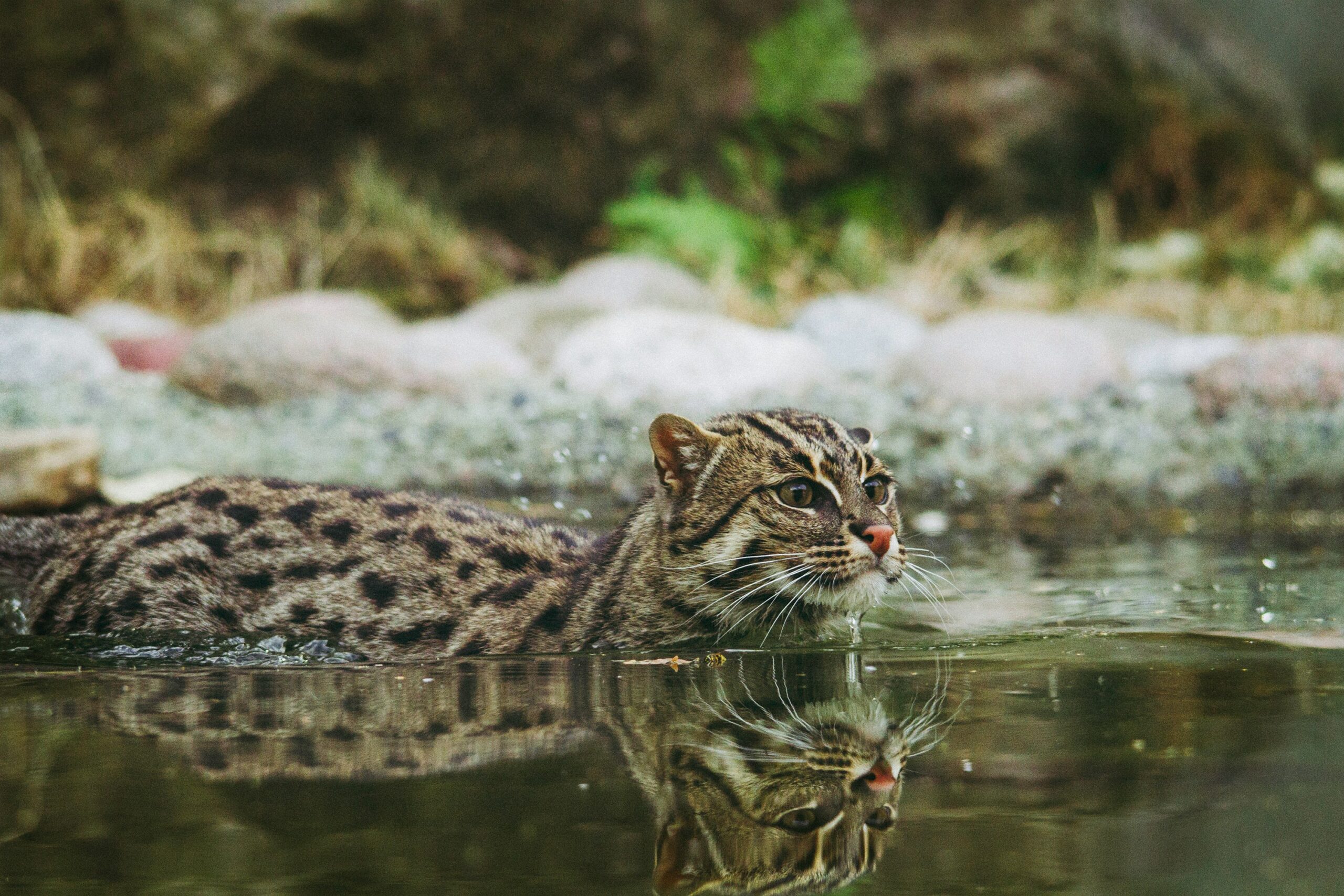
A medium-sized wildcat native to South and Southeast Asia, the fishing cat does something unusual for a feline: it thrives in wetlands. It swims. It hunts fish. It has partially webbed paws. It lives in mangroves, marshes, and riverine ecosystems — the very landscapes most vulnerable to wetland loss, urban expansion, and climate stress.
This is not just a wildlife story.
It’s a systems story.
Built for Water, Living in Risk
Unlike most cats, fishing cats evolved around water:
- Dense, water-resistant fur
- Strong swimmers
- Webbed forepaws
- Diet centered on fish, crustaceans, and amphibians
They are highly specialized — which makes them both remarkable and fragile. When wetlands disappear, fishing cats cannot simply migrate to forests or grasslands. Their niche is narrow. Their survival depends on intact hydrological systems threatened by wetland loss.
That dependence is where sustainability begins.
Wetland Loss and the Invisible Infrastructure
Wetlands are often dismissed as wastelands — swamps to be drained, mangroves to be cleared, riverbanks to be developed. But wetlands are infrastructure.
They:
- Absorb floodwaters
- Filter pollutants
- Store carbon
- Support fisheries
- Protect coastlines from storm surge
When wetlands vanish, fishing cats disappear. But so does human resilience. This is why wetland loss is not just ecological decline — it is infrastructure erosion.
Urban Expansion and Ecological Compression
Fishing cats live near some of the fastest-growing urban corridors in Asia. Expansion of aquaculture, agriculture, highways, and housing compresses their habitat into fragmented patches. Across the region, accelerating wetland loss is fragmenting habitat faster than species can adapt.
This creates a cascade of risk:
- Increased human-wildlife conflict
- Road mortality
- Poaching
- Genetic isolation
The species is currently classified as Vulnerable by the International Union for Conservation of Nature (IUCN). For a baseline reference, see the IUCN Red List.
But vulnerability here is not just about population counts. It’s about systemic fragility. When we convert wetlands into industrial zones, we don’t just remove habitat — we destabilize ecological services that sustain millions of people.
Mangroves and Climate Resilience
In regions like the Sundarbans — the vast mangrove forest shared by India and Bangladesh — fishing cats coexist with both communities and extreme weather systems.
Mangroves reduce cyclone intensity. They stabilize coastlines. They store significant amounts of carbon in soil. Destroying mangroves increases climate risk. Mangrove clearing is also one of the most severe forms of coastal wetland loss.
Protecting mangroves protects:
- Fisheries
- Agriculture
- Coastal settlements
- And species like the fishing cat
Sustainability is not about saving a charismatic animal. It is about preserving the systems that make resilience possible.
What Fishing Cats Teach Us About Systems Thinking
Fishing cats reveal three core sustainability lessons:
1. Specialization increases risk
Highly specialized systems — ecological or economic — can be efficient but fragile under wetland loss and rapid land conversion.
2. Infrastructure is often invisible
Wetlands are undervalued because their services are not immediately visible in GDP metrics. Yet the costs of wetland loss surface later in flood damage, water treatment expense, and reduced coastal stability.
3. Resilience requires preservation, not just innovation
We cannot engineer our way out of every ecological collapse. Sometimes the most strategic move is conservation — preventing wetland loss before replacement costs are forced onto communities and governments.
Why This Matters for Sustainable Strategy
At Sustainable Catalyst, systems thinking means looking beyond surface metrics. If we measure only short-term development gains and ignore ecological degradation, we misprice risk. Fishing cats exist at the edge of that mispricing.
Their decline signals:
- Wetland collapse
- Carbon release
- Biodiversity loss
- Increased flood risk
They are not an isolated species story. They are an early warning system for wetland loss and the compounding risks it creates.
If you want the broader framework behind this approach, see the Sustainable Catalyst platform overview.
From Wildlife to Infrastructure Ethics
The fishing cat forces a broader question:
What do we treat as expendable in pursuit of growth?
If wetlands are drained because they do not generate immediate revenue, we sacrifice long-term resilience for short-term expansion. Sustainable strategy requires reframing value.
Not just: Profit • Growth • Development
But: Stability • Risk mitigation • Ecological continuity
In that frame, the fishing cat is not a footnote. It is a signal.
The Quiet Indicator
The most important systems are often the least visible: wetlands, mangroves, soil, watersheds. When they fail, the consequences compound.
The fishing cat survives only where those systems remain intact. If we protect its habitat, we protect far more than a species. We protect the infrastructure that sustains us.
And that is the core lesson:
Sustainability is not about sentiment.
It is about systems.