
Last Updated June 23, 2026
The United Nations collective security system is the central legal framework through which the contemporary international order seeks to prevent conflict, respond to threats to peace, restrain unilateral force, and authorize collective action under international law. Created in the aftermath of the Second World War, the United Nations was founded on the premise that international peace and security should not depend solely on shifting alliances, unilateral deterrence, imperial policing, or ad hoc balances of power. Instead, the Charter of the United Nations established an institutional order in which member states would cooperate through common rules and centralized decision-making structures to address threats to peace.
At the center of that framework is the Security Council, which bears primary responsibility for the maintenance of international peace and security under Article 24 of the Charter. The collective-security idea is among the most ambitious legal projects in modern international law. Its core premise is that threats to peace should be treated as matters of common concern rather than left entirely to unilateral force, retaliation, revenge, imperial intervention, or alliance politics. In theory, the Charter system seeks to move the international order away from self-help and toward an institutional process in which aggression, breaches of the peace, and threats to security are addressed through common procedures and legal authority.
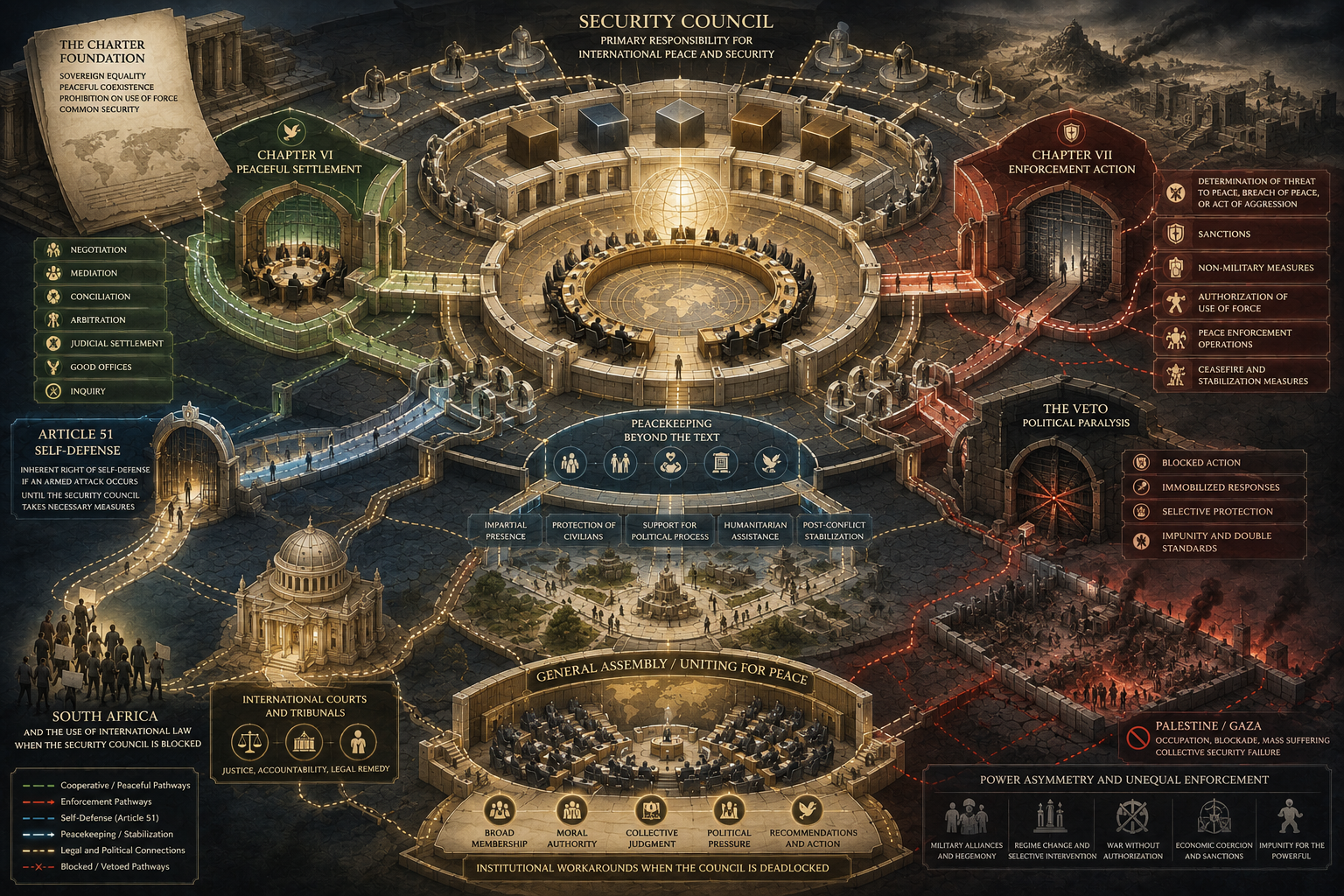
In practice, however, this aspiration has always operated inside a system shaped by sovereignty, geopolitical hierarchy, and the unequal distribution of military, diplomatic, economic, and institutional power. The Security Council is legally centralized but politically unequal. Its permanent-member structure reflects the constitutional settlement of 1945 rather than a democratic distribution of global authority. Its enforcement powers are significant, but their use depends on the interests and tolerances of the permanent members. That means the collective-security system is both a legal achievement and a structural compromise.
A serious treatment of UN collective security must therefore do more than describe Charter structure. It must explain how the Security Council works, how Chapters VI and VII differ, how peacekeeping evolved beyond the text of the Charter, how Article 51 self-defense limits centralization, why the veto has repeatedly produced paralysis in the face of mass suffering, and why the General Assembly has sometimes functioned as a workaround when the Council is blocked. It must also confront the gap between universal legal principle and selective enforcement, especially where Palestine, Gaza, Iraq, Yugoslavia/Kosovo, Libya, Syria, Ukraine, and other cases expose how readily the system constrains some actors while failing to restrain others.
This article treats collective security as both legal architecture and unfinished moral problem. The Charter system remains the central legal framework for the maintenance of international peace and security. But its legitimacy depends not only on what the Charter authorizes. It also depends on whether the system protects the weak as well as disciplines the weak, restrains powerful states as well as their adversaries, and responds to mass suffering without requiring geopolitical permission from the very powers most capable of obstructing action.
The Idea of Collective Security in International Law
Collective security rests on the premise that a threat to peace should be treated as a matter of common concern rather than left entirely to the affected state or to the strongest military actors. Its ambition is to replace unilateral recourse to force with a legal order in which aggression, breaches of the peace, and serious threats to international stability are addressed through shared institutions acting on behalf of the wider international community. The UN Charter embodies this model more fully than any previous international instrument by linking peaceful settlement, enforcement powers, institutional authority, and restraints on unilateral force within a single legal framework.
This system should be distinguished from traditional alliance politics. Collective security is not simply a promise by some states to defend others. It is a legal and institutional mechanism through which the international community, acting through the United Nations, is meant to identify threats to peace and respond through procedures recognized by the Charter. In theory, this shifts the lawful management of force away from private retaliation and toward a common institutional process.
The ambition of collective security is therefore both legal and political. Legally, it seeks to define when force may be used and who may authorize it. Politically, it seeks to prevent international peace from depending solely on the will of powerful states. Morally, it reflects the memory of catastrophic war and the recognition that unregulated power politics had produced destruction on a global scale. The Charter system is not merely a technical arrangement. It is an institutional answer to the failure of the pre-1945 order.
But collective security has always contained an internal contradiction. It claims to act in the name of the international community, yet its primary enforcement organ is controlled by a small group of permanent members. It seeks to restrain unilateral force, yet states retain the inherent right of self-defense. It promises common security, yet political will is uneven. It condemns aggression, yet major powers and their allies have often avoided the consequences imposed on weaker states. The system is therefore best understood as a legal aspiration constrained by a political constitution.
That does not make collective security meaningless. It remains one of the strongest legal restraints on unilateral force and one of the few institutional frameworks capable of authorizing sanctions, peace operations, and force in the name of the United Nations. But its effectiveness depends on whether law can overcome the very power politics the system was designed to tame.
The Charter Architecture of Peace and Security
The Charter architecture of collective security is built around several linked commitments. First, member states must settle disputes by peaceful means so that international peace and security are not endangered. Second, states must refrain from the threat or use of force against the territorial integrity or political independence of any state. Third, the Security Council bears primary responsibility for the maintenance of international peace and security. Fourth, the Council may recommend peaceful procedures, determine threats to peace, impose non-military measures, and authorize military action under Chapter VII. Fifth, Article 51 preserves the inherent right of individual or collective self-defense if an armed attack occurs, until the Council has taken necessary measures.
This architecture matters because the Charter does not simply create the Security Council. It reorganizes the law of force. The pre-Charter world tolerated broader forms of war, reprisal, intervention, and power-balancing. The Charter order attempts to narrow lawful force to two principal pathways: Security Council authorization and self-defense. This is one of the most important transformations in modern international law.
The Charter system also distributes institutional responsibility. The Security Council has primary responsibility, but not exclusive moral or political concern. The General Assembly, Secretary-General, International Court of Justice, regional organizations, peacekeeping operations, specialized agencies, and member states all contribute to the wider peace-and-security architecture. Nevertheless, when it comes to binding enforcement under Chapter VII, the Council remains central.
This makes the Charter system both centralized and decentralized. It centralizes authority over enforcement in the Council, but it remains dependent on sovereign states for implementation. The United Nations does not possess a standing army in the ordinary sense. Sanctions require member-state implementation. Peacekeeping requires troop and police contributions. Military enforcement generally requires authorization to states or coalitions. Even centralized legal authority must be operationalized through decentralized state action.
The Charter architecture therefore does not eliminate sovereignty. It channels sovereignty. Member states accept obligations, participate in institutions, implement decisions, and retain rights of self-defense. Collective security is not a world government. It is a legal system designed to restrain and coordinate sovereign power in matters of peace and security.
The Security Council and Primary Responsibility
The Security Council is the principal organ charged with implementing the UN’s collective-security mandate. Under Article 24 of the Charter, member states confer on the Council primary responsibility for the maintenance of international peace and security and agree that, in carrying out those duties, the Council acts on their behalf. This is the legal basis for the Council’s exceptional role. Unlike most international institutions, the Council may adopt decisions that bind all member states when acting within its Charter authority.
Charter excerpt
“primary responsibility for the maintenance of international peace and security”
United Nations Charter, Article 24.
Article 24 is the foundation of the Security Council’s institutional authority. The Council is not merely a discussion forum; it is the organ entrusted with primary responsibility for peace and security.
Under the Charter and the Security Council’s own official presentation of its functions and powers, the Council may investigate disputes, recommend methods of settlement, determine the existence of threats to peace, breaches of peace, or acts of aggression, impose measures not involving armed force, and authorize military action where necessary. Its powers are therefore both diplomatic and coercive. It can recommend, decide, sanction, authorize, and supervise.
The Council consists of fifteen members: five permanent members and ten elected members. The permanent members — China, France, Russia, the United Kingdom, and the United States — possess a privileged voting position. Article 27 provides that substantive decisions require the concurring votes of the permanent members, a structure that has become known as the veto. This voting structure is the legal key to both the Council’s authority and its paralysis.
Charter excerpt
“including the concurring votes of the permanent members”
United Nations Charter, Article 27.
This language is the legal basis of the permanent-member veto. It reflects the 1945 constitutional settlement and remains one of the most contested features of the Security Council.
The Council’s legal architecture is centralized; its politics remain oligarchic. The permanent members occupy a privileged position not because they are legally more equal, but because the Charter’s institutional design granted them decisive control over substantive enforcement action. This arrangement was justified in 1945 as the political price of keeping the major powers inside the new organization. The cost has been recurring paralysis where a permanent member or close ally is implicated.
The Security Council therefore sits at the heart of a paradox. It is the strongest institutional expression of collective security, but also the place where collective security most visibly breaks down. Its authority is legally exceptional. Its action is politically conditional. Any serious account of the Council must treat both realities as central.
Chapter VI and the Peaceful Settlement of Disputes
Before turning to coercive powers, the Charter gives priority to the peaceful settlement of disputes. Chapter VI calls upon parties to seek resolution through negotiation, enquiry, mediation, conciliation, arbitration, judicial settlement, resort to regional agencies, or other peaceful means of their own choice. The Security Council may investigate disputes and recommend appropriate procedures or methods of adjustment. This reflects a foundational commitment of the Charter system: the preservation of peace should, wherever possible, occur through diplomacy and institutional dispute resolution rather than force.
Charter excerpt
“negotiation, enquiry, mediation, conciliation, arbitration, judicial settlement”
United Nations Charter, Article 33.
Article 33 lists core peaceful methods of dispute settlement. Collective security begins not with enforcement, but with the legal containment of disputes before they escalate.
Chapter VI is therefore central to the legal architecture of collective security even though it does not itself authorize enforcement in the same way as Chapter VII. It creates the procedural and diplomatic context in which conflicts are expected to be managed before they escalate into situations requiring coercive action. In this respect, collective security is not solely about sanctions or military measures; it is equally about prevention, institutional diplomacy, and legal de-escalation.
Chapter VI also reflects respect for sovereign choice. Parties are encouraged to choose peaceful means appropriate to the dispute. The Council may recommend procedures, but the chapter is generally less coercive than Chapter VII. That distinction matters because not every dispute should be treated immediately as a threat to peace requiring enforcement. The Charter preserves a graduated architecture: peaceful settlement first, enforcement only where necessary.
In practice, Chapter VI tools are often politically underestimated because they lack the drama of sanctions or military authorization. But negotiation, mediation, fact-finding, good offices, and judicial settlement can be among the most important peace-and-security tools available. Preventing conflict is legally and morally preferable to managing destruction after violence has already escalated.
Nevertheless, Chapter VI also has limits. Recommendations may be ignored. Parties may use negotiation to delay. Power asymmetries may shape what “peaceful settlement” actually means. A weaker party may be pressured into accepting arrangements that preserve domination. For that reason, peaceful settlement must not be romanticized. It is essential, but it must be linked to legality, equality, and protection against coercive bargaining.
Chapter VII and Enforcement Powers
When peaceful settlement proves insufficient, Chapter VII provides the Charter’s enforcement machinery. Article 39 authorizes the Security Council to determine the existence of any threat to the peace, breach of the peace, or act of aggression and to make recommendations or decide what measures shall be taken to maintain or restore international peace and security. Once the Council makes such a determination, it may proceed to measures under Articles 41 and 42.
Charter excerpt
“threat to the peace, breach of the peace, or act of aggression”
United Nations Charter, Article 39.
Article 39 is the gateway to Chapter VII enforcement. It gives the Security Council authority to classify situations as legally relevant threats, breaches, or acts of aggression.
Article 41 authorizes non-military measures, including economic sanctions, interruption of transport and communications, and severance of diplomatic relations. These measures may be powerful, especially when they involve asset freezes, arms embargoes, travel bans, commodity restrictions, financial restrictions, or broader economic measures. Article 42 permits military action if the Council considers Article 41 measures inadequate or if they have proven inadequate.
Charter excerpt
“measures not involving the use of armed force”
United Nations Charter, Article 41.
Article 41 provides the legal basis for Security Council sanctions and other non-force enforcement measures.
Chapter VII is the legal core of the UN collective-security system. It is where the Charter most clearly moves beyond recommendation into binding enforcement. When the Council acts under Chapter VII, it can impose obligations on all member states. This makes Chapter VII one of the strongest institutional devices in public international law.
Yet Chapter VII authority is not self-executing. The United Nations does not possess standing armed forces capable of independent military enforcement. Article 42 has in practice been implemented through authorization of member states, regional organizations, multinational forces, or peace operations. Sanctions require domestic implementation. Arms embargoes require monitoring and enforcement. Asset freezes require financial systems. Even the strongest Charter powers depend on states to make them real.
Chapter VII also raises legitimacy concerns. Sanctions can harm civilian populations. Military authorization can be interpreted expansively. Mandates can be stretched. Powerful states may use Council authorization to pursue broader strategic goals. The legal authority of Chapter VII is therefore immense, but it must be exercised with precision, proportionality, accountability, and attention to humanitarian consequence.
Self-Defense and the Limits of Centralization
The Charter does not fully monopolize the lawful use of force in the hands of the Security Council. Article 51 preserves the inherent right of individual or collective self-defense if an armed attack occurs, until the Security Council has taken the measures necessary to maintain international peace and security. This creates one of the central tensions within the Charter system: the UN seeks to centralize collective responses to threats, yet states retain a residual right to defend themselves in the face of armed attack.
Charter excerpt
“inherent right of individual or collective self-defence”
United Nations Charter, Article 51.
Article 51 preserves self-defense as a limited exception within a system otherwise designed to restrain unilateral force.
The scope of self-defense has been shaped significantly by international jurisprudence. In Nicaragua, the International Court of Justice emphasized the relationship between self-defense and armed attack, and it treated collective self-defense as subject to strict conditions. That judgment remains one of the most important judicial statements on the relationship between force, self-defense, intervention, and the Charter framework.
Judicial excerpt
“armed attack”
International Court of Justice, Military and Paramilitary Activities in and against Nicaragua, Judgment, 1986.
The Nicaragua judgment remains central because it treats self-defense as legally constrained, not as a general permission for unilateral force.
Self-defense is one of the most abused legal languages in international relations. States rarely announce aggression as aggression. They describe force as anticipatory necessity, counterterrorism, collective defense, humanitarian protection, protection of nationals, or response to proxy attack. Some claims may be legally valid. Many are contested. The discipline of Article 51 lies in requiring legal criteria rather than accepting security rhetoric at face value.
Collective self-defense is especially delicate. It allows states to assist another state facing an armed attack, but it cannot become a blank check for alliance warfare. There must be a legally relevant armed attack, a request or consent from the victim state, necessity, proportionality, and reporting to the Security Council. Without those limits, collective self-defense could recreate the alliance politics the Charter was designed to restrain.
The self-defense exception therefore marks the boundary between collective security and unilateral necessity. It preserves a real right, but it must remain narrow enough not to swallow the Charter’s general prohibition on force. The future of collective security depends heavily on whether states accept that self-defense is a legal doctrine, not a political slogan.
Regional Arrangements and Delegated Enforcement
The Charter also recognizes the role of regional arrangements in Chapter VIII. Regional organizations may assist in the maintenance of international peace and security, especially where disputes are regionally situated and regional institutions possess relevant capacity. But enforcement action by regional arrangements generally requires Security Council authorization, except where self-defense or another lawful basis exists. This reflects the Charter’s attempt to combine regional capacity with centralized legal control.
Regional arrangements can be useful. They may have local knowledge, operational proximity, political legitimacy in the region, and capacity to respond more quickly than the United Nations as a whole. The African Union, European Union, Organization of American States, Arab League, ECOWAS, and other regional or subregional bodies have all played roles in peace and security questions. Regional participation can therefore supplement the UN system.
But regional arrangements can also become vehicles for domination. A powerful regional state may use a regional organization to legitimize intervention. Military alliances may claim regional legitimacy while bypassing Security Council authorization. Regional enforcement can therefore either strengthen collective security or weaken it, depending on whether it remains tied to Charter legality.
NATO is the most consequential example. As a military alliance, NATO is not the United Nations. It may act in collective defense under Article 51 if conditions are met, but it cannot simply substitute itself for the Security Council as the source of legal authority for enforcement action. The 1999 bombing of Yugoslavia without Security Council authorization remains one of the major post-Cold War examples of the tension between claimed humanitarian purpose and Charter legality.
The key legal distinction is therefore not whether regional actors matter. They do. The question is whether their action is authorized, defensive, consensual, or otherwise lawful under the Charter. Regional capacity must not become a route around collective security’s legal restraints.
Peacekeeping and the Evolution of UN Practice
Peacekeeping occupies a distinctive place in the UN system because it is not expressly described in the Charter, yet it has become one of the most visible operational tools of the organization. According to the UN’s own guidance, peace operations are deployed on the basis of Security Council mandates, and their legal basis is generally described across Chapters VI, VII, and VIII of the Charter. Over time, their functions have expanded significantly in response to changing forms of conflict.
Peacekeeping excerpt
“Consent of the parties; Impartiality; Non-use of force”
United Nations Peacekeeping, Principles of Peacekeeping.
The three basic peacekeeping principles distinguish peacekeeping from ordinary military intervention and from peace enforcement, though mandates have grown more complex over time.
Modern UN peace operations often combine military, police, and civilian components. Their mandates may include monitoring ceasefires, protecting civilians, supporting elections, assisting political transitions, facilitating humanitarian access, helping implement peace agreements, supporting disarmament, demobilization and reintegration, assisting rule-of-law reforms, and helping stabilize post-conflict environments. Peacekeeping has therefore evolved far beyond the original image of lightly armed observers between states.
The three basic principles — consent, impartiality, and non-use of force except in self-defense and defense of the mandate — remain central. Consent helps distinguish peacekeeping from invasion. Impartiality requires the mission not to become a party to the conflict, though impartiality does not mean neutrality between lawful and unlawful conduct. Non-use of force limits the mission’s military role while permitting force where necessary for self-defense or mandate protection.
This operational model has advantages. Peacekeeping can create space for political processes, reduce violence, protect civilians, monitor agreements, and provide international presence where local institutions are fragile. But peacekeeping also has severe limits. Missions may be under-resourced, constrained by mandates, dependent on host-state consent, vulnerable to attacks, and unable to stop determined armed actors. Where there is no peace to keep, peacekeeping can become trapped between legal caution and humanitarian catastrophe.
Peacekeeping therefore shows how UN practice evolves through necessity. The Charter did not fully design the institution, but the organization built it through practice. That history is both creative and fragile. Peacekeeping remains one of the clearest examples of international law adapting to practical needs without becoming a full world government.
The Veto, Political Paralysis, and Structural Critique
No serious account of collective security can ignore the veto. The five permanent members’ ability to block substantive action means that the system can become paralyzed precisely when major-power interests are engaged. This is not an accidental defect layered on top of an otherwise apolitical legal regime. It is part of the constitutional design of the Charter order. The system was built on the assumption that collective security could only function if the major powers remained inside the institution rather than outside it. The cost of that design is selective enforcement and recurring inconsistency.
The veto is often defended as political realism. Without it, the major powers might never have joined or remained committed to the organization. But the veto also means that the Council’s ability to act is structurally unequal. A permanent member can block action concerning itself or a close ally. A non-permanent member cannot. A small state can be sanctioned, condemned, or subjected to enforcement more readily than a permanent member or protected ally. The result is not formal equality but managed hierarchy.
Veto paralysis has been especially visible in cases involving mass atrocities, occupation, Syria, Ukraine, Palestine, and other crises where permanent-member interests or alliances prevent decisive action. The problem is not only that the Council fails to act. It is that the failure exposes the gap between the Charter’s universal language and the political design of its enforcement organ. Collective security becomes conditional precisely where it should be most needed.
This has produced calls for veto restraint, procedural reform, expanded Council membership, regional representation, and limits on veto use in situations involving atrocity crimes. These proposals reflect a widely felt legitimacy problem: the 1945 structure no longer reflects the political, demographic, and postcolonial realities of the contemporary world. Africa, Latin America, South Asia, the Arab world, and other regions remain structurally underrepresented in the Council’s permanent-power architecture.
For that reason, the UN collective-security system does not operate as an automatic or fully impartial enforcement mechanism. Its legal authority is real, but its operation is inseparable from geopolitics. The Charter framework remains indispensable, but any credible account must recognize that the veto is both a stabilizing device and an instrument of impunity.
Palestine, Gaza, and the Crisis of Collective Security
Palestine and Gaza stand near the center of any contemporary article on collective security because they expose the contradiction between the Charter’s universal promise and the political paralysis of its institutional machinery. The Security Council is meant to act where there are threats to peace, breaches of peace, and acts of aggression. Yet the Council’s record on Palestine has repeatedly revealed the limits of collective security where a close ally of a permanent member is involved.
This is not merely a political complaint. It is a structural critique of the Charter system as it actually operates. When prolonged occupation, repeated large-scale violence, humanitarian catastrophe, settlement expansion, territorial fragmentation, and widely alleged grave breaches fail to produce consistent collective-security action, the issue is not simply that law is absent. It is that law is present but selectively activated.
The ICJ’s 2024 advisory opinion on the legal consequences arising from Israel’s policies and practices in the Occupied Palestinian Territory, including East Jerusalem, is especially important because it identifies legal consequences not only for Israel but also for other states. The Court’s formulation of non-recognition and non-assistance connects collective security to the broader law of state responsibility and self-determination.
Judicial excerpt
“not to recognize as legal the situation arising from the unlawful presence”
International Court of Justice, Legal Consequences arising from the Policies and Practices of Israel in the Occupied Palestinian Territory, including East Jerusalem, Advisory Opinion, 2024.
The advisory opinion shows that legal consequences may exist even where the Security Council is politically constrained. Collective-security paralysis does not erase third-state obligations.
UN General Assembly Resolution ES-10/24 further demonstrates how the wider UN membership may respond when the Council remains blocked. The resolution follows the advisory opinion and demands that Israel bring its unlawful presence to an end without delay. It reflects an institutional reality: when the Security Council cannot act because of veto politics, the General Assembly may become a forum for articulating the legal and political judgment of the broader membership.
General Assembly excerpt
“brings to an end without delay its unlawful presence”
United Nations General Assembly Resolution ES-10/24, 2024.
The General Assembly’s language underscores that occupation and unlawful presence are not merely political disputes; they raise legal consequences for the UN system and member states.
Palestine therefore reveals that collective security has two faces: one universal in language, the other conditional in practice. The Charter claims to protect international peace and security, but the Council’s response depends on power. The law may be clear, but institutional action may remain blocked. This gap is not peripheral. It is one of the defining crises of collective security today.
For that reason, Palestine should not be treated as a sidebar or case study at the edge of the doctrine. It is a central test of whether the collective-security system can protect a people facing occupation, displacement, siege, and denial of self-determination when the responsible state is politically shielded by a permanent member. The answer so far reveals the system’s deepest weakness.
South Africa, the ICJ, and Collective Security from the Global South
South Africa should also be foregrounded because it has become one of the clearest contemporary examples of a Global South state using international institutions against impunity when the collective-security machinery is blocked. In the ICJ proceedings concerning Gaza, South Africa placed before the Court arguments grounded in the Genocide Convention and the protection of Palestinians under international law. This matters for collective security because it shows how states outside the permanent-power core may try to reactivate legal consequence when the Security Council is politically immobilized.
Contemporary case reference
“Application of the Convention on the Prevention and Punishment of the Crime of Genocide in the Gaza Strip”
International Court of Justice, South Africa v. Israel, General List No. 192.
South Africa’s case demonstrates how international adjudication can become a route for legal accountability when the Security Council is unable or unwilling to act.
South Africa’s role reveals a broader truth: the defense of international legality is not monopolized by the great powers or by the institutions most associated with them. Some of the most morally urgent contemporary uses of international law have come from states shaped by histories of colonial domination, apartheid, and anti-racist struggle. That does not eliminate the limits of the system, but it changes who appears as an agent of legality and who appears as its main obstacle.
The case also demonstrates the relationship between adjudication and collective security. The ICJ cannot replace the Security Council. It cannot authorize sanctions or force. But it can clarify obligations, order provisional measures, create legal records, and make denial more difficult. Where the Council is blocked, courts may become one of the few institutional spaces where legal claims can still be heard.
This does not mean judicial action is sufficient. Legal findings still require implementation. Provisional measures require compliance. States must decide whether to adjust arms transfers, diplomatic support, trade, and cooperation in light of legal risk. International courts can articulate law, but they cannot by themselves restructure the political alliances that obstruct collective action.
South Africa’s use of the ICJ therefore belongs in a broader history of Global South legal agency. It shows that international law can be used not only as a language of domination, but also as a language of resistance against impunity. In a blocked collective-security system, that use becomes especially important.
Double Standards, NATO Power, Iraq, and Unequal Enforcement
A fully serious account of collective security must confront double standards. NATO’s 1999 bombing of Yugoslavia without Security Council authorization, the 2003 invasion of Iraq, and repeated patterns of selective Security Council action have all exposed the asymmetry at the center of the system. The Charter order formally prohibits the threat or use of force except under narrow legal conditions, yet some of its most consequential violations or legal distortions have involved states that present themselves as guardians of the rules-based order.
The Kosovo/Yugoslavia intervention remains a defining example because it was defended by many supporters as morally necessary but lacked Security Council authorization. The legal debate around that intervention has never disappeared because it raised a dangerous question: can a coalition of powerful states use force outside the Charter framework and later claim legitimacy through humanitarian purpose? If the answer becomes yes too easily, the Charter’s centralization of force is weakened.
The 2003 Iraq invasion posed an even more severe challenge. It was widely criticized as lacking a lawful Security Council basis and became one of the clearest examples of great-power military action straining or violating the Charter framework. Its consequences were catastrophic for Iraq and destabilizing for the region. It also deeply damaged the credibility of states that later invoked the “rules-based order” against others.
This asymmetry matters because it weakens the legitimacy of collective security as a universal legal project. If the system acts robustly against some states but proves blocked, evasive, or permissive where major powers or their allies are implicated, then collective security risks becoming less a common legal mechanism than a selectively available instrument. The Charter still matters. But its authority depends in part on whether the international community is willing to name this selective structure honestly.
NATO power deserves direct attention because alliance-based force can be presented as collective action even when it is not collective security in the Charter sense. A military alliance is not the same as the Security Council. Collective defense under Article 51 is not the same as Chapter VII authorization. Regional or alliance action may sometimes be lawful, but it must be analyzed through the Charter rather than substituted for it.
The point is not to deny that non-Western states also violate the Charter. They do. The point is that a credible account of collective security cannot treat Western violations as exceptions while presenting the system as impartial. The legitimacy of the Charter order depends on whether its principles apply equally to the powerful, their allies, and their adversaries.
The General Assembly, Uniting for Peace, and Institutional Workarounds
When the Security Council is blocked, the General Assembly has sometimes emerged as an institutional workaround, most famously through the “Uniting for Peace” framework. Adopted in 1950, General Assembly Resolution 377 A(V) was developed in response to Security Council paralysis and created a procedure by which the Assembly could consider matters of international peace and security where the Council failed to act because of lack of unanimity among permanent members.
Institutional excerpt
“Uniting for Peace”
United Nations General Assembly Resolution 377 A(V), 1950.
The Uniting for Peace framework reflects the General Assembly’s role as a political and legal forum when the Security Council is blocked by permanent-member disagreement.
The General Assembly cannot replace the Council’s Chapter VII authority. It cannot impose binding enforcement measures in the same way the Council can. But it can express the legal and political judgment of the wider membership, recommend collective measures, authorize emergency special sessions, support institutional follow-up, create investigative mechanisms, and generate political pressure where the Council is immobilized.
This matters because the General Assembly is more representative than the Security Council. It includes all member states rather than fifteen Council members and does not give five states permanent veto power. Its resolutions may not have the same binding force as Chapter VII decisions, but they can have considerable legal, political, and moral significance. They can record majority views, crystallize institutional positions, support customary development, and resist permanent-member domination of the legal narrative.
Emergency special sessions have been especially important in relation to Palestine and other crises where Security Council action has been blocked. The General Assembly becomes a forum where states outside the permanent-power core can articulate collective legal judgment even when enforcement remains constrained. That is not a complete solution to Security Council paralysis, but it is an important institutional counterweight.
Uniting for Peace therefore reveals an important feature of the UN system: collective security does not belong only to the Security Council, even though enforcement authority is concentrated there. The General Assembly cannot fully cure the veto problem, but it can prevent permanent-member paralysis from becoming total institutional silence.
Sanctions, Humanitarian Consequences, and Legal Constraint
Sanctions are one of the most important tools of collective security under Article 41. They allow the Security Council to respond to threats to peace without immediately authorizing force. Sanctions may include arms embargoes, travel bans, asset freezes, commodity restrictions, financial measures, aviation restrictions, maritime measures, and other forms of non-military pressure. In theory, sanctions provide a middle ground between diplomatic condemnation and military enforcement.
But sanctions also raise serious legal and humanitarian questions. Broad economic sanctions can harm civilian populations, weaken health systems, restrict access to essential goods, and produce suffering far beyond political elites or military actors. The history of sanctions, especially comprehensive sanctions in the 1990s, pushed the UN system toward more targeted sanctions designed to reduce humanitarian harm. Yet even targeted sanctions require due process, humanitarian safeguards, monitoring, and review.
Sanctions also expose selectivity. Some situations trigger sanctions quickly; others do not. Some states are heavily sanctioned; others are protected by veto or alliance. Some sanctions are authorized by the Security Council; others are unilateral or regional and raise separate questions under international law. The language of sanctions can therefore conceal major differences in legal basis and legitimacy.
Collective-security sanctions must be distinguished from unilateral coercive measures. Security Council sanctions derive their authority from the Charter. Unilateral sanctions may be defended through countermeasures, domestic law, regional policy, or political pressure, but they do not automatically carry the same collective-security legitimacy. Where unilateral sanctions are extraterritorial, broad, or humanitarianly damaging, they raise serious questions about sovereignty, non-intervention, human rights, and economic coercion.
The challenge is to preserve sanctions as a legitimate non-force tool while ensuring they do not become instruments of collective punishment or geopolitical domination. Sanctions must be legally grounded, proportionate, targeted where possible, humanitarianly sensitive, and subject to meaningful review. Otherwise, a tool designed to maintain peace can become another method of inflicting suffering on vulnerable populations.
The Future of Collective Security
The future of collective security will depend on whether the UN system can adapt to a world very different from 1945 while preserving the Charter’s central achievement: the legal restraint of unilateral force. The basic framework remains indispensable. Without the Charter, international peace and security would be even more exposed to unilateral war, coercive alliances, spheres of influence, and imperial policing. Yet the current system also faces legitimacy crises that cannot be dismissed as merely procedural.
Security Council reform remains one of the most important unresolved questions. The Council’s permanent membership reflects the aftermath of the Second World War, not the demographic, political, and regional realities of the contemporary international community. Africa has no permanent seat. Latin America has no permanent seat. The Arab and Muslim worlds have no permanent representation. South Asia’s enormous population is not reflected in the permanent structure. This underrepresentation weakens legitimacy, especially when Council action claims to speak for the international community as a whole.
Veto restraint is another urgent issue. Proposals to limit veto use in cases involving mass atrocities, genocide, war crimes, crimes against humanity, and large-scale humanitarian catastrophe reflect the recognition that permanent-member privilege should not become a license for paralysis in the face of extreme suffering. Whether such reforms can be achieved remains uncertain, but the normative pressure is real.
The future also depends on integrating collective security with human rights, climate security, public health, cyber stability, migration, food security, and environmental collapse without expanding the concept of “security” so broadly that it becomes a pretext for coercion. The Council has increasingly addressed non-traditional threats, but broad security framing can be dangerous if it allows powerful states to securitize problems that require justice, development, ecological repair, or political settlement.
Finally, collective security must confront its credibility problem. The system cannot survive as legitimate if it is seen as binding only weak states, adversaries, or isolated regimes while shielding permanent members and their allies. The Charter’s authority depends on equal application. The future of collective security is therefore not only institutional. It is moral and political: can the international order protect those most exposed to violence, occupation, famine, displacement, and aggression, or will collective security remain an architecture of law constrained by the impunity of power?
The United Nations collective-security system remains the most developed institutional attempt in modern international law to replace unilateral force with common legal mechanisms for the maintenance of peace. Its limitations are substantial, and its operation remains deeply shaped by power politics. Nevertheless, it continues to provide the principal legal framework through which international law addresses threats to peace, structures collective responses to aggression, and seeks to uphold international peace and security in an unstable world. The unfinished question is whether that framework can become more than selective legality.
Conclusion
The United Nations collective-security system remains the central legal framework for restraining unilateral force and organizing common responses to threats to international peace and security. Its core architecture is still indispensable: Article 2(4) limits force, Chapter VI prioritizes peaceful settlement, Chapter VII provides enforcement authority, Article 51 preserves a limited right of self-defense, and the Security Council remains the primary organ for binding collective action.
But the system is also structurally compromised. The veto, permanent-member hierarchy, selective enforcement, alliance politics, underrepresentation of the Global South, and uneven implementation of legal obligations mean that collective security often protects some peoples and territories more effectively than others. Palestine, Gaza, Iraq, Kosovo/Yugoslavia, Libya, Syria, Ukraine, and other crises show that the Charter’s universal language operates inside a political order where power still decides when law becomes action.
The legal task is not to abandon collective security because it is imperfect. It is to defend the Charter’s restraint on unilateral force while making the system more consistent, more representative, more attentive to human suffering, and less deferential to permanent-member impunity. Collective security succeeds only when it restrains the powerful as well as disciplines the weak, protects peoples as well as states, and treats peace as a legal obligation rather than a privilege distributed by geopolitics.
Lawyer’s Collective Security Analysis Checklist
Identify the Charter pathway
Determine whether the issue is framed under peaceful settlement, Chapter VII enforcement, Article 51 self-defense, peacekeeping, regional arrangements, sanctions, advisory proceedings, or General Assembly practice.
Separate recommendation from decision
Distinguish non-binding recommendations from binding Security Council decisions, especially where the Council acts under Chapter VII or uses mandatory language directed to member states.
Check the use-of-force basis
Ask whether force is authorized by the Security Council, justified as self-defense, based on host-state consent, or claimed under a contested doctrine such as humanitarian intervention.
Analyze the veto problem
Identify whether permanent-member interests, alliances, abstentions, or veto threats shape the availability of collective action or push the matter toward the General Assembly or courts.
Evaluate humanitarian effects
For sanctions, peacekeeping, enforcement, or arms measures, assess civilian harm, humanitarian exemptions, proportionality, due process, monitoring, and accountability mechanisms.
Map implementation
Determine who must implement the measure: member states, regional organizations, UN peace operations, domestic authorities, financial institutions, arms suppliers, or courts.
UN Collective Security Practice Table
| Issue | Core legal question | Key authority | Practice caution |
|---|---|---|---|
| Peaceful settlement | Have parties used negotiation, mediation, inquiry, conciliation, arbitration, judicial settlement, regional arrangements, or other peaceful means? | UN Charter, Chapter VI and Article 33. | Peaceful settlement must not become a device for delaying relief or pressuring weaker parties into unjust outcomes. |
| Security Council authority | Has the Council identified a threat to the peace, breach of the peace, or act of aggression? | UN Charter, Articles 24 and 39. | The Council’s authority is legally central but politically conditioned by permanent-member power. |
| Sanctions | Are measures non-force enforcement tools, and are they targeted, lawful, and humanitarianly constrained? | UN Charter, Article 41. | Sanctions can be legitimate alternatives to force, but broad measures may harm civilians and require safeguards. |
| Military enforcement | Has the Council authorized force, and is the mandate being interpreted within lawful limits? | UN Charter, Article 42 and Council resolutions. | Mandates can be stretched by coalitions; legal authorization should not become a blank check for regime change or strategic aims. |
| Self-defense | Has an armed attack occurred, and are necessity, proportionality, reporting, and collective-defense requirements satisfied? | UN Charter, Article 51; ICJ Nicaragua. | Self-defense is often overclaimed; it must remain a limited exception, not a substitute for the Charter’s restraint on force. |
| Peacekeeping | What is the mandate, legal basis, consent structure, use-of-force authority, and protection-of-civilians role? | Security Council mandates; UN peacekeeping principles. | Peacekeeping works best where there is a political process; it cannot solve conflicts by presence alone. |
| General Assembly workaround | Can the General Assembly act through emergency special sessions, recommendations, or institutional pressure when the Council is blocked? | Uniting for Peace; General Assembly practice. | Assembly action may be politically and legally significant but does not replace Chapter VII enforcement authority. |
| Non-recognition and non-assistance | Do unlawful situations create duties for third states even when the Council is paralyzed? | ICJ advisory opinions; state responsibility principles. | Third-state obligations can exist even without effective Council action, but implementation remains politically uneven. |
Leading Authorities for Collective Security
| Authority | Legal significance | Use in argument |
|---|---|---|
| UN Charter, Article 2(4) | Prohibits the threat or use of force against the territorial integrity or political independence of states. | Use as the starting point for any analysis of unilateral force, intervention, aggression, and Charter legality. |
| UN Charter, Article 24 | Confers primary responsibility for international peace and security on the Security Council. | Use to explain why the Council occupies the central institutional role in collective security. |
| UN Charter, Article 27 | Establishes the voting structure that produces the permanent-member veto. | Use to analyze Council paralysis, abstentions, veto threats, and reform debates. |
| UN Charter, Article 33 and Chapter VI | Prioritizes peaceful settlement of disputes before coercive action. | Use to frame negotiation, mediation, judicial settlement, regional procedures, and preventive diplomacy. |
| UN Charter, Articles 39, 41, and 42 | Provide the gateway to Chapter VII enforcement, sanctions, and force authorization. | Use to distinguish threats to peace, non-force measures, and military enforcement powers. |
| UN Charter, Article 51 | Preserves individual and collective self-defense if an armed attack occurs. | Use to test claims of defensive force, collective defense, necessity, proportionality, and Security Council reporting. |
| ICJ, Nicaragua, 1986 | Clarifies limits on self-defense, intervention, force, and armed attack. | Use to discipline claims that security necessity authorizes broad unilateral force. |
| Uniting for Peace, General Assembly Resolution 377 A(V) | Provides a procedural route for Assembly consideration when the Council is blocked. | Use to analyze emergency special sessions, institutional workarounds, and the legal-political role of the wider membership. |
| ICJ Palestine advisory opinion, 2024 | Clarifies non-recognition, non-assistance, and third-state consequences in an unlawful occupation context. | Use to connect collective-security paralysis with continuing obligations under general international law. |
| ICJ South Africa v. Israel proceedings | Illustrate how states may use adjudication where Council action is politically blocked. | Use to analyze the relationship between courts, provisional measures, atrocity prevention, and collective-security failure. |
Applied Collective Security Examples
Security Council sanctions
Begin with Article 39 classification, identify the Article 41 measure, test humanitarian safeguards, and determine the domestic implementation obligations for member states.
Self-defense claim
Ask whether there was an armed attack, who committed it, whether the response is necessary and proportionate, whether collective-defense conditions are met, and whether the Council was notified.
Peacekeeping mandate
Review consent, impartiality, use-of-force limits, protection-of-civilians language, troop-contributing arrangements, host-state cooperation, and reporting obligations.
Veto paralysis
Where the Council is blocked, evaluate General Assembly practice, advisory opinions, unilateral implementation of third-state duties, regional diplomacy, and domestic legal consequences.
Occupation and non-recognition
Separate the Council’s failure to act from state obligations not to recognize, aid, assist, trade with, arm, or normalize an unlawful situation.
Alliance-based force
Do not treat NATO, regional, or coalition action as equivalent to UN authorization; identify the Charter basis and whether force is defensive, consensual, authorized, or unlawful.
Memo, Brief, and Advisory Workflow
- State the institutional actor. Identify whether the Security Council, General Assembly, ICJ, regional organization, peacekeeping operation, state, coalition, or domestic authority is acting.
- Identify the Charter basis. Specify Chapter VI, Chapter VII, Article 51, Chapter VIII, Uniting for Peace, advisory jurisdiction, or another legal pathway.
- Classify the measure. Distinguish recommendation, binding decision, sanctions, peacekeeping mandate, force authorization, self-defense, non-recognition duty, or humanitarian exemption.
- Check procedure and voting. Address Council composition, veto risk, abstentions, permanent-member interests, General Assembly procedure, and whether the action has proper institutional authority.
- Test legality of force. If force is involved, analyze authorization, armed attack, necessity, proportionality, consent, mandate scope, and reporting obligations.
- Assess humanitarian and rights effects. Evaluate civilian harm, protected persons, humanitarian access, sanctions impact, due process, and compatibility with international humanitarian and human-rights law.
- Map implementation. Identify who must act and how: domestic legislation, arms embargoes, asset freezes, troop deployments, peacekeeping rules, court orders, or diplomatic measures.
- Address legitimacy and selectivity. Explain whether the measure restrains power consistently or reproduces geopolitical hierarchy, veto impunity, or unequal enforcement.
Common Pitfalls in Collective-Security Analysis
Equating legality with Council silence
The Security Council’s failure to act does not automatically make conduct lawful, especially where self-determination, occupation, non-recognition, or state responsibility are implicated.
Confusing alliances with collective security
A coalition or alliance may be politically collective, but it is not Charter collective security unless it has a valid UN or other lawful basis.
Overreading self-defense
Article 51 is a narrow exception. It should not be used to justify preventive war, indefinite occupation, reprisals, or unrelated strategic objectives.
Ignoring veto structure
Collective-security outcomes often reflect permanent-member interests. Legal analysis should name the institutional politics rather than presenting paralysis as neutral.
Treating sanctions as costless
Sanctions can be lawful enforcement tools, but they require humanitarian safeguards, due process, targeting, exemptions, and monitoring.
Separating law from implementation
A valid mandate or advisory finding still requires compliance pathways. Ask who must implement the law and what happens if they do not.
Complete Code Repository
The companion repository folder supports this article with structured research materials, source metadata, concept mapping, quote logs, and editorial documentation. It is intended to make the article’s research workflow more transparent while keeping the public article focused on legal explanation rather than technical setup.
Complete Code Repository
Explore the supporting research materials for this article, including UN Charter source notes, Security Council metadata, Chapter VI and Chapter VII concept mapping, peacekeeping legal-basis notes, veto and Uniting for Peace materials, ICJ case references, Palestine and South Africa v. Israel documentation, and research notes on NATO power, Iraq, Yugoslavia/Kosovo, sanctions, and selective enforcement.
Related Articles
- International Law Foundations
- Sovereignty, Jurisdiction, and Non-Intervention in International Law
- State Responsibility in International Law
- International Courts and Tribunals
- Statehood, Recognition, and Legal Personality in International Law
- Jus Cogens, Erga Omnes, and Peremptory Norms in International Law
- Human Rights in International Law
- Sources of International Law
- Fragmentation and Coherence in International Legal Order
Primary Authorities
- United Nations (1945) Charter of the United Nations. Available at: https://www.un.org/en/about-us/un-charter/full-text.
- United Nations (1945) Chapter V: The Security Council. Available at: https://www.un.org/en/about-us/un-charter/chapter-5.
- United Nations (1945) Chapter VI: Pacific Settlement of Disputes. Available at: https://www.un.org/en/about-us/un-charter/chapter-6.
- United Nations (1945) Chapter VII: Action with Respect to Threats to the Peace, Breaches of the Peace, and Acts of Aggression. Available at: https://www.un.org/en/about-us/un-charter/chapter-7.
- United Nations Repertory of Practice (2016) Chapter V: Article 24. Available at: https://legal.un.org/repertory/art24.shtml.
- United Nations Repertory of Practice (n.d.) Chapter V: Article 27. Available at: https://legal.un.org/repertory/art27.shtml.
- United Nations Repertory of Practice (n.d.) Chapter VII: Article 39. Available at: https://legal.un.org/repertory/art39.shtml.
- United Nations Repertory of Practice (n.d.) Chapter VII: Article 41. Available at: https://legal.un.org/repertory/art41.shtml.
- United Nations Security Council (n.d.) Functions and Powers. Available at: https://main.un.org/securitycouncil/en/content/functions-and-powers.
- United Nations Security Council (n.d.) Voting System. Available at: https://main.un.org/securitycouncil/en/content/voting-system.
- Repertoire of the Practice of the Security Council (n.d.) About the Repertoire. Available at: https://main.un.org/securitycouncil/en/content/repertoire/about-repertoire.
- United Nations Peacekeeping (2026) Mandates and the Legal Basis for Peacekeeping. Available at: https://peacekeeping.un.org/en/mandates-and-legal-basis-peacekeeping.
- United Nations Peacekeeping (2026) Principles of Peacekeeping. Available at: https://peacekeeping.un.org/en/principles-of-peacekeeping.
- International Court of Justice (1986) Military and Paramilitary Activities in and against Nicaragua (Nicaragua v. United States of America). Available at: https://www.icj-cij.org/case/70.
- International Court of Justice (1986) Judgment of 27 June 1986. Available at: https://www.icj-cij.org/node/103143.
- International Court of Justice (2023–present) Application of the Convention on the Prevention and Punishment of the Crime of Genocide in the Gaza Strip (South Africa v. Israel). Available at: https://www.icj-cij.org/case/192.
- International Court of Justice (2024) Order of 26 January 2024. Available at: https://www.icj-cij.org/node/203447.
- International Court of Justice (2024) Legal Consequences arising from the Policies and Practices of Israel in the Occupied Palestinian Territory, including East Jerusalem. Available at: https://www.icj-cij.org/case/186.
- United Nations General Assembly (2024) Resolution ES-10/24. Available at: https://docs.un.org/en/A/RES/ES-10/24.
- United Nations (2024) General Assembly 10th Emergency Special Session: Resolution ES-10/24. Available at: https://www.un.org/unispal/document/ga-10th-ess-resolution-18sep24/.
- United Nations Audiovisual Library of International Law (n.d.) Uniting for Peace. Available at: https://legal.un.org/avl/ha/ufp/ufp.html.
- United Nations (1950) Uniting for Peace — General Assembly Resolution 377 A(V). Available at: https://www.un.org/unispal/document/uniting-for-peace-ga-resolution-03nov1950/.
- United Nations Audiovisual Library of International Law (n.d.) Charter of the United Nations. Available at: https://legal.un.org/avl/ha/unch/unch.html.
Further Reading
- Akande, D. and Tzanakopoulos, A. (eds.) (2018) The Oxford Handbook of United Nations Treaties. Oxford: Oxford University Press. Available at: https://global.oup.com/academic/product/the-oxford-handbook-of-united-nations-treaties-9780198808310.
- Gray, C. (2018) International Law and the Use of Force. 4th edn. Oxford: Oxford University Press. Available at: https://global.oup.com/academic/product/international-law-and-the-use-of-force-9780198808426.
- Hurd, I. (2017) How to Do Things with International Law. Princeton: Princeton University Press. Available at: https://press.princeton.edu/books/hardcover/9780691170114/how-to-do-things-with-international-law.
- Orford, A. (2011) International Authority and the Responsibility to Protect. Cambridge: Cambridge University Press. Available at: https://www.cambridge.org/core/books/international-authority-and-the-responsibility-to-protect/27F3FE263BAF2E12E5C344FF155FDD51.
- Shaw, M.N. (2021) International Law. 9th edn. Cambridge: Cambridge University Press. Available at: https://www.cambridge.org/highereducation/books/international-law/2AB3E3A1B863D0F1D9B22F7862B1F0F1.
- White, N.D. (1997) Keeping the Peace: The United Nations and the Maintenance of International Peace and Security. Manchester: Manchester University Press. Available at: https://manchesteruniversitypress.co.uk/9780719059544/.
- United Nations Audiovisual Library of International Law (n.d.) Charter of the United Nations. Available at: https://legal.un.org/avl/ha/unch/unch.html.
References
- International Court of Justice (1986) Military and Paramilitary Activities in and against Nicaragua (Nicaragua v. United States of America). Available at: https://www.icj-cij.org/case/70.
- International Court of Justice (1986) Judgment of 27 June 1986. Available at: https://www.icj-cij.org/node/103143.
- International Court of Justice (2023–present) Application of the Convention on the Prevention and Punishment of the Crime of Genocide in the Gaza Strip (South Africa v. Israel). Available at: https://www.icj-cij.org/case/192.
- International Court of Justice (2024) Legal Consequences arising from the Policies and Practices of Israel in the Occupied Palestinian Territory, including East Jerusalem. Available at: https://www.icj-cij.org/case/186.
- Repertoire of the Practice of the Security Council (n.d.) About the Repertoire. Available at: https://main.un.org/securitycouncil/en/content/repertoire/about-repertoire.
- United Nations (1945) Charter of the United Nations. Available at: https://www.un.org/en/about-us/un-charter/full-text.
- United Nations (1945) Chapter V: The Security Council. Available at: https://www.un.org/en/about-us/un-charter/chapter-5.
- United Nations (1945) Chapter VI: Pacific Settlement of Disputes. Available at: https://www.un.org/en/about-us/un-charter/chapter-6.
- United Nations (1945) Chapter VII: Action with Respect to Threats to the Peace, Breaches of the Peace, and Acts of Aggression. Available at: https://www.un.org/en/about-us/un-charter/chapter-7.
- United Nations Audiovisual Library of International Law (n.d.) Uniting for Peace. Available at: https://legal.un.org/avl/ha/ufp/ufp.html.
- United Nations General Assembly (2024) Resolution ES-10/24. Available at: https://docs.un.org/en/A/RES/ES-10/24.
- United Nations Peacekeeping (2026) Mandates and the Legal Basis for Peacekeeping. Available at: https://peacekeeping.un.org/en/mandates-and-legal-basis-peacekeeping.
- United Nations Peacekeeping (2026) Principles of Peacekeeping. Available at: https://peacekeeping.un.org/en/principles-of-peacekeeping.
- United Nations Repertory of Practice (2016) Chapter V: Article 24. Available at: https://legal.un.org/repertory/art24.shtml.
- United Nations Repertory of Practice (n.d.) Chapter V: Article 27. Available at: https://legal.un.org/repertory/art27.shtml.
- United Nations Repertory of Practice (n.d.) Chapter VII: Article 39. Available at: https://legal.un.org/repertory/art39.shtml.
- United Nations Repertory of Practice (n.d.) Chapter VII: Article 41. Available at: https://legal.un.org/repertory/art41.shtml.
- United Nations Security Council (n.d.) Functions and Powers. Available at: https://main.un.org/securitycouncil/en/content/functions-and-powers.
- United Nations Security Council (n.d.) Voting System. Available at: https://main.un.org/securitycouncil/en/content/voting-system.