
Table of Contents
- Abstract
- Prototype Repository
- SDG Alignment
- Water Quality and the Policy Goals of SDG 6
- Why a Raspberry Pi Water Quality Monitoring System Matters
- Key Water Quality Parameters
- Distributed Water Monitoring Networks
- Raspberry Pi Water Quality Monitoring System Architecture
- Bill of Materials
- Engineering Specifications
- Connecting Water Quality Sensors
- Python Code for Sensor Data Collection
- Logging Water Quality Data
- Integrating Environmental Dashboards
- AI Applications in Water Monitoring
- Engineering Notes
- Validation and Testing
- Suggested Performance Metrics
- Environmental Governance and SDG 6
- The Future of Water Monitoring Networks
- Reproducibility
- Conclusion
Abstract
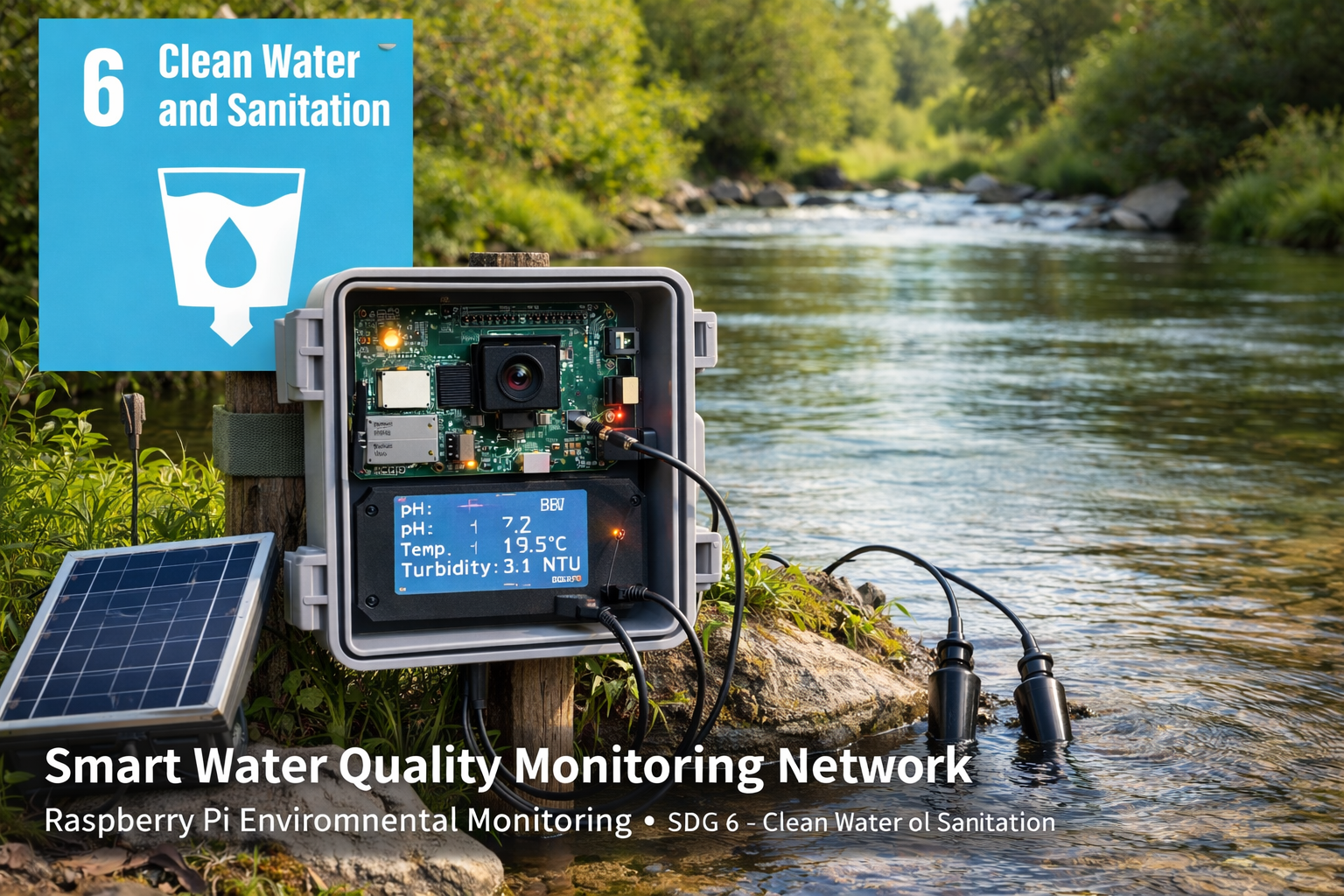
This project presents a prototype Raspberry Pi water quality monitoring system built around environmental sensing, analog-to-digital conversion, local data logging, and optional dashboard integration. The platform reads water-related sensor values such as pH, turbidity, and temperature, stores observations locally, and can be extended with anomaly detection or cloud synchronization.
From an engineering perspective, the system demonstrates a compact environmental observation node with sensing, logging, and analysis layers. From a sustainability perspective, it illustrates how low-cost embedded systems can expand water monitoring capacity and strengthen evidence-based water management.
Prototype Repository
This project is published as an open prototype so that engineers, researchers, students, and advanced makers can reproduce and extend the design. All code, documentation, setup notes, and example monitoring data are available in the project repository.
GitHub Repository:
Raspberry Pi Water Quality Monitoring System – Source Files and Documentation
The repository contains the complete prototype build materials:
- Python sensor-integration scripts
- data logging examples
- environmental dashboard integration notes
- deployment documentation
- example environmental datasets
- configuration files for system setup
Engineers can clone the repository, fork the design, or download the complete project using GitHub’s Download ZIP feature.
All materials are released under the MIT License to support reuse in research, education, and prototype engineering work.
Repository Structure
raspberry-pi-water-quality-monitoring/

README.md
LICENSE
requirements.txt

src/
  read_water_quality.py
  log_water_quality.py
  dashboard_export.py
  anomaly_check.py

docs/
  setup_guide.md
  deployment_notes.md
  sensor_notes.md

data/
  example_water_quality_readings.csv

hardware/
SDG Alignment
This project connects most directly to SDG 6: Clean Water and Sanitation, which emphasizes improving water quality, reducing pollution, and strengthening water-resource management.
It also relates to:
- SDG 9: Industry, Innovation and Infrastructure — through distributed environmental sensing and low-cost data infrastructure
- SDG 14: Life Below Water — because freshwater monitoring affects downstream aquatic ecosystems and watershed health
- SDG 13: Climate Action — because water-quality stress often interacts with flood events, drought, and climate variability
Monitoring infrastructure supports water governance by making contamination, ecosystem stress, and environmental change more visible over time.
Water Quality and the Policy Goals of SDG 6
Water security depends on maintaining healthy freshwater systems and preventing contamination of drinking water sources. The SDG 6 framework places strong emphasis on improving water quality, reducing pollution, increasing treatment and reuse, protecting freshwater ecosystems, and strengthening integrated water-resource management.
Achieving these goals requires reliable environmental measurements. Without consistent monitoring data, it becomes difficult to identify pollution events, evaluate environmental policy, or manage freshwater systems effectively.
Water monitoring networks therefore function as critical infrastructure supporting evidence-based environmental governance.
Why a Raspberry Pi Water Quality Monitoring System Matters
Traditional water monitoring often depends on periodic manual sampling conducted by environmental agencies or research institutions. While these programs are valuable, they may not capture rapid environmental changes such as runoff surges, industrial discharges, algal bloom precursors, or sudden turbidity spikes.
A Raspberry Pi–based monitoring system matters because it can provide continuous, distributed observation at much lower cost. This helps make water systems more visible in rivers, agricultural settings, urban watersheds, and local ecosystems where dense monitoring coverage is often limited.
The platform is not a substitute for laboratory-certified water analysis. Its value is that it brings continuous field measurement into reach for more researchers, communities, and environmental education projects.
Key Water Quality Parameters
Environmental scientists typically monitor several physical and chemical variables when evaluating water quality.
Common measurements include:
- pH – acidity or alkalinity of water
- turbidity – suspended particles and sediment
- temperature – influences aquatic ecosystems and chemical behavior
- dissolved oxygen – critical for aquatic life
- electrical conductivity – indicates dissolved salts
- total dissolved solids (TDS) – reflects dissolved mineral content
Changes in these measurements can indicate contamination, ecosystem stress, or environmental change. Continuous monitoring allows researchers to detect patterns that would be difficult to observe through occasional sampling alone.
Distributed Water Monitoring Networks
Distributed sensor networks allow water systems to be monitored continuously rather than only through periodic field visits. In these systems, low-cost monitoring stations collect environmental measurements and transmit or store observations over time.
The Raspberry Pi can serve as a local data hub that aggregates measurements from multiple sensors, stores them in local databases, and supports environmental analytics or dashboard export. This helps create time-series environmental records that can be interpreted more effectively than isolated samples.
Raspberry Pi Water Quality Monitoring System Architecture
A Raspberry Pi water monitoring station typically follows a layered architecture:
Sensor Layer
- pH sensors
- turbidity sensors
- temperature probes
- dissolved oxygen sensors
Data Collection Layer
- Raspberry Pi computer
- analog-to-digital converter (ADS1115)
- sensor interface circuitry
Data Management Layer
- local database or CSV logging
- cloud synchronization
- dashboard visualization
Typical architecture:
Water Sensors → Raspberry Pi → Local Database → Environmental Dashboard
This structure allows the monitoring station to operate autonomously while still contributing to broader environmental datasets or local decision-support systems.
Bill of Materials
- Raspberry Pi 4 or Raspberry Pi Zero 2 W
- pH sensor module
- turbidity sensor
- DS18B20 waterproof temperature probe
- ADS1115 analog-to-digital converter
- waterproof sensor enclosure
- microSD card
- power supply or solar system
The ADS1115 ADC allows the Raspberry Pi to read analog sensor signals that would otherwise be incompatible with its digital GPIO interface.
Engineering Specifications
| Parameter | Specification |
|---|---|
| Compute platform | Raspberry Pi 4 or Raspberry Pi Zero 2 W |
| Primary sensors | pH sensor, turbidity sensor, DS18B20 probe |
| ADC interface | ADS1115 over I2C |
| Storage options | CSV, SQLite, optional dashboard export |
| Output options | local database, dashboard, optional cloud sync |
| Deployment mode | distributed water observation node |
| Power options | fixed supply or solar-assisted field deployment |
| Target scope | educational, prototype, and experimental water-quality observation |
Connecting Water Quality Sensors
Many water-quality sensors produce analog signals that must be converted to digital values before the Raspberry Pi can process them.
Typical wiring configuration:
- water sensors → ADS1115 analog input
- ADS1115 → Raspberry Pi I2C interface
- DS18B20 → GPIO pin with pull-up resistor
This configuration allows the Raspberry Pi to collect multiple water-quality measurements simultaneously. In practical deployments, careful grounding and sensor isolation matter because analog measurements can be sensitive to electrical noise and environmental conditions.
Python Code for Sensor Data Collection
The following Python example reads analog sensor values through the ADS1115.
import time
import board
import busio
from adafruit_ads1x15.ads1115 import ADS1115
from adafruit_ads1x15.analog_in import AnalogIn

i2c = busio.I2C(board.SCL, board.SDA)
ads = ADS1115(i2c)

ph_channel = AnalogIn(ads, ADS1115.P0)
turbidity_channel = AnalogIn(ads, ADS1115.P1)

while True:
    ph_value = ph_channel.value
    turbidity = turbidity_channel.value

    print("pH sensor reading:", ph_value)
    print("Turbidity reading:", turbidity)

    time.sleep(10)
This code reads analog values from environmental sensors and prints them to the terminal. In practical deployments these values would be converted into calibrated physical measurements.
Logging Water Quality Data
Environmental monitoring systems typically log measurements for long-term analysis.
import csv
import datetime

with open("water_quality_log.csv", "a") as file:
    writer = csv.writer(file)

    writer.writerow([
        datetime.datetime.now(),
        ph_value,
        turbidity
    ])
Over time this dataset forms a time-series record that can reveal seasonal trends, contamination events, or ecosystem changes.
Integrating Environmental Dashboards
Water monitoring stations often transmit data to visualization dashboards that allow researchers and policymakers to interpret environmental conditions more effectively.
Popular tools include:
- Grafana dashboards
- InfluxDB time-series databases
- cloud IoT platforms
These tools allow water monitoring networks to generate real-time environmental intelligence rather than only isolated sensor readings.
AI Applications in Water Monitoring
Machine learning techniques can enhance environmental monitoring systems by detecting patterns that may indicate pollution, runoff events, or ecosystem stress.
Possible applications include:
- pollution anomaly detection
- predictive water-quality forecasting
- algal bloom prediction
- watershed health monitoring
Lightweight frameworks such as TensorFlow Lite can run on Raspberry Pi devices, enabling edge-based environmental analytics in field settings.
Engineering Notes
A few technical considerations are especially important in this build:
- analog dependency: many water sensors require an ADC because the Raspberry Pi lacks native analog input.
- calibration realism: raw sensor values are only useful when linked to real physical measurement ranges.
- field exposure: sensor fouling, moisture, and enclosure design strongly affect long-term performance.
- time-series value: the strength of the system comes from repeated observation over time, not only single readings.
- dashboard usefulness: structured storage and visualization greatly improve interpretability.
These considerations make the project more than a simple sensor demonstration. It becomes a prototype environmental data infrastructure node for water systems.
Validation and Testing
To bring this project closer to engineering-grade documentation, validation should include:
- verify I2C communication with the ADS1115
- confirm that analog sensor values change plausibly under controlled conditions
- compare calibrated pH readings against known buffer solutions where possible
- compare turbidity behavior across clearer and more sediment-rich samples
- verify temperature probe readings against expected conditions
- test CSV or SQLite logging across extended runs
If the system behaves inconsistently, the issue may be related to wiring, calibration, power stability, analog noise, or sensor condition rather than to the monitoring concept itself.
Suggested Performance Metrics
For a more rigorous evaluation, the station can be assessed using several simple metrics:
- sensor stability: consistency of repeated readings under unchanged conditions
- logging reliability: whether observations are stored without loss over long runs
- uptime: how consistently the station continues operating without intervention
- data completeness: whether the expected number of records is captured over time
- trend usefulness: whether the collected series reveals meaningful environmental changes
Even simple tracking of these metrics improves the project’s value as an experimental water monitoring platform.
Environmental Governance and SDG 6
Reliable water monitoring infrastructure supports multiple aspects of environmental governance.
These systems can contribute to:
- drinking water safety monitoring
- river and watershed management
- agricultural runoff monitoring
- industrial pollution detection
- citizen science environmental initiatives
By expanding environmental measurement capabilities, distributed monitoring systems help strengthen the evidence base required for sustainable water policy.
The Future of Water Monitoring Networks
Emerging environmental monitoring systems increasingly combine:
- sensor networks
- satellite data
- AI analytics
- open environmental databases
Low-cost computing platforms such as Raspberry Pi allow students, researchers, and community organizations to prototype these technologies and contribute to broader environmental monitoring efforts. Projects like this demonstrate how open hardware and open-source software can strengthen water governance and environmental stewardship.
Reproducibility
All code, documentation, and supporting build materials necessary to reproduce the prototype are included in the project repository. The design intentionally relies on widely available Raspberry Pi hardware, open-source Python libraries, and common sensing components so that it can be rebuilt in classrooms, labs, and independent water-monitoring projects.
The system is intended as a reference implementation rather than a certified scientific observation node. Engineers adapting it for longer-term deployment should validate calibration, enclosure design, data retention, power stability, and sensor maintenance under local operating conditions.
Conclusion
Building a Raspberry Pi water quality monitoring system demonstrates how embedded sensing and local computation can support stronger water stewardship. By combining water-quality sensors, local logging, and optional dashboard integration, the platform creates a flexible foundation for distributed environmental observation.
Although compact, the design reflects a broader sustainability principle: water resilience depends on environmental visibility. When freshwater systems can be measured continuously and interpreted effectively, communities are better positioned to protect ecosystems, detect pollution, and make more informed decisions.