
Last Updated June 25, 2026
The historical development of international criminal justice is therefore both doctrinal and political. It includes legal innovation, evidentiary architecture, institutional design, moral reckoning, and profound criticism. Nuremberg and Tokyo helped create the language of individual criminal responsibility, superior orders, command responsibility, conspiracy, aggressive war, and crimes against humanity. They also exposed enduring problems that still shape the field: victor’s justice, selectivity, retroactivity, colonial silence, uneven enforcement, state power, race, empire, and the difficulty of building universal justice after catastrophic war.
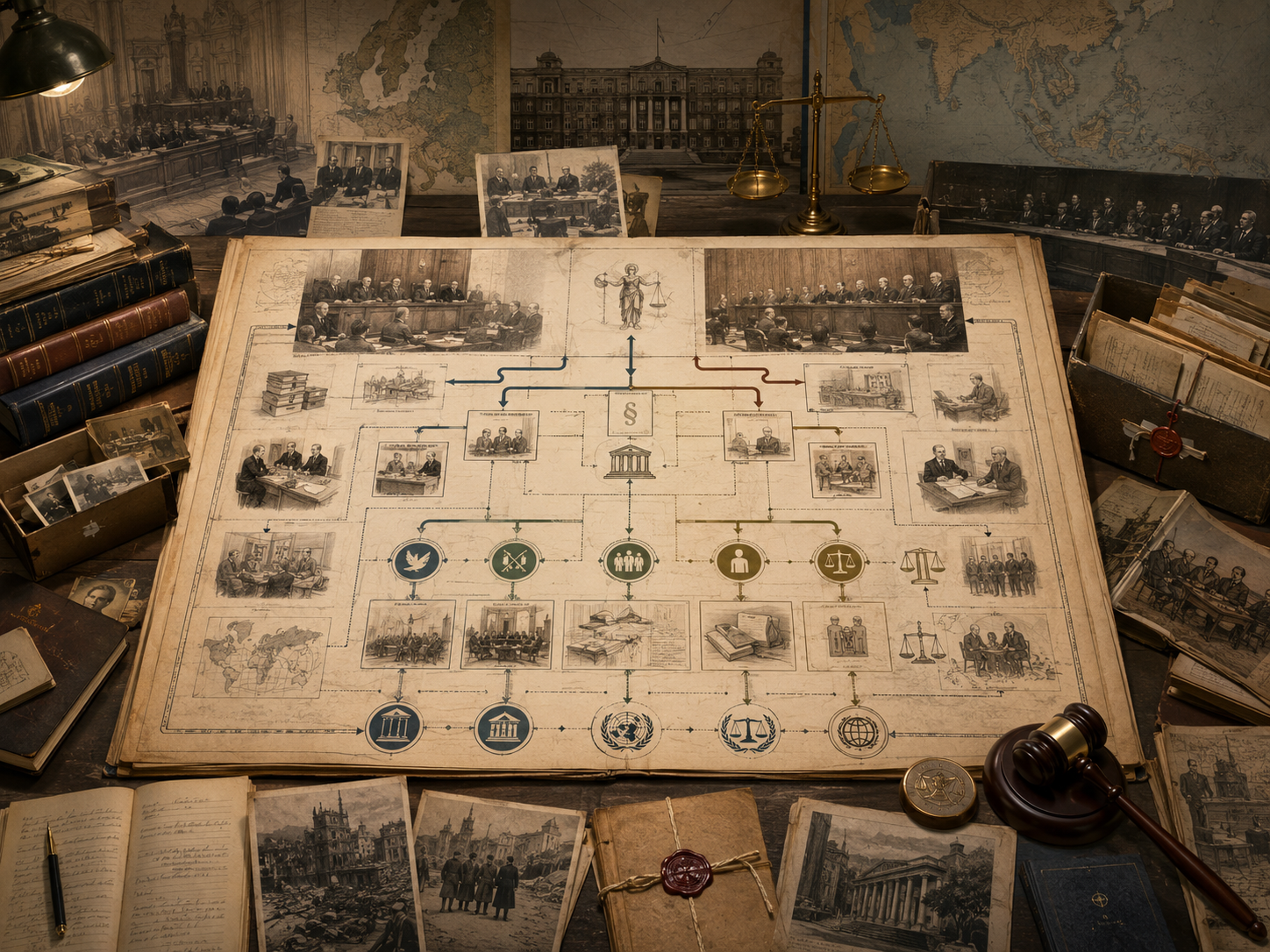
The postwar tribunals were not neutral legal machines. They were created by victorious powers, operated in the shadow of war, and judged defeated enemies while many Allied actions remained outside the dock. Yet they also articulated legal principles that later became foundational: individuals can commit crimes under international law; official position does not automatically shield responsibility; superior orders do not necessarily excuse criminal conduct; and aggressive war, atrocities against civilians, and serious violations of the laws of war can be addressed as international crimes. The history is therefore not simple triumphalism. It is a record of legal construction under conditions of power.
Why the Postwar Tribunals Matter
Nuremberg and Tokyo matter because they changed the relationship between international law and individual responsibility. Before the Second World War, international law primarily regulated states, diplomatic relations, treaty obligations, maritime conduct, war, neutrality, occupation, and state responsibility. Individuals could be punished domestically for ordinary crimes, and some war crimes could be prosecuted by military courts, but there was no permanent global criminal court with general jurisdiction over senior leaders for atrocities and aggressive war.
The postwar tribunals broke that pattern. They treated certain acts as crimes under international law and placed individuals, not abstract states alone, before judicial bodies. This shift became central to later international criminal law. The idea that a head of state, minister, general, camp administrator, propagandist, or police official could be criminally responsible for international crimes is now familiar. At the time, it was institutionally bold and legally contested.
Nuremberg and Tokyo also matter because they remain cautionary examples. They show that criminal justice can emerge from political victory, that legal categories can be shaped by power, that fair-trial guarantees matter even after atrocities, and that selectivity can undermine legitimacy even when the accused committed grave crimes. The history is therefore a foundation and a warning.
From War Responsibility to International Criminal Law
The legal path to Nuremberg and Tokyo did not begin in 1945. Earlier ideas about war crimes, reprisals, military discipline, piracy, humanitarian limits, and state responsibility had already created fragments of accountability. The Hague Regulations, the Geneva tradition, and national military manuals recognized that war was not legally unlimited. The failed attempt after the First World War to hold Kaiser Wilhelm II accountable also revealed the difficulty of translating political responsibility into criminal adjudication.
The interwar period added further legal materials, including the Kellogg-Briand Pact’s renunciation of war as an instrument of national policy. But the legal status of aggressive war as an individual crime remained contested. The Second World War made the issue unavoidable. The scale of aggression, occupation, extermination, forced labor, deportation, mass killing, prisoner abuse, and organized persecution created pressure for a legal response that would go beyond armistice, reparations, or political condemnation.
The postwar tribunals therefore occupied a transitional space. They relied on pre-existing legal materials, wartime declarations, military law, treaty obligations, and customary principles. Yet they also developed new institutional forms and categories. This is why debates about retroactivity and legality are so persistent. Nuremberg and Tokyo were neither invented from nothing nor merely routine applications of settled criminal codes. They were moments of legal consolidation under extraordinary historical pressure.
Nuremberg and the Architecture of Individual Responsibility
The International Military Tribunal at Nuremberg was established through the London Agreement and Charter of 8 August 1945. It was designed to try major war criminals of the European Axis whose offenses had no particular geographical location. Its Charter created jurisdiction over crimes against peace, war crimes, and crimes against humanity, and it allowed responsibility to be assessed not only for direct perpetration but also for leadership, planning, ordering, instigation, and participation in a common plan.
Institutional design
The tribunal was created by the victorious Allied powers and composed of judges and prosecutors from those powers. This gave the process authority from the perspective of military victory, but it also generated the enduring criticism of victor’s justice.
Personal responsibility
The tribunal rejected the idea that international wrongs are only state wrongs. Individuals could be tried for international crimes even when acting through state institutions.
Leadership focus
Nuremberg concentrated on senior political, military, legal, economic, and administrative actors. It treated organized criminality as a system of leadership, policy, bureaucracy, and execution.
Documentary proof
The prosecution relied heavily on captured records, minutes, orders, decrees, correspondence, and institutional archives. This helped establish the modern evidentiary importance of documentary linkage.
Primary legal excerpt
“crimes against peace” — “war crimes” — “crimes against humanity”
Charter of the International Military Tribunal, Article 6.These categories became the core architecture of postwar international criminal law, though later doctrine modified their scope and relationship to armed conflict.
Nuremberg’s importance lies in the way it connected legal categories to institutional responsibility. The defendants were not prosecuted as isolated offenders. They were prosecuted as officials, commanders, ministers, administrators, propagandists, industrialists, and military leaders participating in organized criminal systems. That move remains central to international criminal law, where the hardest cases often involve proof of policy, hierarchy, knowledge, contribution, and control rather than direct physical perpetration.
Tokyo and the Far East Tribunal
The International Military Tribunal for the Far East, commonly called the Tokyo Tribunal, was established in 1946 to try major Japanese war criminals. Like Nuremberg, it addressed crimes against peace, war crimes, and crimes against humanity. But Tokyo had its own institutional setting, procedural history, evidentiary problems, legal controversies, and legacy debates. It lasted longer than Nuremberg, produced a sprawling record, and generated major separate and dissenting opinions.
Different theater, different politics
Tokyo addressed Japan’s war in Asia and the Pacific, including aggression, occupation, atrocities against civilians, and abuse of prisoners. Its record cannot be reduced to a simple copy of Nuremberg.
Command and state structure
The tribunal confronted questions about imperial authority, military command, cabinet responsibility, and bureaucratic participation in a way that remains central to debates about leadership liability.
Dissent and legality
Tokyo is especially important because its separate and dissenting opinions exposed disagreements over legality, aggression, conspiracy, procedure, and the legitimacy of the tribunal itself.
Historical silences
Some forms of harm, including colonial violence, sexual violence, and Allied conduct, were underdeveloped or excluded. These gaps still shape critical assessments of the tribunal.
The Tokyo Tribunal’s legal legacy is more contested than Nuremberg’s in many accounts, partly because of the length and complexity of the proceedings and partly because the trial became entangled with occupation policy, imperial continuity, and Cold War politics. Yet it remains essential to the historical development of international criminal justice. It shows that postwar criminal law was never only European. It also reveals how international criminal justice travels unevenly across regions, languages, archives, and political settlements.
Crimes Against Peace, War Crimes, and Crimes Against Humanity
The postwar tribunals’ most important substantive contribution was the organization of mass violence into legal crime categories. Crimes against peace addressed planning, preparing, initiating, or waging aggressive war. War crimes addressed violations of the laws and customs of war. Crimes against humanity addressed murder, extermination, enslavement, deportation, persecution, and other inhumane acts against civilian populations when connected to the tribunal’s jurisdictional framework.
| Category | Postwar function | Later development | Lawyer-facing issue |
|---|---|---|---|
| Crimes against peace | Made aggressive war a leadership crime. | Developed into the modern crime of aggression, later codified in the Rome Statute amendments. | Was the accused involved in leadership-level planning, preparation, initiation, or execution of aggression? |
| War crimes | Criminalized serious violations of the laws and customs of war. | Expanded through Geneva law, Additional Protocols, customary IHL, ICTY/ICTR jurisprudence, and the Rome Statute. | Is there an armed conflict nexus, protected status, prohibited conduct, and individual linkage? |
| Crimes against humanity | Addressed large-scale atrocities against civilians, initially tied to war and other tribunal crimes. | Later became independent of armed-conflict linkage in modern formulations. | Is there a widespread or systematic attack against a civilian population and knowledge of that attack? |
| Conspiracy/common plan | Helped prosecutors address coordinated leadership criminality. | Influenced later debates on JCE, common-purpose liability, co-perpetration, and group criminality. | What is the accused’s contribution, intent, knowledge, and connection to the criminal plan? |
The categories were not static. Crimes against humanity in particular changed substantially over time. At Nuremberg, the category was linked to other crimes within the tribunal’s jurisdiction, which limited its independent reach. Later tribunals and statutes moved toward a broader understanding centered on widespread or systematic attacks against civilian populations. The modern Rome Statute formulation reflects that later development rather than simply reproducing Nuremberg’s exact framework.
Procedural Innovation and Fair-Trial Controversy
Nuremberg and Tokyo were procedural experiments. They had to build tribunals, appoint judges and prosecutors, define crimes, manage multilingual proceedings, handle mountains of documentary evidence, protect defense rights, conduct cross-examination, and generate judgments that would be legible to domestic and international audiences. They did so under conditions of occupation, public outrage, political pressure, and destroyed social order.
The tribunals offered defense counsel, indictments, evidentiary hearings, judicial opinions, and reasoned judgments. But they also departed from ordinary domestic criminal models. Rules of evidence were flexible. The tribunals were established after the conduct occurred. The prosecuting powers were also victorious powers. Certain Allied actions were outside the tribunals’ jurisdiction. These facts did not make the trials meaningless, but they complicate any simple claim that the proceedings were ordinary criminal trials.
Individual Liability, Official Position, and Superior Orders
One of Nuremberg’s most durable contributions was its rejection of the idea that individuals can avoid responsibility simply because crimes were committed through the state. The postwar tribunals treated official position as no automatic defense. They also limited superior orders as a complete excuse. A soldier, official, or commander could not always escape responsibility by saying that the state commanded the act or that law ended at the border of sovereign authority.
Doctrinal legacy
“official position” — “superior orders” — “individual responsibility”
Nuremberg Principles, Principles III and IV.The Nuremberg Principles helped preserve the tribunal’s core lessons in a more general legal form after the trials ended.
This was a conceptual shift. International law could no longer be described only as a law between states. It also imposed duties on individuals in certain extreme contexts. That move later became central to the statutes of the ICTY, ICTR, hybrid tribunals, and ICC. Modern international criminal law still depends on this shift when it charges presidents, ministers, military commanders, militia leaders, police chiefs, camp officials, propagandists, financiers, and other participants in atrocity systems.
Command Responsibility and Leadership Crimes
The postwar tribunals also contributed to the law of superior responsibility, though the doctrine developed through multiple sources and later tribunals refined its elements. Leadership responsibility does not mean guilt by rank alone. The harder legal questions concern authority, knowledge, control, prevention, punishment, and linkage. A commander or civilian superior is not responsible merely because crimes occurred somewhere within a broad institution. The prosecution must establish a legally relevant relationship between authority and criminal failure.
| Issue | Postwar significance | Modern legal refinement |
|---|---|---|
| Superior-subordinate relationship | Military and administrative hierarchies mattered to responsibility. | Modern doctrine asks whether the superior had effective control. |
| Knowledge | Leaders could not hide behind bureaucratic distance where evidence showed awareness. | Statutes distinguish actual knowledge, reason to know, and conscious disregard standards. |
| Failure to prevent | Liability could arise from omission where authority carried duties. | Modern doctrine asks whether necessary and reasonable measures were available. |
| Failure to punish | Post-crime failure could reveal responsibility and institutional tolerance. | Modern command responsibility treats failure to submit matters for investigation or punishment as legally relevant. |
| Leadership crimes | Aggression and common plan theories focused on senior decision-makers. | Modern law separates perpetration, ordering, aiding and abetting, JCE, co-perpetration, and superior responsibility. |
Victor’s Justice, Selectivity, and Legality
The central criticism of Nuremberg and Tokyo is victor’s justice. The tribunals judged defeated Axis leaders while Allied actions were not placed under comparable scrutiny. The atomic bombings, area bombing, Soviet conduct, colonial violence, and other Allied practices did not receive the same tribunal treatment. That asymmetry remains essential to historical analysis.
But victor’s justice is not a complete answer. Selectivity can undermine legitimacy without proving that all legal findings were wrong. A court may be selective and still identify real crimes. A tribunal may be politically constituted and still articulate legal principles that later become more general. The question is how to analyze the relationship between power and law without collapsing one into the other.
Legality
Were the crimes defined with enough legal basis before the conduct occurred? This is especially contested for crimes against peace and some formulations of crimes against humanity.
Selectivity
Why were only defeated leaders prosecuted? Selectivity affects legitimacy, but does not erase the criminality of prosecuted conduct.
Institutional dependence
The tribunals depended on occupying powers for authority, evidence, custody, security, and enforcement. This shaped the legal field.
Historical use
Lawyers should cite the tribunals carefully: not as perfect models, but as foundational legal sources whose authority is strongest when later codified or reaffirmed.
Colonial Silences and Racial Hierarchy
The historical development of international criminal justice cannot be separated from the world in which it emerged. The postwar trials took place in an international order still shaped by colonial empires, racial hierarchy, unequal sovereignty, and selective recognition of victims. Many atrocities committed in colonial contexts were not framed through the same machinery of international criminal justice. The category of crimes against humanity developed alongside a world that had not yet fully confronted colonial domination as a system of mass legal and political violence.
Tokyo makes this issue especially visible because the war in Asia and the Pacific involved empire, occupation, racial ideology, prisoner abuse, mass violence against civilians, sexual violence, and competing imperial projects. Yet the legal record did not fully capture all dimensions of colonial and racial violence. Nuremberg likewise addressed Nazi crimes while leaving broader histories of empire outside the tribunal’s direct frame.
This does not negate the tribunals’ importance. It clarifies their limits. A contemporary account of international criminal justice must ask whose suffering became legible as international crime, whose remained politically invisible, and how later law can address the exclusions built into earlier institutions.
Nuremberg Principles and Codification
After Nuremberg, the United Nations moved to preserve the tribunal’s core legal principles. The International Law Commission formulated the Nuremberg Principles in 1950, turning central lessons from the Charter and Judgment into a concise statement: individuals can be responsible for crimes under international law; internal law does not necessarily relieve responsibility; official position does not automatically excuse; superior orders do not automatically excuse; and crimes against peace, war crimes, and crimes against humanity are crimes under international law.
The Nuremberg Principles did not create a permanent court. They did not resolve every legality debate. They did not erase selectivity. But they helped convert the tribunal’s legacy into a portable legal vocabulary. That vocabulary later influenced the Genocide Convention, the work of the ILC, the ad hoc tribunals, the Rome Statute, and domestic prosecutions.
Control Council Law No. 10 and Subsequent Nuremberg Trials
The major Nuremberg trial is only part of the postwar justice story. Control Council Law No. 10 authorized additional trials in occupied Germany, including proceedings against doctors, judges, industrialists, military commanders, diplomats, and administrators. These subsequent Nuremberg trials expanded the legal record by examining how professional, bureaucratic, economic, medical, judicial, and military institutions contributed to atrocity systems.
These trials are especially important for modern lawyers because they show how international crimes can be embedded in ordinary institutional roles. A legal system may be used to persecute. A corporation may benefit from forced labor. A medical profession may participate in experimentation and extermination. A military command may organize unlawful reprisals. A ministry may coordinate deportation. The historical lesson is that atrocity is not only battlefield violence; it can be administrative, professional, economic, and legal.
From Cold War Stagnation to the Ad Hoc Tribunals
The postwar momentum toward international criminal justice slowed dramatically during the Cold War. Geopolitical rivalry, sovereignty concerns, decolonization struggles, ideological conflict, and the absence of custody over major suspects limited the creation of new international criminal institutions. The Genocide Convention existed, but enforcement remained weak. The idea of a permanent international criminal court persisted in legal imagination but did not become operational.
The 1990s revived international criminal justice through the establishment of the International Criminal Tribunal for the former Yugoslavia and the International Criminal Tribunal for Rwanda. These tribunals were created by the United Nations Security Council and developed modern doctrine on genocide, crimes against humanity, war crimes, rape and sexual violence, command responsibility, joint criminal enterprise, aiding and abetting, protected persons, and fair-trial procedure.
The ad hoc tribunals did not simply repeat Nuremberg. They updated it. They operated under UN authority rather than direct occupation by victorious states. They developed appellate jurisprudence. They addressed atrocities committed in internal and internationalized conflicts. They clarified crimes against humanity without the same tight war nexus. They made sexual violence central to international criminal law in ways the postwar tribunals had failed to do.
Hybrid Courts and Domestic Internationalization
Hybrid and internationalized courts further diversified the architecture of international criminal justice. Institutions such as the Special Court for Sierra Leone, the Extraordinary Chambers in the Courts of Cambodia, the Special Tribunal for Lebanon, Kosovo Specialist Chambers, and the Extraordinary African Chambers combined domestic, international, regional, and hybrid elements in different ways. These courts responded to the limits of purely international tribunals and purely domestic proceedings.
Hybrid courts matter because they show that international criminal justice is not a single institutional model. Some courts are treaty-based. Some are UN-assisted. Some are domestic courts with international participation. Some are regionalized. Some focus on a specific conflict or period. Some emphasize proximity to affected communities; others emphasize security, neutrality, or specialized capacity. The field that began with Nuremberg and Tokyo now includes multiple institutional pathways.
The ICC and the Post-Nuremberg Architecture
The International Criminal Court represents the most ambitious institutional descendant of the postwar project: a standing treaty-based court with jurisdiction over genocide, crimes against humanity, war crimes, and aggression, subject to complementarity and jurisdictional limits. The ICC does not replace domestic courts. It is designed to act when states are unwilling or unable genuinely to investigate or prosecute cases within its jurisdiction.
The ICC’s architecture reflects lessons from the postwar tribunals and their successors. It codifies crimes more precisely. It contains detailed procedural safeguards. It recognizes victims’ participation and reparations. It includes complementarity. It operates through treaty consent, Security Council referrals, territorial and nationality jurisdiction, and limited aggression jurisdiction. Yet it still faces the old problems: state cooperation, arrest enforcement, selectivity, great-power resistance, resource limits, and accusations that global justice is unevenly distributed.
In that sense, the ICC did not end the Nuremberg problem. It institutionalized one answer to it while leaving the deeper politics of enforcement unresolved.
Case Studies in Practice
The history of international criminal justice is easiest to understand through institutional episodes. Each case study below shows a different legal problem: leadership crime, regional violence, tribunal legitimacy, doctrinal development, hybrid design, or modern complementarity.
Nuremberg
Nuremberg remains the core reference point for individual responsibility, crimes against peace, crimes against humanity, superior orders, official capacity, documentary proof, and leadership criminality. It is also the classic example of the tension between legal innovation and victor’s justice.
Tokyo
Tokyo broadened postwar accountability to Asia and the Pacific while generating major debates over legality, aggression, imperial responsibility, dissenting opinions, procedural fairness, and the selective framing of wartime violence.
Subsequent Nuremberg Trials
The later trials under Control Council Law No. 10 showed how doctors, judges, industrialists, commanders, and administrators could become legally relevant participants in atrocity systems.
ICTY
The ICTY revived international criminal justice after the Cold War and produced major jurisprudence on war crimes, crimes against humanity, genocide, JCE, command responsibility, sexual violence, and fair-trial procedure.
ICTR
The ICTR made decisive contributions to genocide law, incitement, sexual violence as genocide, media responsibility, and accountability for mass killing in a non-European context.
Special Court for Sierra Leone
The SCSL showed how hybrid institutions can address civil-war atrocities, child soldiers, forced marriage, command responsibility, and the liability of external political leaders.
Extraordinary Chambers in Cambodia
The ECCC illustrates delayed justice, hybrid design, victim participation, historical memory, archive-building, and the difficulty of adjudicating mass atrocity decades after events.
International Criminal Court
The ICC transforms postwar lessons into a permanent court, but it remains constrained by complementarity, cooperation, arrests, treaty limits, Security Council politics, and legitimacy debates.
| Question | Why it matters | Historical example |
|---|---|---|
| What created the tribunal? | Institutional authority shapes legitimacy and jurisdiction. | London Agreement, SC resolutions, treaty, domestic-international hybrid law. |
| What crimes were charged? | Crime categories reveal the legal frame and historical limits. | Crimes against peace at Nuremberg and Tokyo; genocide at ICTR; war crimes at ICTY. |
| Who was targeted? | Defendant selection affects selectivity and theory of responsibility. | Major war criminals, commanders, ministers, media actors, hybrid-court defendants. |
| What evidence proved linkage? | International crimes usually require proof of connection to systems. | Captured documents, orders, witness testimony, chain-of-command evidence, archives. |
| What critique followed? | Legitimacy debates are part of the legal history. | Victor’s justice, colonial silence, delayed justice, selectivity, funding constraints. |
Lawyer-Facing Historical Development Toolkit
This toolkit translates the historical development of international criminal justice into practical research and advocacy methods.
1. Identify the institutional model
Was the tribunal occupation-based, Security Council-created, treaty-based, hybrid, domestic, regional, or permanent? Institutional origin affects jurisdiction and legitimacy.
2. Separate crime categories
Do not treat war crimes, crimes against humanity, genocide, aggression, and conspiracy as interchangeable. Each has distinct elements and historical development.
3. Track codification
Ask whether a principle comes from tribunal judgment, UN formulation, treaty text, customary law, domestic implementation, or later judicial interpretation.
4. Analyze liability theory
Identify whether responsibility is based on direct perpetration, ordering, planning, aiding and abetting, common plan, JCE, co-perpetration, or superior responsibility.
5. Address legality
For historical materials, always consider nullum crimen, retroactivity, prior treaty obligations, customary law, and whether later codification changed the rule.
6. Include critique
A credible account should address victor’s justice, selectivity, race, empire, gender, colonial silence, procedural fairness, and enforcement asymmetry.
| Authority | Use | Caution |
|---|---|---|
| Nuremberg Charter and Judgment | Foundational for individual responsibility, crimes against peace, war crimes, crimes against humanity, superior orders, and official position. | Do not ignore selectivity, legality debates, or later doctrinal modification. |
| Tokyo Charter and Judgment | Important for aggression, leadership liability, Pacific war accountability, command issues, and dissenting views. | Use with attention to procedural controversy, separate opinions, and political context. |
| Nuremberg Principles | Portable UN/ILC formulation of postwar principles. | They are concise; modern statutes provide more detailed elements. |
| Control Council Law No. 10 cases | Important for professional, bureaucratic, industrial, judicial, medical, and command responsibility. | Proceedings varied and must be read in context. |
| ICTY/ICTR jurisprudence | Modern development of crimes, liability modes, command responsibility, and procedure. | Tribunal-specific statutes and facts matter. |
| Rome Statute | Most important modern treaty framework for ICC crimes and liability. | Not all Rome Statute formulations reflect customary law exactly. |
GitHub Repository
The International Law Research Repository supports this article with structured research infrastructure for tribunal history, postwar crime categories, liability doctrine, institutional design, source tracking, case-study matrices, and citation guidance for the International Law series.
Complete Code RepositoryUse the companion repository folder for structured tribunal-history matrices, Nuremberg and Tokyo source tables, international criminal justice timelines, liability-development notes, case-study data, citation guidance, and lightweight research utilities for the International Law series.
Related Articles
- War Crimes, Crimes Against Humanity, Genocide, and the Architecture of International Criminal Law
- The International Criminal Court and the Politics of Global Justice
- Universal Jurisdiction and Accountability for Atrocity Crimes
- Command Responsibility, Individual Criminal Liability, and Modes of Participation
- International Humanitarian Law: The Geneva Conventions and the Regulation of Armed Conflict
Primary Authorities
- Allied Powers (1945) London Agreement of 8 August 1945. Available at: https://avalon.law.yale.edu/imt/imtchart.asp.
- Allied Powers (1945) Charter of the International Military Tribunal. Available at: https://avalon.law.yale.edu/imt/imtconst.asp.
- International Military Tribunal (1946) Judgment of the International Military Tribunal. Available at: https://avalon.law.yale.edu/subject_menus/judcont.asp.
- Supreme Commander for the Allied Powers (1946) Charter of the International Military Tribunal for the Far East. Available at: https://www.jus.uio.no/english/services/library/treaties/04/4-06/military-tribunal-far-east.html.
- International Military Tribunal for the Far East (1948) Judgment of the International Military Tribunal for the Far East. Available at: https://www.legal-tools.org/doc/a3c41c/.
- Control Council for Germany (1945) Control Council Law No. 10. Available at: https://avalon.law.yale.edu/imt/imt10.asp.
- International Law Commission (1950) Principles of International Law Recognized in the Charter of the Nürnberg Tribunal and in the Judgment of the Tribunal. Available at: https://legal.un.org/ilc/texts/instruments/english/draft_articles/7_1_1950.pdf.
- United Nations Security Council (1993) Statute of the International Criminal Tribunal for the former Yugoslavia. Available at: https://www.icty.org/en/documents/statute-tribunal.
- United Nations Security Council (1994) Statute of the International Criminal Tribunal for Rwanda. Available at: https://unictr.irmct.org/en/tribunal.
- United Nations Diplomatic Conference of Plenipotentiaries (1998) Rome Statute of the International Criminal Court. Available at: https://www.icc-cpi.int/sites/default/files/2024-05/Rome-Statute-eng.pdf.
- International Criminal Court (2011) Elements of Crimes. Available at: https://www.icc-cpi.int/sites/default/files/Publications/Elements-of-Crimes.pdf.
Further Reading
- Bass, G.J. (2000) Stay the Hand of Vengeance: The Politics of War Crimes Tribunals. Princeton: Princeton University Press. Available at: https://press.princeton.edu/books/paperback/9780691092782/stay-the-hand-of-vengeance.
- Bloxham, D. (2001) Genocide on Trial: War Crimes Trials and the Formation of Holocaust History and Memory. Oxford: Oxford University Press. Available at: https://global.oup.com/academic/product/genocide-on-trial-9780198208723.
- Boister, N. and Cryer, R. (2008) The Tokyo International Military Tribunal: A Reappraisal. Oxford: Oxford University Press. Available at: https://global.oup.com/academic/product/the-tokyo-international-military-tribunal-9780199541928.
- Cassese, A. (2003) International Criminal Law. Oxford: Oxford University Press. Available at: https://global.oup.com/academic/product/international-criminal-law-9780199203109.
- Cryer, R., Robinson, D. and Vasiliev, S. (2019) An Introduction to International Criminal Law and Procedure. 4th edn. Cambridge: Cambridge University Press. Available at: https://www.cambridge.org/core/books/an-introduction-to-international-criminal-law-and-procedure/E4F21C5E720E5FD3E9B4E7B89160B0CE.
- Heller, K.J. and Simpson, G. (eds.) (2011) The Hidden Histories of War Crimes Trials. Oxford: Oxford University Press. Available at: https://global.oup.com/academic/product/the-hidden-histories-of-war-crimes-trials-9780199554317.
- Koskenniemi, M. (2002) The Gentle Civilizer of Nations: The Rise and Fall of International Law 1870–1960. Cambridge: Cambridge University Press. Available at: https://www.cambridge.org/core/books/gentle-civilizer-of-nations/A49F0DA3267A218E1BB57DAD7E3C00B1.
- Minear, R.H. (1971) Victor’s Justice: The Tokyo War Crimes Trial. Princeton: Princeton University Press. Available at: https://press.princeton.edu/books/paperback/9780691627144/victors-justice.
- Priemel, K.C. (2016) The Betrayal: The Nuremberg Trials and German Divergence. Oxford: Oxford University Press. Available at: https://global.oup.com/academic/product/the-betrayal-9780199669752.
- Sands, P. (2016) East West Street: On the Origins of Genocide and Crimes against Humanity. London: Weidenfeld & Nicolson. Available at: https://www.penguinrandomhouse.com/books/317182/east-west-street-by-philippe-sands/.
- Schabas, W.A. (2020) An Introduction to the International Criminal Court. 6th edn. Cambridge: Cambridge University Press. Available at: https://www.cambridge.org/core/books/an-introduction-to-the-international-criminal-court/49ECD7C86898655A241F37ED10A7090A.
- Sellars, K. (2013) Crimes against Peace and International Law. Cambridge: Cambridge University Press. Available at: https://www.cambridge.org/core/books/crimes-against-peace-and-international-law/7E41F478CBB303071B0FCF8D242FE58C.
- Totani, Y. (2008) The Tokyo War Crimes Trial: The Pursuit of Justice in the Wake of World War II. Cambridge, MA: Harvard University Asia Center. Available at: https://www.hup.harvard.edu/books/9780674033399.
- Werle, G. and Jessberger, F. (2020) Principles of International Criminal Law. 4th edn. Oxford: Oxford University Press. Available at: https://global.oup.com/academic/product/principles-of-international-criminal-law-9780198826859.
References
- Allied Powers (1945) Charter of the International Military Tribunal. Available at: https://avalon.law.yale.edu/imt/imtconst.asp.
- Allied Powers (1945) London Agreement of 8 August 1945. Available at: https://avalon.law.yale.edu/imt/imtchart.asp.
- Avalon Project (n.d.) The International Military Tribunal for Germany. Yale Law School. Available at: https://avalon.law.yale.edu/subject_menus/imt.asp.
- Bass, G.J. (2000) Stay the Hand of Vengeance: The Politics of War Crimes Tribunals. Princeton: Princeton University Press. Available at: https://press.princeton.edu/books/paperback/9780691092782/stay-the-hand-of-vengeance.
- Boister, N. and Cryer, R. (2008) The Tokyo International Military Tribunal: A Reappraisal. Oxford: Oxford University Press. Available at: https://global.oup.com/academic/product/the-tokyo-international-military-tribunal-9780199541928.
- Control Council for Germany (1945) Control Council Law No. 10. Available at: https://avalon.law.yale.edu/imt/imt10.asp.
- International Criminal Court (2011) Elements of Crimes. Available at: https://www.icc-cpi.int/sites/default/files/Publications/Elements-of-Crimes.pdf.
- International Criminal Tribunal for Rwanda (n.d.) The Tribunal. United Nations International Residual Mechanism for Criminal Tribunals. Available at: https://unictr.irmct.org/en/tribunal.
- International Criminal Tribunal for the former Yugoslavia (n.d.) Statute of the Tribunal. Available at: https://www.icty.org/en/documents/statute-tribunal.
- International Law Commission (1950) Principles of International Law Recognized in the Charter of the Nürnberg Tribunal and in the Judgment of the Tribunal. Available at: https://legal.un.org/ilc/texts/instruments/english/draft_articles/7_1_1950.pdf.
- International Military Tribunal (1946) Judgment of the International Military Tribunal. Available at: https://avalon.law.yale.edu/subject_menus/judcont.asp.
- International Military Tribunal for the Far East (1948) Judgment of the International Military Tribunal for the Far East. Available at: https://www.legal-tools.org/doc/a3c41c/.
- Minear, R.H. (1971) Victor’s Justice: The Tokyo War Crimes Trial. Princeton: Princeton University Press. Available at: https://press.princeton.edu/books/paperback/9780691627144/victors-justice.
- Supreme Commander for the Allied Powers (1946) Charter of the International Military Tribunal for the Far East. Available at: https://www.jus.uio.no/english/services/library/treaties/04/4-06/military-tribunal-far-east.html.
- United Nations Diplomatic Conference of Plenipotentiaries (1998) Rome Statute of the International Criminal Court. Available at: https://www.icc-cpi.int/sites/default/files/2024-05/Rome-Statute-eng.pdf.
- Werle, G. and Jessberger, F. (2020) Principles of International Criminal Law. 4th edn. Oxford: Oxford University Press. Available at: https://global.oup.com/academic/product/principles-of-international-criminal-law-9780198826859.