
Last Updated June 4, 2026
Heuristics in strategic ideation are the cognitive shortcuts, rules of thumb, simplifying procedures, and search strategies through which individuals and organizations generate ideas under conditions of uncertainty, complexity, and limited information. In practice, strategic ideation rarely proceeds through exhaustive analysis. Decision-makers do not enumerate every possible alternative, calculate every consequence, compare every conceivable configuration, or search the entire landscape of strategic possibility before forming a direction. Instead, they rely on compressed patterns of thought that make ambiguity manageable enough for action.
These shortcuts are not incidental to strategy. They are part of its hidden operating system. Strategic environments are too information-rich, ambiguous, contested, and dynamically evolving to permit fully comprehensive reasoning. Heuristics allow individuals and teams to move from indeterminate problem states to provisional structures of possibility. They make ideation feasible by reducing search burden, directing attention, selecting analogies, identifying plausible options, and helping teams stop searching when an idea appears workable enough.
Yet the same mechanisms that enable speed and adaptability also shape the architecture of the idea space itself. They determine what appears plausible, which analogies become available, which examples dominate memory, which constraints seem real, which risks appear salient, and when the search for alternatives is prematurely terminated. Heuristics are therefore both productive and dangerous. They make strategic thought possible, but they also make strategic imagination partial.
At its deepest level, heuristics matter because they are part of the hidden infrastructure of strategy. They do not merely influence which ideas are selected after generation. They help determine which ideas are generated in the first place. This means that strategic imagination is never fully open. It is always partly organized by the shortcuts through which ambiguity becomes cognitively manageable. Once this is recognized, the real strategic question is no longer whether heuristics are being used, but how they are structuring the search process, narrowing possibility, accelerating convergence, suppressing alternatives, or enabling timely action before reflective evaluation has even begun.
This article examines heuristics as a core discipline within strategic ideation. It explores bounded rationality, heuristic search, availability, representativeness, anchoring, recognition, satisficing, affect, expertise, institutional path dependence, speed-depth tradeoffs, novelty and familiarity, complex systems, practical governance, mathematical representations, and applied workflows for diagnosing when shortcuts support strategy and when they silently constrain it.
Main Library
Publications
Article Map
Strategic Ideation
Related Topic
Cognitive Psychology
Related Topic
Behavioral Economics
Related Topic
Systems Thinking
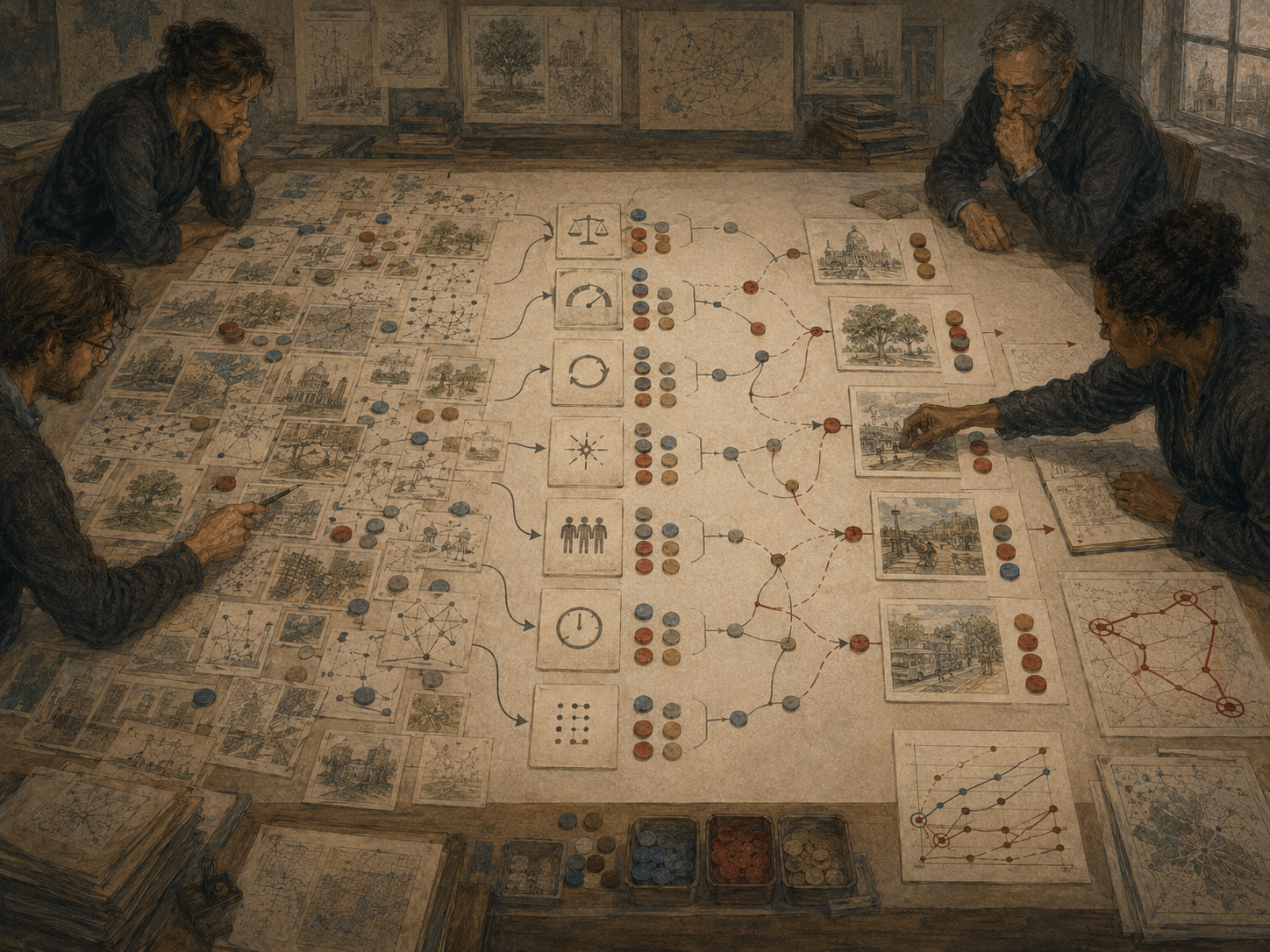
Heuristics as the Hidden Architecture of Ideation
Strategic ideation is often framed as open-ended creativity. This framing is incomplete. In practice, ideation is structured from the outset by cognitive limits, temporal pressure, institutional routines, partial information, social expectations, and inherited categories. The question is not whether these constraints exist, but how thought operates within them.
Heuristics provide that operating logic. They function as simplifying procedures that make idea generation possible without exhaustive search. This matters because simplification is not neutral. The shortcut invoked at the beginning of ideation shapes what becomes salient, what is ignored, what is treated as viable, and what never enters the field of consideration at all.
A team that begins with a competitor benchmark will generate a different idea space from a team that begins with a stakeholder-burden map. A team that begins with a cost-reduction heuristic will generate different options from a team that begins with a trust, resilience, learning, or systems-leverage heuristic. A team that begins by asking “What is the fastest implementable option?” will search differently from a team that asks “What assumption is limiting the available option space?”
In this sense, heuristics do not merely help select among ideas once they have been produced. They are part of the generative machinery through which the idea space is constructed. They influence the raw material of strategy before evaluation begins. This places heuristics in direct relationship to Cognitive Bias in Idea Generation, where shortcuts can produce systematic distortions, and to Mental Models in Strategic Thinking, which structure the representations through which heuristics operate.
This is why heuristic awareness is a strategic capability. Organizations that cannot see their own shortcut logic often mistake the first visible idea space for the whole field of possibility. They believe they are choosing among strategic alternatives when they may only be choosing among the ideas produced by a narrow set of habitual filters.
| Heuristic function | How it helps | How it constrains | Strategic question |
|---|---|---|---|
| Reduces search burden | Makes ideation feasible under time and information limits. | May exclude unfamiliar alternatives before they appear. | What did the shortcut prevent us from searching? |
| Directs attention | Focuses the team on salient variables. | Can make less visible evidence disappear. | What is this heuristic making vivid? |
| Provides initial structure | Turns ambiguity into a workable starting point. | Can anchor the rest of the process. | What happens if we start from another frame? |
| Supports fast judgment | Enables action when exhaustive analysis is impossible. | Can confuse cognitive ease with strategic adequacy. | Is this fast idea also structurally sound? |
| Stabilizes coordination | Gives groups shared language and criteria. | Can convert institutional habit into assumed reality. | Whose shortcut is being treated as common sense? |
Heuristics are the hidden architecture of ideation because they determine not only how fast thought moves, but which directions thought is allowed to take.
Bounded Rationality and the Necessity of Shortcut Reasoning
The modern account of heuristics is inseparable from the concept of bounded rationality. Herbert Simon challenged the classical assumption that decision-makers optimize across a complete set of alternatives under conditions of full information. Real decision-makers do not possess infinite attention, infinite memory, infinite time, unlimited evidence, or unlimited computational capacity. They work under bounded conditions and therefore rely on procedures that are good enough rather than comprehensive.
This insight is central to strategic ideation. Idea generation unfolds within bounded settings. Attention is selective. Information is incomplete. Organizational patience is finite. Political permission is uneven. Technical uncertainty is high. Stakeholder knowledge is distributed. The combinatorial space of possible ideas is far too large for exhaustive exploration. Teams therefore rely on manageable search procedures. They draw from familiar analogies, search near existing categories, apply plausible templates, reuse prior success patterns, and stop once a sufficiently promising direction emerges.
These behaviors are not signs of laziness or weak reasoning. They are structurally rational responses to cognitive limitation. Without such compression, ideation would become computationally unworkable. Yet bounded rationality also introduces path dependence. The first frame invoked, the first analogy recalled, the first leadership cue given, or the first plausible solution identified can shape the trajectory of ideation long before reflective evaluation begins.
Satisficing is especially important here. In bounded environments, people often stop searching when they find an option that appears acceptable relative to a threshold. This may be entirely sensible when conditions demand fast action. But in strategic work, satisficing can become dangerous when the threshold is set by urgency, familiarity, political comfort, or existing capability rather than by the seriousness of the problem.
Bounded rationality therefore reframes the role of strategy. Strategy is not the elimination of limits. It is disciplined reasoning within limits. The goal is not to pretend that decision-makers can search everything. The goal is to design search processes that are bounded intelligently: wide enough to avoid premature closure, structured enough to support action, and reflective enough to expose the shortcuts being used.
Bounded rationality makes heuristics necessary, but necessity does not make their effects neutral.
Heuristics as Constrained Search in a High-Dimensional Problem Space
A useful way to understand heuristics is through the logic of search. Strategic ideation can be treated as a search problem in a high-dimensional possibility space. An exhaustive search model would require decision-makers to map all possible options, compare all relevant variables, anticipate all contingencies, simulate all stakeholder responses, and evaluate all second-order effects before generating a strategic direction. This is impossible in real organizational settings.
Heuristics function as pruning mechanisms. They narrow search, define relevance, and guide attention toward regions of the possibility space that appear promising. In psychological terms, they reduce the number of possible paths that must be explored. In strategic terms, they enable movement from ambiguity to provisional structure.
This reveals the paradox at the center of heuristic reasoning. Heuristics make ideation feasible by reducing computational burden, but they also make ideation partial by constraining the range of options that will be explored. The quality of strategic ideation therefore depends not on whether heuristics are used—they always are—but on how they shape the topology of the search process.
Narrow heuristics produce shallow search. Diverse heuristics produce broader exploration. A team that uses only industry benchmarking, for example, will tend to produce familiar variations on existing patterns. A team that combines benchmarking with stakeholder inquiry, systems mapping, first-principles reasoning, scenario thinking, distant analogy, and prototype learning is still using heuristics, but it is using a richer ecology of shortcuts.
This aligns directly with Divergent vs Convergent Thinking, where expansion and selection must be balanced, and with Analogical Thinking and Idea Transfer, which introduces new regions of the search space by importing structures from outside the immediate domain.
| Search mode | Heuristic pattern | Benefit | Risk |
|---|---|---|---|
| Local search | Search near existing solutions, categories, or competitors. | Fast, feasible, familiar, easy to justify. | Produces incremental variation and misses distant alternatives. |
| Analogical search | Borrow structures from other domains. | Expands the search space beyond local precedent. | Can transfer surface features without structural fit. |
| Stakeholder search | Generate from lived experience and burden visibility. | Reveals friction and legitimacy issues invisible to insiders. | Requires time, trust, and interpretive care. |
| Systems search | Look for feedback, leverage, delays, and second-order effects. | Improves structural understanding. | Can become abstract if not tied to action. |
| First-principles search | Decompose inherited assumptions and rebuild from fundamentals. | Reveals false constraints and hidden design options. | Can be slow or difficult under time pressure. |
| Satisficing search | Stop when an option meets an acceptability threshold. | Supports action under constraint. | Can end exploration before better options appear. |
Heuristics do not remove uncertainty. They carve a manageable path through it.
Core Heuristics that Shape Idea Generation
Several heuristic patterns shape strategic ideation repeatedly. They should not be understood as merely individual psychological tendencies. In organizational settings, they often become embedded in workshops, dashboards, planning templates, strategy rituals, approval norms, and leadership expectations. Each one can help teams move forward, but each one can also narrow the possibility space too early.
1. Availability Heuristic
The availability heuristic operates when individuals generate ideas from what comes most easily to mind. Recent events, vivid failures, memorable case studies, publicized competitor moves, and familiar internal stories dominate the ideation process because they are cognitively accessible. In strategic settings, this often means that teams overdraw from headlines, recent competitors, or familiar industry examples while underweighting less salient but more structurally relevant possibilities.
2. Representativeness Heuristic
The representativeness heuristic leads people to judge or generate ideas based on how closely they match a familiar category, prototype, or success narrative. In ideation, ideas appear stronger when they resemble what innovation is expected to look like: a recognizable startup model, a plausible reform template, a familiar product category, a standard platform feature, or a known policy mechanism. This helps impose order on ambiguity, but it can suppress originality by favoring ideas that fit inherited prototypes.
3. Anchoring Heuristic
Anchoring occurs when the ideation process becomes organized around an initial reference point. In group settings, the first idea proposed often acts as an anchor, even when participants believe they are thinking independently. Subsequent ideas are produced as adjustments around the anchor rather than as genuinely divergent alternatives. Anchoring is especially consequential in workshops, leadership sessions, and innovation meetings because it can constrain exploration without appearing coercive.
4. Recognition Heuristic
The recognition heuristic privileges options that are known, familiar, or institutionally legible. Familiar business models, policy mechanisms, content formats, governance structures, and organizational forms gain traction because they are easier to name, defend, and explain. Recognition reduces ambiguity and lowers social risk, but it can bias ideation toward intelligibility rather than strategic strength.
5. Satisficing Heuristic
Satisficing is the tendency to stop searching once an idea appears sufficiently workable. In many organizations, this leads to premature closure. A plausible option emerges early, the team experiences cognitive relief, and the search ends before more transformative alternatives are surfaced. Satisficing is not irrational in itself. It is a bounded response to time and attention limits. The problem arises when early adequacy is mistaken for strategic completeness.
6. Affect Heuristic
Ideas are often generated and privileged not only through explicit reasoning but through emotional valence. The affect heuristic causes options that feel exciting, elegant, safe, urgent, prestigious, morally satisfying, or institutionally comfortable to receive disproportionate attention. Concepts that generate discomfort, ambiguity, political unease, or interpretive difficulty may be neglected even when they are strategically stronger.
7. Default Heuristic
The default heuristic treats the existing arrangement as the baseline from which alternatives are judged. In ideation, this causes teams to generate modifications of the current model rather than alternatives to it. The default becomes the hidden center of the idea space. Even when teams seek change, they may remain tethered to the structure they are trying to improve.
8. Social Proof Heuristic
The social proof heuristic privileges ideas that appear validated by peer organizations, admired institutions, market leaders, experts, or visible communities. This can reduce risk when genuine learning is involved, but it can also produce imitation. The more uncertain the environment, the more tempting it becomes to treat others’ choices as evidence of strategic soundness.
| Heuristic | How it helps | How it narrows ideation | Corrective practice |
|---|---|---|---|
| Availability | Quickly populates the idea space with accessible examples. | Overweights recent, vivid, familiar, or emotionally salient cases. | Add less visible examples, stakeholder evidence, and distant domains. |
| Representativeness | Matches ideas to recognizable patterns. | Favors ideas that look like familiar success narratives. | Ask whether the resemblance is structural or superficial. |
| Anchoring | Provides an initial starting point for exploration. | Causes later ideas to cluster around the first frame. | Use independent ideation before group discussion. |
| Recognition | Makes ideas easier to explain and justify. | Privileges what is already known or institutionally legible. | Compare familiar ideas with unfamiliar but structurally stronger ones. |
| Satisficing | Supports action under time and cognitive limits. | Ends search when an option seems good enough. | Audit stopping rules before convergence. |
| Affect | Provides fast emotional signals about salience and concern. | Confuses comfort, excitement, or fear with strategic value. | Separate emotional appeal from evidence and systems fit. |
| Default | Uses the current system as a reference point. | Generates modifications rather than alternatives. | Use reversal, escape, and first-principles questioning. |
| Social proof | Allows learning from others under uncertainty. | Can convert imitation into strategy. | Ask whether the peer example fits the target system. |
These heuristics are useful precisely because they reduce complexity quickly, but they also bend the field of ideation toward what is memorable, familiar, anchored, comfortable, socially validated, or merely sufficient.
Heuristics Are Generative, Not Merely Evaluative
In many discussions of cognitive bias, heuristics are treated primarily as sources of judgment error at the evaluation stage. In ideation, however, their role is more fundamental. They do not merely distort an already formed pool of options. They help create that pool.
A team does not first produce a neutral inventory of ideas and then bias it. Rather, shortcuts actively shape the inventory from the beginning. The availability heuristic determines which examples come to mind. Anchoring determines where the search begins. Recognition determines what feels explainable. Satisficing determines when the search stops. Affect determines what feels promising or threatening. Institutional heuristics determine what can be said without risk. The idea pool is already structured before formal evaluation begins.
This distinction matters because it changes how ideation should be designed. If heuristics are generative, then interventions must occur before and during search, not only after options have been created. Diverse framing prompts, independent idea generation, counterfactual exercises, stakeholder rotation, assumption mapping, deliberate domain rotation, and distant analogy matter precisely because they alter the shortcut logic through which ideas are first produced.
Seen this way, heuristics are not simply flaws to be corrected. They are part of the production machinery of strategy. The challenge is to govern them intelligently. Some heuristics should be used deliberately because they help under constraint. Others should be interrupted because they create premature narrowing. The same shortcut may be helpful in one phase and harmful in another.
For example, recognition may be useful during implementation because ideas must become legible to institutions. But recognition may be harmful during early exploration if it suppresses unfamiliar possibilities. Satisficing may be essential during crisis response, but dangerous during long-term strategic design. Availability may be useful for fast sensemaking, but weak as a sole basis for portfolio development.
The crucial question is not only whether an idea was judged well, but whether the search process ever allowed better ideas to appear.
Heuristics and the Speed-Depth Tradeoff
Heuristics persist because they perform well on speed. Strategic ideation often unfolds in settings where waiting for complete certainty is impossible or strategically costly. In fast-moving markets, crisis environments, technological transitions, organizational turnarounds, policy volatility, or public-risk situations, organizations must generate options quickly. Heuristics support this by reducing computational burden and enabling movement from sparse signals to workable ideas.
But speed comes with a cost in depth. Fast ideation may generate conceptually narrow or overfamiliar solution sets. It may use the first available analogy, the most vivid failure, the nearest competitor, the safest internal template, or the easiest-to-explain option. This does not mean that slower is always better. Excessive analysis can destroy creativity through paralysis, overprocessing, bureaucratic drag, or risk aversion. The real issue is calibration: when to rely on fast, experience-based heuristic search and when to slow the process enough to challenge default assumptions and widen the possibility space.
Strong strategic systems do not choose once and for all between speed and depth. They stage ideation so that initial heuristic generation is followed by deliberate reframing, structural variation, and critical expansion. A fast first pass can be useful if it is treated as a starting point rather than a conclusion. The danger is not speed itself. The danger is treating speed-produced options as if they represent the whole field of possibility.
| Strategic condition | Useful heuristic posture | Risk | Governance need |
|---|---|---|---|
| Crisis response | Fast satisficing and recognition-based action. | Overlooking second-order consequences. | After-action review and rapid learning loops. |
| Early exploration | Broad heuristic diversity and multiple starting frames. | Premature narrowing from anchors and familiarity. | Separate generation from evaluation. |
| Portfolio development | Use several heuristics to generate option diversity. | Overweighting familiar low-risk ideas. | Map ideas by risk, novelty, time horizon, and mechanism. |
| Implementation planning | Recognition, sequencing, feasibility, and constraint heuristics. | Suppressing transformative options too soon. | Return to strategic intent before narrowing. |
| Complex systems strategy | Systems, feedback, leverage, and scenario heuristics. | Oversimplifying nonlinear dynamics. | Test shortcuts against feedback and uncertainty. |
Heuristics are most valuable when speed is used to begin exploration, not to end it prematurely.
Expertise and Heuristic Compression
Heuristic use varies with expertise. Experts often possess domain-specific shortcuts that allow them to recognize patterns quickly, avoid obviously poor pathways, and generate plausible options under pressure. In this sense, expertise is partly encoded as compressed inference. The expert does not need to reason from first principles every time because prior experience has condensed many patterns into usable judgment.
This compression is strategically valuable. Experienced practitioners can detect weak ideas quickly, recognize implementation obstacles, distinguish surface novelty from meaningful change, identify missing evidence, and avoid repeating known failures. Expert heuristics reduce search cost and improve practical plausibility.
Yet expertise also introduces rigidity. The more ingrained a domain heuristic becomes, the more easily it hardens into expectation. Experts may generate ideas efficiently within an established frame while missing possibilities that fall outside the logic of the field. Past success can become a cognitive trap. The expert’s pattern recognition may continue to work in stable environments while failing under structural change.
Novices, by contrast, may lack efficient heuristics but sometimes surface alternative ideas precisely because they are less constrained by entrenched pattern recognition. Outsiders may ask naive questions that reveal assumptions insiders no longer notice. Stakeholders may describe the problem in language that disrupts professional categories. Cross-domain thinkers may introduce analogies that experts would not retrieve.
This suggests that ideation benefits from mixed cognitive ecologies. Systems composed only of experts may optimize around existing structures. Systems composed only of novices may lack strategic coherence. Combining experienced pattern recognition with outsider reframing can produce a more robust idea space.
| Cognitive role | Heuristic strength | Heuristic risk | Strategic use |
|---|---|---|---|
| Domain expert | Recognizes patterns and feasibility constraints quickly. | May overuse field-specific frames. | Use for diagnosis, feasibility, and failure-mode review. |
| Novice or outsider | Questions assumptions insiders treat as obvious. | May miss constraints or prior evidence. | Use for frame disruption and assumption surfacing. |
| Stakeholder | Reveals lived friction, burden, and legitimacy gaps. | Experience may be localized or unevenly represented. | Use during generation, not only feedback. |
| Systems thinker | Searches for relationships, feedback, leverage, and boundaries. | May become abstract without implementation connection. | Use to test whether shortcuts fit system dynamics. |
| Implementation owner | Identifies capacity, sequencing, and operational constraints. | May narrow too quickly around feasibility. | Use after initial divergence and reframing. |
Expertise improves search efficiency, but it may also reduce the willingness to search outside familiar terrain.
Institutional Heuristics and Organizational Path Dependence
Heuristics do not reside only in individual minds. Organizations develop procedural shortcuts of their own. Standard playbooks, benchmarking habits, innovation templates, content calendars, market narratives, approval rules, budgeting cycles, risk matrices, transformation frameworks, and decision rituals all function as institutional heuristics. These mechanisms save time and reduce coordination costs, but they also pre-structure ideation in powerful ways.
An organization may habitually search for growth through acquisition, innovation through product features, legitimacy through branding, efficiency through automation, learning through training, or resilience through redundancy because these are the institutionally recognized shortcuts for dealing with strategic uncertainty. Over time, such heuristics become embedded in planning routines and management culture. The organization stops perceiving them as shortcuts at all. They become common sense.
This is one reason institutional path dependence is so difficult to overcome. The strategic imagination of the organization becomes shaped by procedural heuristics that once worked well enough. Unless those shortcuts are surfaced and examined, ideation remains bounded by institutional memory rather than by the structure of the problem itself.
Institutional heuristics are especially powerful because they are often reinforced by incentives. What fits the planning template is easier to approve. What maps to existing metrics is easier to defend. What resembles prior successful work is easier to resource. What leadership already recognizes is easier to frame as realistic. In this way, organizational systems reward ideas that conform to the shortcuts built into the institution.
This directly connects to First Principles Thinking in Strategy, where inherited assumptions are decomposed and tested, and to Lateral Thinking in Strategy, which deliberately interrupts routine inferential pathways.
Institutional heuristics are powerful because they stop feeling like shortcuts and start feeling like reality itself.
Heuristics and the Tension Between Novelty and Familiarity
Strategic ideation always operates in tension between novelty and familiarity. Ideas that are entirely unfamiliar may be difficult to interpret, implement, legitimate, fund, govern, or communicate. Ideas that are overly familiar may fail to solve new problems. Heuristics mediate this tension by pulling thought toward what is legible, comparable, and cognitively manageable.
This is why many ideation processes produce variations on existing categories rather than radical departures. The mind uses familiar templates as scaffolding. This is not inherently a weakness. Many important innovations are recombinations, extensions, transfers, translations, or reframings rather than wholly unprecedented inventions. Familiarity can provide stability, language, organizational confidence, and implementation pathways.
But when heuristics become too dominant, recombination collapses into repetition. The organization produces ideas that look new at the surface while preserving the same underlying mechanism. A new platform reproduces the same service burden. A new strategy repeats the same incentive logic. A new content framework uses the same knowledge architecture. A new product feature preserves the same weak assumption about the user.
The strategic task is therefore not to reject familiarity altogether, but to ensure that familiar structures remain provisional starting points rather than final boundaries. Familiarity can scaffold novelty, but it should not imprison it.
| Ideation pattern | Role of heuristic familiarity | Strategic value | Strategic danger |
|---|---|---|---|
| Incremental improvement | Uses known categories and proven procedures. | Reliable improvement under stable conditions. | May optimize an obsolete model. |
| Recombination | Combines familiar elements in new ways. | Creates plausible novelty with implementation pathways. | May remain within inherited assumptions. |
| Distant transfer | Uses analogy to import unfamiliar structure. | Expands the idea space meaningfully. | Can become superficial if structure is not mapped. |
| Frame rupture | Challenges the familiar category itself. | Enables transformational reframing. | May be hard to legitimate or operationalize. |
| Pseudo-innovation | Uses novelty language while preserving familiar structure. | May produce short-term alignment. | Creates the appearance of change without strategic movement. |
Heuristics are most generative when they provide scaffolding for novelty instead of fences around it.
Managing Heuristics in Strategic Ideation
Because heuristics are inevitable, the practical challenge is governance rather than elimination. High-quality ideation systems make shortcuts visible, vary the conditions under which they operate, and prevent any single inferential pathway from becoming too dominant. The aim is not to remove cognitive shortcuts, but to design a heuristic ecology that supports speed, variation, reflection, and strategic discipline.
1. Use Multiple Starting Prompts
Single-prompt ideation invites anchoring and narrow availability effects. Generating ideas from several starting questions, frames, or stakeholder perspectives increases conceptual variation. A strategy team should ask not only “What should we do?” but also “What problem are we assuming this is?” “Who experiences it differently?” “What would the system do if we changed nothing?” and “What analogy from another domain changes what becomes visible?”
2. Separate Rapid Generation from Structured Reframing
Fast heuristic ideation can be useful in an initial phase, but it should be followed by deliberate reframing. Teams should ask what assumptions governed the first round, which examples dominated memory, which options appeared too quickly, and which alternatives were left unexplored.
3. Introduce Distant Analogies
Because heuristics tend to draw from familiar source domains, deliberate use of far analogies can widen the search space and reduce the dominance of obvious examples. Public health, ecology, logistics, law, infrastructure, education, archives, game theory, governance, and software systems can all provide structures that help strategic teams escape local search.
4. Use Independent Generation Before Group Interaction
Individual ideation before group discussion helps reduce anchoring and conformity effects. It makes it less likely that one dominant shortcut will govern the collective search. This is especially useful in hierarchical settings where the first senior voice can define what feels realistic.
5. Audit Stopping Rules
Organizations should ask explicitly when and why they stop generating ideas. If the answer is simply that one option seemed “good enough,” satisficing may have closed the process too early. Stronger ideation systems define stopping rules by variation quality, stakeholder coverage, frame diversity, evidence readiness, and strategic relevance.
6. Vary Team Composition
Cognitive diversity alters the heuristic landscape. Different disciplines, experiences, institutional vantage points, stakeholder roles, and professional backgrounds introduce different default shortcuts and can prevent premature convergence. Diversity matters strategically because it changes the search process, not only because it changes representation.
7. Make Shortcuts Visible
Teams should name the shortcuts they are using. Are they benchmarking? Satisficing? Using a prior success template? Following leadership preference? Searching from recent memory? Treating recognizability as feasibility? Naming the heuristic allows it to become an object of strategic review rather than an invisible driver of thought.
8. Preserve Decision Memory
Decision memory records which ideas were generated, which were rejected, which were deferred, which heuristics shaped the search, and what evidence would reopen the decision. This prevents organizations from repeatedly narrowing the idea space in the same way across cycles.
| Management practice | Heuristic risk addressed | Strategic benefit | Artifact |
|---|---|---|---|
| Multiple prompts | Single-frame anchoring. | Expands starting conditions. | Prompt and frame matrix. |
| Structured reframing | Premature closure after fast generation. | Transforms quick ideas into better problem representations. | Reframe log. |
| Distant analogies | Availability and local search. | Opens nonlocal regions of the idea space. | Source-domain library. |
| Independent generation | Group anchoring and conformity. | Protects diverse initial inputs. | Anonymous idea intake. |
| Stopping-rule audit | Satisficing and early adequacy. | Prevents search from ending too soon. | Search-closure checklist. |
| Team variation | Expert enclosure and institutional habit. | Introduces different shortcut ecologies. | Participation map. |
| Shortcut naming | Invisible heuristic control. | Makes search logic reviewable. | Heuristic audit table. |
| Decision memory | Institutional forgetting. | Preserves alternatives and learning. | Decision-memory archive. |
The goal is not to remove shortcuts, but to design ideation systems in which no single shortcut silently controls the whole search.
Heuristics, Bias, and Strategic Judgment
Heuristics and biases are closely linked but not identical. Heuristics are the shortcut procedures. Biases are the systematic distortions that sometimes result from their use. In strategic ideation, this distinction matters because not every heuristic use leads to error. Some shortcuts are highly adaptive, especially when environments are repetitive, time is limited, patterns are stable, and rapid response is necessary.
Ideation becomes strategically fragile when heuristic efficiency is mistaken for epistemic adequacy. A fast-generated idea that feels plausible may simply be the product of availability, recognition, affect, or social proof. If organizations do not distinguish between cognitive ease and strategic strength, they risk privileging ideas that are psychologically convenient over those that are structurally sound.
This is where ideation meets judgment. The quality of strategic judgment depends not only on how ideas are evaluated, but on whether the ideas entering evaluation were generated through a sufficiently rich and reflective process. A team can apply rigorous evaluation criteria to a weakly generated pool of options and still produce poor strategy. Evaluation cannot fully correct for an impoverished idea space.
Strong strategic judgment therefore requires a dual question. First, are we evaluating the available ideas well? Second, did our heuristic search process generate a sufficiently diverse, relevant, and structurally meaningful set of ideas in the first place? Most organizations emphasize the first question. Bias-aware strategic ideation institutionalizes the second.
Fast plausibility is not the same as strategic adequacy.
Heuristics in Complex and Uncertain Systems
Complex systems intensify the importance of heuristics because causal relationships are difficult to map, future states are uncertain, and feedback loops are often delayed, nonlinear, or adaptive. Under such conditions, exhaustive reasoning becomes even less feasible. Strategists rely more heavily on pattern recognition, analogy, framing shortcuts, and satisficing because the alternative can be paralysis.
Yet complexity also makes many simple heuristics less reliable. A shortcut derived from stable, linear environments may perform poorly in adaptive, interconnected systems. For example, searching only for direct cause-and-effect relationships may mislead teams working in ecological, institutional, or platform environments where second-order effects matter deeply. Optimizing a visible metric may weaken the system that metric is meant to represent. Copying a successful model from one context may fail when incentives, feedback loops, stakeholders, or institutional histories differ.
The strategic challenge is therefore double: heuristics are more necessary in complex systems, but also more dangerous when they oversimplify the structure of the problem. This is why heuristic awareness must be linked to Systems Thinking in Ideation and Complex Systems and Strategic Uncertainty. Heuristics need not be abandoned, but they must be checked against the possibility that the environment is more dynamic than the shortcut assumes.
In complex systems, useful heuristics often shift from direct solution-finding to sensemaking. Instead of asking “What worked before?” teams may ask “What feedback loop is sustaining this behavior?” “Which boundary defines the problem?” “Where are the delays?” “What second-order effects could follow?” “What would the system adapt around?” “What are we assuming is stable?” These are still shortcuts, but they are shortcuts designed for complexity rather than simplicity.
| Simple heuristic | Complex-system risk | Complexity-aware replacement |
|---|---|---|
| Fix the visible symptom. | Leaves structural cause intact. | Map feedback loops and leverage points. |
| Copy a peer success. | Ignores context, incentives, and system structure. | Test source-target structural fit. |
| Optimize the metric. | Can game or distort the system. | Review what the metric hides and incentivizes. |
| Choose the fastest solution. | Can create downstream fragility. | Assess second-order effects and path dependence. |
| Stop when the idea seems good enough. | Prematurely closes search under uncertainty. | Use scenario and robustness checks before closure. |
Complexity does not reduce the need for heuristics. It increases the need to understand when they cease to fit the world.
Common Failure Modes
Heuristic failure often appears reasonable from inside the organization. The ideas are familiar, explainable, efficient, and socially acceptable. They may even be supported by precedent. The problem is that the heuristic has silently narrowed the search space or substituted cognitive convenience for strategic understanding.
1. Fast Familiarity
The team generates ideas quickly from familiar examples and mistakes fluency for relevance. The resulting options are easy to explain but may not fit the structure of the problem. This failure mode is common when teams rely heavily on recent competitor moves, industry norms, or internal precedent.
2. Anchor Lock
The first frame, idea, metric, or leadership statement becomes the center of ideation. Later ideas are adjustments around that anchor rather than independent alternatives. Anchor lock is dangerous because the group may experience itself as creative while remaining conceptually tethered to the starting point.
3. Premature Satisficing
The team stops generating ideas when an option appears adequate. This may be justified under time pressure, but it becomes a strategic failure when early adequacy prevents more relevant, robust, or transformative options from emerging.
4. Recognition Trap
Ideas are favored because they are recognizable, easy to name, and institutionally legible. The organization confuses explainability with strategic strength. This often privileges ideas that fit existing categories over ideas that require new language or governance.
5. Expert Enclosure
Expert heuristics dominate the idea space, causing strategy to remain inside established professional frames. The group benefits from expertise but loses access to outsider questions, stakeholder perspectives, and cross-domain analogies.
6. Institutional Autopilot
The organization applies standard playbooks, templates, or planning routines without examining whether they fit the current problem. Institutional heuristics substitute procedural familiarity for strategic understanding.
7. Complexity Mismatch
A heuristic appropriate for stable, linear environments is applied to a complex, adaptive system. The shortcut simplifies the problem in a way that makes the resulting idea fragile, misleading, or harmful.
| Failure mode | Symptom | Strategic consequence | Corrective practice |
|---|---|---|---|
| Fast familiarity | Ideas come quickly from familiar examples. | Search follows memory rather than structure. | Introduce less visible evidence and distant domains. |
| Anchor lock | Later ideas cluster around the first frame. | False divergence. | Use independent generation and multiple starting frames. |
| Premature satisficing | The first workable idea ends the search. | Better alternatives never appear. | Audit stopping rules and require option diversity. |
| Recognition trap | Legible ideas are favored over unfamiliar ones. | Strategic novelty is underweighted. | Separate explainability from structural value. |
| Expert enclosure | Professional heuristics dominate the process. | The idea space becomes narrow but polished. | Add outsider, stakeholder, and cross-domain review. |
| Institutional autopilot | Standard templates define what counts as strategy. | Path dependence is mistaken for discipline. | Audit planning rituals and procedural shortcuts. |
| Complexity mismatch | Simple rules are applied to adaptive systems. | Unintended consequences and fragility increase. | Use systems review, scenario testing, and feedback analysis. |
Heuristic failure is most dangerous when the shortcut still produces ideas that feel practical, familiar, and easy to defend.
A Practical Heuristic Audit for Strategic Ideation
A heuristic audit helps teams examine which shortcuts shaped the idea space before evaluation begins. It can be used before strategy workshops, after brainstorming sessions, during portfolio reviews, or when an organization repeatedly generates familiar options despite changing conditions.
1. Identify the Starting Frame
State the initial problem definition, prompt, metric, or leadership concern that began the ideation process. Ask whether it functioned as an anchor and what alternative starting frames were not used.
2. Review Availability Pressure
List the examples, cases, competitors, failures, trends, or stories that came most quickly to mind. Ask whether they were structurally relevant or merely vivid and familiar.
3. Examine Recognition and Legibility
Identify which ideas gained traction because they were easy to name, explain, fund, approve, or compare. Ask whether unfamiliar but stronger ideas were excluded because they lacked institutional language.
4. Audit Stopping Rules
Ask when the team stopped generating ideas and why. Did the search end because the idea space was sufficiently diverse, or because one option felt adequate, comfortable, or politically safe?
5. Evaluate Source Diversity
Review whether ideas came from one domain, one stakeholder group, one discipline, one time horizon, or one institutional memory. Add distant analogies and alternative source domains when the search is too local.
6. Surface Institutional Shortcuts
Identify planning templates, dashboards, approval criteria, budget cycles, governance rules, and management rituals that shaped what counted as a legitimate idea. Ask whether the institution’s shortcut logic fits the actual problem.
7. Test Complexity Fit
Ask whether the heuristic assumes a simple, stable, linear environment. If the system is adaptive, nonlinear, delayed, or interdependent, test the idea against feedback loops, second-order effects, and stakeholder adaptation.
8. Record the Search Logic
Preserve which heuristics were used, which were challenged, which ideas were rejected, and what evidence would reopen the search. This turns heuristic use into an institutional learning asset.
| Audit step | Core question | Useful output |
|---|---|---|
| Starting frame | What prompt or frame began the search? | Frame-origin note. |
| Availability | Which examples came most easily to mind? | Availability inventory. |
| Recognition | Which ideas gained traction because they were legible? | Legibility-versus-value review. |
| Stopping rules | Why did the team stop searching? | Search-closure memo. |
| Source diversity | How many domains shaped the idea space? | Source-domain map. |
| Institutional shortcuts | Which procedures shaped what counted as realistic? | Institutional heuristic audit. |
| Complexity fit | Does the heuristic match the system? | Systems-fit review. |
| Decision memory | What did we learn about the search process? | Heuristic decision-memory record. |
A heuristic audit makes shortcut reasoning visible enough to improve rather than silently constrain strategic imagination.
Mathematical Lens: Search, Pruning, and Bounded Inference
A stylized search process can be represented as:
\Omega’ \subset \Omega
\]
Interpretation: \(\Omega\) is the full possibility space and \(\Omega’\) is the reduced search space actually explored under heuristic constraints. This captures a central fact of strategic ideation: the full space is rarely searched, and heuristics function by reducing the set of possibilities that receive attention.
Satisficing can be represented conceptually as:
a^* = \{a \in \Omega’ : V(a) \geq \tau\}
\]
Interpretation: \(a^*\) is the first or earliest action \(a\) in the searched space whose value \(V(a)\) meets or exceeds an acceptability threshold \(\tau\). This formalizes why ideation often stops before exhaustive exploration: the search ends when something appears good enough.
Anchoring can be represented as a constrained adjustment process:
I_{t+1} = I_t + \alpha(A – I_t)
\]
Interpretation: \(I_t\) is the current idea state, \(A\) is the anchor, and \(\alpha\) is the adjustment factor. When \(\alpha\) is small, ideation remains tightly tethered to the initial frame; when it is larger, ideas move further from the original anchor.
Heuristic diversity can be represented as:
D_H = g(H_f, H_s, H_a, H_p)
\]
Interpretation: \(D_H\) represents heuristic diversity. It depends on the range of framing heuristics \(H_f\), search heuristics \(H_s\), analogy heuristics \(H_a\), and stakeholder-perspective heuristics \(H_p\). A team using many ideas but only one heuristic family may still have a narrow search process.
Bias-adjusted heuristic value can be represented as:
Q_H = \alpha S + \beta R + \gamma D – \delta C
\]
Interpretation: \(Q_H\) is heuristic quality. \(S\) represents speed, \(R\) represents relevance, \(D\) represents search diversity, and \(C\) represents closure pressure. The value of a heuristic depends on whether it helps action without closing the possibility space too soon.
The mathematical lens shows that heuristics are not irrational noise. They are search-compression mechanisms whose strategic value depends on how they prune, guide, and terminate exploration.
Advanced R Workflow: Comparing Heuristic Profiles in Strategic Ideation
The R workflow below compares stylized ideation systems across availability dependence, anchoring intensity, recognition comfort, satisficing tendency, exploratory diversity, stakeholder variation, and systems-check quality. It is designed as an evergreen illustration of how heuristic structure shapes search quality.
# Install packages if needed.
# install.packages(c("tidyverse"))

library(tidyverse)

# ------------------------------------------------------------
# R Workflow: Comparing Heuristic Profiles in Strategic Ideation
# Purpose:
#   Build stylized profiles across ideation systems using
#   availability dependence, anchoring intensity,
#   recognition comfort, satisficing tendency,
#   exploratory diversity, stakeholder variation,
#   and systems-check quality.
# ------------------------------------------------------------

systems <- tibble(
  system = c(
    "Fast Familiarity-Driven System",
    "Balanced Reflective System",
    "Anchor-Dominated Workshop System",
    "Diverse Exploratory System",
    "Institutional Autopilot System"
  ),
  availability_dependence = c(0.84, 0.48, 0.62, 0.31, 0.76),
  anchoring_intensity = c(0.63, 0.39, 0.88, 0.27, 0.72),
  recognition_comfort = c(0.79, 0.54, 0.71, 0.36, 0.82),
  satisficing_tendency = c(0.82, 0.47, 0.76, 0.34, 0.78),
  exploratory_diversity = c(0.29, 0.72, 0.24, 0.89, 0.30),
  stakeholder_variation = c(0.34, 0.68, 0.30, 0.82, 0.28),
  systems_check_quality = c(0.40, 0.70, 0.38, 0.78, 0.36)
)

systems <- systems %>%
  mutate(
    closure_pressure =
      anchoring_intensity * satisficing_tendency,
    heuristic_profile =
      -0.15 * availability_dependence -
      0.15 * anchoring_intensity -
      0.13 * recognition_comfort -
      0.15 * satisficing_tendency +
      0.20 * exploratory_diversity +
      0.14 * stakeholder_variation +
      0.14 * systems_check_quality,
    diagnosis = case_when(
      closure_pressure >= 0.55 ~ "premature_closure_risk",
      recognition_comfort >= 0.80 & exploratory_diversity < 0.40 ~ "recognition_trap",
      stakeholder_variation < 0.35 ~ "stakeholder_visibility_gap",
      heuristic_profile >= 0.20 ~ "stronger_heuristic_ecology",
      TRUE ~ "requires_heuristic_review"
    )
  )

print(systems)

systems_long <- systems %>%
  pivot_longer(
    cols = c(
      availability_dependence,
      anchoring_intensity,
      recognition_comfort,
      satisficing_tendency,
      exploratory_diversity,
      stakeholder_variation,
      systems_check_quality
    ),
    names_to = "dimension",
    values_to = "value"
  )

ggplot(systems_long, aes(x = dimension, y = value, fill = system)) +
  geom_col(position = "dodge") +
  labs(
    title = "Stylized Heuristic Dimensions in Strategic Ideation",
    x = "Dimension",
    y = "Value",
    fill = "System"
  ) +
  theme_minimal(base_size = 12) +
  coord_flip()

ggplot(systems, aes(x = reorder(system, heuristic_profile), y = heuristic_profile)) +
  geom_col() +
  coord_flip() +
  labs(
    title = "Stylized Heuristic Search Profile",
    x = "System",
    y = "Profile Score"
  ) +
  theme_minimal(base_size = 12)

write_csv(systems, "heuristics_ideation_profiles.csv")
This workflow can be extended with real workshop data, frame inventories, source-domain records, stakeholder participation records, and decision-memory archives. Its purpose is not to mechanize ideation, but to make the shortcut structure of strategic search visible enough for improvement.
Advanced Python Workflow: Simulating Heuristic Search and Premature Convergence
The Python workflow below simulates stylized ideation systems over repeated steps, showing how strong anchoring and satisficing can narrow search, while exploratory diversity, stakeholder variation, and systems review support broader idea development over time.
# Install packages if needed:
# pip install pandas numpy matplotlib

import numpy as np
import pandas as pd
import matplotlib.pyplot as plt

# ------------------------------------------------------------
# Python Workflow: Simulating Heuristic Search
# Purpose:
#   Compare ideation systems whose search breadth depends on
#   anchoring, satisficing, exploratory diversity,
#   stakeholder variation, and systems review.
# ------------------------------------------------------------

time_steps = np.arange(1, 31)

def simulate_system(
    anchor,
    satisficing,
    recognition,
    diversity,
    stakeholder_variation,
    systems_review,
    initial_state=0.30
):
    state = np.zeros(len(time_steps))
    state[0] = initial_state

    for t in range(1, len(time_steps)):
        exploration = (
            0.14 * diversity +
            0.08 * stakeholder_variation +
            0.08 * systems_review
        )

        closure = (
            0.12 * anchor +
            0.12 * satisficing +
            0.08 * recognition
        )

        state[t] = state[t - 1] + exploration / 5 - closure / 7
        state[t] = np.clip(state[t], 0, 1.6)

    return state

fast_familiar = simulate_system(
    anchor=0.63,
    satisficing=0.82,
    recognition=0.79,
    diversity=0.29,
    stakeholder_variation=0.34,
    systems_review=0.40
)

balanced_reflective = simulate_system(
    anchor=0.39,
    satisficing=0.47,
    recognition=0.54,
    diversity=0.72,
    stakeholder_variation=0.68,
    systems_review=0.70
)

anchor_dominated = simulate_system(
    anchor=0.88,
    satisficing=0.76,
    recognition=0.71,
    diversity=0.24,
    stakeholder_variation=0.30,
    systems_review=0.38
)

diverse_exploratory = simulate_system(
    anchor=0.27,
    satisficing=0.34,
    recognition=0.36,
    diversity=0.89,
    stakeholder_variation=0.82,
    systems_review=0.78
)

institutional_autopilot = simulate_system(
    anchor=0.72,
    satisficing=0.78,
    recognition=0.82,
    diversity=0.30,
    stakeholder_variation=0.28,
    systems_review=0.36
)

df = pd.DataFrame({
    "time": time_steps,
    "Fast Familiarity-Driven System": fast_familiar,
    "Balanced Reflective System": balanced_reflective,
    "Anchor-Dominated Workshop System": anchor_dominated,
    "Diverse Exploratory System": diverse_exploratory,
    "Institutional Autopilot System": institutional_autopilot
})

print(df.head())

plt.figure(figsize=(10, 6))

for col in df.columns[1:]:
    plt.plot(df["time"], df[col], label=col)

plt.xlabel("Ideation Step")
plt.ylabel("Search Breadth")
plt.title("Heuristic Search and Premature Convergence")
plt.legend()
plt.tight_layout()
plt.show()

df.to_csv("heuristics_search_simulation.csv", index=False)
This simulation can be developed into a more serious workflow by using real ideation logs, idea diversity coding, stakeholder participation measures, heuristic audit data, source-domain inventories, and decision-memory records. The central lesson remains: heuristic search becomes stronger when fast shortcut reasoning is paired with variation, stakeholder visibility, systems review, and explicit stopping-rule governance.
GitHub Repository
The companion repository for this article will provide advanced strategist-facing workflows for heuristic-profile diagnostics, search-breadth scoring, anchoring and satisficing review, recognition-trap analysis, source-domain diversity, institutional shortcut audits, systems-fit checks, stakeholder visibility review, and decision-memory records.
Complete Code Repository
The companion code includes Python, R, Julia, SQL, Rust, Go, C++, Fortran, C, documentation, synthetic datasets, outputs, and notebook placeholders for applied heuristic analysis and strategic ideation workflows.
The repository structure is designed to support professional strategic analysis rather than generic coding demonstrations. The python/ folder can model availability dependence, anchoring intensity, recognition comfort, satisficing tendency, exploratory diversity, stakeholder variation, systems-check quality, closure pressure, and heuristic ecology scores. The r/ folder can compare heuristic profiles, visualize premature closure risk, and flag contexts requiring review. The julia/ folder can support scenario-based sensitivity analysis for heuristic search and bounded inference. The sql/ folder can define schemas for ideation sessions, heuristics, ideas, frames, assumptions, stakeholders, source domains, evaluation rounds, decision memory, and intervention design.
Additional folders can support command-line diagnostics, lower-level scoring utilities, and reproducible documentation. The rust/ folder can provide a command-line heuristic diagnostics scaffold. The go/ folder can provide a search-breadth review utility. The cpp, fortran, and c folders can provide efficient scoring examples and low-level utilities. The docs, data, outputs, and notebooks folders can support article notes, modeling principles, synthetic datasets, generated outputs, and notebook placeholders.
This code should be understood as a transparent learning and modeling scaffold. It is intended for synthetic-data research, methods demonstration, institutional learning, strategic analysis, and reproducible workflow development. It is not a substitute for stakeholder engagement, ethical review, domain expertise, accountable governance, or participatory judgment.
Conclusion
Heuristics in strategic ideation are not peripheral cognitive quirks. They are foundational mechanisms through which individuals and organizations generate ideas under real-world conditions of uncertainty, time pressure, and bounded rationality. They make ideation possible by reducing complexity and enabling movement from ambiguity to provisional structure. At the same time, they shape the possibility space, influence which options become salient, and introduce systematic distortions that can narrow strategic imagination.
The practical objective is not to create an ideation process free of shortcuts. That is impossible. The objective is to build ideation systems in which shortcuts are visible, varied, challenged, and prevented from becoming invisible determinants of the outcome. Heuristics are neither enemies of innovation nor sufficient engines of it. They are part of the cognitive infrastructure of strategy, and their role must be understood if ideation is to be both creative and intellectually disciplined.
In advanced strategic practice, the strongest systems do not rely on one shortcut. They cultivate heuristic diversity. They use fast pattern recognition when speed matters, distant analogy when local search is narrow, stakeholder inquiry when institutional knowledge is incomplete, systems thinking when feedback matters, first-principles reasoning when inherited assumptions are suspect, and convergence discipline when action is required.
This is the deeper role of heuristics in strategy. They are not merely shortcuts around thinking. They are structured ways of thinking under limitation. When governed well, they support timely action, disciplined creativity, and adaptive search. When left invisible, they quietly decide which futures the organization is able to imagine.
Strategic ideation becomes stronger when organizations stop asking whether they use heuristics and start asking which heuristics are governing the search.
Related articles
- Strategic Ideation
- Cognitive Bias in Idea Generation
- Mental Models in Strategic Thinking
- Divergent vs Convergent Thinking
- Analogical Thinking and Idea Transfer
- Lateral Thinking in Strategy
- First Principles Thinking in Strategy
- Systems Thinking in Ideation
- Complex Systems and Strategic Uncertainty
- Problem Framing and Problem Definition
- Decision-Making Under Uncertainty
Further reading
- Gigerenzer, G. (2007) Gut Feelings: The Intelligence of the Unconscious. New York: Viking.
- Gigerenzer, G. and Gaissmaier, W. (2011) ‘Heuristic decision making’, Annual Review of Psychology, 62, pp. 451–482. Available at: https://doi.org/10.1146/annurev-psych-120709-145346
- Kahneman, D. (2011) Thinking, Fast and Slow. New York: Farrar, Straus and Giroux.
- Kahneman, D. and Tversky, A. (1974) ‘Judgment under uncertainty: Heuristics and biases’, Science, 185(4157), pp. 1124–1131. Available at: https://www.science.org/doi/10.1126/science.185.4157.1124
- Simon, H.A. (1996) The Sciences of the Artificial. 3rd edn. Cambridge, MA: MIT Press. Available at: https://mitpress.mit.edu/9780262690232/the-sciences-of-the-artificial/
- Stanford Encyclopedia of Philosophy (no date) Bounded Rationality. Available at: https://plato.stanford.edu/entries/bounded-rationality/
- American Psychological Association (no date) Heuristic. Available at: https://dictionary.apa.org/heuristic
- American Psychological Association (no date) Heuristic Search. Available at: https://dictionary.apa.org/heuristic-search
- OECD (no date) Behavioural Science. Available at: https://www.oecd.org/en/topics/behavioural-science.html
- Stanovich, K.E. (2011) Rationality and the Reflective Mind. Oxford: Oxford University Press.
References
- Gigerenzer, G. (2007) Gut Feelings: The Intelligence of the Unconscious. New York: Viking.
- Gigerenzer, G. and Gaissmaier, W. (2011) ‘Heuristic decision making’, Annual Review of Psychology, 62, pp. 451–482. Available at: https://doi.org/10.1146/annurev-psych-120709-145346
- Kahneman, D. (2011) Thinking, Fast and Slow. New York: Farrar, Straus and Giroux.
- Kahneman, D. and Tversky, A. (1974) ‘Judgment under uncertainty: Heuristics and biases’, Science, 185(4157), pp. 1124–1131. Available at: https://www.science.org/doi/10.1126/science.185.4157.1124
- Simon, H.A. (1996) The Sciences of the Artificial. 3rd edn. Cambridge, MA: MIT Press. Available at: https://mitpress.mit.edu/9780262690232/the-sciences-of-the-artificial/
- Stanovich, K.E. (2011) Rationality and the Reflective Mind. Oxford: Oxford University Press.
- Stanovich, K.E., West, R.F. and Toplak, M.E. (2016) The Rationality Quotient: Toward a Test of Rational Thinking. Cambridge, MA: MIT Press.
- Tversky, A. and Kahneman, D. (1973) ‘Availability: A heuristic for judging frequency and probability’, Cognitive Psychology, 5(2), pp. 207–232. Available at: https://doi.org/10.1016/0010-0285(73)90033-9
- Tversky, A. and Kahneman, D. (1981) ‘The framing of decisions and the psychology of choice’, Science, 211(4481), pp. 453–458. Available at: https://doi.org/10.1126/science.7455683