
Last Updated June 13, 2026
Mathematical modeling in engineering uses formal representations to design systems, evaluate alternatives, simulate performance, test constraints, optimize tradeoffs, estimate risk, and support safe, reliable, and accountable decisions. Engineering models connect physical principles, design requirements, materials, loads, tolerances, costs, uncertainty, constraints, failure modes, and operating conditions.
In engineering, models are not only tools for explanation. They are tools for making things work. A model may support the design of a bridge, aircraft component, water system, circuit, control system, production process, software architecture, energy grid, medical device, or infrastructure network.
Responsible engineering modeling requires clear requirements, explicit assumptions, validated equations, tested simulations, uncertainty assessment, safety margins, sensitivity analysis, verification, documentation, and communication of use limits. A model that is mathematically elegant but unsafe for the design context is not an adequate engineering model.
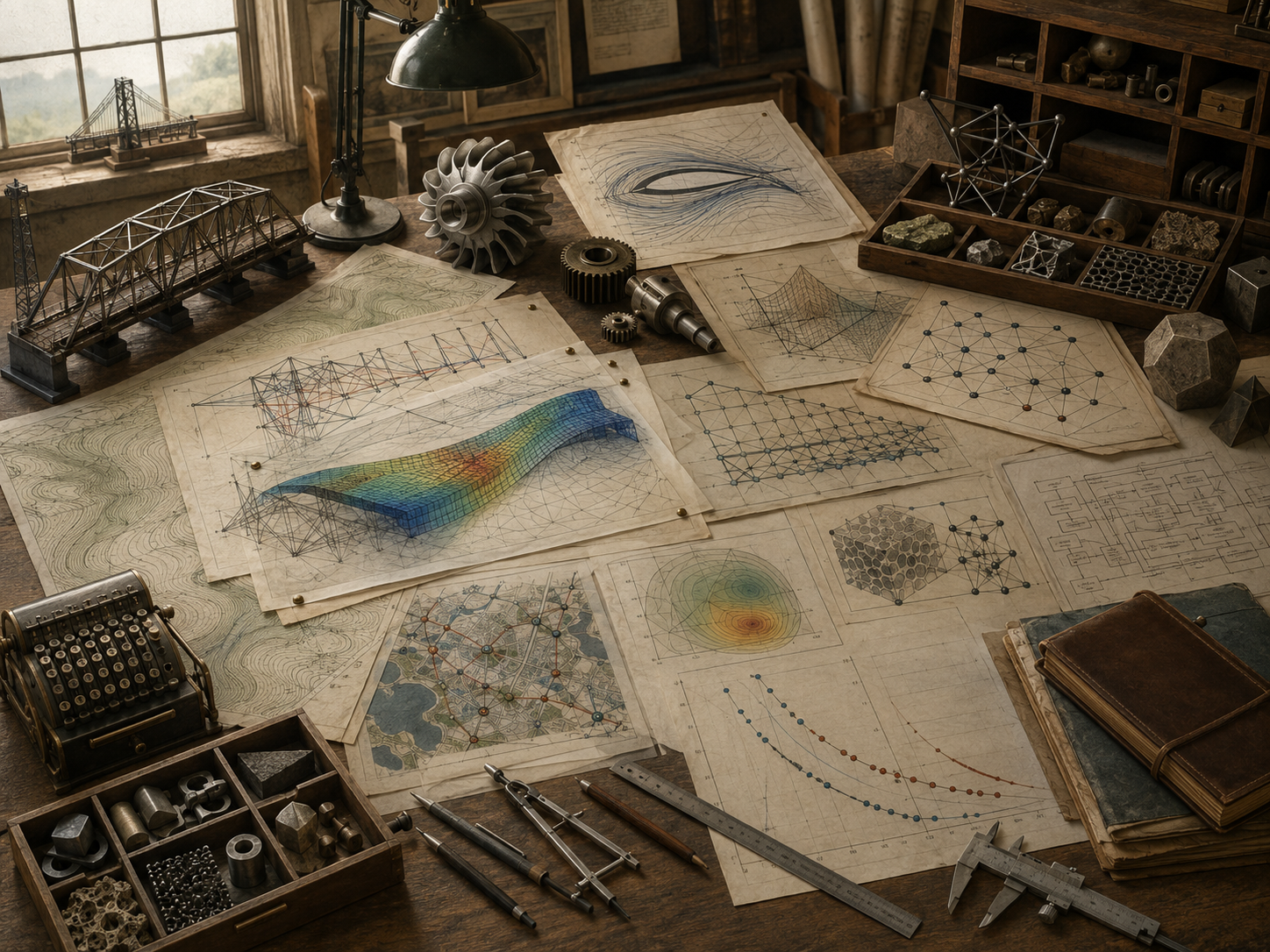
Engineering models are powerful because they make design reasoning explicit. They show what is being optimized, what constraints must be respected, what failure modes are possible, what uncertainty remains, and what evidence supports safe use. Their value lies not only in prediction, but in disciplined design judgment.
Why Modeling Matters in Engineering
Mathematical modeling matters in engineering because engineered systems must perform under constraints. Engineers must design for loads, flows, temperatures, pressures, currents, tolerances, vibrations, costs, materials, failures, users, environments, maintenance, and uncertainty. Models allow these relationships to be represented before, during, and after physical implementation.
Engineering modeling is therefore both analytical and practical. It helps engineers ask whether a design will work, how it might fail, which alternative is preferable, what margin of safety exists, which constraint is binding, and what evidence is needed before deployment.
| Engineering need | Modeling contribution | Example |
|---|---|---|
| Design | Connects requirements to geometry, materials, components, and performance. | Selecting beam dimensions or circuit parameters. |
| Analysis | Evaluates system behavior under specified conditions. | Stress analysis, thermal analysis, flow analysis. |
| Simulation | Tests performance virtually before physical prototyping. | Finite element simulation or control-system simulation. |
| Optimization | Compares alternatives under objectives and constraints. | Minimizing weight while meeting safety requirements. |
| Reliability | Estimates failure risk, durability, and safety margins. | Fatigue life or component failure probability. |
| Operation | Supports monitoring, control, maintenance, and adaptation. | Predictive maintenance or digital twin workflows. |
Engineering models make design accountable by forcing assumptions, constraints, evidence, and tradeoffs into reviewable form.
What Engineering Models Do
Engineering models serve many purposes. Some estimate physical behavior. Some test whether a design meets requirements. Some optimize a system under competing constraints. Some simulate failure modes. Some support control, monitoring, maintenance, or lifecycle planning.
The model’s purpose determines what counts as adequacy. A rough sizing model may be useful early in design. A certified safety model requires stronger evidence, validation, traceability, and review.
| Model role | Engineering question | Typical output |
|---|---|---|
| Sizing model | What approximate dimensions or capacities are needed? | Initial geometry, capacity, or component size. |
| Performance model | How will the system behave under operating conditions? | Temperature, stress, flow, voltage, speed, or efficiency. |
| Failure model | How might the system fail? | Stress ratio, fatigue life, failure probability, or limit state. |
| Optimization model | Which design best satisfies objectives and constraints? | Selected design, tradeoff curve, or feasible region. |
| Control model | How should the system respond over time? | Control law, stability condition, or feedback response. |
| Lifecycle model | How will performance change through use, maintenance, and aging? | Maintenance schedule, degradation estimate, or risk trend. |
Good engineering modeling begins by naming the model’s role. A conceptual design model should not be mistaken for a validated safety model. A simulation output should not be treated as field evidence unless its assumptions, verification, and validation support that use.
Requirements, Constraints, and Design Intent
Engineering models are shaped by requirements. Requirements describe what the system must do, where it must operate, what constraints it must respect, and what consequences matter. A model without requirements may be mathematically interesting but engineering-incomplete.
Design intent translates goals into formal variables, objectives, constraints, thresholds, tolerances, and acceptance criteria. This is where engineering judgment enters the model.
| Design element | Modeling representation | Interpretive issue |
|---|---|---|
| Requirement | Minimum performance or required function. | Who defines acceptable performance? |
| Constraint | Limit on cost, weight, load, geometry, safety, or regulation. | Which constraints are hard versus negotiable? |
| Objective | Quantity to maximize or minimize. | Does the objective capture the true design goal? |
| Tolerance | Allowed variation in manufacturing or operation. | How does variation affect performance? |
| Acceptance criterion | Test or threshold for approval. | Does passing the model criterion imply real-world adequacy? |
| Use case | Operating condition or scenario. | Has the model covered realistic and adverse conditions? |
Engineering models should make requirements visible. Otherwise, users may see a result without understanding what design problem the model actually solved.
Physics, Materials, and System Behavior
Many engineering models are grounded in physical principles: conservation of mass, energy, and momentum; equilibrium; thermodynamics; electromagnetism; material behavior; fluid dynamics; chemical kinetics; control theory; and systems dynamics.
But engineering models also depend on material properties, boundary conditions, manufacturing processes, operating environments, and system interactions. A physical law may be general, but its engineering model is contextual.
| Modeling ingredient | Engineering role | Example |
|---|---|---|
| Physical law | Defines governing relationship. | Equilibrium, conservation, heat transfer, circuit laws. |
| Material property | Connects load or input to response. | Elastic modulus, yield strength, conductivity, viscosity. |
| Boundary condition | Defines how system interacts with its environment. | Fixed support, inlet flow, ambient temperature, voltage source. |
| Operating condition | Defines expected or extreme use. | Normal load, peak demand, storm event, thermal cycle. |
| System interaction | Links components and subsystems. | Feedback loop, network flow, coupled thermal-structural response. |
| Degradation process | Represents aging, wear, corrosion, fatigue, or drift. | Remaining useful life or maintenance interval. |
Engineering model quality depends on how well these ingredients match the actual design context. The same equation can be safe in one context and inadequate in another.
Loads, Stress, Failure, and Safety Margins
Engineering models often focus on whether systems can withstand loads, stresses, pressures, currents, temperatures, vibrations, or other demands. Failure modeling asks how a system might break, degrade, become unstable, lose function, or exceed acceptable risk.
Safety margins are central because engineering decisions must account for uncertainty. Material properties vary. Loads may be underestimated. Manufacturing tolerances matter. Operating conditions can exceed expectations. Models must therefore support not only expected performance, but resilience under plausible variation.
| Failure-related concept | Modeling question | Engineering response |
|---|---|---|
| Load | What demand is placed on the system? | Define normal, peak, and extreme load cases. |
| Capacity | What resistance or performance limit exists? | Estimate strength, flow capacity, thermal tolerance, or signal limit. |
| Margin | How far is the system from failure? | Use factor of safety or reliability index. |
| Failure mode | How could the system fail? | Evaluate yield, buckling, fatigue, overheating, instability, or overload. |
| Uncertainty | How variable are load and capacity? | Use sensitivity, reliability, and stress testing. |
| Consequence | What happens if failure occurs? | Adjust design criteria, redundancy, monitoring, or review level. |
A model that predicts ordinary performance but ignores failure modes is incomplete for many engineering uses.
Simulation and Digital Prototyping
Simulation allows engineers to test designs virtually before building, deploying, or modifying physical systems. Digital prototyping can reduce cost, reveal failure risks, compare alternatives, explore extreme conditions, and improve design iteration.
However, simulation is not automatically reality. Simulation results depend on governing equations, mesh resolution, numerical methods, material models, boundary conditions, assumptions, calibration, and verification.
| Simulation issue | Engineering risk | Responsible practice |
|---|---|---|
| Mesh or discretization | Numerical approximation may distort stress, flow, or temperature. | Use convergence testing and mesh sensitivity. |
| Boundary condition | Unrealistic support, load, or environment changes outcome. | Document boundary assumptions and stress cases. |
| Material model | Material behavior may be simplified or invalid under extremes. | Validate material assumptions and nonlinear regimes. |
| Solver settings | Algorithmic choices affect results. | Use verification checks and reproducible settings. |
| Scenario selection | Important use cases may be omitted. | Test normal, peak, adverse, and failure conditions. |
| Visualization | Color maps may imply more certainty than exists. | Communicate scales, thresholds, and uncertainty. |
Digital prototypes are most useful when treated as evidence to be verified, validated, and interpreted—not as substitutes for engineering accountability.
Optimization and Engineering Tradeoffs
Engineering often involves competing objectives. A design may need to be strong but lightweight, efficient but affordable, safe but maintainable, fast but stable, precise but manufacturable, or high-performing but robust under uncertainty.
Optimization models formalize these tradeoffs through objective functions and constraints. But optimization does not remove judgment. The objective, constraints, weights, penalties, and feasible alternatives reflect design priorities.
| Optimization element | Engineering meaning | Interpretive risk |
|---|---|---|
| Objective function | What the design is trying to improve. | One metric may dominate broader performance. |
| Constraint | Requirement that the design must satisfy. | Hidden assumptions may define feasibility. |
| Design variable | Quantity the engineer can choose. | Chosen variables may exclude better design changes. |
| Penalty term | Cost assigned to undesirable behavior. | Harms or risks may be underweighted. |
| Tradeoff curve | Shows relationship between competing goals. | Users may select a point without understanding consequences. |
| Robust optimum | Performs acceptably under uncertainty. | May be less efficient under baseline conditions but safer overall. |
Engineering optimization is responsible when tradeoffs are explicit and the selected design is reviewed against real-world consequences, not only mathematical optimality.
Control, Feedback, and Dynamic Systems
Many engineered systems operate dynamically. They respond to changing inputs, disturbances, users, sensors, actuators, and environments. Control models help engineers design systems that remain stable, responsive, efficient, and safe over time.
Feedback is powerful because it allows correction. It is also risky because poorly designed feedback can amplify instability, oscillation, delay, overshoot, or cascading failure.
| Control concept | Engineering role | Modeling concern |
|---|---|---|
| State | Represents current system condition. | State may be hidden, noisy, or estimated. |
| Input | Represents control action or disturbance. | Actuator limits and delays matter. |
| Output | Represents observed performance. | Sensors may introduce noise or lag. |
| Feedback | Uses output or state to adjust input. | Poor feedback can destabilize the system. |
| Stability | Assesses whether system behavior remains bounded. | Stability may depend on operating region. |
| Robust control | Maintains performance under uncertainty. | Requires disturbance and uncertainty modeling. |
Control modeling shows why engineering models must often represent time, feedback, uncertainty, and operating context together.
Verification, Validation, and Testing
Engineering modeling relies on verification and validation. Verification asks whether the model was implemented correctly. Validation asks whether the model is adequate for its intended real-world use. Testing provides evidence through experiments, prototypes, field data, inspections, and operational monitoring.
These are not bureaucratic extras. They are how engineering models earn trust.
| Review activity | Question | Example |
|---|---|---|
| Code verification | Was the model implemented correctly? | Unit tests, benchmark cases, conservation checks. |
| Numerical verification | Are numerical errors controlled? | Convergence tests, solver diagnostics, mesh refinement. |
| Model validation | Does the model match reality for its intended use? | Comparison with experiments, prototypes, or field measurements. |
| Design testing | Does the design meet requirements? | Load tests, thermal tests, performance tests. |
| Stress testing | How does the system behave under extremes? | Failure envelopes, adverse scenarios, overload cases. |
| Operational monitoring | Does real-world performance remain within expectations? | Sensors, inspections, maintenance records, digital twins. |
Validation should be tied to purpose. A model validated for preliminary sizing is not necessarily validated for safety certification, field deployment, or automated control.
Uncertainty, Reliability, and Robustness
Engineering models operate under uncertainty. Loads vary. Material properties vary. Manufacturing introduces tolerances. Environments change. Users behave unpredictably. Sensors fail. Components age. Maintenance can be delayed. Models must therefore support reliability and robustness, not only nominal performance.
| Uncertainty source | Engineering implication | Modeling response |
|---|---|---|
| Load uncertainty | Demand may exceed baseline assumptions. | Use load cases, distributions, stress tests, and safety factors. |
| Material uncertainty | Strength, stiffness, fatigue, or conductivity may vary. | Use conservative properties or reliability modeling. |
| Manufacturing tolerance | Actual geometry may differ from design. | Use tolerance analysis and sensitivity testing. |
| Environmental uncertainty | Temperature, humidity, wind, corrosion, or shock may vary. | Use environmental scenarios and degradation models. |
| Model-form uncertainty | Simplified model may omit relevant physics or interactions. | Compare models and validate against tests. |
| Operational uncertainty | Use patterns and maintenance conditions change over time. | Use monitoring, updating, and lifecycle modeling. |
Robust engineering models ask whether a design remains acceptable across plausible variation, not only whether it succeeds in an idealized baseline case.
Major Model Families in Engineering
Engineering uses many model families. The right model depends on design stage, physical domain, available data, acceptable uncertainty, regulatory context, and consequence of failure.
| Model family | Engineering use | Example |
|---|---|---|
| Algebraic design models | Initial sizing, equilibrium, capacity, and scaling. | Beam stress, pressure drop, power balance. |
| Differential equation models | Continuous dynamics, transport, motion, heat, flow, and control. | Vibration, fluid flow, thermal response, chemical reactors. |
| Finite element models | Spatial stress, deformation, heat, and coupled physics. | Structural analysis, thermal stress, mechanical components. |
| Network models | Flow, connectivity, reliability, and infrastructure dependencies. | Power grids, water networks, transportation systems. |
| Optimization models | Design selection under objectives and constraints. | Weight minimization, scheduling, routing, resource allocation. |
| Control models | Feedback, stability, and response over time. | Robotics, aircraft control, process control. |
| Reliability models | Failure probability, redundancy, and maintenance. | Fault trees, survival models, fatigue models. |
| Simulation models | Virtual testing under scenarios and operating conditions. | Digital prototypes, system simulations, discrete event simulation. |
No model family is universally best. Engineering modeling requires matching model form to design purpose, required evidence, and acceptable risk.
Disciplinary Examples
Mathematical modeling appears across engineering disciplines. The forms differ, but the shared purpose is to make design and performance reasoning explicit enough to test, compare, improve, and govern.
| Engineering field | Modeling use | Typical model forms |
|---|---|---|
| Civil engineering | Structures, soils, water systems, transportation, and infrastructure risk. | Structural models, hydrologic models, network models. |
| Mechanical engineering | Motion, stress, heat, vibration, machines, and manufacturing. | Dynamics, finite element models, thermal models. |
| Electrical engineering | Circuits, signals, power systems, communication, and control. | Circuit models, signal models, network flow, control systems. |
| Chemical engineering | Reaction systems, transport, process design, and safety. | Mass balance, reaction kinetics, process simulations. |
| Aerospace engineering | Flight, propulsion, aerodynamics, structures, and control. | Fluid dynamics, control models, structural simulations. |
| Environmental engineering | Water, waste, air quality, remediation, and sustainability systems. | Transport models, fate models, system simulations. |
| Software engineering | Performance, reliability, networks, queues, and system architecture. | Queueing models, reliability models, formal models. |
| Systems engineering | Complex system integration, requirements, risk, and lifecycle design. | Architecture models, optimization, simulation, decision models. |
Across fields, engineering models help connect technical feasibility to safety, reliability, cost, and consequence.
Mathematical Lens: Engineering Models as Design-Constrained Representations
An engineering model often maps design variables, inputs, parameters, and assumptions into performance outputs:
Y = f(x,u,\theta,A,C)
\]
Interpretation: Performance output \(Y\) depends on design variables \(x\), operating inputs \(u\), parameters \(\theta\), assumptions \(A\), and constraints or context \(C\).
Engineering design often requires satisfying constraints:
g_i(x,u,\theta,A,C)\leq 0 \quad \text{for } i=1,\ldots,n
\]
Interpretation: A design is feasible only when all constraint functions \(g_i\) remain within acceptable limits.
Optimization selects a design according to an objective and constraints:
x^*=\arg\min_x J(x)
\quad \text{subject to} \quad g_i(x)\leq 0
\]
Interpretation: The selected design \(x^*\) minimizes objective \(J\), while satisfying design constraints.
A safety margin compares capacity against demand:
M = R – S
\]
Interpretation: Margin \(M\) is positive when resistance or capacity \(R\) exceeds demand or load \(S\).
A reliability-oriented expression asks whether demand exceeds capacity:
P_f = P(S \gt R)
\]
Interpretation: Failure probability \(P_f\) is the probability that demand \(S\) exceeds resistance \(R\).
The mathematical lesson is that engineering models are not only descriptions. They are constrained representations used to evaluate whether designs are feasible, safe, reliable, and fit for purpose.
Example: Beam Design Under Load and Safety Constraints
A simple beam design example shows how engineering modeling connects physical law, design variables, constraints, and safety margins. Suppose a beam must carry a load without exceeding an allowable stress. A simplified bending-stress model may estimate maximum stress as:
\sigma = \frac{M c}{I}
\]
Interpretation: Bending stress \(\sigma\) depends on bending moment \(M\), distance from neutral axis \(c\), and second moment of area \(I\).
The design is acceptable only if stress remains below allowable stress:
\sigma \leq \sigma_{\text{allow}}
\]
Interpretation: The allowable stress represents a safety-related design limit.
| Engineering element | Beam model example | Interpretive issue |
|---|---|---|
| Design variable | Beam dimensions and cross-section. | Geometry affects strength, weight, and manufacturability. |
| Load | Applied force or distributed load. | Actual load may exceed baseline assumption. |
| Material property | Allowable stress or yield strength. | Material properties vary and may degrade. |
| Constraint | Stress must remain below allowable limit. | Constraint depends on safety factor and design code. |
| Objective | Minimize weight or cost. | Optimization must not erode safety margin. |
| Validation | Compare against tests or accepted design standards. | Simplified model may not capture buckling, fatigue, or connections. |
The model is useful because it connects design geometry to safety-relevant performance. But it remains conditional. A complete engineering review may also require buckling, fatigue, deflection, vibration, connection design, manufacturing tolerance, environmental exposure, and applicable design codes.
Models, Prototypes, and Engineering Decision Support
Engineering models support decisions throughout the design lifecycle. Early models help frame feasibility. Detailed simulations support design comparison. Prototypes and tests validate assumptions. Operational models support monitoring and maintenance.
The relationship between model and prototype is not one-way. Models inform prototypes, and prototypes challenge models. Testing can reveal missing mechanisms, incorrect assumptions, unexpected failure modes, or real-world variability.
| Lifecycle stage | Model role | Decision support |
|---|---|---|
| Concept design | Estimate feasibility and rough performance. | Select promising design directions. |
| Preliminary design | Compare alternatives and identify constraints. | Choose candidate architecture or configuration. |
| Detailed design | Simulate stress, flow, thermal, control, and reliability behavior. | Refine design and check requirements. |
| Testing | Compare predicted and observed behavior. | Validate, revise, or reject model assumptions. |
| Deployment | Monitor performance under real conditions. | Detect drift, degradation, or abnormal behavior. |
| Maintenance | Predict remaining useful life and update risk. | Plan inspection, repair, replacement, or redesign. |
Engineering decision support is strongest when models, tests, prototypes, field observations, and governance records are connected rather than isolated.
Ethical Stakes of Engineering Modeling
Engineering models have ethical stakes because engineered systems affect safety, public infrastructure, environmental conditions, resource use, accessibility, health, privacy, and economic life. A model that underestimates risk can contribute to real harm.
Ethical engineering modeling requires transparency about assumptions, margins, validation, uncertainty, use limits, failure modes, affected stakeholders, and decision ownership. It also requires humility about what the model does not capture.
| Ethical issue | Engineering modeling risk | Responsible response |
|---|---|---|
| False safety | Model suggests design is safe under incomplete assumptions. | Use validation, stress testing, and safety margins. |
| Hidden tradeoffs | Optimization reduces cost or weight while increasing risk. | Document objectives, constraints, and consequence tradeoffs. |
| Misuse outside domain | Model is applied beyond validated conditions. | State domain of validity and use limits. |
| Irreproducibility | Design reasoning cannot be reviewed or audited. | Preserve code, data, assumptions, versions, and outputs. |
| Unequal burden | Failure risks fall on people not involved in the design decision. | Include affected stakeholders and public consequence review. |
| Accountability gap | Responsibility is shifted to software or simulation output. | Assign human and institutional decision ownership. |
Engineering modeling is ethical when it supports safe design, honest communication, documented judgment, and accountable use.
Python Workflow: Engineering Design Register and Safety Review
The Python workflow below creates an engineering model register, evaluates beam design alternatives, computes simplified stress margins, flags designs that fail safety constraints, and writes an engineering design review card.
# mathematical_modeling_in_engineering_workflow.py
# Dependency-light workflow for engineering design and safety review.

from __future__ import annotations

from dataclasses import asdict, dataclass
from pathlib import Path
import csv
import json
import statistics


ARTICLE_ROOT = Path(__file__).resolve().parents[1]
OUTPUTS = ARTICLE_ROOT / "outputs"
TABLES = OUTPUTS / "tables"
JSON_DIR = OUTPUTS / "json"


@dataclass(frozen=True)
class EngineeringModelRecord:
    key: str
    engineering_domain: str
    model_role: str
    model_family: str
    design_question: str
    status: str


@dataclass(frozen=True)
class BeamDesign:
    key: str
    width_m: float
    height_m: float
    span_m: float
    load_n: float
    allowable_stress_pa: float
    material_density_kg_m3: float


def engineering_model_register() -> list[EngineeringModelRecord]:
    return [
        EngineeringModelRecord(
            key="sizing_model",
            engineering_domain="structural_engineering",
            model_role="initial_design",
            model_family="algebraic_design_model",
            design_question="What beam dimensions are feasible under baseline load?",
            status="active",
        ),
        EngineeringModelRecord(
            key="safety_model",
            engineering_domain="structural_engineering",
            model_role="safety_review",
            model_family="limit_state_model",
            design_question="Does the design maintain positive stress margin?",
            status="review",
        ),
        EngineeringModelRecord(
            key="optimization_model",
            engineering_domain="engineering_design",
            model_role="tradeoff_analysis",
            model_family="constrained_optimization",
            design_question="Which design balances weight and safety margin?",
            status="review",
        ),
        EngineeringModelRecord(
            key="uncertainty_model",
            engineering_domain="reliability_engineering",
            model_role="uncertainty_review",
            model_family="sensitivity_analysis",
            design_question="Which assumptions most affect safety margin?",
            status="review",
        ),
        EngineeringModelRecord(
            key="validation_model",
            engineering_domain="engineering_testing",
            model_role="validation",
            model_family="test_comparison",
            design_question="What test evidence is needed before use?",
            status="review",
        ),
    ]


def beam_designs() -> list[BeamDesign]:
    return [
        BeamDesign("light_design", 0.08, 0.16, 3.0, 4200.0, 145_000_000.0, 7850.0),
        BeamDesign("balanced_design", 0.10, 0.18, 3.0, 4200.0, 145_000_000.0, 7850.0),
        BeamDesign("stiff_design", 0.12, 0.22, 3.0, 4200.0, 145_000_000.0, 7850.0),
        BeamDesign("overloaded_case", 0.10, 0.18, 3.0, 7000.0, 145_000_000.0, 7850.0),
    ]


def evaluate_beam(design: BeamDesign) -> dict[str, object]:
    # Simple center-point load model for a simply supported beam:
    # max bending moment M = P L / 4.
    # Rectangular section: I = b h^3 / 12, c = h / 2.
    moment = design.load_n * design.span_m / 4.0
    inertia = design.width_m * design.height_m**3 / 12.0
    c = design.height_m / 2.0
    stress = moment * c / inertia
    margin = design.allowable_stress_pa - stress
    safety_factor = design.allowable_stress_pa / stress if stress > 0 else float("inf")
    volume = design.width_m * design.height_m * design.span_m
    mass = volume * design.material_density_kg_m3

    return {
        **asdict(design),
        "bending_moment_nm": round(moment, 8),
        "second_moment_area_m4": round(inertia, 12),
        "max_stress_pa": round(stress, 8),
        "stress_margin_pa": round(margin, 8),
        "safety_factor": round(safety_factor, 8),
        "estimated_mass_kg": round(mass, 8),
        "passes_stress_constraint": stress <= design.allowable_stress_pa,
        "review_class": "acceptable" if stress <= design.allowable_stress_pa else "fails_constraint",
    }


def engineering_priority(record: EngineeringModelRecord) -> float:
    score = {"active": 1.0, "review": 5.0, "revise": 8.0, "archive": 2.0}.get(
        record.status.lower(),
        4.0,
    )
    text = f"{record.model_role} {record.model_family} {record.design_question}".lower()
    for term in ["safety", "validation", "uncertainty", "constraint", "optimization", "margin"]:
        if term in text:
            score += 1.0
    return round(score, 3)


def design_summary(rows: list[dict[str, object]]) -> dict[str, object]:
    safety_factors = [float(row["safety_factor"]) for row in rows]
    masses = [float(row["estimated_mass_kg"]) for row in rows]
    failures = sum(1 for row in rows if not bool(row["passes_stress_constraint"]))
    acceptable_rows = [row for row in rows if bool(row["passes_stress_constraint"])]
    lightest_acceptable = min(acceptable_rows, key=lambda row: float(row["estimated_mass_kg"])) if acceptable_rows else None

    return {
        "mean_safety_factor": round(statistics.mean(safety_factors), 8),
        "min_safety_factor": round(min(safety_factors), 8),
        "max_safety_factor": round(max(safety_factors), 8),
        "mean_mass_kg": round(statistics.mean(masses), 8),
        "failed_design_count": failures,
        "design_count": len(rows),
        "lightest_acceptable_design": None if lightest_acceptable is None else lightest_acceptable["key"],
    }


def write_csv(path: Path, rows: list[dict[str, object]]) -> None:
    path.parent.mkdir(parents=True, exist_ok=True)
    if not rows:
        raise ValueError(f"No rows supplied for {path}")
    with path.open("w", newline="", encoding="utf-8") as handle:
        writer = csv.DictWriter(handle, fieldnames=list(rows[0].keys()))
        writer.writeheader()
        writer.writerows(rows)


def write_json(path: Path, payload: object) -> None:
    path.parent.mkdir(parents=True, exist_ok=True)
    with path.open("w", encoding="utf-8") as handle:
        json.dump(payload, handle, indent=2, sort_keys=True)


def main() -> None:
    records = engineering_model_register()
    designs = beam_designs()

    register_rows = [
        {**asdict(record), "engineering_priority": engineering_priority(record)}
        for record in records
    ]

    design_rows = [evaluate_beam(design) for design in designs]

    write_csv(TABLES / "engineering_model_register.csv", register_rows)
    write_csv(TABLES / "beam_design_review.csv", design_rows)

    write_json(JSON_DIR / "engineering_design_review_card.json", {
        "article": "Mathematical Modeling in Engineering",
        "design_summary": design_summary(design_rows),
        "engineering_model_register": register_rows,
        "beam_design_review": design_rows,
        "use_limit": "This simplified beam workflow is illustrative and does not replace engineering standards, professional review, detailed structural analysis, or applicable design codes.",
        "diagnostic_checks": [
            "requirements and constraints are stated",
            "stress margin is computed",
            "failed designs are flagged",
            "tradeoff between mass and safety is visible",
            "validation evidence is required before use",
            "use limits are stated explicitly",
        ],
    })

    print("Engineering modeling workflow complete.")
    print(f"Design summary: {design_summary(design_rows)}")
    print(f"Wrote outputs to {OUTPUTS}")


if __name__ == "__main__":
    main()
This workflow treats engineering modeling as design evidence. It records model purpose, design constraints, stress margins, safety factors, failed alternatives, tradeoffs, validation needs, and use limits.
R Workflow: Design Alternative Summary and Safety Review
The R workflow below reviews generated engineering outputs, ranks designs by safety factor and mass, summarizes failed designs, and creates a base R safety-factor plot.
# mathematical_modeling_in_engineering_review.R
# Base R workflow for engineering design and safety review.

args <- commandArgs(trailingOnly = FALSE)
file_arg <- grep("^--file=", args, value = TRUE)

if (length(file_arg) > 0) {
  script_path <- normalizePath(sub("^--file=", "", file_arg[1]), mustWork = TRUE)
  article_root <- normalizePath(file.path(dirname(script_path), ".."), mustWork = TRUE)
} else {
  article_root <- getwd()
}

tables_dir <- file.path(article_root, "outputs", "tables")
figures_dir <- file.path(article_root, "outputs", "figures")
dir.create(tables_dir, recursive = TRUE, showWarnings = FALSE)
dir.create(figures_dir, recursive = TRUE, showWarnings = FALSE)

register_path <- file.path(tables_dir, "engineering_model_register.csv")
design_path <- file.path(tables_dir, "beam_design_review.csv")

if (!file.exists(register_path) || !file.exists(design_path)) {
  stop("Missing engineering modeling outputs. Run the Python workflow first.")
}

register <- read.csv(register_path, stringsAsFactors = FALSE)
designs <- read.csv(design_path, stringsAsFactors = FALSE)

register$engineering_priority <- as.numeric(register$engineering_priority)
designs$safety_factor <- as.numeric(designs$safety_factor)
designs$estimated_mass_kg <- as.numeric(designs$estimated_mass_kg)
designs$max_stress_pa <- as.numeric(designs$max_stress_pa)
designs$stress_margin_pa <- as.numeric(designs$stress_margin_pa)

register <- register[order(-register$engineering_priority), ]
designs <- designs[order(-designs$safety_factor), ]

summary_table <- data.frame(
  mean_safety_factor = mean(designs$safety_factor),
  min_safety_factor = min(designs$safety_factor),
  max_safety_factor = max(designs$safety_factor),
  failed_design_count = sum(designs$passes_stress_constraint == "False" | designs$passes_stress_constraint == FALSE),
  design_count = nrow(designs)
)

write.csv(
  register,
  file.path(tables_dir, "r_engineering_model_review_queue.csv"),
  row.names = FALSE
)

write.csv(
  designs,
  file.path(tables_dir, "r_beam_design_ranking.csv"),
  row.names = FALSE
)

write.csv(
  summary_table,
  file.path(tables_dir, "r_engineering_design_summary.csv"),
  row.names = FALSE
)

png(file.path(figures_dir, "r_beam_safety_factors.png"), width = 1000, height = 700)

barplot(
  designs$safety_factor,
  names.arg = designs$key,
  las = 2,
  ylab = "Safety factor",
  main = "Beam Design Safety Factors"
)

dev.off()

print(register)
print(summary_table)
print(designs)
The R layer supports engineering review by preserving model priorities, design rankings, safety factors, failed constraints, and summary diagnostics.
Haskell Workflow: Typed Engineering Model Records
Haskell is useful here because engineering model categories should remain distinct. A sizing model is not a validation model. Optimization is not safety certification. Simulation is not physical testing. A use limit is not a design requirement.
{-# OPTIONS_GHC -Wall #-}

module Main where

data EngineeringDomain
  = StructuralEngineering
  | MechanicalEngineering
  | ElectricalEngineering
  | ChemicalEngineering
  | SystemsEngineering
  | ReliabilityEngineering
  deriving (Eq, Show)

data EngineeringModelRole
  = InitialDesign
  | PerformanceAnalysis
  | SafetyReview
  | Optimization
  | Validation
  | LifecycleMonitoring
  deriving (Eq, Show)

data EngineeringModelFamily
  = AlgebraicDesignModel
  | DifferentialEquationModel
  | FiniteElementModel
  | ControlModel
  | ReliabilityModel
  | SimulationModel
  deriving (Eq, Show)

data ReviewStatus
  = Active
  | RequiresReview
  | RequiresValidation
  | RequiresSafetyReview
  | Revise
  deriving (Eq, Show)

data EngineeringModelRecord = EngineeringModelRecord
  { key :: String
  , domain :: EngineeringDomain
  , role :: EngineeringModelRole
  , family :: EngineeringModelFamily
  , designQuestion :: String
  , status :: ReviewStatus
  } deriving (Eq, Show)

engineeringRegister :: [EngineeringModelRecord]
engineeringRegister =
  [ EngineeringModelRecord
      "sizing_model"
      StructuralEngineering
      InitialDesign
      AlgebraicDesignModel
      "What beam dimensions are feasible under baseline load?"
      Active
  , EngineeringModelRecord
      "safety_model"
      StructuralEngineering
      SafetyReview
      AlgebraicDesignModel
      "Does the design maintain positive stress margin?"
      RequiresSafetyReview
  , EngineeringModelRecord
      "optimization_model"
      SystemsEngineering
      Optimization
      SimulationModel
      "Which design balances weight and safety margin?"
      RequiresReview
  , EngineeringModelRecord
      "validation_model"
      ReliabilityEngineering
      Validation
      ReliabilityModel
      "What test evidence is needed before use?"
      RequiresValidation
  ]

needsReview :: EngineeringModelRecord -> Bool
needsReview item =
  case status item of
    Active -> False
    _ -> True

main :: IO ()
main = do
  putStrLn "Typed engineering model records:"
  mapM_ print engineeringRegister

  putStrLn "\nEngineering model records requiring review:"
  mapM_ print (filter needsReview engineeringRegister)
This typed layer supports engineering model governance by keeping domains, roles, model families, design questions, and review obligations distinct.
GitHub Repository
The companion repository for this article is designed as a reproducible mathematical-modeling workspace. It contains article-specific code, data, documentation, notebooks, schemas, and generated outputs for engineering model registers, beam design review, stress-margin analysis, design-alternative comparison, safety-factor summaries, typed Haskell engineering records, and responsible engineering modeling workflows.
Complete Code Repository
Companion article folder with Python, R, Julia, SQL, Haskell, Rust, Go, C++, Fortran, and C examples for professional mathematical modeling, engineering model registers, design constraints, beam safety review, stress-margin analysis, optimization tradeoffs, reliability framing, typed engineering records, and responsible engineering interpretation workflows.
A Practical Method for Mathematical Modeling in Engineering
Engineering modeling should be structured enough to support review, testing, revision, and accountability. The goal is not only to compute a result, but to show why a design is believed to be feasible, safe, and fit for purpose.
| Step | Task | Question | Artifact |
|---|---|---|---|
| 1 | Define engineering purpose | What design, analysis, control, or safety question is being modeled? | Purpose statement. |
| 2 | State requirements | What must the system do? | Requirements and acceptance criteria. |
| 3 | Identify constraints | What limits must the design satisfy? | Constraint register. |
| 4 | Choose model family | Which equations, simulations, or algorithms match the design problem? | Model-form rationale. |
| 5 | Define inputs and parameters | What loads, properties, tolerances, and conditions matter? | Input and parameter table. |
| 6 | Compute performance and margins | Does the design meet performance and safety requirements? | Performance and margin summary. |
| 7 | Analyze uncertainty | Which uncertainties affect feasibility or safety? | Uncertainty and sensitivity summary. |
| 8 | Compare alternatives | Which design best balances performance, cost, risk, and robustness? | Design alternative table. |
| 9 | Verify and validate | Was the model implemented correctly and tested against evidence? | Verification and validation record. |
| 10 | State use limits | Where should the model not be used as decisive evidence? | Use-limit and monitoring note. |
This method keeps engineering models tied to design responsibility. It prevents calculations from being detached from requirements, constraints, safety margins, validation, and consequences.
Common Pitfalls
Engineering modeling can fail when formal analysis is treated as stronger than the assumptions, evidence, and validation behind it. Many failures come from overconfidence, not from modeling itself.
- Unclear requirements: building a technically detailed model without clear design criteria.
- Baseline-only modeling: testing ordinary conditions while ignoring peak, adverse, or failure cases.
- Hidden safety assumptions: using margins or factors without documenting their rationale.
- Optimization without consequence review: minimizing cost, mass, or energy while increasing risk elsewhere.
- Simulation overconfidence: treating digital output as validated reality.
- Weak validation: calibrating or fitting a model but not testing it against independent evidence.
- Ignoring tolerances: assuming manufactured components match ideal geometry exactly.
- Missing failure modes: modeling expected performance while omitting fatigue, buckling, wear, overheating, instability, or cascading effects.
- No lifecycle thinking: ignoring aging, maintenance, degradation, and operational drift.
- No use-limit statement: allowing the model to be applied beyond its design context or validation domain.
These pitfalls can be reduced through clear requirements, failure-mode review, uncertainty analysis, design alternatives, validation, reproducible workflows, and explicit use limits.
Conclusion: Engineering Models Turn Formal Reasoning Into Responsible Design
Mathematical modeling is central to engineering because it turns formal reasoning into design evidence. It helps engineers connect requirements, physics, materials, constraints, simulations, safety margins, optimization, uncertainty, and testing into a coherent design process.
But engineering models do not replace engineering judgment. They depend on assumptions, data, simplifications, material properties, boundary conditions, validation evidence, and use context. Their authority comes from disciplined review, not from calculation alone.
A strong engineering model makes design reasoning inspectable. It shows what the system is expected to do, what could go wrong, how much margin exists, which tradeoffs were accepted, and what evidence is needed before use.
Used responsibly, mathematical modeling helps engineering move from concept to safe implementation without pretending that uncertainty, failure, or accountability have disappeared.
Related Articles
- What Is Mathematical Modeling?
- Model Purpose: Explanation, Prediction, Control, and Decision Support
- Variables, Parameters, and Constraints
- Optimization Models and Objective Functions
- Simulation and Computational Modeling
- Numerical Methods for Mathematical Models
- Validation and Model Assessment
- Uncertainty in Mathematical Models
- Mathematical Modeling in Science
- Mathematical Modeling in Policy and Public Systems
Further Reading
- Blanchard, B.S. and Fabrycky, W.J. (2011) Systems Engineering and Analysis. 5th edn. Upper Saddle River, NJ: Prentice Hall.
- Dieter, G.E. and Schmidt, L.C. (2013) Engineering Design. 5th edn. New York: McGraw-Hill.
- Fishman, G.S. (2001) Discrete-Event Simulation: Modeling, Programming, and Analysis. New York: Springer.
- Haimes, Y.Y. (2016) Risk Modeling, Assessment, and Management. 4th edn. Hoboken, NJ: Wiley.
- Hibbeler, R.C. (2017) Mechanics of Materials. 10th edn. Boston: Pearson.
- INCOSE (2015) Systems Engineering Handbook: A Guide for System Life Cycle Processes and Activities. 4th edn. Hoboken, NJ: Wiley.
- Oberkampf, W.L. and Roy, C.J. (2010) Verification and Validation in Scientific Computing. Cambridge: Cambridge University Press.
- Pahl, G., Beitz, W., Feldhusen, J. and Grote, K.H. (2007) Engineering Design: A Systematic Approach. 3rd edn. London: Springer.
- Saltelli, A. et al. (2008) Global Sensitivity Analysis: The Primer. Chichester: Wiley.
- Ulrich, K.T. and Eppinger, S.D. (2016) Product Design and Development. 6th edn. New York: McGraw-Hill Education.
References
- Blanchard, B.S. and Fabrycky, W.J. (2011) Systems Engineering and Analysis. 5th edn. Upper Saddle River, NJ: Prentice Hall.
- Dieter, G.E. and Schmidt, L.C. (2013) Engineering Design. 5th edn. New York: McGraw-Hill.
- Fishman, G.S. (2001) Discrete-Event Simulation: Modeling, Programming, and Analysis. New York: Springer.
- Haimes, Y.Y. (2016) Risk Modeling, Assessment, and Management. 4th edn. Hoboken, NJ: Wiley.
- Hibbeler, R.C. (2017) Mechanics of Materials. 10th edn. Boston: Pearson.
- INCOSE (2015) Systems Engineering Handbook: A Guide for System Life Cycle Processes and Activities. 4th edn. Hoboken, NJ: Wiley.
- Oberkampf, W.L. and Roy, C.J. (2010) Verification and Validation in Scientific Computing. Cambridge: Cambridge University Press.
- Pahl, G., Beitz, W., Feldhusen, J. and Grote, K.H. (2007) Engineering Design: A Systematic Approach. 3rd edn. London: Springer.
- Saltelli, A. et al. (2008) Global Sensitivity Analysis: The Primer. Chichester: Wiley.
- Ulrich, K.T. and Eppinger, S.D. (2016) Product Design and Development. 6th edn. New York: McGraw-Hill Education.