
Last Updated June 8, 2026
Pillar pages and topic clusters are core structures for scalable knowledge architecture. A pillar page gives a reader a central explanatory entry point into a broad subject. Topic-cluster articles develop the supporting concepts, methods, examples, applications, and edge cases around that central subject. Internal links connect the system so readers can move from overview to depth, from concept to application, and from one related idea to another.
This structure matters because large publications cannot rely on isolated articles. As a knowledge system grows, readers need orientation, pathways, context, and meaningful relationships among pages. Editors need a way to plan coverage, identify gaps, prevent duplication, maintain metadata, and govern updates. Pillar pages and topic clusters turn a collection of articles into a navigable body of knowledge.
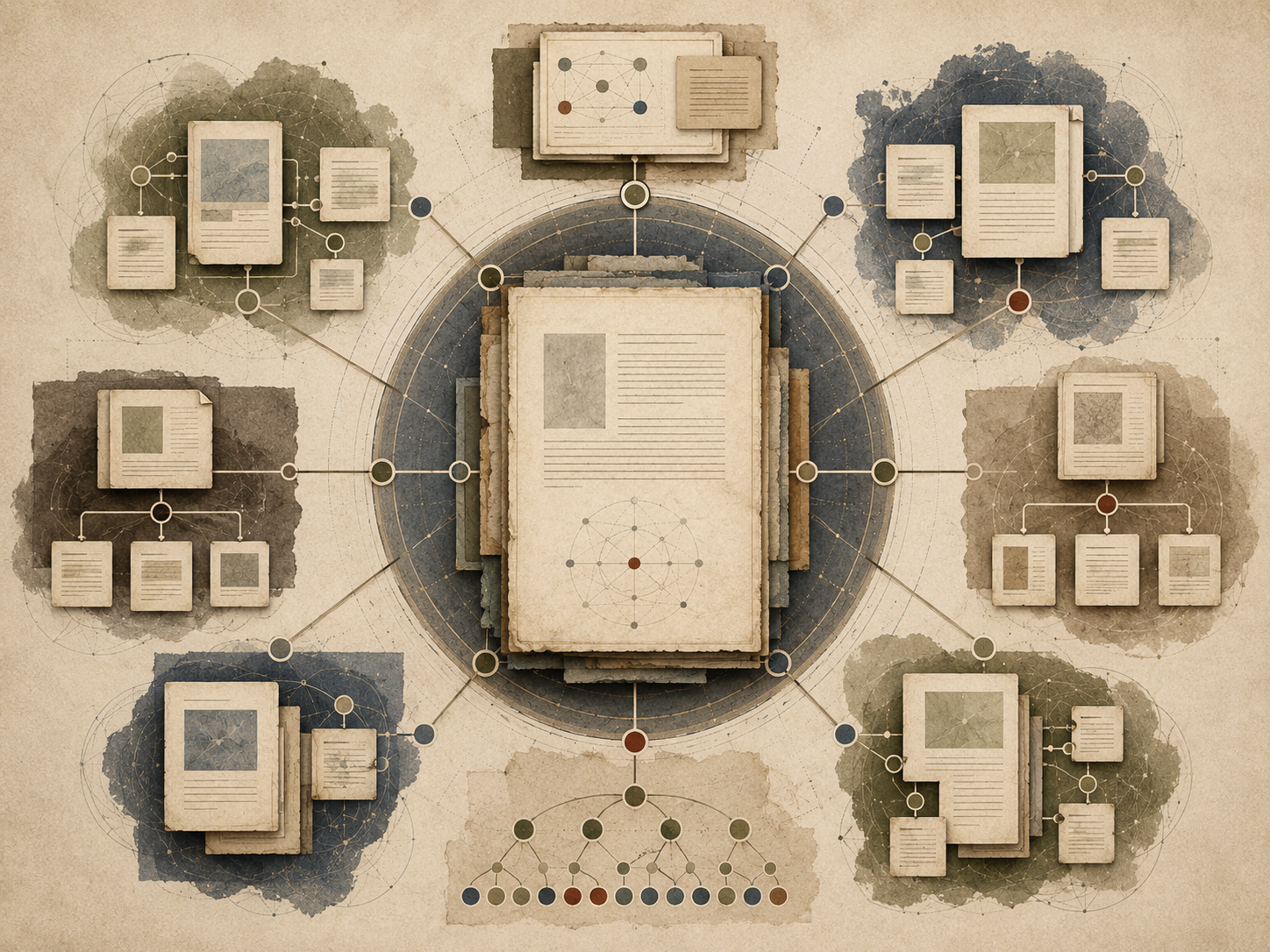
This article explains how pillar pages and topic clusters work, why they matter for content frameworks, how they support readers and editors, and how they can be governed over time. It treats pillar-cluster architecture as more than an SEO tactic. A strong pillar-cluster system is a knowledge framework: it organizes concepts, sequences learning, connects related articles, supports evidence architecture, and gives a publication a durable structure for expansion.
What Are Pillar Pages and Topic Clusters?
A pillar page is a central page that introduces, organizes, and explains a broad topic. It gives readers an overview of the subject, defines major concepts, explains why the topic matters, and links to deeper supporting articles.
A topic cluster is the group of related articles that surround and support the pillar page. These articles explain subtopics in greater depth. They may cover definitions, methods, histories, examples, case studies, applications, critiques, governance issues, tools, and future directions.
A pillar-cluster system works through relationships. The pillar page links outward to cluster articles. Cluster articles link back to the pillar page. Cluster articles also link to one another when concepts are meaningfully related. The result is a structured knowledge system rather than a set of disconnected posts.
\text{Pillar-Cluster System} = \text{Central Topic} + \text{Supporting Articles} + \text{Internal Links} + \text{Governance}
\]
Interpretation: A pillar-cluster system combines a central explanatory page, supporting depth articles, meaningful internal links, and maintenance rules that keep the structure coherent over time.
In a content framework series, a pillar page may serve as the article map or central guide. It gives readers a way to see the whole subject before entering specific subtopics. Topic-cluster articles then provide the depth that a single page cannot responsibly contain.
For example, a pillar page on content frameworks might link to articles on framework literacy, pillar pages, topic clusters, educational scaffolding, message houses, content audits, metadata, taxonomy design, and framework governance. Each article develops one part of the larger knowledge architecture.
The strength of the system comes from both breadth and depth. The pillar provides orientation. The cluster provides substance.
Why the Structure Matters
Pillar pages and topic clusters matter because readers rarely experience a knowledge system in the order the publisher created it. They may arrive from search, social media, a newsletter, an internal link, a reference, or a related article. They may begin with a specific question rather than the broad topic. They may need orientation after landing deep inside a cluster.
A pillar-cluster architecture supports these readers by making relationships visible. It gives them ways to move upward to a broad overview, sideways to related concepts, and downward into more detailed articles.
The structure also matters for editors. Without pillar-cluster architecture, a publication can grow chaotically. Articles may duplicate one another. Important foundations may be missing. Metadata may become inconsistent. Internal links may be ad hoc. Search visibility may depend on individual pages rather than coherent topical authority. Updates may happen article by article without regard to the larger system.
A strong pillar-cluster system supports:
- reader orientation by showing where a topic fits within a larger subject;
- learning progression by sequencing concepts from foundation to depth;
- editorial planning by revealing coverage gaps and duplication;
- internal linking by creating meaningful pathways across related articles;
- search visibility by organizing related content around central topics;
- governance by making article status, freshness, metadata, and relationships reviewable;
- knowledge scaling by allowing a publication to grow without losing coherence.
The point is not simply to create more pages. The point is to create a structure in which each page has a clear role.
What a Pillar Page Does
A pillar page is not just a long article. It is an organizing page. Its job is to explain the central topic at a useful level of breadth while guiding readers toward deeper articles. A pillar page should not try to exhaust every subtopic. It should make the subject legible and navigable.
A strong pillar page usually performs several functions at once:
- defines the broad topic;
- explains why the topic matters;
- identifies major subtopics;
- organizes those subtopics into a coherent structure;
- links to supporting articles;
- shows how the topic connects to related domains;
- supports both scanning and deeper exploration;
- provides an updateable structure for future expansion.
The pillar page is often the reader’s map. It tells the reader: this is the territory, these are the major regions, these are the pathways, and these are the places where you can go deeper.
| Pillar page function | What it does | Why it matters |
|---|---|---|
| Definition | Introduces the central topic clearly. | Gives readers a shared starting point. |
| Orientation | Shows the structure of the subject. | Prevents readers from getting lost in isolated details. |
| Segmentation | Divides the broad topic into meaningful subtopics. | Supports comprehension and navigation. |
| Pathway design | Links to deeper articles in a purposeful order. | Supports learning progression and exploration. |
| Governance | Acts as a central review point for the topic system. | Makes gaps, outdated content, and structural drift visible. |
A pillar page should be broad enough to orient the reader but focused enough to remain useful. If it becomes too broad, it stops guiding. If it becomes too narrow, it cannot function as a pillar.
What a Topic Cluster Does
A topic cluster gives depth to the pillar. Each cluster article develops a supporting topic that would be too large, specific, technical, historical, applied, or critical to treat fully on the pillar page.
A cluster article should not simply repeat the pillar page. It should add something distinct. It may define a subtopic, explain a method, present a case study, examine limitations, compare frameworks, develop a historical line, provide technical implementation, or address governance.
Examples of topic-cluster article types include:
- definition articles that clarify core concepts;
- method articles that explain how to apply a framework or process;
- historical articles that explain where a framework came from;
- comparison articles that distinguish related concepts;
- application articles that show how the topic works in practice;
- critical articles that explain limits, risks, and ethical issues;
- technical articles that connect editorial systems with code, metadata, repositories, or data models;
- governance articles that explain maintenance, review, and accountability.
The topic cluster turns the pillar page into a living knowledge hub. It allows the publication to expand without forcing every detail into one page.
\text{Cluster Depth} = \text{Definitions} + \text{Methods} + \text{Examples} + \text{Applications} + \text{Critique}
\]
Interpretation: A strong topic cluster develops a broad subject through multiple article types rather than relying on a single overview page.
A topic cluster is strongest when each article has a clear role and a clear relationship to the pillar. Weak clusters accumulate pages. Strong clusters build knowledge.
Internal Links as Knowledge Pathways
Internal links are the infrastructure that makes pillar-cluster architecture work. Without internal links, a pillar page and its cluster articles remain separate pages. With meaningful links, they become a navigable knowledge system.
Internal links serve several functions. They help readers find related information. They show conceptual relationships. They support learning pathways. They reinforce the role of the pillar page. They help editors understand which articles depend on one another. They also help search engines interpret the topical structure of a site.
But internal links should not be random. A link should have a reason. It should connect related concepts, support context, help the reader go deeper, or clarify a dependency. Excessive, irrelevant, or mechanical linking weakens trust.
| Link type | Purpose | Example use |
|---|---|---|
| Pillar-to-cluster link | Sends readers from overview to depth. | A pillar page links to an article on taxonomy design. |
| Cluster-to-pillar link | Restores orientation and connects the article to the larger topic. | A taxonomy article links back to the Content Frameworks article map. |
| Cluster-to-cluster link | Connects related subtopics. | An article on metadata links to an article on content audits. |
| Prerequisite link | Points readers to foundational knowledge. | A technical article links to a definition article. |
| Next-step link | Guides readers toward application or deeper analysis. | A foundational article links to a method article. |
| Governance link | Connects content to maintenance, review, or repository materials. | An article links to a GitHub companion folder or governance guide. |
Internal links should be treated as editorial decisions. They are not just navigation aids. They are statements about how knowledge relates.
Pillar-Cluster Architecture as Knowledge Architecture
Pillar pages and topic clusters are often discussed in search-engine terms, but their deeper value is architectural. They help structure knowledge at scale.
A knowledge architecture defines how information is organized, related, retrieved, maintained, and expanded. A pillar-cluster system contributes to that architecture by creating central hubs, supporting pages, internal pathways, metadata relationships, and editorial governance points.
In a mature knowledge architecture, the pillar-cluster system connects with:
- article maps;
- taxonomies;
- metadata fields;
- internal-link graphs;
- content audits;
- editorial workflows;
- repository structures;
- image metadata;
- references and further reading;
- governance documentation.
This is where pillar-cluster architecture becomes part of a broader content framework. The pillar page is not only a page. It is a system node. The topic cluster is not only a group of articles. It is a structured body of knowledge.
\text{Knowledge Architecture} = \text{Pillars} + \text{Clusters} + \text{Taxonomy} + \text{Metadata} + \text{Links} + \text{Governance}
\]
Interpretation: Pillar pages and topic clusters become most powerful when they are integrated with taxonomy, metadata, links, and governance.
The strongest pillar-cluster systems do not merely create topical coverage. They create a maintained structure for understanding.
Reader Pathways, Search Intent, and Learning Progression
A pillar-cluster system must serve different reader pathways. Some readers are beginners who need orientation. Some are searching for a specific answer. Some are comparing concepts. Some are looking for methods. Some are returning to update their understanding. Some are moving from research to application.
This means pillar-cluster architecture should not assume a single linear path. It should support multiple routes through the same knowledge system.
Reader pathways often include:
- overview pathway: reader begins with the pillar page and explores supporting articles;
- search pathway: reader lands directly on a cluster article and needs orientation;
- learning pathway: reader moves from foundation to method to application;
- comparison pathway: reader moves across related articles to distinguish concepts;
- governance pathway: editor moves from an article to metadata, audit, repository, or maintenance notes;
- research pathway: reader follows references, evidence, and related framework articles.
Search intent matters, but it should not dominate the system. A page can answer search intent while still belonging to a deeper learning architecture. Search visibility helps readers arrive. Knowledge architecture helps them understand where they are.
| Reader need | Architecture response | Example |
|---|---|---|
| I need the big picture. | Pillar page overview. | Content Frameworks article map. |
| I need a specific answer. | Focused cluster article. | Article on internal linking or metadata. |
| I need to learn in sequence. | Ordered pathway through articles. | Definition → quality criteria → framework literacy → methods. |
| I need to compare concepts. | Cluster-to-cluster links. | Frameworks vs templates vs models. |
| I need to maintain the system. | Governance links and metadata records. | Content audit and repository links. |
A strong pillar-cluster system supports both discovery and learning. It should help readers arrive, orient, move, and remember.
Editorial Planning and Coverage Design
Pillar-cluster architecture is also an editorial planning tool. It helps a publication decide what to write, what to update, what to merge, what to retire, and what to connect.
Instead of planning articles one by one, editors can plan coverage across a topic system. They can ask whether the cluster includes foundations, methods, applications, examples, ethics, governance, technical implementation, references, and future directions. They can identify missing pieces before the system becomes uneven.
For a major knowledge series, editorial planning should consider:
- the central pillar topic;
- the major clusters or parts;
- the article sequence within each cluster;
- foundational articles required before advanced articles;
- planned versus published status;
- which articles need images, metadata, and repository support;
- which articles need methods wrappers or code examples;
- where references and further reading should be expanded;
- how footer navigation and internal links should behave;
- how future updates will be governed.
This planning role is why pillar pages and topic clusters are content frameworks. They do not merely organize existing articles. They guide future creation.
A well-designed cluster makes absence visible. If a series includes foundations and applications but lacks governance, that gap becomes clear. If it includes strategy frameworks but lacks ethical critique, the structure reveals the imbalance. If it has many planned articles but few published supporting pieces, the cluster shows development status.
Pillar-cluster planning turns editorial growth into a system rather than a queue.
Metadata, Governance, and Maintenance
A pillar-cluster system needs metadata and governance to remain useful. Without maintenance, a cluster can decay. Links break. Articles become outdated. Tags drift. Images lose metadata. Repository links fall out of sync. Planned articles remain uncreated. References age. Footer navigation becomes inconsistent.
Metadata makes the system reviewable. It records the fields needed to manage articles as part of a larger architecture. Governance defines who reviews the system, how often, and according to what standards.
Useful pillar-cluster metadata may include:
- pillar title;
- cluster name;
- article title;
- slug;
- status;
- publication date;
- last reviewed date;
- review owner;
- excerpt status;
- tag completeness;
- image metadata status;
- GitHub repository link;
- references status;
- previous and next navigation;
- internal-link count;
- governance notes.
Governance questions include:
- Is the pillar page still accurate?
- Do cluster articles still match the pillar structure?
- Are planned articles still needed?
- Are any articles duplicated or overlapping?
- Are internal links meaningful and current?
- Are references authoritative and up to date?
- Are repository links present and functional?
- Does the article sequence still support reader learning?
Pillar-cluster systems should be designed for maintenance from the beginning. A knowledge architecture that cannot be governed will eventually become confusing.
Core Methods for Designing Pillar Pages and Topic Clusters
Pillar-cluster design is a methodical process. It combines conceptual planning, audience understanding, editorial sequencing, internal linking, metadata, and governance.
Define the central topic
Identify the broad subject that deserves a central explanatory page. The topic should be large enough to support multiple articles but specific enough to remain coherent.
Map the conceptual territory
List the major subtopics, concepts, methods, examples, applications, critiques, and governance issues that belong within the topic.
Group subtopics into clusters
Organize supporting articles into meaningful groups such as foundations, methods, applications, ethics, governance, case studies, and future directions.
Define article roles
Decide what each article contributes. Avoid creating articles that duplicate one another or repeat the pillar page.
Sequence reader pathways
Arrange articles so readers can move from orientation to depth, from concept to method, and from application to critique.
Design internal links
Create pillar-to-cluster, cluster-to-pillar, prerequisite, next-step, and related-concept links.
Apply metadata
Track titles, slugs, excerpts, tags, image metadata, status, review dates, references, repository links, and navigation.
Audit coverage
Check for gaps, duplication, outdated content, weak links, metadata errors, and missing supporting articles.
Govern the system
Assign ownership, review cycles, update rules, and retirement criteria.
These methods turn pillar-cluster design into a repeatable editorial practice. The goal is not only to build a page structure, but to maintain a coherent knowledge system over time.
Quality Criteria for Pillar-Cluster Systems
A pillar-cluster system should be evaluated by more than traffic or search ranking. Search performance may be useful, but knowledge architecture should also be judged by clarity, coherence, coverage, navigability, evidence quality, and governance readiness.
| Quality criterion | Diagnostic question | Weak signal |
|---|---|---|
| Conceptual clarity | Does the pillar define the central topic clearly? | The page is broad but vague. |
| Cluster coherence | Do supporting articles belong together? | The cluster feels like a loose collection of posts. |
| Coverage depth | Does the cluster include foundations, methods, examples, critique, and governance? | Only introductory or promotional articles exist. |
| Link quality | Do internal links help readers move meaningfully? | Links are generic, excessive, or missing. |
| Reader orientation | Can readers understand where they are in the system? | Cluster articles lack links back to the pillar or related pages. |
| Metadata completeness | Are titles, slugs, excerpts, tags, images, references, and repository links complete? | Important fields are missing or inconsistent. |
| Governance readiness | Can the system be reviewed and maintained? | No owner, review cycle, or update process exists. |
| Ethical and evidence quality | Does the structure preserve context, evidence, and limitations? | The cluster optimizes visibility while thinning substance. |
The best pillar-cluster systems are useful to readers and manageable for editors. They support discovery, understanding, and maintenance at the same time.
Common Pillar-Cluster Patterns
Pillar-cluster systems can be organized in different ways depending on the topic. Some subjects need a learning sequence. Others need a methods library. Others need a reference architecture, a policy explainer, a strategic framework library, or a public reasoning system.
| Pattern | Best for | Typical structure |
|---|---|---|
| Foundations-to-applications | Educational and research topics. | Definitions → principles → methods → applications → critique. |
| Method library | Strategic, analytical, or technical domains. | Overview → individual methods → comparisons → use cases. |
| Problem-solution cluster | Practical or advisory content. | Problem overview → causes → options → implementation → evaluation. |
| Conceptual map | Complex intellectual fields. | Core concepts → relationships → debates → applications. |
| Governance cluster | Editorial, institutional, or policy systems. | Principles → roles → workflows → audits → maintenance. |
| Public reasoning cluster | Policy, sustainability, technology, and scientific communication. | Context → tradeoffs → evidence → uncertainty → public value. |
The chosen pattern should fit the subject. A technical series may need methods and implementation pathways. A public policy series may need context, institutions, tradeoffs, and evidence. A learning series may need scaffolding and sequence. A framework library may need definitions, comparisons, use conditions, and governance.
Pattern choice is not cosmetic. It shapes how readers understand the subject.
Common Failures
Pillar pages and topic clusters often fail when they are treated as production tactics rather than knowledge architecture. The most common failures are structural.
- Thin pillar page: the pillar page is only a list of links and does not explain the subject.
- Overloaded pillar page: the pillar tries to cover every subtopic in too much detail.
- Weak cluster coherence: supporting articles do not clearly belong together.
- Duplicate cluster articles: multiple pages cover nearly the same concept without differentiation.
- Missing foundations: advanced articles exist before the basic concepts are explained.
- Poor internal linking: articles are not connected in meaningful reader pathways.
- Search-first structure: the cluster is optimized for keywords but not understanding.
- Metadata decay: articles lack complete excerpts, tags, image metadata, repository links, or review dates.
- No governance: the structure is created once and never reviewed.
These failures often appear slowly. A cluster may begin coherently and become weaker as new articles are added without rules. This is why pillar-cluster systems need governance.
The most important warning sign is when the structure looks organized from the outside but feels confusing to readers moving through it. Visual neatness is not the same as knowledge coherence.
Use in Research, Education, and Strategic Communication
Pillar pages and topic clusters are useful across research, education, and strategic communication, but their purpose changes by domain.
In research communication, a pillar-cluster system can help organize a field of evidence. The pillar page explains the central research area. Cluster articles examine methods, findings, debates, applications, limitations, and implications. This helps readers move from overview to evidence without losing context.
In education, pillar-cluster architecture can support learning pathways. The pillar page introduces the course-like structure of the subject. Cluster articles develop concepts in sequence. Internal links can guide prerequisite knowledge, deeper practice, and transfer.
In strategic communication, a pillar-cluster system can organize message architecture, audience needs, positioning, evidence, cases, decision pathways, and governance. It can support both public explanation and internal alignment.
| Domain | Pillar role | Cluster role | Governance concern |
|---|---|---|---|
| Research communication | Frames the research area and key questions. | Develops methods, evidence, debates, and implications. | References, uncertainty, and evidence quality. |
| Education | Introduces the learning pathway. | Builds concepts progressively. | Prerequisites, cognitive load, and transfer. |
| Strategic communication | Defines the strategic theme or narrative architecture. | Supports audience, proof, positioning, and use cases. | Evidence, audience agency, and message drift. |
| Digital publishing | Acts as a central knowledge hub. | Expands topical authority and depth. | Metadata, internal links, freshness, and duplication. |
| Public reasoning | Explains a complex issue in context. | Develops institutions, tradeoffs, uncertainty, and affected groups. | Fairness, evidence, and democratic understanding. |
The structure is the same, but the standards of quality differ. Research clusters must preserve evidence. Educational clusters must support learning. Strategic clusters must align claims and proof. Public reasoning clusters must protect context and audience agency.
AI-Assisted Pillar-Cluster Design
AI can help design pillar pages and topic clusters, but it can also create shallow structures if used without editorial judgment. AI systems can generate article maps, suggest subtopics, classify articles, draft metadata, propose internal links, identify missing coverage, and summarize clusters. These are useful capabilities.
The risk is that AI may produce plausible structures that lack evidence, domain fit, or conceptual depth. It may generate clusters based on surface similarity rather than meaningful relationships. It may overproduce articles. It may suggest internal links that are semantically weak. It may create a neat map without understanding the subject’s real complexity.
AI-assisted pillar-cluster design should therefore include review gates:
- human validation of the central topic;
- editorial review of cluster categories;
- evidence checks for supporting articles;
- internal-link quality review;
- metadata validation;
- duplication detection;
- governance queue generation;
- review of use conditions and limitations.
AI should support the architecture, not define it alone. It can help accelerate mapping, auditing, and maintenance, but the final structure should be governed by human editorial judgment.
In a professional product such as Catalyst Canvas, AI-assisted pillar-cluster design would need a structured audit layer: article maps, link graphs, metadata records, taxonomy checks, status tracking, evidence review, and governance queues.
Mathematics, Computation, and Modeling
Pillar-cluster systems can be modeled computationally as graphs. Articles are nodes. Internal links are edges. Pillar pages can be treated as central nodes. Cluster articles can be grouped by topic, status, role, and relationship type. This makes it possible to audit the knowledge architecture.
G = (V, E)
\]
Interpretation: A pillar-cluster system can be represented as a graph \(G\), where \(V\) is the set of article nodes and \(E\) is the set of internal-link edges.
D_p = \frac{\text{Links from Pillar to Cluster Articles}}{\text{Total Cluster Articles}}
\]
Interpretation: Pillar coverage density \(D_p\) estimates whether the pillar page links to the supporting articles it is supposed to organize.
R_c = \frac{\text{Published Cluster Articles}}{\text{Planned Cluster Articles} + \text{Published Cluster Articles}}
\]
Interpretation: Cluster readiness \(R_c\) estimates how complete a topic cluster is relative to its planned scope.
M_a = \frac{\text{Completed Metadata Fields}_a}{\text{Required Metadata Fields}_a}
\]
Interpretation: Article metadata readiness \(M_a\) estimates whether an article has the required fields needed for governance and discoverability.
These measures do not replace editorial judgment. A cluster can have strong link density and still be conceptually weak. An article can have complete metadata and still need revision. But computational models can make the system easier to inspect.
When pillar-cluster architecture is represented as data, editors can identify orphan pages, thin clusters, missing links, overloaded hubs, stale metadata, duplicate roles, and incomplete coverage.
Python Workflow: Pillar-Cluster Graph Audit, Gap Detection, and Governance Queue
A professional Python workflow can audit a pillar-cluster system as a content graph. The workflow below reads synthetic article, cluster, metadata, and link records. It calculates coverage, link density, metadata readiness, orphan status, cluster readiness, and governance review items.
#!/usr/bin/env python3
from __future__ import annotations

from dataclasses import dataclass, asdict
from pathlib import Path
from datetime import datetime, timezone
from collections import Counter, defaultdict, deque
import csv
import json

ROOT = Path(__file__).resolve().parents[1]
DATA = ROOT / "data"
CONFIG = ROOT / "config" / "pillar_cluster_config.json"
TABLES = ROOT / "outputs" / "tables"
REPORTS = ROOT / "outputs" / "reports"
AUDIT_LOGS = ROOT / "outputs" / "audit_logs"
CATALOG_EXPORTS = ROOT / "outputs" / "catalog_exports"

for directory in [TABLES, REPORTS, AUDIT_LOGS, CATALOG_EXPORTS]:
    directory.mkdir(parents=True, exist_ok=True)

@dataclass(frozen=True)
class GovernanceFinding:
    severity: str
    article_slug: str
    category: str
    message: str
    recommended_action: str

def read_json(path):
    return json.loads(path.read_text(encoding="utf-8"))

def read_csv(path):
    with path.open(newline="", encoding="utf-8") as f:
        return list(csv.DictReader(f))

def write_csv(path, rows):
    if not rows:
        return
    with path.open("w", newline="", encoding="utf-8") as f:
        writer = csv.DictWriter(f, fieldnames=list(rows[0].keys()))
        writer.writeheader()
        writer.writerows(rows)

def yes(value):
    return value.strip().lower() in {"yes", "true", "1", "complete", "completed"}

def metadata_completion(row, required_fields):
    completed = [field for field in required_fields if yes(row.get(field, ""))]
    missing = [field for field in required_fields if field not in completed]
    rate = round(len(completed) / len(required_fields), 4)
    return rate, missing

def build_graph(links):
    outgoing = defaultdict(set)
    incoming = defaultdict(set)

    for link in links:
        source = link["source_slug"]
        target = link["target_slug"]
        outgoing[source].add(target)
        incoming[target].add(source)

    return outgoing, incoming

def shortest_path_exists(outgoing, start, target, max_depth=4):
    queue = deque([(start, 0)])
    visited = {start}

    while queue:
        node, depth = queue.popleft()

        if node == target:
            return True

        if depth >= max_depth:
            continue

        for neighbor in outgoing.get(node, set()):
            if neighbor not in visited:
                visited.add(neighbor)
                queue.append((neighbor, depth + 1))

    return False

config = read_json(CONFIG)
articles = read_csv(DATA / "pillar_cluster_articles.csv")
links = read_csv(DATA / "internal_links.csv")
metadata = read_csv(DATA / "metadata_inventory.csv")

required_metadata = config["required_metadata_fields"]
pillar_slug = config["pillar_slug"]

outgoing, incoming = build_graph(links)
article_by_slug = {row["slug"]: row for row in articles}
metadata_by_slug = {row["slug"]: row for row in metadata}

cluster_counts = Counter(row["cluster"] for row in articles)
published_counts = Counter(row["cluster"] for row in articles if row["status"] == "published")

article_rows = []
findings = []

for article in articles:
    slug = article["slug"]
    meta = metadata_by_slug.get(slug, {})
    metadata_rate, missing_metadata = metadata_completion(meta, required_metadata) if meta else (0.0, required_metadata)

    outgoing_count = len(outgoing.get(slug, set()))
    incoming_count = len(incoming.get(slug, set()))
    total_degree = outgoing_count + incoming_count

    is_pillar = slug == pillar_slug
    links_to_pillar = pillar_slug in outgoing.get(slug, set())
    linked_from_pillar = slug in outgoing.get(pillar_slug, set())

    if is_pillar:
        architecture_role = "pillar"
    elif linked_from_pillar and links_to_pillar:
        architecture_role = "well-connected cluster article"
    elif linked_from_pillar:
        architecture_role = "pillar-linked cluster article"
    elif links_to_pillar:
        architecture_role = "cluster article linking to pillar"
    elif total_degree == 0:
        architecture_role = "orphan"
    else:
        architecture_role = "weakly connected article"

    article_rows.append({
        "slug": slug,
        "title": article["title"],
        "cluster": article["cluster"],
        "status": article["status"],
        "article_role": article["article_role"],
        "architecture_role": architecture_role,
        "outgoing_links": outgoing_count,
        "incoming_links": incoming_count,
        "total_link_degree": total_degree,
        "metadata_completion": metadata_rate,
        "missing_metadata": "; ".join(missing_metadata) if missing_metadata else "none",
        "linked_from_pillar": linked_from_pillar,
        "links_to_pillar": links_to_pillar
    })

    if article["status"] == "published" and metadata_rate < float(config["minimum_metadata_completion"]):
        findings.append(GovernanceFinding(
            severity="medium",
            article_slug=slug,
            category="metadata",
            message=f"Published article metadata completion is {metadata_rate:.0%}.",
            recommended_action="Complete required metadata fields before the next review cycle."
        ))

    if not is_pillar and article["status"] == "published" and not links_to_pillar:
        findings.append(GovernanceFinding(
            severity="medium",
            article_slug=slug,
            category="cluster_orientation",
            message="Published cluster article does not link back to the pillar page.",
            recommended_action="Add a meaningful link back to the pillar or article map."
        ))

    if not is_pillar and article["status"] == "published" and not linked_from_pillar:
        findings.append(GovernanceFinding(
            severity="medium",
            article_slug=slug,
            category="pillar_coverage",
            message="Published cluster article is not linked from the pillar page.",
            recommended_action="Add the article to the pillar page or review whether it belongs in the cluster."
        ))

cluster_rows = []
for cluster in sorted(cluster_counts):
    total = cluster_counts[cluster]
    published = published_counts[cluster]
    readiness = round(published / total, 4) if total else 0.0

    cluster_rows.append({
        "cluster": cluster,
        "published_articles": published,
        "total_articles": total,
        "planned_articles": total - published,
        "cluster_readiness": readiness,
        "cluster_status": "mature" if readiness >= 0.75 else "developing" if readiness >= 0.40 else "early stage"
    })

pillar_links = len(outgoing.get(pillar_slug, set()))
cluster_article_count = len([row for row in articles if row["slug"] != pillar_slug])
pillar_coverage_density = round(pillar_links / cluster_article_count, 4) if cluster_article_count else 0.0

governance_queue = [asdict(finding) for finding in findings]

write_csv(TABLES / "pillar_cluster_article_audit.csv", article_rows)
write_csv(TABLES / "pillar_cluster_coverage_summary.csv", cluster_rows)
write_csv(TABLES / "pillar_cluster_governance_queue.csv", governance_queue)

report = {
    "article": "Pillar Pages and Topic Clusters",
    "generated_at": datetime.now(timezone.utc).isoformat(),
    "pillar_slug": pillar_slug,
    "counts": {
        "articles": len(articles),
        "links": len(links),
        "clusters": len(cluster_counts),
        "governance_findings": len(findings)
    },
    "pillar_coverage_density": pillar_coverage_density,
    "article_audit": article_rows,
    "cluster_summary": cluster_rows,
    "governance_queue": governance_queue
}

(REPORTS / "pillar_cluster_audit.json").write_text(
    json.dumps(report, indent=2),
    encoding="utf-8"
)

(REPORTS / "pillar_cluster_audit.md").write_text(
    "# Pillar-Cluster Audit\n\n"
    f"Pillar slug: `{pillar_slug}`\n\n"
    f"Articles reviewed: {len(articles)}\n\n"
    f"Pillar coverage density: {pillar_coverage_density}\n\n"
    f"Governance findings: {len(findings)}\n",
    encoding="utf-8"
)

(CATALOG_EXPORTS / "catalyst_canvas_pillar_cluster_catalog.json").write_text(
    json.dumps({
        "catalog_product": "Catalyst Canvas",
        "series": "Content Frameworks",
        "pillar_slug": pillar_slug,
        "articles": article_rows,
        "clusters": cluster_rows
    }, indent=2),
    encoding="utf-8"
)

print("Pillar-cluster audit complete.")
print(TABLES / "pillar_cluster_article_audit.csv")
print(TABLES / "pillar_cluster_coverage_summary.csv")
print(TABLES / "pillar_cluster_governance_queue.csv")
This workflow treats pillar-cluster architecture as a managed content system. It does not simply count pages. It evaluates whether articles are connected to the pillar, whether metadata is complete, whether clusters are mature, and whether governance review is needed.
In a professional content intelligence product such as Catalyst Canvas, this kind of audit could support article-map maintenance, internal-link planning, content-gap analysis, publication readiness, and editorial governance.
R Workflow: Cluster Coverage, Link Density, and Editorial Readiness
An R workflow can summarize pillar-cluster coverage, compare cluster readiness, analyze link density, and produce review-ready tables and figures for editorial planning.
# pillar_cluster_analysis.R
# Base R workflow for pillar pages, topic clusters,
# article coverage, internal-link diagnostics, metadata readiness,
# and editorial governance.

args <- commandArgs(trailingOnly = FALSE)
file_arg <- grep("^--file=", args, value = TRUE)

if (length(file_arg) > 0) {
  script_path <- normalizePath(sub("^--file=", "", file_arg[1]), mustWork = TRUE)
  article_root <- normalizePath(file.path(dirname(script_path), ".."), mustWork = TRUE)
} else {
  article_root <- getwd()
}

data_dir <- file.path(article_root, "data")
tables_dir <- file.path(article_root, "outputs", "tables")
figures_dir <- file.path(article_root, "outputs", "figures")
reports_dir <- file.path(article_root, "outputs", "reports")
catalog_dir <- file.path(article_root, "outputs", "catalog_exports")

dir.create(tables_dir, recursive = TRUE, showWarnings = FALSE)
dir.create(figures_dir, recursive = TRUE, showWarnings = FALSE)
dir.create(reports_dir, recursive = TRUE, showWarnings = FALSE)
dir.create(catalog_dir, recursive = TRUE, showWarnings = FALSE)

articles <- read.csv(
  file.path(data_dir, "pillar_cluster_articles.csv"),
  stringsAsFactors = FALSE
)

links <- read.csv(
  file.path(data_dir, "internal_links.csv"),
  stringsAsFactors = FALSE
)

metadata <- read.csv(
  file.path(data_dir, "metadata_inventory.csv"),
  stringsAsFactors = FALSE
)

pillar_slug <- "pillar-pages-and-topic-clusters"

metadata_fields <- c(
  "excerpt",
  "tags",
  "github_url",
  "image_alt",
  "references",
  "last_reviewed",
  "series_context",
  "footer_navigation"
)

# ------------------------------------------------------------
# Cluster coverage
# ------------------------------------------------------------
cluster_total <- aggregate(
  slug ~ cluster,
  data = articles,
  FUN = length
)

names(cluster_total) <- c("cluster", "total_articles")

published_articles <- subset(articles, status == "published")

cluster_published <- aggregate(
  slug ~ cluster,
  data = published_articles,
  FUN = length
)

names(cluster_published) <- c("cluster", "published_articles")

cluster_summary <- merge(cluster_total, cluster_published, by = "cluster", all.x = TRUE)
cluster_summary$published_articles[is.na(cluster_summary$published_articles)] <- 0
cluster_summary$planned_articles <- cluster_summary$total_articles - cluster_summary$published_articles
cluster_summary$cluster_readiness <- round(cluster_summary$published_articles / cluster_summary$total_articles, 4)

cluster_summary$cluster_status <- ifelse(
  cluster_summary$cluster_readiness >= 0.75,
  "mature",
  ifelse(cluster_summary$cluster_readiness >= 0.40, "developing", "early stage")
)

# ------------------------------------------------------------
# Internal-link degree
# ------------------------------------------------------------
outgoing <- as.data.frame(table(links$source_slug), stringsAsFactors = FALSE)
names(outgoing) <- c("slug", "outgoing_links")

incoming <- as.data.frame(table(links$target_slug), stringsAsFactors = FALSE)
names(incoming) <- c("slug", "incoming_links")

link_report <- merge(articles[, c("slug", "title", "cluster", "status", "article_role")], outgoing, by = "slug", all.x = TRUE)
link_report <- merge(link_report, incoming, by = "slug", all.x = TRUE)
link_report$outgoing_links[is.na(link_report$outgoing_links)] <- 0
link_report$incoming_links[is.na(link_report$incoming_links)] <- 0
link_report$total_link_degree <- link_report$outgoing_links + link_report$incoming_links

link_report$network_role <- ifelse(
  link_report$slug == pillar_slug,
  "pillar",
  ifelse(
    link_report$total_link_degree >= 5,
    "cluster hub",
    ifelse(link_report$total_link_degree >= 2, "connected article", "thinly linked article")
  )
)

# ------------------------------------------------------------
# Metadata readiness
# ------------------------------------------------------------
metadata_complete <- metadata[, metadata_fields] == "yes"
metadata$completed_fields <- rowSums(metadata_complete)
metadata$required_fields <- length(metadata_fields)
metadata$metadata_completion <- round(metadata$completed_fields / metadata$required_fields, 4)
metadata$metadata_status <- ifelse(metadata$metadata_completion >= 0.85, "ready", "needs metadata work")

metadata_report <- metadata[, c(
  "slug",
  "title",
  "status",
  "completed_fields",
  "required_fields",
  "metadata_completion",
  "metadata_status"
)]

# ------------------------------------------------------------
# Join article, link, and metadata diagnostics
# ------------------------------------------------------------
article_readiness <- merge(
  link_report,
  metadata_report[, c("slug", "metadata_completion", "metadata_status")],
  by = "slug",
  all.x = TRUE
)

article_readiness$editorial_status <- ifelse(
  article_readiness$status == "published" &
    article_readiness$metadata_completion >= 0.85 &
    article_readiness$total_link_degree >= 2,
  "ready",
  ifelse(article_readiness$status == "planned", "planned", "review required")
)

# ------------------------------------------------------------
# Pillar coverage density
# ------------------------------------------------------------
pillar_outgoing <- subset(links, source_slug == pillar_slug)
cluster_article_count <- nrow(subset(articles, slug != pillar_slug))
pillar_coverage_density <- ifelse(
  cluster_article_count > 0,
  round(nrow(pillar_outgoing) / cluster_article_count, 4),
  0
)

# ------------------------------------------------------------
# Catalog export
# ------------------------------------------------------------
catalog <- article_readiness
catalog$catalog_product <- "Catalyst Canvas"
catalog$series <- "Content Frameworks"
catalog$github_path <- paste0("articles/", catalog$slug, "/")

catalog <- catalog[, c(
  "catalog_product",
  "series",
  "slug",
  "title",
  "cluster",
  "status",
  "article_role",
  "network_role",
  "metadata_completion",
  "metadata_status",
  "editorial_status",
  "github_path"
)]

# ------------------------------------------------------------
# Write outputs
# ------------------------------------------------------------
write.csv(cluster_summary, file.path(tables_dir, "r_pillar_cluster_coverage_summary.csv"), row.names = FALSE)
write.csv(link_report, file.path(tables_dir, "r_pillar_cluster_link_report.csv"), row.names = FALSE)
write.csv(metadata_report, file.path(tables_dir, "r_pillar_cluster_metadata_readiness.csv"), row.names = FALSE)
write.csv(article_readiness, file.path(tables_dir, "r_pillar_cluster_article_readiness.csv"), row.names = FALSE)
write.csv(catalog, file.path(catalog_dir, "r_catalyst_canvas_pillar_cluster_catalog.csv"), row.names = FALSE)

# ------------------------------------------------------------
# Figures
# ------------------------------------------------------------
png(file.path(figures_dir, "r_cluster_readiness.png"), width = 1200, height = 800)
barplot(
  cluster_summary$cluster_readiness,
  names.arg = cluster_summary$cluster,
  las = 2,
  main = "Cluster Readiness by Topic Group",
  ylab = "Published / total articles"
)
dev.off()

png(file.path(figures_dir, "r_article_link_degree.png"), width = 1300, height = 850)
barplot(
  article_readiness$total_link_degree,
  names.arg = article_readiness$slug,
  las = 2,
  main = "Article Link Degree in Pillar-Cluster System",
  ylab = "Total link degree"
)
dev.off()

png(file.path(figures_dir, "r_metadata_completion.png"), width = 1300, height = 850)
barplot(
  article_readiness$metadata_completion,
  names.arg = article_readiness$slug,
  las = 2,
  main = "Metadata Completion by Article",
  ylab = "Metadata completion"
)
dev.off()

# ------------------------------------------------------------
# Markdown report
# ------------------------------------------------------------
report_lines <- c(
  "# Pillar-Cluster Analysis",
  "",
  "Article: Pillar Pages and Topic Clusters",
  "",
  "## Summary",
  "",
  paste0("- Articles reviewed: ", nrow(articles)),
  paste0("- Internal links reviewed: ", nrow(links)),
  paste0("- Topic clusters: ", nrow(cluster_summary)),
  paste0("- Pillar coverage density: ", pillar_coverage_density),
  paste0("- Articles requiring review: ", sum(article_readiness$editorial_status == "review required")),
  "",
  "## Outputs",
  "",
  "- `r_pillar_cluster_coverage_summary.csv`",
  "- `r_pillar_cluster_link_report.csv`",
  "- `r_pillar_cluster_metadata_readiness.csv`",
  "- `r_pillar_cluster_article_readiness.csv`",
  "- `r_catalyst_canvas_pillar_cluster_catalog.csv`"
)

writeLines(
  report_lines,
  file.path(reports_dir, "r_pillar_cluster_analysis.md")
)

print(cluster_summary)
print(article_readiness[, c("slug", "network_role", "metadata_status", "editorial_status")])
This R workflow helps editors see whether the pillar-cluster system is balanced, connected, and ready for publication. It can identify thin clusters, weakly linked articles, incomplete metadata, and review needs across the architecture.
Used alongside Python, SQL, metadata schemas, and governance documentation, it supports professional knowledge architecture rather than isolated article production.
GitHub repository
The companion repository provides a reproducible technical scaffold for the article’s computational examples, including pillar-cluster graph audits, internal-link diagnostics, cluster coverage summaries, metadata readiness checks, governance review queues, taxonomy records, synthetic data, generated outputs, and reproducibility documentation.
Complete Code Repository
The full code distribution for this article, including selected article examples, expanded computational workflows, reusable HTML/CSS/PHP components, Java content models, Python and R workflows, SQL schemas, synthetic datasets, generated outputs, governance documentation, and notebook placeholders, is available on GitHub.
A Practical Method for Building a Pillar-Cluster System
A pillar-cluster system should be designed deliberately. The goal is to create a durable architecture that supports readers, editors, search discovery, and long-term governance.
1. Choose the pillar topic
Select a broad subject that can support multiple supporting articles and deserves a central explanatory page.
2. Define the purpose
Decide whether the pillar exists to teach, explain, guide, compare, support research, organize strategy, or govern a knowledge system.
3. Map the topic territory
List the foundations, methods, examples, applications, critiques, governance issues, and future directions that belong within the topic.
4. Group articles into clusters
Organize the supporting articles into meaningful groups so readers can understand the structure of the subject.
5. Define each article’s role
Assign each article a purpose: definition, method, comparison, history, application, critique, technical implementation, or governance.
6. Create the pillar page
Write the central page as an explanatory map, not only as a directory of links.
7. Build internal links
Connect the pillar to cluster articles, cluster articles back to the pillar, and related cluster articles to each other.
8. Add metadata
Track slugs, excerpts, tags, image metadata, GitHub links, references, review dates, status, and footer navigation.
9. Audit the system
Review gaps, duplication, link quality, metadata completeness, article status, and cluster maturity.
10. Govern updates
Assign ownership, review cycles, update rules, and retirement criteria.
| Step | Question | Output |
|---|---|---|
| Topic selection | What broad subject deserves a central page? | Pillar topic. |
| Purpose | What should the system help readers do? | Purpose statement. |
| Territory mapping | What belongs inside the topic? | Subtopic inventory. |
| Cluster grouping | How should subtopics be organized? | Cluster map. |
| Article role | What does each article contribute? | Article-role table. |
| Internal linking | How should readers move through the system? | Link plan. |
| Metadata | What fields are needed for governance? | Metadata inventory. |
| Audit | What is missing, duplicated, weak, or outdated? | Coverage report. |
| Governance | How will the system remain useful? | Review process. |
This method keeps pillar-cluster design grounded in knowledge architecture rather than page production alone.
Common Pitfalls
Pillar-cluster systems can fail even when they look organized. The most common problems involve shallow planning, weak relationships, and poor maintenance.
| Pitfall | What goes wrong | Better practice |
|---|---|---|
| Building clusters from keywords alone | The system follows search demand but not conceptual structure. | Use search data alongside topic mapping and editorial judgment. |
| Writing a pillar page as a link list | The page does not explain the subject. | Make the pillar a true explanatory guide. |
| Creating too many thin cluster articles | The cluster grows in quantity but not depth. | Define article roles and minimum quality standards. |
| Failing to link cluster articles back to the pillar | Readers lose orientation after entering from search. | Add meaningful pillar links and series context. |
| Overlapping articles without clear distinction | Duplication weakens coherence and maintenance. | Clarify article purpose or merge overlapping pages. |
| Ignoring metadata | The system becomes hard to audit and govern. | Use required metadata fields and review reports. |
| No review cycle | The architecture decays as content changes. | Assign ownership and scheduled maintenance. |
The deeper pitfall is treating pillar-cluster architecture as a one-time build. It is a living system. It must be maintained as the publication grows.
Why This Matters Now
Pillar pages and topic clusters matter now because digital knowledge is abundant and fragmented. Readers can find individual pages quickly, but finding a page is not the same as understanding a subject. Search results, feeds, recommendations, and AI summaries may bring people to isolated fragments. Knowledge architecture helps put those fragments into context.
For publishers, pillar-cluster systems support scale. A publication can grow from a handful of articles into a serious research library, educational platform, or public knowledge system only if its structure can expand without collapsing into clutter.
For AI-assisted content work, pillar-cluster architecture is even more important. AI can generate many articles, but it cannot guarantee that the articles form a coherent knowledge system. Without a pillar-cluster framework, AI-assisted publishing can produce volume without architecture.
For public reasoning, pillar-cluster systems can support better understanding of complex topics. They can help readers see definitions, evidence, uncertainty, methods, policy context, ethics, and applications across a structured body of work.
The challenge is not simply creating content. The challenge is creating navigable, evidence-aware, responsibly governed knowledge.
Conclusion
Pillar pages and topic clusters are fundamental structures for scalable content frameworks. A pillar page provides the central explanatory map. Topic-cluster articles provide depth. Internal links create pathways. Metadata makes the system governable. Audits keep the architecture coherent over time.
The strongest pillar-cluster systems are not merely SEO structures. They are knowledge architectures. They help readers orient, learn, compare, and explore. They help editors plan, maintain, and improve coverage. They help publications scale without losing conceptual clarity.
A weak pillar-cluster system can become a directory of links, a set of keyword pages, or a production tactic. A strong pillar-cluster system becomes an organized body of knowledge. It has purpose, sequence, relationships, evidence, metadata, and governance.
As digital publishing, research communication, education, strategy, and AI-assisted workflows continue to grow, pillar pages and topic clusters provide a durable way to connect individual articles into something larger: a usable knowledge system.
Related articles
- Content Frameworks
- What Are Content Frameworks?
- Why Frameworks Matter in Research, Education, and Strategic Communication
- What Makes a Powerful Content Framework?
- Framework Literacy and the Structure of Usable Knowledge
- Frameworks, Templates, and Models
- The History of Framework Thinking in Communication and Strategy
- Narrative Pathways and Knowledge Architecture
- Frameworks for Digital Knowledge Systems
- Taxonomy Design for Content Frameworks
- Internal Linking as Framework Infrastructure
- Content Audits and Framework Governance
Further reading
- Google Search Central (n.d.) Search Engine Optimization (SEO) Starter Guide. Google for Developers. Available at: https://developers.google.com/search/docs/fundamentals/seo-starter-guide
- Google Search Central (n.d.) Links best practices for Google. Google for Developers. Available at: https://developers.google.com/search/docs/crawling-indexing/links-crawlable
- Google Search Central (n.d.) Creating helpful, reliable, people-first content. Google for Developers. Available at: https://developers.google.com/search/docs/fundamentals/creating-helpful-content
- Nielsen Norman Group (2022) Information Architecture: Study Guide. Available at: https://www.nngroup.com/articles/ia-study-guide/
- Nielsen Norman Group (n.d.) Information Architecture Articles & Videos. Available at: https://www.nngroup.com/topic/information-architecture/
- Covert, A. (2014) How to Make Sense of Any Mess: Information Architecture for Everybody. Available at: https://www.howtomakesenseofanymess.com/
- Rosenfeld, L., Morville, P. and Arango, J. (2015) Information Architecture: For the Web and Beyond. 4th edn. Sebastopol, CA: O’Reilly Media. Available at: https://www.oreilly.com/library/view/information-architecture-4th/9781491913529/
- Dublin Core Metadata Initiative (2020) DCMI Metadata Terms. Available at: https://www.dublincore.org/specifications/dublin-core/dcmi-terms/
- Schema.org (n.d.) Schema.org Vocabulary. Available at: https://schema.org/
- World Wide Web Consortium (2024) Web Content Accessibility Guidelines (WCAG) 2.2. Available at: https://www.w3.org/TR/WCAG22/
- National Academies of Sciences, Engineering, and Medicine (2018) How People Learn II: Learners, Contexts, and Cultures. Washington, DC: National Academies Press. Available at: https://nap.nationalacademies.org/catalog/24783/how-people-learn-ii-learners-contexts-and-cultures
- Association of College and Research Libraries (2016) Framework for Information Literacy for Higher Education. Available at: https://www.ala.org/acrl/standards/ilframework
References
- Association of College and Research Libraries (2016) Framework for Information Literacy for Higher Education. American Library Association. Available at: https://www.ala.org/acrl/standards/ilframework
- Bransford, J.D., Brown, A.L. and Cocking, R.R. (eds.) (2000) How People Learn: Brain, Mind, Experience, and School. Washington, DC: National Academies Press. Available at: https://nap.nationalacademies.org/catalog/9853/how-people-learn-brain-mind-experience-and-school-expanded-edition
- Covert, A. (2014) How to Make Sense of Any Mess: Information Architecture for Everybody. Available at: https://www.howtomakesenseofanymess.com/
- Digital.gov (2025) Plain Language Guide Series. U.S. General Services Administration. Available at: https://digital.gov/guides/plain-language
- Dublin Core Metadata Initiative (2020) DCMI Metadata Terms. Available at: https://www.dublincore.org/specifications/dublin-core/dcmi-terms/
- Google Search Central (n.d.) Creating helpful, reliable, people-first content. Google for Developers. Available at: https://developers.google.com/search/docs/fundamentals/creating-helpful-content
- Google Search Central (n.d.) Introduction to Structured Data Markup in Google Search. Google for Developers. Available at: https://developers.google.com/search/docs/appearance/structured-data/intro-structured-data
- Google Search Central (n.d.) Links best practices for Google. Google for Developers. Available at: https://developers.google.com/search/docs/crawling-indexing/links-crawlable
- Google Search Central (n.d.) Search Engine Optimization (SEO) Starter Guide. Google for Developers. Available at: https://developers.google.com/search/docs/fundamentals/seo-starter-guide
- Halvorson, K. and Rach, M. (2012) Content Strategy for the Web. 2nd edn. Berkeley, CA: New Riders.
- National Academies of Sciences, Engineering, and Medicine (2018) How People Learn II: Learners, Contexts, and Cultures. Washington, DC: National Academies Press. Available at: https://nap.nationalacademies.org/catalog/24783/how-people-learn-ii-learners-contexts-and-cultures
- Nielsen Norman Group (2022) Information Architecture: Study Guide. Available at: https://www.nngroup.com/articles/ia-study-guide/
- Nielsen Norman Group (n.d.) Information Architecture Articles & Videos. Available at: https://www.nngroup.com/topic/information-architecture/
- Rosenfeld, L., Morville, P. and Arango, J. (2015) Information Architecture: For the Web and Beyond. 4th edn. Sebastopol, CA: O’Reilly Media. Available at: https://www.oreilly.com/library/view/information-architecture-4th/9781491913529/
- Schema.org (n.d.) Schema.org Vocabulary. Available at: https://schema.org/
- Sweller, J. (1988) ‘Cognitive load during problem solving: Effects on learning’, Cognitive Science, 12(2), pp. 257–285. Available at: https://onlinelibrary.wiley.com/doi/10.1207/s15516709cog1202_4
- Wiggins, G. and McTighe, J. (2005) Understanding by Design. 2nd edn. Alexandria, VA: ASCD. Available at: https://www.ascd.org/books/understanding-by-design-expanded-2nd-edition
- Wilkinson, M.D., Dumontier, M., Aalbersberg, I.J., Appleton, G., Axton, M., Baak, A., et al. (2016) ‘The FAIR Guiding Principles for scientific data management and stewardship’, Scientific Data, 3, 160018. Available at: https://www.nature.com/articles/sdata201618
- World Wide Web Consortium (2024) Web Content Accessibility Guidelines (WCAG) 2.2. W3C Recommendation. Available at: https://www.w3.org/TR/WCAG22/
- Wurman, R.S. (1997) Information Architects. Zurich: Graphis Press.