
Last Updated May 23, 2026
Post-traumatic growth refers to the positive psychological transformation that can sometimes emerge through the struggle with highly challenging life circumstances. Within positive psychology, the concept describes how profound adversity may lead some individuals to develop deeper meaning, stronger relationships, greater appreciation for life, altered priorities, new possibilities, spiritual or existential development, and a revised sense of personal strength.
The central claim is neither sentimental nor naive. Post-traumatic growth does not mean that trauma is good. It does not mean that suffering is necessary for wisdom. It does not mean that people who do not report growth have failed. Trauma can devastate lives, fracture trust, damage health, disrupt identity, and produce long-lasting psychological distress. A serious account of post-traumatic growth must begin there.
The concept matters because human beings sometimes do more than recover from disruption. In some cases, the struggle to confront, interpret, narrate, and integrate traumatic experience changes a person’s understanding of life in enduring ways. People may emerge with different priorities, deeper compassion, greater existential seriousness, renewed purpose, altered spirituality, stronger commitments, or a changed sense of what truly matters. These changes are not automatic. They are not evenly distributed. They do not erase pain. But they are real enough to deserve careful scientific, clinical, ethical, and philosophical attention.
Post-traumatic growth sits at the intersection of trauma research, existential psychology, meaning-making, resilience science, narrative identity, social support, and the broader study of flourishing. It is one of the most compelling concepts in positive psychology precisely because it forces the field to address suffering without reducing flourishing to happiness.
Main Library
Publications
Article Map
Positive Psychology
Related Topic
Cognitive Psychology
Related Topic
Developmental Psychology
Related Topic
Social Psychology
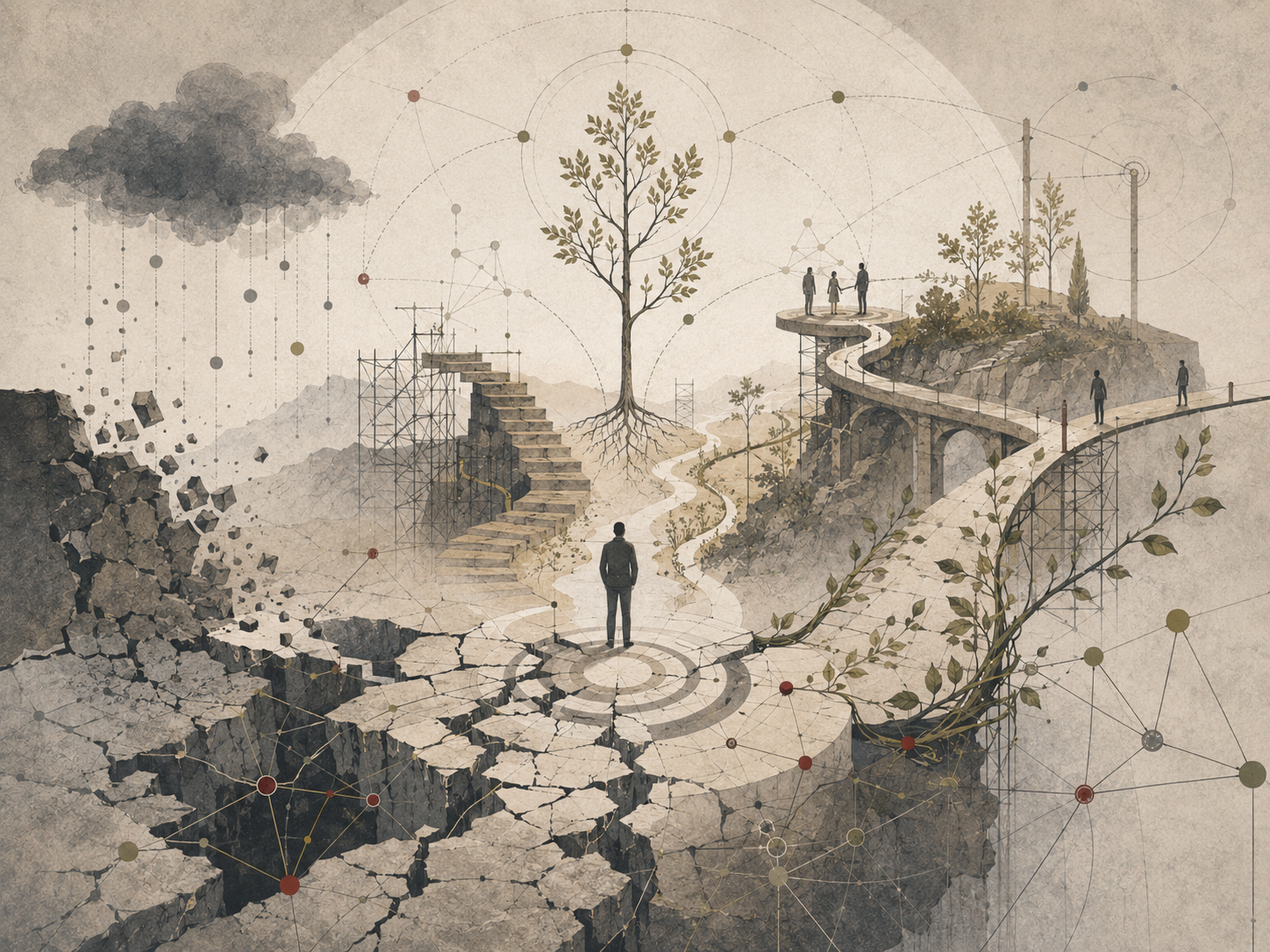
This article examines the conceptual foundations of post-traumatic growth, its relationship to trauma, meaning-making, resilience, identity reconstruction, social support, and narrative integration, the five major domains in which growth is often reported, the measurement debates surrounding the construct, and the ethical cautions required if the idea is to remain scientifically and morally serious.
What Is Post-Traumatic Growth?
Post-traumatic growth describes positive psychological change that can occur through the struggle with major life crises. The concept was developed most prominently by Richard Tedeschi and Lawrence Calhoun, who studied how individuals respond to events that disrupt their assumptions about life, safety, identity, mortality, relationship, and meaning.
The word growth is important, but it must be used carefully. PTG is not the same as feeling better. It is not the same as returning to one’s previous baseline. It is not the same as resilience, optimism, gratitude, or symptom reduction. It refers to perceived or actual transformation in how people understand themselves, relate to others, orient toward the future, value life, or interpret existential reality after traumatic disruption.
A person may experience distress and growth at the same time. A survivor of serious illness may report a stronger appreciation for life while still experiencing fear, fatigue, anger, or grief. A bereaved person may develop deeper compassion while still carrying loss. A person who has experienced violence may gain a new sense of strength while still living with symptoms of trauma. PTG does not erase suffering. It describes one possible transformation that may occur alongside suffering.
| Concept | Core meaning | How it differs from PTG |
|---|---|---|
| Recovery | Return toward previous functioning after disruption | Recovery may restore baseline without producing deeper transformation |
| Resilience | Capacity to maintain or regain stability under adversity | Resilience may involve less disruption and less identity reconstruction |
| Post-traumatic growth | Positive transformation through the struggle with trauma | PTG implies changed priorities, relationships, meaning, strength, or worldview |
| Optimism | Expectation that future outcomes may be favorable | Optimism can exist without traumatic disruption or identity change |
| Meaning-making | Effort to interpret and integrate difficult experience | Meaning-making is often a mechanism of PTG, not the whole construct |
This distinction matters because PTG is sometimes misunderstood as a cheerful message about suffering. That is not the serious version of the theory. The serious version says that trauma can fracture previous assumptions so deeply that individuals are forced into existential reconstruction. Sometimes that reconstruction produces growth. Sometimes it does not. Sometimes it produces both growth and continuing pain.
The most responsible definition of post-traumatic growth is therefore: positive psychological transformation that may occur through the difficult process of confronting, interpreting, narrating, and integrating traumatic disruption.
Intellectual Roots of Growth Through Adversity
Although the term post-traumatic growth is modern, the underlying idea is much older. Philosophical, religious, literary, and moral traditions have long wrestled with the possibility that suffering can transform character, clarify values, deepen compassion, and alter the meaning of a life.
Stoic thought asked how human beings might preserve dignity under conditions they cannot control. Religious traditions have often interpreted suffering in relation to endurance, purification, mercy, dependence, humility, compassion, sacrifice, or redemption. Existential philosophy confronted mortality, absurdity, anxiety, and the burden of meaning-making in a fragile world. Literature has repeatedly explored how loss, exile, illness, war, and grief reshape the self.
Modern PTG research does not simply repeat these traditions. It translates an old human concern into empirical psychological language. It asks: after severe disruption, do people report positive change? In what domains? Through what mechanisms? Under what conditions? How stable are those reports? How do they relate to distress, social support, narrative reconstruction, and meaning-making?
Viktor Frankl’s work on meaning after extreme suffering is especially important in this broader intellectual background. Frankl did not claim that suffering is inherently good. His central contribution was to show that meaning can become psychologically crucial when circumstances cannot be easily changed. PTG research inherits this concern but studies it through contemporary psychological constructs, measurement tools, and longitudinal questions.
The intellectual roots of PTG matter because they prevent the concept from becoming a shallow self-help slogan. Growth through adversity is one of the oldest human questions. Positive psychology’s contribution is to study that question systematically while preserving the moral seriousness of trauma.
Trauma and Psychological Transformation
Trauma often disrupts a person’s basic assumptions about the world. Many people move through life with implicit beliefs that the world is at least somewhat predictable, that life has coherence, that effort can influence outcomes, that loved ones are relatively safe, that the self is continuous, and that the future remains imaginable. Trauma can fracture these assumptions.
Serious illness, violence, bereavement, war, displacement, disaster, assault, abuse, sudden loss, or life-threatening events can confront people with mortality, randomness, injustice, vulnerability, betrayal, helplessness, or the limits of personal control. These experiences do not merely produce emotional distress. They can destabilize the interpretive frameworks through which life had previously made sense.
Post-traumatic growth theory treats this assumptive disruption as central. Growth does not arise from the traumatic event itself. It may arise from the struggle to rebuild meaning after the event has disrupted previous ways of understanding life.
People may begin asking:
- What kind of world do I live in now?
- Who am I after this happened?
- What matters most now?
- What can still be trusted?
- What relationships remain real?
- What future is still possible?
- How do I carry this without being wholly defined by it?
These questions are not abstract. They often emerge from pain, fear, grief, anger, confusion, and loss. For some people, the effort to live with these questions leads to changed priorities, deeper relationships, spiritual reflection, altered identity, or new commitments. For others, the disruption remains unresolved or produces ongoing distress without clear growth. Both outcomes must be acknowledged.
| Trauma-related disruption | Psychological question | Possible growth pathway |
|---|---|---|
| Mortality awareness | How fragile is life? | Greater appreciation for life, urgency, or changed priorities |
| Loss of control | What can I influence now? | More realistic agency, humility, or adaptive goal revision |
| Relational rupture | Who can be trusted? | Deeper discernment, intimacy, or compassion |
| Identity disruption | Who am I after this? | Reconstructed self-understanding or new life narrative |
| Meaning collapse | What does life mean now? | New purpose, spiritual development, or existential reorientation |
Trauma can therefore become a catalyst for transformation, but only in a precise sense. It creates disruption. Growth, when it occurs, emerges through the struggle to respond to that disruption. That distinction is essential for keeping PTG ethically serious.
The Five Domains of Post-Traumatic Growth
Research on post-traumatic growth commonly identifies five broad domains in which people report positive change: greater appreciation for life, stronger relationships, recognition of personal strength, new possibilities, and spiritual or existential development. These domains were formalized in the Posttraumatic Growth Inventory and remain central to the field.
| PTG domain | Core change | Example | Interpretive caution |
|---|---|---|---|
| Appreciation of life | Heightened awareness of life’s fragility and value | Ordinary moments become more meaningful | Appreciation does not cancel grief or fear |
| Relating to others | Greater intimacy, empathy, compassion, or relational depth | Closer bonds with trusted family, friends, or communities | Trauma can also damage trust and isolate people |
| Personal strength | Recognition of endurance, courage, or adaptive capacity | “I learned I could survive more than I imagined” | Strength should not be used to minimize vulnerability |
| New possibilities | New roles, commitments, goals, or life directions | Career change, service, advocacy, creative work, renewed learning | Possibility depends partly on resources and access |
| Spiritual or existential change | Altered relationship to faith, mortality, purpose, or transcendence | Renewed faith, changed philosophy, deeper existential reflection | May be religious, spiritual, philosophical, or secular |
Greater Appreciation for Life
One of the most commonly reported forms of PTG is greater appreciation for life. After serious disruption, ordinary experiences may feel more vivid or significant. People may become more aware of mortality, time, fragility, and the value of everyday life.
This does not mean that life becomes easy or uniformly joyful. Appreciation can coexist with grief. A cancer survivor may appreciate mornings more deeply while still fearing recurrence. A bereaved person may value family more intensely while still missing the person who died. A person who survived danger may become more attentive to small moments of safety, kindness, or beauty while still carrying trauma.
The growth lies not in simple happiness, but in changed valuation. What once seemed routine may become precious. What once seemed urgent may seem trivial. What once seemed postponed may become worth doing now.
Stronger Relationships
Many people report deeper relationships after traumatic experience. This may involve greater emotional honesty, compassion, empathy, vulnerability, or appreciation for people who remained present during crisis. Trauma can reveal which relationships are trustworthy and which are fragile. It can also increase awareness of human vulnerability, making compassion more available.
At the same time, trauma can also damage relationships. People may feel misunderstood, abandoned, isolated, ashamed, or unable to trust. PTG should not imply that trauma automatically deepens connection. Instead, it recognizes that, under some conditions, the struggle with trauma can lead to more meaningful relational life.
Recognition of Personal Strength
Another PTG domain involves recognition of personal strength. People may discover capacities for endurance, courage, patience, adaptation, or survival that they did not previously know they possessed. This is not the same as invulnerability. In fact, a more mature form of strength often includes a clearer awareness of vulnerability.
A person might say, “I did not know I could live through that,” or “I learned that I can ask for help,” or “I found strength in continuing, not in pretending I was untouched.” PTG’s account of personal strength should therefore avoid heroic exaggeration. Strength after trauma may be quiet, relational, uneven, and incomplete.
New Possibilities
Trauma sometimes opens new possibilities—not because the trauma was desirable, but because old assumptions, routines, or priorities were disrupted. People may change careers, deepen commitments, begin advocacy, enter helping professions, repair relationships, pursue creative work, return to education, or orient toward service.
This domain requires special caution because new possibilities are unequally available. A person’s ability to pursue new directions depends on health, money, social support, citizenship, disability access, safety, care responsibilities, education, and institutional opportunity. A responsible PTG framework should therefore interpret new possibilities in relation to context, not merely personal mindset.
Spiritual or Existential Development
The fifth domain involves spiritual or existential development. Some people experience trauma as a rupture in their relationship to faith, mortality, transcendence, moral reality, or the meaning of suffering. Others become less religious but more philosophically serious. Some deepen prayer, ritual, compassion, service, or trust. Others revise inherited beliefs or develop a more sober worldview.
Later developments in PTG measurement, including expanded attention to existential and spiritual change, reflect the importance of this domain. Growth here does not require a specific theology. It may be religious, spiritual, philosophical, moral, or secular. What matters is that trauma leads to deeper reflection on life’s ultimate questions.
Meaning-Making After Trauma
Meaning-making is one of the central mechanisms through which post-traumatic growth may occur. Trauma often disrupts prior assumptions, leaving people with experiences that do not fit their old life story. Meaning-making refers to the effort to interpret, narrate, and integrate the event into a broader understanding of self, life, relationship, and future.
This process is rarely simple. Meaning-making after trauma does not always mean finding a clear explanation. Many traumatic events are unjust, senseless, or morally intolerable. A person may never find an answer to why something happened. The work of meaning-making is often less about explanation than integration. It asks: how can this be carried? How can life remain meaningful after this? What values remain? What must change? What story can hold both the wound and the future?
Meaning-making connects PTG directly with meaning and purpose. Growth often depends on whether individuals can construct a livable framework that preserves significance after disruption. It also connects with Hope Theory, because hope helps people imagine that life can still move toward valued ends after trauma.
| Meaning-making process | Psychological function | Possible PTG connection |
|---|---|---|
| Naming the disruption | Recognizes that life has been changed | Creates conditions for honest reconstruction |
| Revising assumptions | Updates beliefs about safety, control, mortality, trust, or meaning | Supports a more complex worldview |
| Narrative reconstruction | Integrates the event into a life story | Helps rebuild identity across rupture |
| Value clarification | Identifies what matters after trauma | Can produce changed priorities and new commitments |
| Future reorientation | Restores some sense of possible movement | Supports new possibilities and renewed agency |
Meaning-making often unfolds relationally. People tell and retell what happened. They speak with therapists, friends, family, clergy, peers, support groups, or communities. They write, pray, create, remember, protest, serve, or engage in rituals. These practices can help transform unspeakable disruption into a story that can be carried.
But meaning-making should never be forced. Some experiences remain unresolved for a long time. Some people need safety, stabilization, medical care, legal support, rest, or protection before meaning-making is possible. A responsible PTG framework respects timing. It does not demand interpretation before a person is ready.
Resilience Versus Post-Traumatic Growth
Resilience and post-traumatic growth are related but distinct. Resilience refers to the ability to maintain or regain functioning after adversity. PTG refers to positive transformation that occurs through the struggle with trauma. A resilient person may experience distress but remain relatively stable. A person experiencing PTG may undergo deep disruption before reconstructing meaning and identity.
This distinction prevents several errors. First, it prevents the assumption that all healthy adaptation must involve dramatic growth. A person who returns to functioning after trauma without reporting major transformation may still be adapting well. Second, it prevents the assumption that growth means a person is no longer distressed. PTG and distress can coexist. Third, it prevents the assumption that people who suffer deeply are less resilient. Some forms of growth may require sustained confrontation with disruption.
| Adaptive pathway | Typical pattern | Relation to distress | Relation to identity |
|---|---|---|---|
| Resilience | Maintaining or regaining stability after adversity | Distress may be limited, temporary, or manageable | Identity may remain relatively continuous |
| Recovery | Gradual return toward previous functioning | Distress declines over time | Identity may largely return to prior form |
| Post-traumatic growth | Transformation through struggle with disruption | Distress may remain even as growth occurs | Identity, values, priorities, or worldview may be reconstructed |
| Chronic distress | Persistent impairment or unresolved trauma burden | Distress remains high | Identity may feel fragmented, threatened, or narrowed |
The distinction also matters ethically. No one should be told that they must grow from trauma. Resilience, recovery, survival, endurance, grief, and ongoing struggle are all real responses. PTG is one possible pathway, not the normative endpoint of trauma recovery.
A mature positive psychology must therefore avoid ranking responses to trauma. Growth is meaningful when it occurs, but it should not become a moral expectation.
The Psychological Process of Growth
Post-traumatic growth generally unfolds gradually. It is rarely immediate. It often begins with distress, confusion, intrusive thoughts, emotional upheaval, and the breakdown of prior assumptions. Over time, some individuals move from involuntary distress toward more deliberate reflection, meaning-making, narrative reconstruction, and renewed agency.
A useful distinction in PTG research is between intrusive rumination and deliberate rumination. Intrusive rumination involves unwanted, recurring thoughts about the traumatic event. It is often distressing and difficult to control. Deliberate rumination involves more intentional reflection on what happened, what it means, how life has changed, and how the experience might be integrated. Deliberate rumination is more closely associated with growth because it supports meaning-making rather than only repeating distress.
| Process stage | Common experience | Possible growth-relevant function |
|---|---|---|
| Disruption | Shock, fear, loss, confusion, violation of assumptions | Old frameworks no longer fully explain life |
| Intrusive rumination | Unwanted recurrence of thoughts, images, or questions | Signals unresolved disruption, but can maintain distress |
| Support and stabilization | Safety, care, listening, practical help, regulation | Creates conditions for reflection and integration |
| Deliberate rumination | Intentional reflection on meaning, values, and future | Supports cognitive and narrative reconstruction |
| Narrative integration | Developing a story that can hold trauma and future life | Rebuilds continuity of identity |
| Reorientation | Changed priorities, relationships, purpose, or worldview | Represents possible post-traumatic growth |
Social support plays a major role in this process. Trusted relationships can help individuals regulate distress, articulate what happened, test interpretations, receive validation, and imagine future possibilities. Growth is often relational, not merely internal. People grow through conversations, communities, rituals, care networks, therapeutic relationships, peer support, and shared meaning.
Agency also matters. Trauma can produce helplessness, passivity, or a sense that the future is closed. Growth often requires some restoration of agency, even if agency begins with small actions: telling the story, asking for help, returning to a routine, making one decision, protecting oneself, participating in treatment, or naming a changed value.
PTG therefore emerges from a dynamic process: disruption, distress, support, reflection, narration, meaning-making, agency restoration, and life reorientation. The process is uneven, recursive, and deeply personal. It cannot be rushed.
Measuring Post-Traumatic Growth
Post-traumatic growth became influential partly because it could be measured. The most widely used instrument is the Posttraumatic Growth Inventory, developed by Tedeschi and Calhoun. The PTGI asks individuals to report positive changes across domains such as appreciation of life, relationships, personal strength, new possibilities, and spiritual change.
The PTGI made systematic research possible. It allowed scholars to examine PTG across different populations, events, cultures, and time periods. It also helped distinguish PTG from adjacent constructs such as resilience, optimism, coping, life satisfaction, and symptom reduction.
Measurement, however, is one of the most contested parts of the field. PTG is often measured through self-report. A person reports that they have changed. The question is how to interpret that report. Does it reflect actual durable transformation? Does it reflect a coping narrative? Does it reflect a sincere perception of growth that may or may not be visible behaviorally? Does it reflect social desirability? Does it reflect meaning-making still in progress?
| Measurement issue | Why it matters | Responsible interpretation |
|---|---|---|
| Self-report | Most PTG measures depend on perceived change | Treat scores as reports of experienced growth, not automatic proof of objective transformation |
| Retrospective comparison | People compare present self to remembered pre-trauma self | Memory, interpretation, and narrative may influence reports |
| Distress coexistence | Growth and distress can occur together | Do not infer that high PTG means low suffering |
| Social desirability | People may feel pressure to find meaning in suffering | Measure cultural and interpersonal expectations where possible |
| Behavioral corroboration | Reported growth may or may not appear in behavior | Use longitudinal, relational, qualitative, or behavioral evidence when feasible |
The measurement challenge does not make PTG meaningless. It makes the construct more complex. Self-reported growth can be psychologically important even if it is difficult to verify independently, because it reflects how people are organizing experience after trauma. But researchers and practitioners should be careful not to overinterpret a score.
A strong PTG measurement design should include distress measures, time since trauma, event type, social support, meaning-making, agency, rumination type, functional outcomes, and context. It should avoid treating a single PTG score as a complete account of recovery or transformation.
Perceived Growth, Corroborated Growth, and the Measurement Debate
One of the most important debates in PTG research concerns the difference between perceived growth and corroborated growth. Perceived growth refers to a person’s own report that they have changed positively after trauma. Corroborated growth refers to change that is supported by additional evidence: behavior, relationships, longitudinal data, observer reports, value changes, life decisions, or sustained patterns of action.
This distinction is not meant to dismiss self-report. Trauma is deeply subjective, and people are often the primary interpreters of their own transformation. But the distinction matters because perceived growth may sometimes function as coping, meaning-making, or self-protection rather than fully realized transformation.
Zoellner and Maercker’s critical work helped sharpen this issue by suggesting that PTG may include both constructive and illusory components. Some reported growth may correspond to real transformation. Some may help people cope in the short term without reflecting durable change. Some may be both: a narrative initially formed to cope that later becomes a basis for actual behavioral and relational change.
| Growth type | Description | Research implication |
|---|---|---|
| Perceived growth | Self-reported positive change after trauma | Important subjective indicator, but should be interpreted carefully |
| Corroborated growth | Growth supported by behavior, relationships, time, or external evidence | Requires longitudinal, qualitative, or multi-informant evidence |
| Constructive growth narrative | Meaning-making story that helps organize experience and guide action | May become behaviorally real over time |
| Illusory or defensive growth | Reported growth that may protect the self without deeper change | Should not be dismissed harshly; may still have coping value |
| Integrated growth | Perceived, behavioral, relational, and existential change align | Strongest form of PTG evidence |
The best research does not ask only whether someone reports growth. It asks what kind of growth is being reported, how stable it is, whether it is connected to action, whether it coexists with distress, and whether the person’s life has actually been reorganized.
This debate is a sign of the field’s maturity. It prevents PTG from becoming a simplistic story and pushes researchers toward stronger evidence, better models, and more ethical interpretation.
Applications in Therapy, Recovery, Education, and Community Life
Post-traumatic growth has influenced therapy, counseling, grief work, illness adjustment, rehabilitation, military psychology, disaster recovery, education, and community support. Its practical value lies in recognizing that some people may need help not only reducing symptoms, but reconstructing meaning, identity, values, and future orientation.
In therapy and counseling, PTG-informed work should never pressure people to “find the good” in trauma. That framing can be harmful. A careful approach creates space for the possibility of growth without demanding it. It may help clients explore how trauma has changed their priorities, relationships, sense of self, worldview, or life direction. It may support meaning-making, narrative reconstruction, restored agency, relational repair, and future reorientation.
In illness and rehabilitation contexts, PTG may help people reflect on changed bodies, vulnerability, dependence, mortality, care, and priorities. A person facing serious illness may not become “better” in a simple sense, but may develop a changed understanding of life, relationships, or purpose. This work must remain medically realistic and emotionally sensitive.
In grief contexts, PTG must be handled especially carefully. Growth after loss does not mean the loss was worthwhile. It may mean that the person, over time, finds new depth, compassion, purpose, or appreciation while continuing to carry grief. The goal is not closure as erasure, but integration.
In education and community life, PTG can support trauma-informed reflection, peer support, meaning-making, civic engagement, and collective recovery. Communities affected by violence, disaster, displacement, or collective trauma may engage in rituals, memorials, public storytelling, mutual aid, advocacy, or institutional reform. These collective practices can create conditions for shared meaning and agency.
| Setting | PTG-relevant work | Responsible-use concern |
|---|---|---|
| Therapy and counseling | Meaning reconstruction, narrative integration, agency restoration | Do not pressure clients to report growth |
| Illness and rehabilitation | Changed priorities, adaptation, embodied vulnerability, future planning | Do not confuse growth with cure or denial |
| Grief support | Integration of loss, continuing bonds, changed meaning | Do not imply that loss was necessary or beneficial |
| Education | Trauma-informed reflection, support, identity development | Do not require disclosure or public performance of growth |
| Community recovery | Ritual, memorial, mutual aid, civic repair, collective meaning | Pair growth language with material and institutional support |
The most responsible applications of PTG are invitational, not prescriptive. They allow growth to be named when it appears, but they do not demand growth as proof of recovery.
Context, Culture, Social Support, and the Ecology of Growth
Post-traumatic growth does not occur in a vacuum. Social support, culture, resources, institutions, economic security, spiritual traditions, family systems, healthcare access, legal systems, and community responses all shape whether people can process trauma and rebuild meaning.
Social support is especially important. Trusted others can help people regulate distress, tell their story, receive validation, explore meaning, and imagine future possibilities. Poor support, by contrast, can compound trauma. Dismissal, disbelief, stigma, blame, abandonment, or forced positivity can deepen isolation and obstruct growth.
Culture also shapes PTG. Different societies offer different narratives about suffering, strength, grief, spirituality, family duty, communal healing, endurance, honor, shame, faith, and recovery. A PTG framework developed in one cultural context should not be applied universally without adaptation. Spiritual or existential change may be central in some contexts and less visible in others. Relational growth may be understood collectively rather than individually.
Material context matters as well. A person facing unsafe housing, medical debt, discrimination, legal insecurity, workplace retaliation, disability exclusion, or lack of care may have fewer opportunities for reflective integration. Growth requires not only inner work but conditions that make rebuilding possible.
| Context layer | Growth-supporting condition | Growth-obstructing condition |
|---|---|---|
| Personal | Emotional regulation, reflection, agency, meaning-making | Overwhelming distress, shame, exhaustion, dissociation |
| Relational | Validation, listening, trust, compassion, nonjudgmental presence | Blame, disbelief, abandonment, forced positivity |
| Cultural | Shared rituals, language for suffering, communal meaning | Stigma, silence, rigid expectations of strength |
| Institutional | Healthcare, legal support, trauma-informed schools and workplaces | Neglect, retraumatization, bureaucratic harm, inaccessible services |
| Structural | Safety, housing, income, rights, protection, community resources | Poverty, violence, exclusion, instability, discrimination |
A serious PTG framework therefore asks not only “Did this person grow?” but also “What conditions made growth more or less possible?” This question keeps the concept from becoming individualistic and connects positive psychology to social responsibility.
Critiques and Limitations
Post-traumatic growth is one of the most compelling concepts in positive psychology, but it is also one of the most easily misused. The first major critique concerns romanticizing trauma. Trauma can cause severe, lasting harm. Public discussions of PTG can drift into the implication that suffering is secretly beneficial or that people should be grateful for hardship. That implication must be rejected.
The second critique concerns moral pressure. If growth becomes the expected outcome, people who do not report growth may feel inadequate, ashamed, or judged. A person who remains angry, grieving, symptomatic, numb, or exhausted after trauma has not failed. PTG is a possibility, not a duty.
The third critique concerns measurement. Self-reported growth may not always reflect durable transformation. It may sometimes reflect coping, self-protection, social desirability, or an effort to make suffering bearable. These processes are not necessarily invalid, but they complicate interpretation.
The fourth critique concerns context. PTG can become too individualistic if it ignores social support, inequality, institutional failure, disability, poverty, discrimination, violence, or ongoing exposure to danger. Growth is easier to imagine when people have safety, care, resources, and time.
The fifth critique concerns timing. Encouraging growth too early can be harmful. People in acute crisis may need safety, stabilization, medical care, legal protection, rest, grief support, or symptom treatment before meaning-making is appropriate.
| Critique | Risk | Responsible response |
|---|---|---|
| Romanticizing trauma | Suggests suffering is beneficial or necessary | Emphasize that growth occurs through struggle, not because trauma is good |
| Moral pressure | Imposes growth as an expectation | Treat PTG as possible, not required |
| Self-report limitations | Confuses perceived growth with durable transformation | Use longitudinal, qualitative, behavioral, and contextual evidence where possible |
| Individualism | Ignores structural barriers and social support | Measure context, resources, institutions, and inequality |
| Poor timing | Pushes meaning-making before safety or stabilization | Prioritize trauma-informed care, consent, and readiness |
These critiques do not destroy the concept. They make it more precise. Post-traumatic growth remains valuable when it is treated as a complex, context-dependent, ethically delicate form of transformation rather than a motivational slogan.
A Semi-Formal Framework for Post-Traumatic Growth
Post-traumatic growth can be represented semi-formally as a transformation process emerging from disruption, reflective struggle, social support, restored agency, and narrative integration.
PTG_t = \alpha_1 D_t + \alpha_2 M_t + \alpha_3 S_t + \alpha_4 A_t + \varepsilon_t
\]
Interpretation: Post-traumatic growth \(PTG_t\) is modeled as a function of assumptive disruption \(D_t\), meaning-making effort \(M_t\), social support \(S_t\), restored agency \(A_t\), and unmeasured variation \(\varepsilon_t\). Trauma alone does not produce growth; transformation depends on the processes that follow disruption.
A dynamic model can represent growth over time:
PTG_{t+1} = PTG_t + \beta_1 R_t + \beta_2 N_t + \beta_3 C_t – \beta_4 X_t + u_t
\]
Interpretation: Future growth \(PTG_{t+1}\) develops through deliberate rumination \(R_t\), narrative integration \(N_t\), context support \(C_t\), and is reduced or delayed by ongoing destabilization \(X_t\).
The distinction between perceived and corroborated growth can be represented as:
G^*_t = \gamma_1 P_t + \gamma_2 C_t
\]
Interpretation: Integrated growth \(G^*_t\) depends on perceived growth \(P_t\) and corroborated or behaviorally instantiated change \(C_t\). The measurement debate concerns how strongly these components align and under what conditions they diverge.
Distress and growth should be modeled separately rather than as simple opposites:
W_t = \delta_1 PTG_t – \delta_2 Distress_t + \delta_3 Support_t + \eta_t
\]
Interpretation: Well-being \(W_t\) may be influenced by growth, distress, and support at the same time. High PTG does not automatically imply low distress.
A context-sensitive model can be written as:
PTG^{context}_t = f(D_t, M_t, S_t, A_t, N_t) – B_t
\]
Interpretation: Context-sensitive PTG depends on disruption, meaning-making, support, agency, and narrative integration, while being constrained by ongoing barriers \(B_t\), such as unsafe conditions, poverty, exclusion, chronic stress, or institutional failure.
These equations are not intended to reduce trauma recovery to mathematics. They clarify the theory’s structure: growth may emerge when disruption is met by meaning-making, support, agency, reflection, and integration within conditions that make recovery and reconstruction possible.
Data Design and Measurement Notes
A serious evaluation of post-traumatic growth should measure more than a single PTG score. It should include trauma context, time since event, disruption, distress, rumination type, meaning-making, social support, restored agency, narrative integration, perceived growth, corroborated change, and ongoing barriers.
| Domain | Example variables | Interpretive role |
|---|---|---|
| Trauma context | Event type, timing, chronicity, exposure, ongoing danger | Prevents growth from being interpreted without context |
| Assumptive disruption | Threat to worldview, identity, safety, trust, meaning | Captures the depth of psychological rupture |
| Distress | Symptoms, fear, grief, intrusive thoughts, avoidance, impairment | Shows that growth and suffering may coexist |
| Rumination | Intrusive rumination, deliberate rumination | Distinguishes repetitive distress from reflective meaning-making |
| Meaning-making | Coherence, purpose, interpretation, value reconstruction | Captures a central mechanism of growth |
| Social support | Validation, trust, care, belonging, support quality | Captures relational conditions for integration |
| Agency | Restored action, self-direction, future orientation | Shows whether the person can participate in rebuilding life |
| Growth outcomes | Appreciation of life, relationships, strength, possibilities, spirituality | Captures PTG domains |
| Corroboration | Behavioral change, relational reports, longitudinal patterns | Helps distinguish perceived from integrated growth |
| Context barriers | Housing, income, healthcare, safety, discrimination, institutional response | Prevents individualistic interpretation |
Several design principles follow:
- Measure distress and growth separately. They are not opposite ends of a single scale.
- Preserve the five PTG domains. A total score can hide meaningful differences across appreciation, relationships, strength, possibilities, and existential change.
- Distinguish intrusive and deliberate rumination. These processes have different psychological implications.
- Include context and barriers. Growth should not be interpreted outside material, social, and institutional conditions.
- Use longitudinal designs when possible. Growth is a process over time, not only a retrospective report.
- Include qualitative evidence where feasible. Narrative change, meaning reconstruction, and existential development are difficult to capture fully through scales alone.
- Protect privacy and consent. Trauma data, recovery narratives, and growth reports are sensitive.
The purpose of measurement is not to demand growth. It is to understand how people struggle, adapt, reconstruct meaning, and sometimes transform after profound disruption.
R: Modeling Post-Traumatic Growth and Meaning Reconstruction
The following R workflow illustrates how a researcher might model post-traumatic growth as a joint function of assumptive disruption, meaning-making, deliberate rumination, social support, restored agency, narrative integration, and ongoing stress burden. It also models distress separately so growth is not treated as the simple inverse of suffering.
# Post-traumatic growth longitudinal modeling workflow
#
# Purpose:
#   Model PTG as a process involving disruption, meaning-making,
#   deliberate rumination, social support, restored agency, narrative
#   integration, and context support.
#
# Notes:
#   This workflow is for research, teaching, and exploratory analysis.
#   It is not a clinical, diagnostic, therapeutic, crisis-support,
#   employment-selection, workplace-screening, student-ranking,
#   benefits-eligibility, or individual assessment tool.

library(tidyverse)
library(lme4)
library(lmerTest)
library(broom.mixed)
library(emmeans)
library(performance)

# Expected columns:
# id, wave, trauma_context,
# assumptive_disruption, intrusive_rumination, deliberate_rumination,
# meaning_making, social_support, restored_agency,
# narrative_integration, context_support, ongoing_stress,
# ptg_appreciation, ptg_relationships, ptg_strength,
# ptg_new_possibilities, ptg_existential_change,
# ptg_score, distress_score, wellbeing_score

df <- read_csv("data/post_traumatic_growth_panel.csv")

panel <- df %>%
  mutate(
    id = as.factor(id),
    wave = as.integer(wave),
    trauma_context = as.factor(trauma_context)
  ) %>%
  filter(complete.cases(
    assumptive_disruption,
    intrusive_rumination,
    deliberate_rumination,
    meaning_making,
    social_support,
    restored_agency,
    narrative_integration,
    context_support,
    ongoing_stress,
    ptg_appreciation,
    ptg_relationships,
    ptg_strength,
    ptg_new_possibilities,
    ptg_existential_change,
    ptg_score,
    distress_score,
    wellbeing_score
  )) %>%
  mutate(
    wave_c = as.numeric(scale(wave, center = TRUE, scale = FALSE)),
    disruption_c = as.numeric(scale(assumptive_disruption, center = TRUE, scale = FALSE)),
    intrusive_c = as.numeric(scale(intrusive_rumination, center = TRUE, scale = FALSE)),
    deliberate_c = as.numeric(scale(deliberate_rumination, center = TRUE, scale = FALSE)),
    meaning_c = as.numeric(scale(meaning_making, center = TRUE, scale = FALSE)),
    support_c = as.numeric(scale(social_support, center = TRUE, scale = FALSE)),
    agency_c = as.numeric(scale(restored_agency, center = TRUE, scale = FALSE)),
    narrative_c = as.numeric(scale(narrative_integration, center = TRUE, scale = FALSE)),
    context_c = as.numeric(scale(context_support, center = TRUE, scale = FALSE)),
    stress_c = as.numeric(scale(ongoing_stress, center = TRUE, scale = FALSE)),
    distress_c = as.numeric(scale(distress_score, center = TRUE, scale = FALSE)),
    ptg_domain_balance = rowMeans(
      select(
        .,
        ptg_appreciation,
        ptg_relationships,
        ptg_strength,
        ptg_new_possibilities,
        ptg_existential_change
      ),
      na.rm = TRUE
    ),
    integration_index = rowMeans(
      select(., meaning_making, restored_agency, narrative_integration, social_support),
      na.rm = TRUE
    )
  )

model_ptg <- lmer(
  ptg_score ~
    wave_c +
    disruption_c +
    deliberate_c +
    meaning_c +
    support_c +
    agency_c +
    narrative_c +
    context_c -
    stress_c +
    meaning_c:agency_c +
    deliberate_c:narrative_c +
    support_c:stress_c +
    (1 + wave_c | id),
  data = panel,
  REML = FALSE
)

model_distress <- lmer(
  distress_score ~
    wave_c +
    disruption_c +
    intrusive_c +
    stress_c -
    support_c -
    agency_c -
    context_c +
    intrusive_c:stress_c +
    (1 + wave_c | id),
  data = panel,
  REML = FALSE
)

model_wellbeing <- lmer(
  wellbeing_score ~
    wave_c +
    ptg_score +
    distress_c +
    integration_index +
    context_c -
    stress_c +
    ptg_score:distress_c +
    (1 + wave_c | id),
  data = panel,
  REML = FALSE
)

summary(model_ptg)
summary(model_distress)
summary(model_wellbeing)

performance::check_model(model_ptg)
performance::check_model(model_distress)
performance::check_model(model_wellbeing)

emm_ptg_meaning_agency <- emmeans(
  model_ptg,
  ~ meaning_c | agency_c,
  at = list(
    meaning_c = c(-1, 0, 1),
    agency_c = c(-1, 0, 1),
    disruption_c = 0,
    deliberate_c = 0,
    support_c = 0,
    narrative_c = 0,
    context_c = 0,
    stress_c = 0,
    wave_c = 0
  )
)

emm_ptg_support_stress <- emmeans(
  model_ptg,
  ~ support_c | stress_c,
  at = list(
    support_c = c(-1, 0, 1),
    stress_c = c(-1, 0, 1),
    disruption_c = 0,
    deliberate_c = 0,
    meaning_c = 0,
    agency_c = 0,
    narrative_c = 0,
    context_c = 0,
    wave_c = 0
  )
)

emm_wellbeing_growth_distress <- emmeans(
  model_wellbeing,
  ~ ptg_score | distress_c,
  at = list(
    ptg_score = quantile(panel$ptg_score, probs = c(0.25, 0.50, 0.75), na.rm = TRUE),
    distress_c = c(-1, 0, 1),
    integration_index = mean(panel$integration_index, na.rm = TRUE),
    context_c = 0,
    stress_c = 0,
    wave_c = 0
  )
)

dir.create("outputs", showWarnings = FALSE)

write_csv(
  broom.mixed::tidy(model_ptg, effects = "fixed", conf.int = TRUE),
  "outputs/ptg_growth_fixed_effects.csv"
)

write_csv(
  broom.mixed::tidy(model_distress, effects = "fixed", conf.int = TRUE),
  "outputs/ptg_distress_fixed_effects.csv"
)

write_csv(
  broom.mixed::tidy(model_wellbeing, effects = "fixed", conf.int = TRUE),
  "outputs/ptg_wellbeing_fixed_effects.csv"
)

write_csv(
  as.data.frame(emm_ptg_meaning_agency),
  "outputs/ptg_meaning_by_agency_margins.csv"
)

write_csv(
  as.data.frame(emm_ptg_support_stress),
  "outputs/ptg_support_by_stress_margins.csv"
)

write_csv(
  as.data.frame(emm_wellbeing_growth_distress),
  "outputs/ptg_wellbeing_growth_by_distress_margins.csv"
)

domain_summary <- panel %>%
  group_by(trauma_context) %>%
  summarize(
    mean_disruption = mean(assumptive_disruption, na.rm = TRUE),
    mean_intrusive_rumination = mean(intrusive_rumination, na.rm = TRUE),
    mean_deliberate_rumination = mean(deliberate_rumination, na.rm = TRUE),
    mean_meaning_making = mean(meaning_making, na.rm = TRUE),
    mean_social_support = mean(social_support, na.rm = TRUE),
    mean_restored_agency = mean(restored_agency, na.rm = TRUE),
    mean_narrative_integration = mean(narrative_integration, na.rm = TRUE),
    mean_context_support = mean(context_support, na.rm = TRUE),
    mean_ongoing_stress = mean(ongoing_stress, na.rm = TRUE),
    mean_ptg = mean(ptg_score, na.rm = TRUE),
    mean_distress = mean(distress_score, na.rm = TRUE),
    mean_wellbeing = mean(wellbeing_score, na.rm = TRUE),
    .groups = "drop"
  )

write_csv(
  domain_summary,
  "outputs/ptg_context_summary.csv"
)
This workflow preserves a core PTG insight: growth and distress are not simple opposites. The mechanisms that support growth may not automatically eliminate distress, and distress may remain even when people report meaningful transformation.
Python: Network Analysis of PTG Dynamics
The following Python example treats post-traumatic growth as a connected system of disruption, rumination, meaning-making, social support, restored agency, narrative integration, distress, and well-being. It estimates a sparse partial-correlation network to identify which variables are most central in a synthetic PTG recovery ecology.
"""
Post-traumatic growth network workflow

Purpose:
    Estimate a sparse network of PTG variables using partial correlations,
    then summarize centrality, edge structure, and integrated growth indices.

Use:
    Research, teaching, exploratory systems analysis, and trauma-informed
    recovery-model design.

Not for:
    Clinical diagnosis, therapeutic decision-making, crisis triage,
    employment selection, workplace screening, student ranking,
    benefits decisions, or individual psychological assessment.
"""

from pathlib import Path

import matplotlib.pyplot as plt
import networkx as nx
import numpy as np
import pandas as pd

from sklearn.covariance import GraphicalLassoCV
from sklearn.decomposition import PCA
from sklearn.impute import SimpleImputer
from sklearn.preprocessing import StandardScaler

DATA_PATH = Path("data/ptg_network.csv")
OUTPUT_DIR = Path("outputs")
OUTPUT_DIR.mkdir(exist_ok=True)

cols = [
    "assumptive_disruption",
    "intrusive_rumination",
    "deliberate_rumination",
    "meaning_making",
    "social_support",
    "restored_agency",
    "narrative_integration",
    "context_support",
    "ongoing_stress",
    "ptg_score",
    "distress_score",
    "wellbeing_score",
]

df = pd.read_csv(DATA_PATH)

missing_cols = [col for col in cols if col not in df.columns]
if missing_cols:
    raise ValueError(f"Missing expected columns: {missing_cols}")

imputer = SimpleImputer(strategy="median")
X = pd.DataFrame(imputer.fit_transform(df[cols]), columns=cols)

scaler = StandardScaler()
X_scaled = pd.DataFrame(scaler.fit_transform(X), columns=cols)

X_scaled["integration_index"] = (
    X_scaled["meaning_making"] +
    X_scaled["restored_agency"] +
    X_scaled["narrative_integration"] +
    X_scaled["social_support"]
) / 4

X_scaled["growth_distress_balance"] = (
    X_scaled["ptg_score"] +
    X_scaled["wellbeing_score"] +
    X_scaled["integration_index"] -
    X_scaled["distress_score"] -
    X_scaled["ongoing_stress"]
)

X_scaled["reflective_processing_balance"] = (
    X_scaled["deliberate_rumination"] -
    X_scaled["intrusive_rumination"]
)

glasso = GraphicalLassoCV()
glasso.fit(X_scaled[cols])

precision = glasso.precision_
partial_corr = -precision / np.sqrt(np.outer(np.diag(precision), np.diag(precision)))
np.fill_diagonal(partial_corr, 0)

partial_df = pd.DataFrame(partial_corr, index=cols, columns=cols)

threshold = 0.08
G = nx.Graph()

for node in cols:
    G.add_node(node)

for i, source in enumerate(cols):
    for j, target in enumerate(cols):
        if j > i:
            weight = partial_df.iloc[i, j]
            if abs(weight) >= threshold:
                G.add_edge(source, target, weight=weight)

degree = nx.degree_centrality(G)
betweenness = nx.betweenness_centrality(G, weight="weight")

try:
    eigenvector = nx.eigenvector_centrality_numpy(G, weight="weight")
except nx.NetworkXException:
    eigenvector = {node: np.nan for node in G.nodes()}

centrality = pd.DataFrame({
    "node": list(G.nodes()),
    "degree_centrality": [degree[node] for node in G.nodes()],
    "betweenness_centrality": [betweenness[node] for node in G.nodes()],
    "eigenvector_centrality": [eigenvector[node] for node in G.nodes()],
}).sort_values(
    ["eigenvector_centrality", "degree_centrality"],
    ascending=False
)

edge_table = pd.DataFrame([
    {
        "source": source,
        "target": target,
        "partial_correlation": data["weight"],
        "absolute_weight": abs(data["weight"]),
        "sign": "positive" if data["weight"] > 0 else "negative",
    }
    for source, target, data in G.edges(data=True)
]).sort_values("absolute_weight", ascending=False)

pca = PCA(n_components=4)
pca.fit(X_scaled[cols])

pca_summary = pd.DataFrame({
    "component": [1, 2, 3, 4],
    "variance_explained": pca.explained_variance_ratio_,
    "cumulative_variance_explained": np.cumsum(pca.explained_variance_ratio_),
})

centrality.to_csv(OUTPUT_DIR / "ptg_network_centrality.csv", index=False)
edge_table.to_csv(OUTPUT_DIR / "ptg_network_edges.csv", index=False)
partial_df.to_csv(OUTPUT_DIR / "ptg_partial_correlations.csv")
pca_summary.to_csv(OUTPUT_DIR / "ptg_pca_summary.csv", index=False)
X_scaled.to_csv(OUTPUT_DIR / "ptg_scaled_indices.csv", index=False)

print("\nCentrality summary:")
print(centrality)

print("\nStrongest edges:")
print(edge_table.head(15))

plt.figure(figsize=(12, 9))
pos = nx.spring_layout(G, seed=42, k=0.85)

positive_edges = [(u, v) for u, v in G.edges() if G[u][v]["weight"] > 0]
negative_edges = [(u, v) for u, v in G.edges() if G[u][v]["weight"] < 0]

nx.draw_networkx_nodes(G, pos, node_size=1800)
nx.draw_networkx_labels(G, pos, font_size=9)

nx.draw_networkx_edges(
    G,
    pos,
    edgelist=positive_edges,
    width=[abs(G[u][v]["weight"]) * 5 for u, v in positive_edges],
    alpha=0.75,
)

nx.draw_networkx_edges(
    G,
    pos,
    edgelist=negative_edges,
    width=[abs(G[u][v]["weight"]) * 5 for u, v in negative_edges],
    style="dashed",
    alpha=0.75,
)

plt.title("Partial Correlation Network of Post-Traumatic Growth Variables")
plt.axis("off")
plt.tight_layout()
plt.savefig(OUTPUT_DIR / "ptg_network.png", dpi=300)
plt.close()
This type of analysis can reveal whether support, restored agency, meaning-making, deliberate rumination, or narrative integration appears structurally central in a given PTG dataset. It can also show whether distress and growth occupy separate parts of the network rather than functioning as simple opposites.
Network models should not be interpreted as causal proof. They are exploratory tools for identifying patterns that may deserve longitudinal testing, qualitative interpretation, clinical expertise, ethical review, or trauma-informed institutional analysis.
Interpretation and Responsible Use
Post-traumatic growth is an ethically delicate concept. It should never be used to pressure people to grow from trauma, to minimize suffering, to deny injustice, or to transform harm into a motivational lesson. The responsible use of PTG begins with a simple principle: trauma is not good. Growth, when it occurs, comes through struggle, support, meaning-making, and reconstruction—not from trauma as a gift.
The code examples above are designed for research, teaching, exploratory modeling, and trauma-informed conceptual analysis. They should not be used as clinical diagnostic instruments, therapeutic decision tools, crisis triage tools, workplace-screening systems, employment-selection tools, student-ranking systems, public-benefits eligibility tools, or individual psychological assessments.
Several principles follow:
- Do not require growth. PTG is a possible outcome, not an obligation.
- Do not romanticize trauma. Growth does not make trauma desirable or necessary.
- Do not treat distress as failure. People can suffer deeply and still be adapting with dignity.
- Respect timing. Safety, stabilization, care, and consent come before meaning-making.
- Measure context. Social support, resources, institutions, and ongoing barriers shape recovery.
- Protect privacy. Trauma narratives and growth reports are sensitive personal data.
- Use findings to improve support. PTG research should strengthen care, listening, access, protection, and relational conditions.
A serious PTG framework does not ask people to turn pain into productivity. It asks how human beings sometimes reconstruct meaning, relationship, agency, and identity after profound disruption—and what kinds of support make that reconstruction more possible.
GitHub Repository
The companion repository for this article organizes the R, Python, data-schema, and documentation materials into a reproducible workflow for post-traumatic growth research. It includes sample data dictionaries, scripts for longitudinal PTG modeling, network-analysis outputs, validation notes, and guidance for responsible interpretation.
Complete Code Repository
Access the full companion repository for this article, including reproducible analysis materials, R and Python workflows, data-schema documentation, validation notes, and network-modeling examples for post-traumatic growth research.
Conclusion
Post-traumatic growth represents one of the most compelling ideas in positive psychology because it identifies the possibility of transformation through adversity without denying the reality of suffering. The concept matters because it reveals that traumatic disruption can sometimes lead to deeper meaning, stronger relationships, revised priorities, spiritual or existential development, new possibilities, and new forms of personal strength.
But PTG must be handled with care. It is not a promise. It is not a requirement. It is not a justification for trauma. It should never be used to minimize harm or pressure people into positive narratives. Growth occurs, when it occurs, through the difficult psychological work of confronting, interpreting, narrating, and integrating what has happened within conditions of support, safety, and time.
The most serious account of PTG therefore holds two truths together. Trauma can wound, destabilize, and remain painful. Human beings can also sometimes reconstruct life after rupture in ways that are deeper, more compassionate, more meaningful, and more honest than before. A mature positive psychology must be able to speak about both without collapsing one into the other.
Post-traumatic growth reminds us that flourishing is not only about happiness, strength, or achievement. It is also about the capacity to rebuild meaning after life has been broken open.
Related articles
- Positive Psychology article map
- Meaning and Purpose in Positive Psychology
- Hope Theory in Positive Psychology
- Learned Helplessness and Depression
- Resilience in Positive Psychology
- Explanatory Style and Optimism in Positive Psychology
- Positive Psychology Interventions
- Self-Determination Theory in Positive Psychology
- Gratitude and Wellbeing in Positive Psychology
Further reading
- Bonanno, G.A. (2004) ‘Loss, trauma, and human resilience’, American Psychologist, 59(1), pp. 20–28.
- Frankl, V.E. (2006) Man’s Search for Meaning. Boston: Beacon Press.
- Joseph, S. (2011) What Doesn’t Kill Us: The New Psychology of Posttraumatic Growth. New York: Basic Books.
- Janoff-Bulman, R. (1992) Shattered Assumptions: Towards a New Psychology of Trauma. New York: Free Press.
- Tedeschi, R.G. and Calhoun, L.G. (2004) ‘Posttraumatic growth: Conceptual foundations and empirical evidence’, Psychological Inquiry, 15(1), pp. 1–18. Available at: https://www.tandfonline.com/doi/abs/10.1207/s15327965pli1501_01.
- Tedeschi, R.G., Shakespeare-Finch, J., Taku, K. and Calhoun, L.G. (eds.) (2018) Posttraumatic Growth: Theory, Research, and Applications. New York: Routledge.
- Zoellner, T. and Maercker, A. (2006) ‘Posttraumatic growth in clinical psychology: A critical review and introduction of a two-component model’, Clinical Psychology Review, 26(5), pp. 626–653. Available at: https://pubmed.ncbi.nlm.nih.gov/16515831/.
References
- Bonanno, G.A. (2004) ‘Loss, trauma, and human resilience’, American Psychologist, 59(1), pp. 20–28.
- Frankl, V.E. (2006) Man’s Search for Meaning. Boston: Beacon Press.
- Janoff-Bulman, R. (1992) Shattered Assumptions: Towards a New Psychology of Trauma. New York: Free Press.
- Joseph, S. (2011) What Doesn’t Kill Us: The New Psychology of Posttraumatic Growth. New York: Basic Books.
- Taku, K., Calhoun, L.G., Cann, A. and Tedeschi, R.G. (2008) ‘The role of rumination in the coexistence of distress and posttraumatic growth among bereaved Japanese university students’, Death Studies, 32(5), pp. 428–444.
- Tedeschi, R.G. and Calhoun, L.G. (1996) ‘The Posttraumatic Growth Inventory: Measuring the positive legacy of trauma’, Journal of Traumatic Stress, 9(3), pp. 455–471. Available at: https://pubmed.ncbi.nlm.nih.gov/8827649/.
- Tedeschi, R.G. and Calhoun, L.G. (2004) ‘Posttraumatic growth: Conceptual foundations and empirical evidence’, Psychological Inquiry, 15(1), pp. 1–18. Available at: https://www.tandfonline.com/doi/abs/10.1207/s15327965pli1501_01.
- Tedeschi, R.G., Shakespeare-Finch, J., Taku, K. and Calhoun, L.G. (eds.) (2018) Posttraumatic Growth: Theory, Research, and Applications. New York: Routledge.
- Zoellner, T. and Maercker, A. (2006) ‘Posttraumatic growth in clinical psychology: A critical review and introduction of a two-component model’, Clinical Psychology Review, 26(5), pp. 626–653. Available at: https://pubmed.ncbi.nlm.nih.gov/16515831/.