
Last Updated May 23, 2026
Flow and optimal experience describe a psychological state of deep engagement in which attention, skill, challenge, feedback, and intrinsic motivation become organized around meaningful action. First articulated by Mihaly Csikszentmihalyi, flow theory explains why some of the most rewarding moments in human life occur not during ease or passive pleasure, but during demanding activities that fully absorb consciousness and stretch human capacity.
Within positive psychology, flow matters because it identifies a dimension of flourishing that cannot be reduced to comfort, mood, life satisfaction, or external achievement alone. Flow concerns how people become fully involved in what they are doing. It describes the architecture of deep attention: a state in which goals are clear, feedback is available, challenge and skill are well matched, distractions recede, self-consciousness fades, time is experienced differently, and action becomes intrinsically rewarding.
Flow is therefore one of the clearest bridges between well-being and disciplined effort. It helps explain why artists, athletes, scientists, writers, musicians, engineers, teachers, surgeons, programmers, craftspeople, and learners often describe their best moments not as easy, but as intensely engaging. The activity itself becomes worth doing. Attention is no longer scattered across competing demands. It is gathered, focused, and carried forward by the structure of the task.
This makes flow one of the most important theories for an age of distraction. In contemporary educational, workplace, creative, and digital environments, attention is often fragmented by notifications, surveillance, multitasking, algorithmic distraction, shallow productivity metrics, and unstable work conditions. Flow theory offers a language for asking what kinds of activities, institutions, and technologies protect the conditions for deep human engagement.
Main Library
Publications
Article Map
Positive Psychology
Related Topic
Cognitive Psychology
Related Topic
Developmental Psychology
Related Topic
Social Psychology
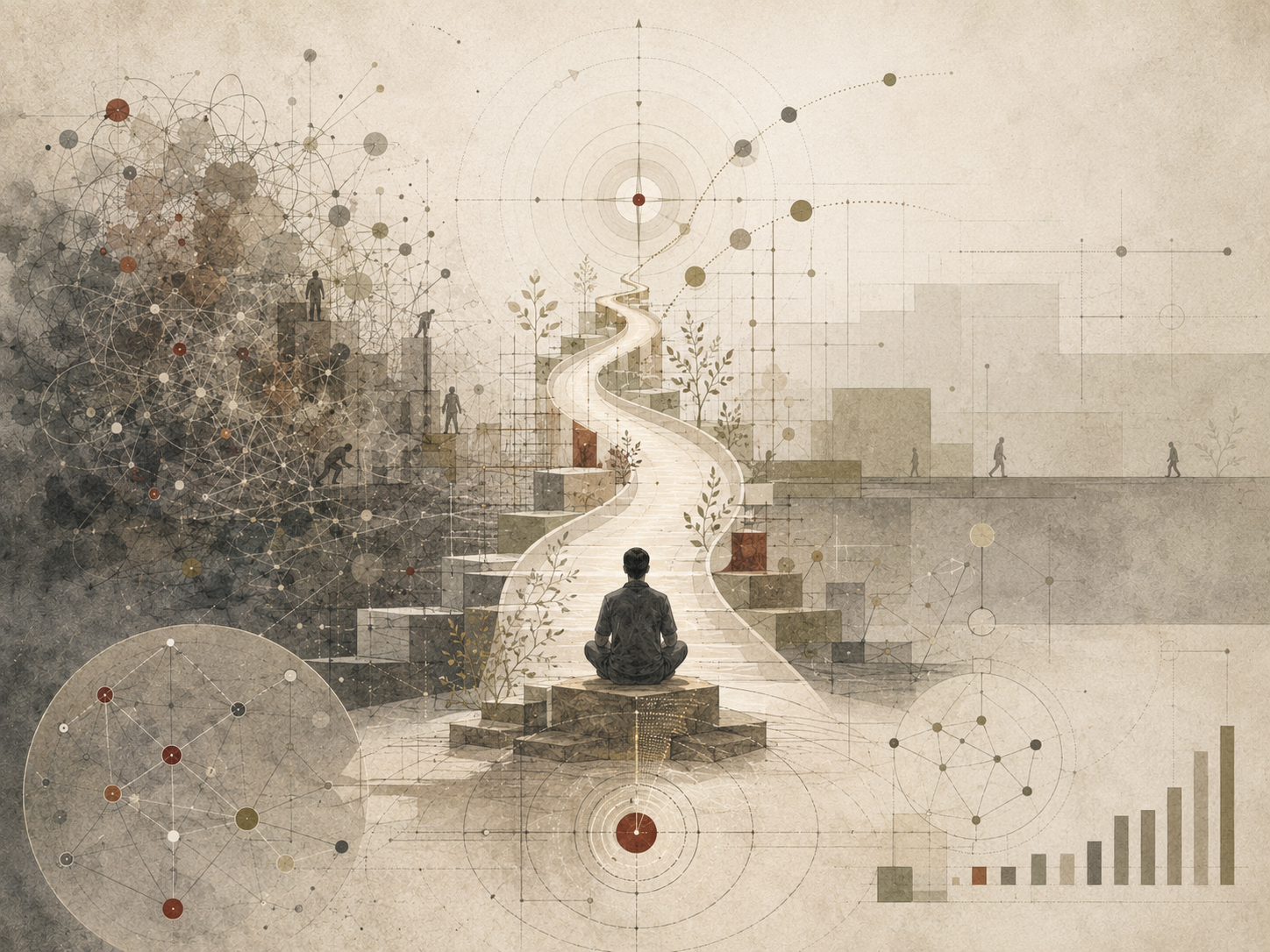
This article examines the intellectual origins of flow theory, the concept of optimal experience, the role of attention in structuring consciousness, the challenge-skill relationship, the connection between flow and intrinsic motivation, the role of flow in expertise and creativity, its place within the PERMA model of well-being, and the broader institutional and technological conditions that support or undermine deep engagement.
What Is Flow?
Flow is a state of deep absorption in which a person becomes fully involved in an activity that is challenging, structured, meaningful, and matched to their current level of skill. The person is not merely entertained. They are actively engaged. Attention narrows around the task, action and awareness become closely coordinated, feedback is processed rapidly, and the activity becomes rewarding in itself.
Csikszentmihalyi described flow as an optimal experience because it represents a high-quality organization of consciousness. Instead of being fragmented by distraction, anxiety, boredom, or self-conscious rumination, the mind becomes ordered around the activity at hand. The person knows what they are trying to do, receives feedback from the task, adjusts behavior in real time, and experiences the activity as intrinsically worthwhile.
Flow is often associated with activities such as music, sport, writing, programming, surgery, teaching, design, mathematics, scientific problem solving, craft, chess, dance, climbing, research, and deep reading. But flow is not limited to elite performers. A child building something, a student solving a problem, a nurse coordinating care, a gardener tending plants, or a cook preparing a difficult meal can also enter flow when challenge, skill, feedback, and attention align.
| Flow feature | Core meaning | Why it matters |
|---|---|---|
| Clear goals | The person knows what the activity requires | Directs attention and reduces ambiguity |
| Immediate feedback | The task provides information about progress | Allows real-time adjustment and learning |
| Challenge-skill balance | The task stretches ability without overwhelming it | Prevents boredom and anxiety |
| Deep concentration | Attention becomes focused on the activity | Reduces fragmentation and supports performance |
| Action-awareness merging | Thinking and doing feel closely integrated | Creates a sense of smooth, absorbed activity |
| Reduced self-consciousness | Attention shifts away from self-evaluation | Supports immersion and task-centered focus |
| Altered sense of time | Time may feel faster, slower, or less salient | Reflects changed attentional organization |
| Autotelic reward | The activity becomes rewarding in itself | Supports intrinsic motivation and sustained practice |
Flow is therefore not simply happiness. It is a form of engaged functioning. It may feel joyful, but its defining feature is not pleasure alone. Its defining feature is the deep organization of consciousness around a meaningful challenge.
The Intellectual Origins of Flow Theory
Flow theory emerged from Mihaly Csikszentmihalyi’s attempt to understand why certain activities feel intrinsically rewarding even when they are difficult, demanding, and not externally rewarded. Beginning in the 1960s, he conducted interviews with artists, athletes, musicians, scientists, and other individuals deeply engaged in skilled pursuits. Many described remarkably similar experiences of intense immersion in their work. During these moments, attention became completely focused, self-consciousness faded, and time seemed to pass differently. Actions unfolded smoothly despite requiring considerable effort and expertise.
These descriptions led Csikszentmihalyi to conceptualize the experience as flow, a metaphor reflecting the sense of being carried forward by the activity itself. The term captured both effort and ease: the activity was demanding, yet it seemed to unfold in an organized and self-sustaining way once attention, skill, and feedback became aligned.
Although flow theory emerged within modern psychology, its intellectual roots extend further back. William James emphasized the central role of attention in shaping human experience. John Dewey explored aesthetic experience, active engagement, and the meaningful organization of activity. Educational theorists examined how learning depends on active involvement rather than passive reception. Philosophers of art, craft, and practice had long observed that skillful activity can produce a distinctive form of absorption.
Csikszentmihalyi’s achievement was to synthesize these themes into a systematic psychological framework. Flow theory linked attention, skill, motivation, and subjective experience in a way that made deep engagement measurable, teachable, and applicable across domains.
| Intellectual influence | Key concern | Connection to flow theory |
|---|---|---|
| William James | Attention and consciousness | Flow depends on the disciplined organization of limited attention |
| John Dewey | Experience, activity, and education | Flow treats meaningful activity as structured, active, and developmental |
| Aesthetic theory | Absorption in artistic and creative experience | Flow explains why artistic practice can be intrinsically rewarding |
| Skill acquisition research | Practice, feedback, and mastery | Flow is supported by clear goals, feedback, and increasing competence |
| Positive psychology | Engagement, well-being, and flourishing | Flow becomes a central example of engaged well-being |
This was an important conceptual move because it shifted the study of well-being away from static states and toward lived processes. Flow concerns how consciousness is organized in action, not merely how people feel in retrospect.
Flow and Optimal Experience
Flow represents one of the clearest examples of what Csikszentmihalyi called optimal experience: moments when individuals function near the limits of their capabilities while experiencing deep involvement in the activity itself. Optimal experience differs from passive pleasure. It often requires effort, discipline, uncertainty, and sustained concentration. Yet individuals frequently describe such experiences as among the most rewarding in life.
This apparent paradox is central to the theory. Some of the most satisfying experiences in human life arise not from ease, rest, or passive enjoyment, but from full engagement in demanding activity. A meaningful musical performance, a stretch of concentrated writing, a challenging athletic contest, a difficult scientific problem, a complex engineering task, or a moment of absorbed teaching may be strenuous rather than relaxing, yet still feel profoundly worthwhile.
Flow therefore helps explain why flourishing cannot be reduced to comfort. Human beings are often at their best not when difficulty disappears, but when they are fully and skillfully engaged by worthwhile challenge.
| Experience type | Typical structure | Relationship to flow |
|---|---|---|
| Passive pleasure | Low effort, immediate reward, minimal challenge | May feel pleasant but does not necessarily organize attention deeply |
| Relaxation | Low demand, restoration, reduced stimulation | Important for well-being but distinct from optimal challenge |
| Flow | High engagement, clear goals, feedback, matched challenge and skill | Represents deep absorption in meaningful activity |
| Mastery practice | Effortful skill refinement, feedback, correction | May include flow when challenge remains well calibrated |
| Overload | High demand, insufficient skill, high stress | Often undermines flow by producing anxiety or fragmentation |
Optimal experience also has a temporal structure. It is not only about the moment of absorption. Repeated flow experiences can support long-term growth because people return to activities that are challenging but rewarding. Over time, this can deepen skill, identity, confidence, and commitment. The person does not merely enjoy the activity. They become shaped by it.
Attention and the Structure of Consciousness
At the core of flow theory lies a theory of attention. Human consciousness is shaped by the allocation of attentional resources. Because attention is limited, the quality of experience depends heavily on how it is structured. Flow occurs when attentional resources become fully organized around a single meaningful activity. Under these conditions, distractions diminish, cognitive resources become highly focused, and action and awareness merge into a unified process.
This organization of attention helps explain the distinctive phenomenology of flow. Individuals often report diminished self-reflection, reduced awareness of irrelevant concerns, and altered perceptions of time. The ordinary fragmentation of consciousness gives way to a more integrated mode of functioning in which thought and action become tightly coordinated.
From this perspective, flow represents an optimal configuration of attention. It is not merely a pleasant feeling layered onto activity. It is a specific way consciousness becomes ordered in relation to challenge, feedback, and purposeful effort.
| Attentional condition | Flow-supporting form | Flow-undermining form |
|---|---|---|
| Focus | Sustained attention on the task | Multitasking, interruption, context switching |
| Feedback | Clear information about progress | Ambiguous or delayed feedback |
| Self-awareness | Reduced self-conscious evaluation | Excessive self-monitoring, shame, performance anxiety |
| Time experience | Absorption changes temporal awareness | Clock-watching, impatience, fragmented duration |
| Cognitive load | Demand fits capacity | Overload, confusion, or under-stimulation |
| Environmental support | Protected space for uninterrupted engagement | Noise, surveillance, notifications, unnecessary meetings |
The attentional dimension of flow is especially important today. Many contemporary environments are designed to capture, divide, or monetize attention rather than protect it. Flow theory therefore has implications not only for individual psychology but also for technological design, educational structure, work organization, and civic life.
The Challenge-Skill Balance
One of the most widely cited elements of flow theory is the relationship between challenge and skill. Flow emerges when individuals confront tasks that stretch their abilities without overwhelming them. When challenge greatly exceeds skill, anxiety becomes likely. When skill greatly exceeds challenge, boredom tends to dominate. Flow therefore occurs in a dynamic equilibrium between challenge and competence.
This balance is developmentally important because it encourages individuals to pursue progressively more complex challenges as their skills increase. In this way, flow can function as a motivational engine for learning and mastery. Activities that sustain flow are rarely static. They demand adjustment, refinement, and continued growth.
The challenge-skill relationship also explains why flow is fragile. Too much difficulty can fragment attention through stress and self-doubt. Too little difficulty can collapse engagement into monotony. The conditions for flow must therefore be cultivated and recalibrated rather than assumed.
| Challenge level | Skill level | Likely experience | Flow implication |
|---|---|---|---|
| Low | Low | Apathy or disengagement | The activity lacks both stimulation and competence |
| Low | High | Boredom | The task no longer stretches capacity |
| High | Low | Anxiety or overwhelm | The person lacks the skill or support needed to meet demand |
| Moderate to high | Moderate to high | Flow or deep engagement | Challenge stretches skill without breaking attention |
| Very high | Very high | Expert performance or high-stakes absorption | Flow may occur if feedback and attentional conditions remain stable |
This model is especially useful in education and work design. A classroom that is too easy may produce boredom. A classroom that is too difficult may produce anxiety. A workplace that gives skilled people repetitive low-control tasks may undermine engagement. A workplace that demands constant output without support may produce stress rather than flow. In each case, the challenge-skill balance must be designed, monitored, and adjusted.
Flow and Intrinsic Motivation
Flow is closely linked to intrinsic motivation, the tendency to engage in activities because they are inherently interesting or satisfying. Research in Self-Determination Theory suggests that intrinsic motivation emerges when individuals experience autonomy, competence, and relatedness. Flow states often occur in contexts where individuals feel capable of meeting meaningful challenges and exercising agency over their actions.
Because the activity itself becomes rewarding, individuals are more likely to persist in demanding tasks and develop higher levels of expertise. This helps explain why flow is so important across domains of learning, craft, art, science, and sport. It is not simply a by-product of success. It is part of the experiential structure that makes sustained effort psychologically viable.
Flow therefore reveals a deeper principle about human flourishing: people are often most alive when activity is self-endorsed, skillfully challenging, and sufficiently meaningful to organize attention from within rather than through external compulsion alone.
| Motivational condition | Flow-supporting form | Flow-undermining form |
|---|---|---|
| Autonomy | The person experiences meaningful agency in the activity | Coercion, surveillance, arbitrary control |
| Competence | The person can meet and grow through the challenge | Persistent failure without support or feedback |
| Relatedness | The activity is connected to relationships, community, craft, or shared standards | Isolation, humiliation, or lack of recognition |
| Intrinsic interest | The activity is rewarding in itself | Purely external pressure or meaningless compliance |
| Task value | The activity matters to the person | Activity feels empty, arbitrary, or disconnected from values |
This does not mean that extrinsic rewards always destroy flow. People can be paid for meaningful work and still experience flow. The problem arises when external control, pressure, surveillance, or reward structures overwhelm the intrinsic structure of the activity. When people perform only for evaluation, status, fear, or compliance, attention often shifts away from the task and toward self-monitoring.
Flow and the Development of Expertise
Flow also plays a significant role in the development of expertise. Research on skill acquisition suggests that expert performance typically emerges through sustained practice within environments that provide clear feedback and progressively increasing challenge. These conditions closely resemble those that foster flow.
When individuals experience flow during practice or performance, they are more likely to maintain the sustained attention necessary for refinement, error correction, and complex learning. In this sense, flow may function as an experiential mechanism supporting long-term mastery. It helps explain why difficult practice can remain engaging when it is structured well, and why some learners continue advancing while others disengage.
Flow should not be confused with expertise itself. A novice can experience flow under suitable conditions, and an expert can work effectively without entering flow. But the theory offers a compelling account of how deep engagement may support the long arc of competence development.
| Expertise condition | Flow-related mechanism | Developmental implication |
|---|---|---|
| Deliberate practice | Clear goals and feedback focus attention | Skill improves through repeated correction |
| Progressive challenge | Tasks stretch capability without overwhelming it | Skill and challenge increase together |
| Error information | Feedback reveals what to adjust | Mistakes become part of learning rather than only failure |
| Identity investment | The activity becomes part of self-understanding | Persistence becomes more likely across years |
| Community of practice | Shared standards shape feedback and aspiration | Mastery becomes social, not only individual |
This connection between flow and expertise has an important caveat. Flow can feel smooth, while deliberate practice can feel difficult and effortful. Not all practice is flow. Sometimes growth requires awkwardness, frustration, correction, and conscious effort. The strongest learning environments allow both: moments of absorbed engagement and moments of deliberate reflection, feedback, and revision.
Flow, Creativity, and Innovation
Many creative processes depend on periods of deep immersion similar to those described in flow theory. Artists, composers, engineers, writers, designers, and scientists frequently report that their most productive work occurs during episodes of sustained concentration in which ideas develop rapidly and self-conscious evaluation temporarily recedes.
This relationship between creativity and immersion highlights the importance of environments that support focused engagement and intellectual exploration. Flow provides a psychological explanation for why creative work often requires uninterrupted time, meaningful difficulty, and freedom from excessive external pressures. Creativity frequently depends not only on talent or originality, but on the capacity to remain deeply involved with complex problems long enough for new forms to emerge.
In this respect, flow theory contributes to a broader understanding of innovation. Breakthroughs often arise not from scattered effort, but from organized attention sustained across time.
| Creative condition | Flow-supporting form | Risk when absent |
|---|---|---|
| Protected attention | Time and space for uninterrupted work | Fragmented output, shallow iteration, low originality |
| Meaningful difficulty | The problem is hard enough to matter | Routine execution without discovery |
| Skill depth | The creator has enough craft to explore freely | Ideas cannot be realized or tested effectively |
| Feedback | The work itself or a community provides useful response | Stagnation, drift, or uncorrected error |
| Autonomy | The creator can make meaningful decisions | Compliance replaces exploration |
| Incubation and reflection | Flow alternates with rest and evaluation | Absorption becomes overwork or fixation |
Flow is not the whole of creativity. Creative work also requires preparation, domain knowledge, criticism, revision, collaboration, evaluation, and sometimes boredom. But flow explains why deep immersion is so often part of the creative process. It is the state in which complex material can be held, manipulated, transformed, and brought into form.
Flow and the PERMA Model of Well-Being
Flow corresponds closely to the PERMA model of well-being, particularly the dimension of engagement. In the PERMA framework, flourishing involves more than positive emotion. Deep involvement in meaningful activities represents a distinct and essential component of well-being.
Flow helps explain why some of the most fulfilling experiences in life occur during sustained effort rather than leisure or relaxation. It also clarifies why engagement deserves its own place in a multidimensional account of flourishing. A person may have pleasure without flow, and flow without simple pleasure. What engagement captures is the quality of immersion in action.
| PERMA dimension | Connection to flow | Interpretive note |
|---|---|---|
| Positive emotion | Flow may produce joy, satisfaction, or vitality | Flow is not reducible to pleasant feeling |
| Engagement | Flow is one of the clearest examples of deep engagement | Engagement concerns absorption in activity |
| Relationships | Shared flow may occur in teams, music, sport, teaching, or conversation | Flow can be social as well as individual |
| Meaning | Flow is stronger when activities matter | Meaning gives engagement significance beyond absorption |
| Accomplishment | Flow can support learning, mastery, and performance | Achievement is strengthened when effort becomes absorbing |
This is one reason flow remains central to positive psychology. It gives the field a way of describing how disciplined attention, challenge, and activity contribute to flourishing alongside emotion, relationships, meaning, and accomplishment.
Measuring Flow and Optimal Experience
Flow can be studied through self-report scales, experience sampling, diary methods, behavioral indicators, task-performance data, physiological measures, and observational designs. Each method captures a different part of the phenomenon. Because flow is a dynamic state rather than a stable trait alone, measurement should attend to timing, context, task structure, and within-person variation.
Experience sampling has been especially influential because it asks participants to report their current experience during everyday life. This approach fits flow theory because flow occurs in specific activity contexts. A person may experience flow during music practice but not during administrative work, or during teaching but not during grading. Measuring flow only as a general trait can miss this contextual specificity.
Self-report instruments often assess concentration, challenge-skill balance, clear goals, feedback, reduced self-consciousness, altered time perception, and autotelic experience. These dimensions are useful, but they require careful interpretation. People may retrospectively overstate flow in activities they value. They may also underreport flow if they lack language for deep engagement or if cultural expectations shape how absorption is described.
| Measurement approach | What it captures | Limitation |
|---|---|---|
| Flow scales | Self-reported flow dimensions | May be affected by memory, interpretation, and social desirability |
| Experience sampling | Flow-like states in real time across daily life | Can interrupt the very experience being measured |
| Diary methods | Patterns of engagement across days or sessions | Depends on participant consistency and reflection |
| Behavioral data | Persistence, performance, error correction, time on task | Cannot fully capture subjective absorption |
| Physiological measures | Arousal, effort, attention, stress signals | Physiology does not map cleanly onto flow by itself |
| Qualitative interviews | Rich descriptions of absorption and meaning | Less standardized and more interpretive |
A strong measurement design should separate flow conditions from flow experience and flow outcomes. Challenge-skill balance, feedback, autonomy, and distraction load are conditions. Absorption, concentration, altered time, and autotelic reward are experiential features. Learning, performance, persistence, creativity, and well-being are possible outcomes. Collapsing all three into one score can make interpretation unclear.
Applications Across Domains
Flow theory has influenced research and practice across numerous fields. In education, learning environments that balance challenge and skill can foster deeper engagement and intellectual development. In sport psychology, athletes often seek conditions that allow attention to remain fully focused on performance rather than on self-conscious evaluation or distraction.
In organizational psychology, job design and leadership strategies increasingly incorporate flow-related principles to support engagement, creativity, and productivity. Work that provides autonomy, clear goals, immediate feedback, and appropriate challenge is more likely to support sustained immersion. In creative and technical fields, flow has become especially important as a framework for understanding deep work, concentration, and cognitively demanding performance.
Across these domains, the central insight remains the same: environments that enable deep engagement tend to produce both higher-quality performance and a more meaningful experience of activity itself.
| Domain | Flow-supporting design | Responsible-use concern |
|---|---|---|
| Education | Appropriate challenge, formative feedback, autonomy, active learning | Do not confuse flow with constant stimulation or pressure |
| Work | Clear goals, skill use, autonomy, feedback, protected focus time | Do not use flow language to justify overwork or surveillance |
| Sport | Skill-challenge calibration, embodied feedback, performance routines | Do not ignore injury, burnout, or unhealthy identity pressure |
| Creative practice | Uninterrupted time, meaningful difficulty, iterative feedback | Do not romanticize isolation or exhaustion |
| Technology design | Interfaces that support focus, feedback, learning, and agency | Distinguish flow from addictive engagement or attention capture |
| Healthcare and training | Simulation, feedback, mastery progression, attentional discipline | Do not create unsafe challenge levels or punitive feedback loops |
The most responsible applications of flow theory do not simply ask people to concentrate harder. They redesign conditions so that attention can be protected, challenge can be calibrated, feedback can be useful, and the activity can become meaningful enough to sustain engagement.
Institutions, Technology, and the Ecology of Attention
Flow is often described as an individual state, but it depends heavily on environmental conditions. Schools, workplaces, digital platforms, families, studios, laboratories, sports teams, hospitals, and civic institutions all shape whether deep engagement is possible. They distribute time, autonomy, feedback, challenge, interruption, recognition, and control.
An institution that constantly interrupts people will make flow harder. A classroom that gives students no meaningful feedback will make flow harder. A workplace that treats every task as urgent will make flow harder. A digital platform that monetizes distraction will make flow harder. A culture that equates productivity with visible busyness will make flow harder.
This means flow has an ecology. It depends on how attention is protected or exploited, how challenge is calibrated, how skill is developed, and how feedback is structured. It also depends on whether people have the resources, safety, and autonomy needed to become deeply engaged.
| Ecological layer | Flow-supporting condition | Flow-undermining condition |
|---|---|---|
| Personal | Skill, interest, attention habits, self-regulation | Fatigue, anxiety, low skill, chronic distraction |
| Task | Clear goals, feedback, challenge-skill fit | Ambiguity, meaningless repetition, chaotic demand |
| Relational | Trust, coaching, shared standards, psychological safety | Humiliation, excessive evaluation, interpersonal threat |
| Institutional | Autonomy, focus time, fair workload, skill development | Surveillance, interruption, arbitrary control, overload |
| Technological | Tools that support focus and feedback | Notifications, addictive design, shallow engagement metrics |
| Structural | Security, access, time, education, resources | Precarity, exclusion, instability, chronic stress |
A serious flow framework must therefore ask not only whether a person is capable of flow, but whether the setting permits it. Deep engagement is not merely a personal achievement. It is also an institutional and cultural accomplishment.
Critiques and Theoretical Debates
Despite its influence, flow theory has generated several important critiques. Some scholars argue that opportunities for flow depend heavily on social and economic conditions. Individuals facing precarious work, surveillance-heavy environments, instability, chronic insecurity, unsafe schools, disability barriers, or poorly designed jobs may have fewer opportunities to engage in activities that foster sustained immersion. Flow can therefore be unevenly distributed across institutions and social classes rather than available on equal terms.
Others note that intense engagement can sometimes obscure the need for rest, reflection, or relationships. In extreme cases, the pursuit of flow may contribute to overwork, workaholism, burnout, or unhealthy forms of obsessive absorption. An activity can be deeply engaging without being good for the whole person or the surrounding community.
There is also a technological critique. Digital platforms can create highly absorbing experiences that resemble flow but are oriented toward capture rather than growth. Games, feeds, and apps may produce immersion, feedback, and time distortion, but that does not automatically mean they support flourishing. Flow must be distinguished from addictive engagement, compulsive use, and attention extraction.
Methodological questions also remain regarding how best to measure flow. Many studies rely on self-report or experience sampling methods, which are informative but may not fully capture the complexity and temporal texture of the phenomenon.
| Critique | Risk | Responsible response |
|---|---|---|
| Individualism | Treating flow as personal mindset while ignoring institutional barriers | Measure autonomy, workload, resources, and environmental support |
| Overwork | Using flow language to celebrate unhealthy absorption | Pair engagement with rest, boundaries, and whole-person well-being |
| Attention capture | Confusing addictive digital immersion with flourishing | Distinguish growth-oriented engagement from exploitative design |
| Measurement limits | Overreliance on retrospective self-report | Use mixed methods, experience sampling, behavioral data, and context measures |
| Unequal access | Ignoring class, disability, safety, and educational opportunity | Treat flow as distributed through social and institutional conditions |
| Value neutrality | Assuming any absorbing activity is beneficial | Evaluate the ethical, developmental, and relational quality of the activity |
These debates do not nullify the theory. They refine it by reminding us that deep engagement operates within broader social, institutional, bodily, and technological contexts. Flow is powerful, but it is not the whole of flourishing.
Flow and the Future of Human Work
In contemporary economies increasingly shaped by knowledge work, digital technology, automation, and complex problem solving, the concept of flow has gained renewed relevance. Many modern occupations, from software development to research to design and writing, depend on sustained concentration and complex cognition. Environments that support uninterrupted engagement may therefore become increasingly important for productivity, learning, creativity, and responsible innovation.
At the same time, the digital attention economy poses direct challenges to flow. Constant notifications, fragmented work environments, context switching, algorithmically optimized distractions, and performance dashboards can undermine the sustained attention necessary for deep engagement. This makes flow theory especially relevant to the design of workplaces, educational systems, digital tools, and professional cultures.
Understanding the conditions that foster flow may therefore become more important, not less, in the coming decades. The theory is now as much about institutional design and attentional ecology as it is about individual experience.
| Future challenge | Flow-theory insight | Design implication |
|---|---|---|
| AI-assisted work | Automation may reduce drudgery but also fragment agency | Design tools that preserve human judgment, skill, and deep engagement |
| Remote and hybrid work | Focus can improve or deteriorate depending on norms | Protect uninterrupted work blocks and reduce unnecessary meetings |
| Education technology | Digital systems can scaffold learning or distract from it | Prioritize feedback, challenge calibration, and student agency |
| Creative labor | Original work depends on sustained attention | Build cultures that value depth rather than constant availability |
| Attention economy | Platforms often monetize distraction | Design ethical tools that support focus and reflective agency |
| Burnout and overload | Flow is not the same as endless work | Balance engagement with rest, recovery, and human limits |
The future of flow is therefore not only about helping individuals “focus better.” It is about designing environments where meaningful attention remains possible.
A Semi-Formal Framework for Flow
Flow can be expressed semi-formally as a state of deep engagement emerging when challenge, skill, and attentional organization align. Let flow intensity at time \(t\) be represented as:
F_t = \alpha_1 B_t + \alpha_2 A_t + \alpha_3 M_t + \alpha_4 G_t + \alpha_5 R_t – \alpha_6 D_t + \varepsilon_t
\]
Interpretation: Flow \(F_t\) depends on challenge-skill balance \(B_t\), attentional concentration \(A_t\), task meaning \(M_t\), goal clarity \(G_t\), feedback quality \(R_t\), and distraction load \(D_t\). The model captures the idea that flow depends on alignment rather than one factor alone.
The challenge-skill relationship can be modeled more explicitly as:
B_t = L_t – |C_t – S_t|
\]
Interpretation: Challenge-skill balance \(B_t\) is strongest when challenge \(C_t\) and skill \(S_t\) are close together at a sufficiently high level \(L_t\). Flow is not produced by easy tasks; it emerges when challenge and skill are both meaningfully engaged.
Attentional fragmentation can be represented as:
A_t = \delta_1 Focus_t + \delta_2 Feedback_t – \delta_3 Interruptions_t – \delta_4 SelfMonitoring_t
\]
Interpretation: Attentional concentration \(A_t\) increases with focus and useful feedback, but decreases with interruptions and excessive self-monitoring.
Developmental accumulation can be represented as:
E_{t+1} = E_t + \beta_1 F_t + \beta_2 P_t + \beta_3 Feedback_t – \beta_4 Burnout_t + u_t
\]
Interpretation: Expertise \(E_{t+1}\) may grow through flow, sustained practice \(P_t\), and feedback, while being reduced or disrupted by burnout. This reflects the theory’s wider implication that repeated flow-conducive engagement can support long-term skill development.
A context-sensitive model can be expressed as:
F^{context}_t = f(B_t, A_t, M_t, G_t, R_t, Autonomy_t) – X_t
\]
Interpretation: Context-sensitive flow depends on balance, attention, meaning, goals, feedback, and autonomy, while being reduced by contextual friction \(X_t\), such as surveillance, overload, noise, instability, or attention-capturing technology.
These equations do not reduce flow to mathematics. They clarify the structure of the theory: flow is dynamic, attention-dependent, skill-sensitive, feedback-dependent, and context-shaped.
Data Design and Measurement Notes
A serious evaluation of flow should measure more than a single flow score. It should distinguish task conditions, subjective experience, performance outcomes, environmental support, and responsible-use context.
| Domain | Example variables | Interpretive role |
|---|---|---|
| Task challenge | Difficulty, complexity, novelty, stakes | Shows whether the activity stretches skill |
| Skill level | Competence, training, prior experience, self-efficacy | Shows whether the person can meet the challenge |
| Balance | Challenge-skill fit, adaptive difficulty | Captures a central condition for flow |
| Attention | Focus, concentration, interruption rate, cognitive load | Captures the structure of consciousness during the activity |
| Feedback | Immediacy, clarity, usefulness, correction quality | Shows whether the person can adjust action in real time |
| Autonomy | Choice, control, agency, self-endorsement | Connects flow to intrinsic motivation |
| Meaning | Task value, identity relevance, contribution, purpose | Distinguishes deep engagement from empty absorption |
| Distraction | Notifications, interruptions, noise, surveillance, context switching | Captures attentional friction |
| Outcomes | Learning, performance, creativity, persistence, well-being | Shows what flow may support over time |
| Recovery | Rest, fatigue, burnout, boundaries | Prevents flow from being confused with endless exertion |
Several design principles follow:
- Separate conditions, experience, and outcomes. Challenge-skill balance is not the same as subjective flow, and flow is not the same as later performance.
- Measure within-person variation. Flow often changes by activity, session, time of day, environment, and skill level.
- Include distraction and interruption data. Attentional ecology is central to modern flow research.
- Measure autonomy and meaning. Absorption without agency or value can become capture rather than flourishing.
- Include fatigue and recovery. Flow should not be interpreted apart from human limits.
- Use mixed methods where possible. Qualitative descriptions can capture the texture of absorption better than scales alone.
The purpose of measurement is not simply to maximize engagement. It is to understand when deep engagement supports learning, mastery, creativity, well-being, and meaningful participation.
R: Modeling Flow, Skill, and Performance Over Time
The following R workflow illustrates how a researcher might model flow as a function of challenge-skill balance, attention, feedback, autonomy, meaning, and distraction in repeated-measures data. It also estimates whether flow predicts later performance growth while accounting for fatigue and recovery.
# Flow and optimal experience longitudinal modeling workflow
#
# Purpose:
#   Model flow as a function of challenge-skill balance,
#   attention, feedback, task meaning, autonomy, distraction,
#   fatigue, and recovery.
#
# Notes:
#   This workflow is for research, teaching, and exploratory analysis.
#   It is not a clinical, diagnostic, therapeutic, employment-selection,
#   workplace-screening, student-ranking, productivity-surveillance,
#   or individual assessment tool.

library(tidyverse)
library(lme4)
library(lmerTest)
library(broom.mixed)
library(emmeans)
library(performance)

# Expected columns:
# id, session, domain,
# challenge_level, skill_level, attention_focus,
# feedback_quality, goal_clarity, task_meaning,
# autonomy_support, distraction_load, interruption_count,
# flow_score, performance_score, learning_gain,
# fatigue_score, recovery_quality, wellbeing_score

df <- read_csv("data/flow_optimal_experience_panel.csv")

panel <- df %>%
  mutate(
    id = as.factor(id),
    session = as.integer(session),
    domain = as.factor(domain)
  ) %>%
  filter(complete.cases(
    challenge_level,
    skill_level,
    attention_focus,
    feedback_quality,
    goal_clarity,
    task_meaning,
    autonomy_support,
    distraction_load,
    interruption_count,
    flow_score,
    performance_score,
    learning_gain,
    fatigue_score,
    recovery_quality,
    wellbeing_score
  )) %>%
  mutate(
    session_c = as.numeric(scale(session, center = TRUE, scale = FALSE)),
    challenge_c = as.numeric(scale(challenge_level, center = TRUE, scale = FALSE)),
    skill_c = as.numeric(scale(skill_level, center = TRUE, scale = FALSE)),
    attention_c = as.numeric(scale(attention_focus, center = TRUE, scale = FALSE)),
    feedback_c = as.numeric(scale(feedback_quality, center = TRUE, scale = FALSE)),
    clarity_c = as.numeric(scale(goal_clarity, center = TRUE, scale = FALSE)),
    meaning_c = as.numeric(scale(task_meaning, center = TRUE, scale = FALSE)),
    autonomy_c = as.numeric(scale(autonomy_support, center = TRUE, scale = FALSE)),
    distraction_c = as.numeric(scale(distraction_load, center = TRUE, scale = FALSE)),
    interruption_c = as.numeric(scale(interruption_count, center = TRUE, scale = FALSE)),
    fatigue_c = as.numeric(scale(fatigue_score, center = TRUE, scale = FALSE)),
    recovery_c = as.numeric(scale(recovery_quality, center = TRUE, scale = FALSE)),
    balance_index = -abs(challenge_c - skill_c),
    attentional_ecology =
      attention_focus +
      feedback_quality +
      goal_clarity -
      distraction_load -
      interruption_count,
    deep_engagement_context =
      balance_index +
      attention_c +
      feedback_c +
      clarity_c +
      meaning_c +
      autonomy_c -
      distraction_c -
      interruption_c
  )

model_flow <- lmer(
  flow_score ~
    session_c +
    balance_index +
    attention_c +
    feedback_c +
    clarity_c +
    meaning_c +
    autonomy_c -
    distraction_c -
    interruption_c -
    fatigue_c +
    recovery_c +
    balance_index:attention_c +
    meaning_c:autonomy_c +
    (1 + session_c | id),
  data = panel,
  REML = FALSE
)

model_performance <- lmer(
  performance_score ~
    session_c +
    flow_score +
    balance_index +
    attention_c +
    feedback_c +
    learning_gain -
    distraction_c -
    fatigue_c +
    recovery_c +
    (1 + session_c | id),
  data = panel,
  REML = FALSE
)

model_wellbeing <- lmer(
  wellbeing_score ~
    session_c +
    flow_score +
    task_meaning +
    autonomy_support +
    recovery_quality -
    fatigue_score -
    distraction_load +
    flow_score:recovery_quality +
    (1 + session_c | id),
  data = panel,
  REML = FALSE
)

summary(model_flow)
summary(model_performance)
summary(model_wellbeing)

performance::check_model(model_flow)
performance::check_model(model_performance)
performance::check_model(model_wellbeing)

emm_flow_balance_attention <- emmeans(
  model_flow,
  ~ balance_index | attention_c,
  at = list(
    balance_index = c(-1, 0, 1),
    attention_c = c(-1, 0, 1),
    feedback_c = 0,
    clarity_c = 0,
    meaning_c = 0,
    autonomy_c = 0,
    distraction_c = 0,
    interruption_c = 0,
    fatigue_c = 0,
    recovery_c = 0,
    session_c = 0
  )
)

emm_flow_distraction <- emmeans(
  model_flow,
  ~ attention_c | distraction_c,
  at = list(
    attention_c = c(-1, 0, 1),
    distraction_c = c(-1, 0, 1),
    balance_index = 0,
    feedback_c = 0,
    clarity_c = 0,
    meaning_c = 0,
    autonomy_c = 0,
    interruption_c = 0,
    fatigue_c = 0,
    recovery_c = 0,
    session_c = 0
  )
)

emm_wellbeing_recovery <- emmeans(
  model_wellbeing,
  ~ flow_score | recovery_quality,
  at = list(
    flow_score = quantile(panel$flow_score, probs = c(0.25, 0.50, 0.75), na.rm = TRUE),
    recovery_quality = quantile(panel$recovery_quality, probs = c(0.25, 0.50, 0.75), na.rm = TRUE),
    task_meaning = mean(panel$task_meaning, na.rm = TRUE),
    autonomy_support = mean(panel$autonomy_support, na.rm = TRUE),
    fatigue_score = mean(panel$fatigue_score, na.rm = TRUE),
    distraction_load = mean(panel$distraction_load, na.rm = TRUE),
    session_c = 0
  )
)

dir.create("outputs", showWarnings = FALSE)

write_csv(
  broom.mixed::tidy(model_flow, effects = "fixed", conf.int = TRUE),
  "outputs/flow_model_fixed_effects.csv"
)

write_csv(
  broom.mixed::tidy(model_performance, effects = "fixed", conf.int = TRUE),
  "outputs/flow_performance_fixed_effects.csv"
)

write_csv(
  broom.mixed::tidy(model_wellbeing, effects = "fixed", conf.int = TRUE),
  "outputs/flow_wellbeing_fixed_effects.csv"
)

write_csv(
  as.data.frame(emm_flow_balance_attention),
  "outputs/flow_balance_by_attention_margins.csv"
)

write_csv(
  as.data.frame(emm_flow_distraction),
  "outputs/flow_attention_by_distraction_margins.csv"
)

write_csv(
  as.data.frame(emm_wellbeing_recovery),
  "outputs/flow_wellbeing_by_recovery_margins.csv"
)

domain_summary <- panel %>%
  group_by(domain) %>%
  summarize(
    mean_challenge = mean(challenge_level, na.rm = TRUE),
    mean_skill = mean(skill_level, na.rm = TRUE),
    mean_attention = mean(attention_focus, na.rm = TRUE),
    mean_feedback = mean(feedback_quality, na.rm = TRUE),
    mean_goal_clarity = mean(goal_clarity, na.rm = TRUE),
    mean_task_meaning = mean(task_meaning, na.rm = TRUE),
    mean_autonomy = mean(autonomy_support, na.rm = TRUE),
    mean_distraction = mean(distraction_load, na.rm = TRUE),
    mean_interruptions = mean(interruption_count, na.rm = TRUE),
    mean_flow = mean(flow_score, na.rm = TRUE),
    mean_performance = mean(performance_score, na.rm = TRUE),
    mean_learning_gain = mean(learning_gain, na.rm = TRUE),
    mean_fatigue = mean(fatigue_score, na.rm = TRUE),
    mean_recovery = mean(recovery_quality, na.rm = TRUE),
    mean_wellbeing = mean(wellbeing_score, na.rm = TRUE),
    .groups = "drop"
  )

write_csv(
  domain_summary,
  "outputs/flow_domain_summary.csv"
)
This workflow is useful because it separates the conditions that make flow more likely from the later outcomes flow may help support, such as stronger performance, learning, creativity, and well-being. It also includes fatigue and recovery so that flow is not misinterpreted as an argument for endless exertion.
Python: Network Analysis of Flow Dynamics
The following Python example treats flow as part of a connected system of challenge, skill, attention, feedback, meaning, autonomy, distraction, fatigue, recovery, performance, learning, and well-being rather than as a single isolated score.
"""
Flow and optimal experience network workflow

Purpose:
    Estimate a sparse network of flow variables using partial correlations,
    then summarize centrality, edge structure, and context-sensitive
    engagement indices.

Use:
    Research, teaching, exploratory systems analysis, education design,
    work-design research, creativity research, and attention ecology research.

Not for:
    Clinical diagnosis, therapeutic decision-making, employment selection,
    workplace screening, productivity surveillance, student ranking,
    benefits decisions, or individual psychological assessment.
"""

from pathlib import Path

import matplotlib.pyplot as plt
import networkx as nx
import numpy as np
import pandas as pd

from sklearn.covariance import GraphicalLassoCV
from sklearn.decomposition import PCA
from sklearn.impute import SimpleImputer
from sklearn.preprocessing import StandardScaler

DATA_PATH = Path("data/flow_optimal_experience_network.csv")
OUTPUT_DIR = Path("outputs")
OUTPUT_DIR.mkdir(exist_ok=True)

cols = [
    "challenge_level",
    "skill_level",
    "attention_focus",
    "feedback_quality",
    "goal_clarity",
    "task_meaning",
    "autonomy_support",
    "distraction_load",
    "interruption_count",
    "flow_score",
    "performance_score",
    "learning_gain",
    "fatigue_score",
    "recovery_quality",
    "wellbeing_score",
]

df = pd.read_csv(DATA_PATH)

missing_cols = [col for col in cols if col not in df.columns]
if missing_cols:
    raise ValueError(f"Missing expected columns: {missing_cols}")

imputer = SimpleImputer(strategy="median")
X = pd.DataFrame(imputer.fit_transform(df[cols]), columns=cols)

scaler = StandardScaler()
X_scaled = pd.DataFrame(scaler.fit_transform(X), columns=cols)

X_scaled["balance_index"] = -(
    X_scaled["challenge_level"] - X_scaled["skill_level"]
).abs()

X_scaled["attentional_ecology"] = (
    X_scaled["attention_focus"] +
    X_scaled["feedback_quality"] +
    X_scaled["goal_clarity"] -
    X_scaled["distraction_load"] -
    X_scaled["interruption_count"]
)

X_scaled["deep_engagement_context"] = (
    X_scaled["balance_index"] +
    X_scaled["attention_focus"] +
    X_scaled["feedback_quality"] +
    X_scaled["goal_clarity"] +
    X_scaled["task_meaning"] +
    X_scaled["autonomy_support"] -
    X_scaled["distraction_load"] -
    X_scaled["interruption_count"]
)

X_scaled["sustainable_flow_index"] = (
    X_scaled["flow_score"] +
    X_scaled["task_meaning"] +
    X_scaled["autonomy_support"] +
    X_scaled["recovery_quality"] -
    X_scaled["fatigue_score"] -
    X_scaled["distraction_load"]
)

glasso = GraphicalLassoCV()
glasso.fit(X_scaled[cols])

precision = glasso.precision_
partial_corr = -precision / np.sqrt(np.outer(np.diag(precision), np.diag(precision)))
np.fill_diagonal(partial_corr, 0)

partial_df = pd.DataFrame(partial_corr, index=cols, columns=cols)

threshold = 0.08
G = nx.Graph()

for node in cols:
    G.add_node(node)

for i, source in enumerate(cols):
    for j, target in enumerate(cols):
        if j > i:
            weight = partial_df.iloc[i, j]
            if abs(weight) >= threshold:
                G.add_edge(source, target, weight=weight)

degree = nx.degree_centrality(G)
betweenness = nx.betweenness_centrality(G, weight="weight")

try:
    eigenvector = nx.eigenvector_centrality_numpy(G, weight="weight")
except nx.NetworkXException:
    eigenvector = {node: np.nan for node in G.nodes()}

centrality = pd.DataFrame({
    "node": list(G.nodes()),
    "degree_centrality": [degree[node] for node in G.nodes()],
    "betweenness_centrality": [betweenness[node] for node in G.nodes()],
    "eigenvector_centrality": [eigenvector[node] for node in G.nodes()],
}).sort_values(
    ["eigenvector_centrality", "degree_centrality"],
    ascending=False
)

edge_table = pd.DataFrame([
    {
        "source": source,
        "target": target,
        "partial_correlation": data["weight"],
        "absolute_weight": abs(data["weight"]),
        "sign": "positive" if data["weight"] > 0 else "negative",
    }
    for source, target, data in G.edges(data=True)
]).sort_values("absolute_weight", ascending=False)

pca = PCA(n_components=4)
pca.fit(X_scaled[cols])

pca_summary = pd.DataFrame({
    "component": [1, 2, 3, 4],
    "variance_explained": pca.explained_variance_ratio_,
    "cumulative_variance_explained": np.cumsum(pca.explained_variance_ratio_),
})

centrality.to_csv(OUTPUT_DIR / "flow_network_centrality.csv", index=False)
edge_table.to_csv(OUTPUT_DIR / "flow_network_edges.csv", index=False)
partial_df.to_csv(OUTPUT_DIR / "flow_partial_correlations.csv")
pca_summary.to_csv(OUTPUT_DIR / "flow_pca_summary.csv", index=False)
X_scaled.to_csv(OUTPUT_DIR / "flow_scaled_indices.csv", index=False)

print("\nCentrality summary:")
print(centrality)

print("\nStrongest edges:")
print(edge_table.head(15))

plt.figure(figsize=(12, 9))
pos = nx.spring_layout(G, seed=42, k=0.85)

positive_edges = [(u, v) for u, v in G.edges() if G[u][v]["weight"] > 0]
negative_edges = [(u, v) for u, v in G.edges() if G[u][v]["weight"] < 0]

nx.draw_networkx_nodes(G, pos, node_size=1800)
nx.draw_networkx_labels(G, pos, font_size=8)

nx.draw_networkx_edges(
    G,
    pos,
    edgelist=positive_edges,
    width=[abs(G[u][v]["weight"]) * 5 for u, v in positive_edges],
    alpha=0.75,
)

nx.draw_networkx_edges(
    G,
    pos,
    edgelist=negative_edges,
    width=[abs(G[u][v]["weight"]) * 5 for u, v in negative_edges],
    style="dashed",
    alpha=0.75,
)

plt.title("Partial Correlation Network of Flow and Optimal Experience Variables")
plt.axis("off")
plt.tight_layout()
plt.savefig(OUTPUT_DIR / "flow_network.png", dpi=300)
plt.close()
This type of analysis can reveal whether attention, challenge-skill balance, feedback quality, autonomy, meaning, recovery, or distraction control functions as the more central leverage point in a given setting. That matters because interventions to support flow may need to target task design, attentional ecology, skill development, autonomy, recovery, or institutional conditions differently depending on where the system is breaking down.
Network models should not be interpreted as causal proof. They are exploratory tools for identifying patterns that may deserve longitudinal testing, qualitative interpretation, experimental follow-up, or institutional analysis.
Interpretation and Responsible Use
Flow is a powerful concept, which means it can be misused. Schools, workplaces, platforms, and performance systems may invoke flow to justify constant engagement, endless productivity, surveillance, gamification, or emotional capture. That is not a responsible use of the theory. Flow supports flourishing only when engagement is connected to agency, meaning, skill development, ethical design, rest, and whole-person well-being.
The code examples above are designed for research, teaching, exploratory modeling, and flow-system analysis. They should not be used as clinical diagnostic instruments, therapeutic decision tools, workplace-screening systems, employment-selection tools, student-ranking systems, productivity-surveillance tools, employee-evaluation systems, benefits eligibility tools, or individual psychological assessments.
Several principles follow:
- Do not confuse flow with productivity maximization. Flow concerns meaningful engagement, not extracting more output from people.
- Do not ignore rest and recovery. Deep engagement must be balanced with human limits.
- Distinguish flow from attention capture. Addictive or compulsive immersion is not the same as flourishing.
- Measure autonomy and meaning. Absorption without agency or value can become exploitation.
- Assess institutional conditions. Flow depends on time, safety, feedback, resources, and fair design.
- Protect privacy. Attention, performance, engagement, and productivity data can be sensitive and easily misused.
- Use findings to improve environments. Flow research should support better education, work, creativity, learning, and humane technology design.
A responsible flow framework treats deep engagement as a human good, not merely a management tool. It asks how people can become fully involved in meaningful activity without being exploited, monitored, exhausted, or manipulated.
GitHub Repository
The companion repository for this article organizes the R, Python, data-schema, and documentation materials into a reproducible workflow for flow and optimal experience research. It includes sample data dictionaries, scripts for longitudinal flow modeling, network-analysis outputs, validation notes, and guidance for responsible interpretation.
Complete Code Repository
Access the full companion repository for this article, including reproducible analysis materials, R and Python workflows, data-schema documentation, validation notes, and network-modeling examples for flow and optimal experience research.
Conclusion
Flow and optimal experience provide one of the most compelling accounts in modern psychology of how individuals become deeply engaged in meaningful activity. By identifying the conditions under which challenge, skill, attention, feedback, and intrinsic motivation converge, flow theory helps explain why certain forms of effort feel profoundly rewarding and developmentally significant.
Its enduring contribution lies in demonstrating that human flourishing depends not only on feeling good but also on becoming fully involved in activities that cultivate skill, purpose, attention, and engagement. Flow shows that some of the best moments in life are not moments of ease, but moments when difficulty becomes organized, skill becomes active, and consciousness becomes fully present to what is being done.
At the same time, flow must be interpreted within context. Deep engagement depends on institutions, technologies, time, autonomy, safety, feedback, rest, and access to meaningful activity. It can be cultivated responsibly, but it can also be distorted into overwork, surveillance, or attention capture.
A mature positive psychology of flow therefore asks not only how individuals can enter flow, but what kinds of environments make deep human attention possible. In an age increasingly defined by distraction, fragmentation, and over-stimulation, that question is no longer optional. It is central to the future of learning, work, creativity, and human flourishing.
Related articles
- Positive Psychology article map
- The PERMA Model of Well-Being
- Self-Determination Theory in Positive Psychology
- Meaning and Purpose in Positive Psychology
- Hope Theory in Positive Psychology
- Positive Education
- Character Strengths and Virtues in Positive Psychology
- Hedonic vs. Eudaimonic Well-Being
- The Science of Flourishing
Further reading
- Csikszentmihalyi, M. (1990) Flow: The Psychology of Optimal Experience. New York: Harper & Row.
- Csikszentmihalyi, M. (1997) Finding Flow: The Psychology of Engagement with Everyday Life. New York: Basic Books.
- Csikszentmihalyi, M. (2014) Applications of Flow in Human Development and Education. Dordrecht: Springer.
- Engeser, S. (ed.) (2012) Advances in Flow Research. New York: Springer.
- Nakamura, J. and Csikszentmihalyi, M. (2002) ‘The concept of flow’, in Snyder, C.R. and Lopez, S.J. (eds.) Handbook of Positive Psychology. New York: Oxford University Press.
- Peterson, C. (2006) A Primer in Positive Psychology. New York: Oxford University Press.
- Ryan, R.M. and Deci, E.L. (2000) ‘Intrinsic and extrinsic motivations: Classic definitions and new directions’, Contemporary Educational Psychology, 25(1), pp. 54–67.
- Seligman, M.E.P. (2011) Flourish. New York: Free Press.
References
- Csikszentmihalyi, M. (1990) Flow: The Psychology of Optimal Experience. New York: Harper & Row.
- Csikszentmihalyi, M. (1997) Finding Flow: The Psychology of Engagement with Everyday Life. New York: Basic Books.
- Csikszentmihalyi, M. (2008) Flow: The Psychology of Optimal Experience. Updated edn. New York: Harper Perennial.
- Csikszentmihalyi, M. (2014) Applications of Flow in Human Development and Education. Dordrecht: Springer.
- Engeser, S. (ed.) (2012) Advances in Flow Research. New York: Springer.
- Nakamura, J. and Csikszentmihalyi, M. (2002) ‘The concept of flow’, in Snyder, C.R. and Lopez, S.J. (eds.) Handbook of Positive Psychology. New York: Oxford University Press.
- Peterson, C. (2006) A Primer in Positive Psychology. New York: Oxford University Press.
- Ryan, R.M. and Deci, E.L. (2000) ‘Intrinsic and extrinsic motivations: Classic definitions and new directions’, Contemporary Educational Psychology, 25(1), pp. 54–67.
- Seligman, M.E.P. (2011) Flourish. New York: Free Press.