
Last Updated March 12, 2026
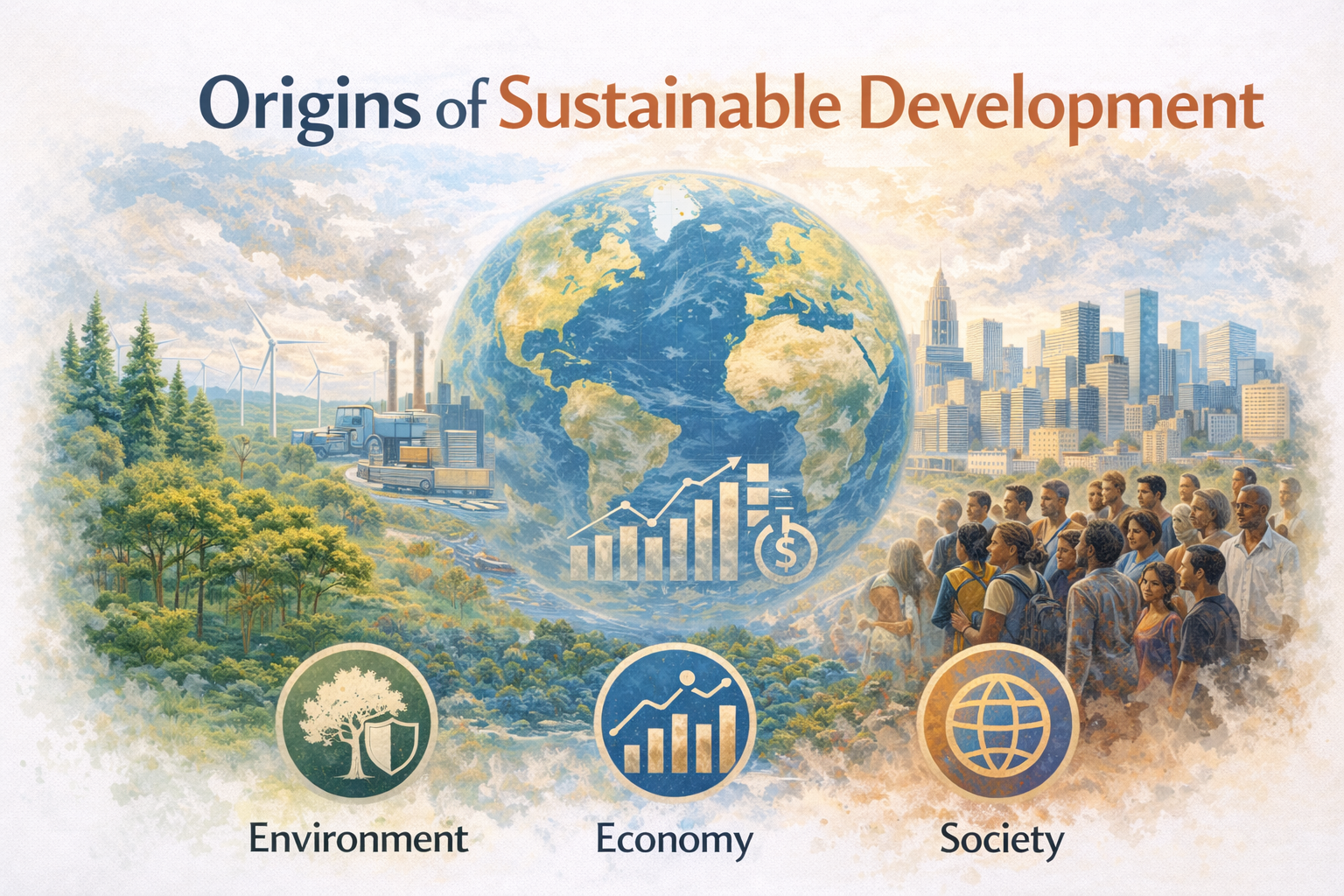
Understanding the origins of sustainable development helps clarify why modern development strategies increasingly emphasize long-term environmental stability, social inclusion, and economic resilience. The framework reflects decades of learning about how human activity interacts with planetary systems and global inequality.
Contents
- Early Environmental Awareness
- The Limits to Growth Debate
- The Brundtland Report and the Modern Definition
- The Rio Earth Summit and Global Environmental Governance
- From Millennium Development Goals to Sustainable Development Goals
- Integrating Economy, Society, and Environment
- Related Reading
- References
Early Environmental Awareness
Concerns about environmental degradation began gaining widespread attention during the mid-twentieth century. Rapid industrialization after World War II led to expanding energy use, urbanization, and resource extraction. While these changes produced remarkable economic growth, they also generated new environmental pressures including air pollution, water contamination, and habitat destruction.
One of the most influential early works was Rachel Carson’s Silent Spring (1962), which documented the ecological consequences of widespread pesticide use. Carson’s work helped launch the modern environmental movement by demonstrating that technological progress could produce unintended ecological consequences.
During this period, scientists increasingly recognized that human activity was beginning to influence global environmental systems. Pollution, deforestation, and industrial production were altering ecosystems at scales that had previously been associated only with natural processes.
The Limits to Growth Debate
A major milestone in the development of sustainability thinking came with the publication of The Limits to Growth in 1972. Produced by researchers working with the Club of Rome, the report used computer modeling to explore how population growth, industrial production, resource use, and environmental degradation might interact over time.
The report suggested that if existing growth patterns continued without adjustment, the global economy could encounter ecological and resource constraints during the twenty-first century. Although controversial, the work helped shift global debate by emphasizing that economic systems ultimately operate within finite environmental limits.
The Limits to Growth debate encouraged policymakers and researchers to consider long-term interactions between economic development and environmental sustainability rather than treating them as separate issues.
The Brundtland Report and the Modern Definition
The most widely cited definition of sustainable development emerged from the 1987 report of the World Commission on Environment and Development, commonly known as the Brundtland Report. Titled Our Common Future, the report defined sustainable development as development that meets the needs of the present without compromising the ability of future generations to meet their own needs.
This definition emphasized two central ideas. First, development must prioritize meeting the basic needs of people, particularly those living in poverty. Second, economic progress must respect the environmental limits necessary to sustain future prosperity.
The Brundtland framework helped integrate environmental protection and economic development into a single policy concept. Rather than viewing environmental protection as a constraint on development, the report argued that long-term development depends on environmental stability.
The Rio Earth Summit and Global Environmental Governance
The concept of sustainable development gained global political momentum during the 1992 United Nations Conference on Environment and Development, commonly known as the Rio Earth Summit. Representatives from governments around the world gathered to address the growing relationship between environmental protection and economic development.
The summit produced several important agreements, including Agenda 21, a comprehensive framework for sustainable development planning, and international conventions addressing climate change and biodiversity. These initiatives marked an important step toward coordinated global environmental governance.
The Rio conference reinforced the idea that environmental challenges such as climate change and biodiversity loss require international cooperation. Because environmental systems operate across national borders, sustainable development must also be addressed through multilateral institutions.
From Millennium Development Goals to Sustainable Development Goals
During the early twenty-first century, global development policy increasingly incorporated sustainability principles. The Millennium Development Goals (MDGs), adopted by the United Nations in 2000, focused primarily on poverty reduction, education, and health outcomes.
Building on this experience, the international community adopted the Sustainable Development Goals (SDGs) in 2015 as part of the United Nations 2030 Agenda for Sustainable Development. The SDGs expanded the development framework to include environmental sustainability, economic inclusion, climate action, and institutional governance.
The SDGs reflect the recognition that development challenges are interconnected. Poverty reduction, environmental protection, economic opportunity, and social inclusion cannot be addressed effectively in isolation.
Integrating Economy, Society, and Environment
The modern concept of sustainable development rests on the integration of three core dimensions: economic prosperity, social inclusion, and environmental sustainability. These dimensions are often described as the three pillars of sustainable development.
Economic systems must generate opportunities for employment, innovation, and rising living standards. Social systems must ensure that development benefits are broadly shared across societies. Environmental systems must remain stable enough to support human civilization over the long term.
Sustainable development therefore represents a shift in how progress is evaluated. Instead of focusing exclusively on short-term economic output, policymakers increasingly consider long-term resilience, environmental stability, and human wellbeing as core indicators of success.
This integrated perspective has become central to global policy debates about climate change, energy systems, urbanization, agriculture, and economic development in the twenty-first century.
Related Reading
- Business as Usual vs Sustainable Development
- Anthropocene & Planetary Boundaries
- Geography of Global Poverty
- Economic Growth & Human Progress
References
- Sachs, J. D. (2015). The Age of Sustainable Development. Columbia University Press.
- World Commission on Environment and Development. (1987). Our Common Future. Oxford University Press.
- Meadows, D. H., Meadows, D. L., Randers, J., & Behrens, W. W. (1972). The Limits to Growth. Universe Books.
- United Nations. (2015). Transforming Our World: The 2030 Agenda for Sustainable Development.
- Carson, R. (1962). Silent Spring. Houghton Mifflin.