
Last Updated May 26, 2026
Business cycles are the recurring movements of economic life through expansion, peak, recession, trough, and recovery. They describe the fact that modern economies rarely grow in a smooth line. Output rises and falls. Employment strengthens and weakens. Investment accelerates and retreats. Credit expands and tightens. Confidence builds during good times, then can break suddenly when households, firms, lenders, investors, or public institutions reassess risk.
Understanding business cycles is central to macroeconomics because cycles shape employment, income, inflation, credit, public budgets, investment, household security, and long-term resilience. A society may become wealthier over generations, but that long-run growth path is repeatedly interrupted by short-run fluctuations. Those fluctuations are not merely technical deviations around a trend. They determine whether workers keep jobs, whether firms survive downturns, whether households can pay rent or mortgages, whether public services are maintained, and whether economic institutions retain legitimacy during stress.
This article explains the business cycle as both a macroeconomic pattern and a systems problem. It examines the phases of expansion, peak, recession, trough, and recovery; the difference between long-run growth and short-run instability; the causes of cyclical fluctuation; the role of expectations, finance, supply shocks, and policy; and the importance of stabilization institutions. It also introduces companion research workflows in Python and R, while the full GitHub research package standardizes the Economic Systems stack around Python, R, Stata, SQL, and Julia.
Main Library
Publications
Article Map
Economic Systems
Related Topic
Risk & Resilience
Related Topic
Institutions & Governance
Related Topic
Sustainable Development
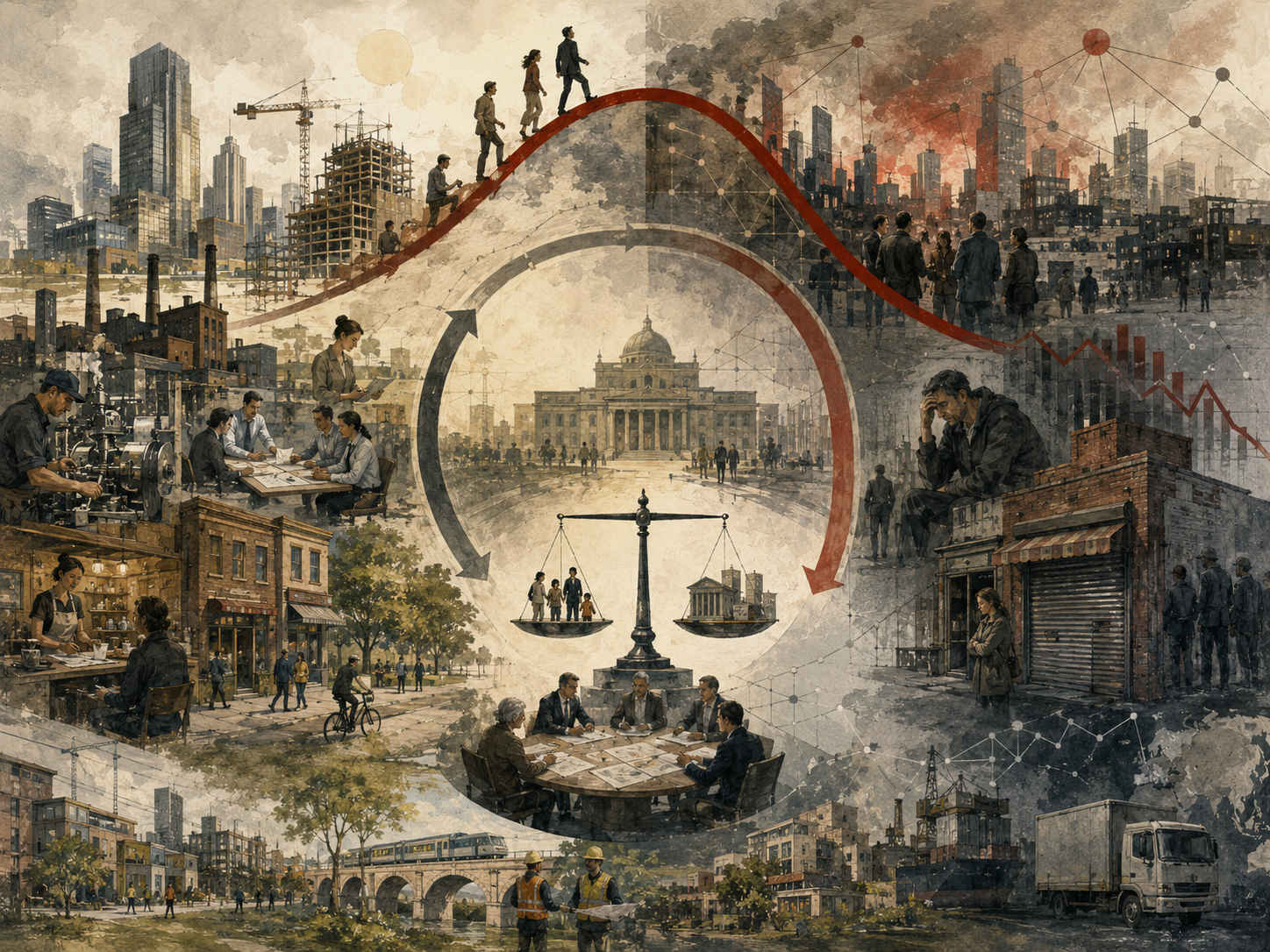
Business cycles are often described with charts of gross domestic product, unemployment, industrial production, income, sales, inflation, interest rates, and recession shading. But they are also lived social processes. An expansion may appear as rising wages, stronger job prospects, easier credit, new firms, and public optimism. A recession may appear as layoffs, delayed investment, business closures, debt distress, budget shortfalls, reduced mobility, and anxiety about the future. Macroeconomic stability therefore matters not only because it smooths output, but because it protects the conditions under which households, firms, communities, and public institutions can plan.
What Business Cycles Are
Business cycles are recurring fluctuations in aggregate economic activity. They are visible in output, employment, income, sales, production, investment, credit, and expectations. During expansions, economic activity rises across many sectors. During recessions, activity falls broadly enough to affect households, firms, labor markets, financial systems, and public budgets.
A business cycle is not the same thing as ordinary volatility in one industry or one region. A local factory closing, a temporary drop in one commodity price, or a single-sector slowdown may be serious, but it does not necessarily constitute a macroeconomic recession. A business-cycle downturn becomes macroeconomic when weakness spreads across the economy and appears in multiple indicators at once.
The concept is also different from long-run economic development. Long-run growth concerns the expansion of productive capacity over years and decades through productivity, education, capital formation, technology, infrastructure, institutions, and demographic change. Business-cycle analysis concerns the shorter-run movement of actual economic activity around that longer-run path.
That distinction matters. An economy may retain strong long-run productive capacity while still experiencing a recession. Workers still have skills. Firms still have equipment. Households still have needs. Public infrastructure still requires maintenance. Yet if spending, confidence, credit, production, or income flows break down, actual output can fall below potential output. Business cycles therefore reveal the difference between what an economy could produce and what it actually produces under changing macroeconomic conditions.
Business cycles are not mechanically regular. They do not occur at fixed intervals. Expansions can last many years or end quickly. Recessions can be brief or severe. Recoveries can be broad-based or uneven. Some downturns begin in financial markets, others in oil markets, housing markets, public-health crises, geopolitical shocks, monetary tightening, or collapsing expectations. The “cycle” is therefore a recurring pattern, not a clock.
The Main Phases of the Business Cycle
Business cycles are commonly described through five related phases: expansion, peak, recession, trough, and recovery. These terms simplify reality, but they provide a useful framework for interpreting macroeconomic movement.
| Phase | Typical Economic Pattern | Institutional Significance |
|---|---|---|
| Expansion | Output, employment, income, investment, credit, and confidence generally rise. | Institutions should strengthen buffers, monitor risk, and avoid assuming growth is permanent. |
| Peak | Economic activity reaches a high point before turning downward. | Financial excess, inflation pressure, tightening credit, or weakening demand may become visible. |
| Recession | Production falls, unemployment rises, income growth weakens, spending slows, and confidence declines. | Stabilization policy, social protection, financial oversight, and public capacity become critical. |
| Trough | Economic activity reaches its low point before recovery begins. | The economy may stop contracting, but households and firms may still face severe stress. |
| Recovery | Output and employment begin to improve after the trough. | The quality of recovery determines whether losses are repaired broadly or concentrated unevenly. |
Expansion is the phase in which the economy grows. Firms hire workers, households spend more, investment rises, incomes improve, and public revenues often strengthen. But expansions can contain hidden fragility. Credit booms, asset bubbles, excessive leverage, supply bottlenecks, inflationary pressure, or speculative optimism may accumulate during periods that appear healthy on the surface.
A peak marks the turning point from expansion to contraction. It is usually identified only after the fact because real-time data are noisy and often revised. At the peak, economic activity is still high, but the forces that supported expansion may be weakening. Sales may slow, inventories may build, credit may tighten, interest-sensitive sectors may contract, or confidence may begin to deteriorate.
A recession is a broad decline in economic activity. It is not simply a bad quarter or a temporary market correction. It involves a sufficiently widespread contraction in output, income, employment, production, and spending. The social meaning of recession is severe because macroeconomic contraction becomes household insecurity, job loss, business failure, fiscal stress, and institutional pressure.
A trough marks the low point of the cycle. The economy may still be weak, but the contraction has stopped deepening. The trough is not the same as full recovery. A household that has lost a job, savings, housing stability, or health insurance may not experience the trough as good news. It simply means that aggregate activity has stopped falling and the recovery phase has begun.
Recovery is the process by which output, employment, income, investment, and confidence return. Some recoveries are fast and broad. Others are slow, unequal, and fragile. A recovery that restores asset prices but leaves wages weak, labor-force participation depressed, or public services damaged may be technically real but socially incomplete.
Business Cycles and Long-Run Growth
Business cycles occur around a long-run growth path. Over decades, economies may become more productive through technological progress, capital accumulation, education, infrastructure, institutional learning, and organizational change. Yet actual output repeatedly rises above and falls below estimated potential output.
Y_t = T_t + C_t
\]
Interpretation: A simple trend-cycle representation divides observed output \(Y_t\) into a long-run trend component \(T_t\) and a cyclical component \(C_t\). Business-cycle analysis focuses on the cyclical movement around the trend.
This framework is useful because it distinguishes two different questions. Long-run growth asks how societies expand productive capacity. Business-cycle analysis asks why actual activity sometimes falls short of that capacity. An economy may have the workers, machines, knowledge, and institutions needed to produce more, yet still experience unemployment and idle capacity if demand, credit, confidence, or coordination fail.
Potential output is an estimate of what the economy can produce when labor and capital are used at sustainable levels. Actual output can exceed or fall below this estimate. When actual output is below potential, an output gap opens. Negative output gaps often correspond to weak demand, elevated unemployment, and underused resources.
\text{Output Gap} = \frac{Y – Y^*}{Y^*} \times 100
\]
Interpretation: \(Y\) represents actual output and \(Y^*\) represents potential output. A negative output gap suggests that the economy is operating below estimated capacity.
Business-cycle instability can also affect long-run growth. Severe or repeated recessions may damage skills, reduce business formation, weaken investment, undermine public services, and create long-term scars for workers and communities. Conversely, well-managed stabilization can protect productive capacity by preventing temporary shocks from becoming permanent losses.
For this reason, macroeconomic stability is not separate from development, resilience, or institutional design. A society that tolerates repeated deep recessions may lose human capability, trust, entrepreneurship, and public capacity. A society that suppresses all short-run adjustment through unsustainable policy may create inflation, debt stress, financial distortion, or speculative excess. The challenge is to build institutions that stabilize shocks without denying real structural change.
Why Business Cycles Occur
Business cycles occur because modern economies are complex, interdependent, monetary, financial, and expectation-driven systems. Production depends on expected demand. Employment depends on sales. Investment depends on future profitability. Credit depends on repayment expectations. Public budgets depend on income and activity. When one part of this system changes, the effects can spread.
Economists have developed many explanations of business cycles. Keynesian theories emphasize aggregate demand, expectations, wage and price rigidities, and involuntary unemployment. Monetarist traditions emphasize money, credit, and central-bank policy. Real business cycle theories emphasize productivity and real shocks. Financial theories emphasize leverage, asset prices, credit cycles, and banking instability. New Keynesian models combine optimizing behavior with nominal rigidities and policy rules. Political economy approaches examine power, institutions, distribution, public investment, austerity, and financialization.
In practice, actual business cycles usually combine several mechanisms. A recession may begin with a financial shock, but deepen through falling demand. It may begin with an energy-price shock, but become worse if central banks tighten aggressively or households cut spending. It may begin in housing markets, then spread to banks, construction, consumption, employment, and public budgets. It may begin with a pandemic, then produce supply disruption, demand collapse, emergency fiscal policy, inflation, monetary tightening, and uneven recovery.
Because cycles have multiple causes, no single indicator can explain them fully. A serious business-cycle framework must examine output, labor markets, income, investment, inflation, credit, financial stress, expectations, policy, and external shocks together. The goal is not to force every downturn into one theory, but to understand how different mechanisms interact in each historical episode.
Demand Shocks, Expectations, and Confidence
Demand shocks occur when households, firms, governments, or foreign buyers change spending in ways that affect total economic activity. A decline in consumption, investment, public spending, or net exports can reduce aggregate demand. If the decline is large enough, firms cut production, employment weakens, incomes fall, and demand may decline further.
AD = C + I + G + NX
\]
Interpretation: Aggregate demand combines consumption \(C\), investment \(I\), government spending \(G\), and net exports \(NX\). Business-cycle contractions often involve weakness in one or more of these components.
Expectations are central because economic decisions are forward-looking. A firm invests because it expects future demand. A household purchases a home because it expects future income. A bank lends because it expects repayment. When expectations deteriorate, investment may fall before current conditions fully justify the decline. Fear becomes action; action changes the economy; the changed economy confirms the fear.
This self-reinforcing structure is one reason recessions can emerge rapidly. Households reduce spending because they fear job loss. Firms reduce hiring because they expect weaker sales. Banks restrict lending because they expect higher defaults. Investors sell assets because they expect declining earnings. These decisions may be individually rational but collectively destabilizing.
Macroeconomic stability therefore depends partly on confidence, but confidence should not be treated as mere sentiment. It is grounded in material institutions: job security, income support, credible policy, functioning credit markets, stable prices, public health, financial regulation, and trust in public authority. Confidence is stronger when households and firms believe that the economic system can absorb shocks without allowing temporary disruption to become widespread collapse.
Supply Shocks and Real Disruptions
Supply shocks occur when the economy’s ability to produce goods and services is disrupted. Wars, energy-price spikes, pandemics, natural disasters, climate hazards, geopolitical conflicts, shipping disruptions, technological failures, or sudden shortages can reduce production or raise costs. These shocks differ from pure demand shocks because they affect the real side of the economy: inputs, labor availability, logistics, energy, infrastructure, and productive capacity.
Supply shocks can create difficult policy dilemmas. If output falls because production has been disrupted, stimulating demand may not immediately restore supply. If prices rise because energy, food, transportation, or critical inputs become scarce, monetary easing may worsen inflation. Yet aggressive tightening during a supply shock can also raise unemployment and reduce investment. Policymakers must distinguish between weak demand, constrained supply, and mixed shocks.
Supply shocks can also interact with inequality. Households with low incomes spend a larger share of income on necessities such as food, rent, energy, and transportation. When supply shocks raise prices in these categories, the burden falls unevenly. Firms with stronger balance sheets may survive input-cost volatility, while small businesses may fail. Regions dependent on specific industries or trade routes may be exposed more severely than diversified economies.
In a systems framework, supply resilience matters as much as demand stabilization. Economies need diversified supply chains, energy security, infrastructure redundancy, public-health capacity, climate adaptation, strategic reserves, and adaptive institutions. Business-cycle management cannot be separated from the physical and institutional systems that make production possible.
Financial Cycles and Credit Instability
Business cycles are often amplified by financial cycles. Credit expansion can support growth, investment, housing, consumption, and innovation. But credit also creates leverage. During expansions, rising asset prices and optimistic expectations can encourage additional borrowing. Lenders may loosen standards. Households may take on more debt. Firms may finance expansion with fragile balance sheets. Financial institutions may underestimate risk.
When conditions turn, the same mechanisms can operate in reverse. Asset prices fall. Collateral values decline. Borrowers struggle to refinance. Banks tighten credit. Investment slows. Households reduce spending to repair balance sheets. Firms cut employment. Defaults rise. Financial stress spreads to the real economy.
This credit-amplification mechanism explains why some recessions are deeper and longer than others. A downturn accompanied by a banking crisis, housing crash, or major deleveraging episode may produce lasting damage because credit intermediation itself becomes impaired. Even after output stops falling, households and firms may remain cautious for years.
Financial resilience is therefore part of macroeconomic stability. Regulation, capital buffers, liquidity facilities, supervision, consumer protection, anti-fraud enforcement, and macroprudential policy can reduce the likelihood that expansions become speculative bubbles and that downturns become systemic crises. Good stabilization policy does not simply respond after collapse. It monitors fragility during the expansion itself.
Peaks, Troughs, and Business-Cycle Dating
Business-cycle dating identifies turning points in aggregate economic activity. In the United States, the National Bureau of Economic Research’s Business Cycle Dating Committee maintains the official chronology of U.S. business-cycle peaks and troughs. The NBER defines expansions as periods between a trough and a peak and recessions as periods between a peak and a trough.
This dating process is important because recessions are not identified only by a simple rule such as two consecutive quarters of falling GDP. That rule may be useful as a rough heuristic, but official business-cycle dating examines broader evidence. Employment, income, industrial production, sales, and other indicators can matter because a recession is a broad contraction in economic activity rather than a single-statistic event.
Turning points are often recognized with a delay because data are revised, indicators move unevenly, and the economy may send mixed signals. A recession may begin in one sector before appearing in the aggregate data. A recovery may begin before unemployment has fallen substantially. For households and firms, the lived experience of recovery can lag behind the official trough.
Business-cycle dating also shapes historical interpretation. It allows economists to compare episodes: how long expansions lasted, how deep recessions became, how fast employment recovered, whether output returned to trend, and whether policy responses shortened or lengthened downturns. Without consistent dating, it is difficult to distinguish ordinary volatility from systemic contraction.
Macroeconomic Stability and Policy Institutions
Macroeconomic stability means more than avoiding recession. It means maintaining conditions under which employment, prices, credit, public finance, investment, and household security remain compatible with sustainable economic life. A stable economy does not eliminate change, failure, or adjustment. It prevents ordinary adjustment from cascading into systemic harm.
Policy institutions matter because markets alone may not stabilize quickly or fairly during downturns. If every household cuts spending at once, aggregate demand falls. If every firm reduces hiring at once, unemployment rises. If every lender tightens credit at once, investment contracts. If every government cuts spending during recession, public austerity can deepen the downturn. Coordination failures can make individually cautious behavior collectively damaging.
Institutions that support macroeconomic stability include central banks, fiscal authorities, unemployment insurance systems, public health systems, bank regulators, deposit insurance, automatic stabilizers, public investment agencies, statistical agencies, and credible democratic oversight. These institutions do not replace markets. They help prevent market fluctuations from destroying the social and productive foundations on which markets depend.
Stability also requires legitimacy. Stabilization policies can fail politically if people believe that public rescue protects financial institutions while abandoning workers, households, or communities. A credible stabilization system must be both technically competent and publicly accountable. It must stabilize the economy without converting crisis response into permanent privilege for the already powerful.
Fiscal Policy and Automatic Stabilizers
Fiscal policy uses public spending, taxation, transfers, borrowing, and investment to influence economic activity. During downturns, governments may increase spending, reduce taxes, expand transfers, aid state and local governments, invest in infrastructure, or support households and firms directly. The goal is to prevent private-sector contraction from becoming a deeper macroeconomic collapse.
Automatic stabilizers are especially important because they respond without requiring new legislation each time conditions worsen. Unemployment insurance, progressive tax systems, food assistance, health coverage, and income-support programs can automatically help sustain household purchasing power when labor income falls. These systems reduce hardship and support aggregate demand.
Discretionary fiscal policy may also be necessary during severe downturns. Public investment, direct transfers, emergency aid, payroll support, small-business support, and public-service funding can reduce the depth of recessions and accelerate recovery. The design matters: support that reaches liquidity-constrained households, maintains employment, preserves public services, and builds long-term capacity is usually more resilience-enhancing than poorly targeted stimulus.
Fiscal policy also requires prudence. Deficits can be appropriate during downturns, but public finance must remain credible over time. The central question is not whether governments should always spend more or always spend less. It is whether fiscal institutions can act counter-cyclically: saving capacity during expansions, supporting demand during contractions, investing in public goods, and avoiding premature austerity that weakens recovery.
Monetary Policy and the Cycle
Monetary policy influences business cycles through interest rates, liquidity, credit conditions, inflation expectations, asset prices, and financial stability. Central banks may lower interest rates to support borrowing, investment, and spending during weak conditions. They may raise rates to reduce inflationary pressure or cool overheated demand. They may also provide liquidity during financial stress.
In the United States, the Federal Reserve conducts monetary policy under a mandate commonly described as maximum employment and stable prices. This dual responsibility illustrates the business-cycle challenge. If policy is too tight during weakness, unemployment may rise unnecessarily. If policy is too loose during overheating, inflation or financial excess may build. Stabilization requires judgment under uncertainty.
Monetary policy can be powerful, but it has limits. Lower interest rates may not stimulate enough demand if households are overindebted, firms are pessimistic, banks are impaired, or rates are already near effective lower bounds. Central banks can support financial conditions, but they cannot directly replace lost household income, rebuild local public services, or guarantee equitable recovery.
This is why severe business-cycle downturns often require coordination between monetary policy, fiscal policy, financial regulation, and social protection. Monetary policy can stabilize credit and expectations. Fiscal policy can support demand directly. Regulation can prevent panic and contain systemic risk. Public programs can protect households from immediate harm. No single institution can carry the full burden of macroeconomic resilience alone.
Business Cycles and Economic Resilience
Business cycles reveal whether an economy is resilient. A resilient economy can absorb shocks, stabilize essential systems, protect households, preserve productive capacity, and recover without allowing temporary disruption to become permanent social damage. A fragile economy turns shocks into cascading unemployment, business failure, debt distress, institutional distrust, and long-term scarring.
Resilience does not mean preventing every recession. Some shocks are unavoidable, and some structural adjustments are necessary. Resilience means reducing unnecessary harm, shortening downturns where possible, protecting people during transitions, and ensuring that recovery restores broad-based capability rather than only aggregate statistics.
From a resilience perspective, the expansion phase is not simply a time to celebrate growth. It is also the time to build buffers. Governments can strengthen automatic stabilizers, reduce financial fragility, invest in infrastructure, maintain public-health capacity, improve data systems, and address household insecurity. Firms can reduce excessive leverage and build supply-chain flexibility. Households benefit from stronger wages, savings, healthcare access, and stable housing.
Recessions test whether those buffers exist. If households have no savings, public systems are underfunded, firms are overleveraged, banks are fragile, and governments lack fiscal capacity, downturns become more destructive. If institutions are prepared, the same shock may produce less long-term damage.
The quality of recovery is also central. A recovery that leaves behind low-wage workers, young workers, disabled workers, caregivers, small firms, marginalized communities, or struggling regions is incomplete. Business-cycle stability should therefore be evaluated not only by how quickly GDP rebounds, but by how fully employment, income, public services, credit access, and community wellbeing recover.
Measuring Business Cycles
Business-cycle measurement requires multiple indicators. GDP is important, but insufficient by itself. Employment, income, industrial production, retail sales, credit conditions, inflation, interest rates, and output gaps each reveal different aspects of the cycle.
| Indicator | Cycle-Relevant Question | Why It Matters |
|---|---|---|
| Real GDP | Is aggregate output rising or falling? | Tracks broad production and income in the economy. |
| Potential GDP | What could the economy produce sustainably? | Provides a benchmark for output-gap analysis. |
| Output Gap | Is actual output above or below estimated potential? | Measures macroeconomic slack or overheating. |
| Unemployment Rate | Is labor-market stress rising? | Shows how cycles affect workers and households. |
| Payroll Employment | Are firms adding or cutting jobs? | Captures employment momentum across firms. |
| Industrial Production | Is production weakening or expanding? | Provides a production-side measure of cyclical activity. |
| Retail Sales | Is consumer demand strengthening or weakening? | Shows spending behavior in the household sector. |
| Real Disposable Income | Are households gaining or losing purchasing power? | Connects macro cycles to household capacity. |
| Federal Funds Rate | How is monetary policy positioned? | Provides context for credit conditions and stabilization. |
| Inflation | Are prices stable, rising rapidly, or falling? | Shapes real income, interest rates, and policy trade-offs. |
Business-cycle analysis should also examine duration, depth, diffusion, and recovery. Duration asks how long expansions and recessions last. Depth asks how large the decline becomes. Diffusion asks how widely weakness spreads across sectors and indicators. Recovery asks how long it takes to regain prior output, employment, income, and investment levels.
The companion GitHub workflow for this article converts these concepts into reproducible outputs. It builds monthly and quarterly panels, calculates output gaps and growth rates, identifies business-cycle phases from NBER-based recession indicators, summarizes expansions and recessions, estimates volatility measures, and creates trend-cycle decompositions for real GDP.
Python Workflow: Business-Cycle Indicators
Python is useful for building reproducible data pipelines, downloading public macroeconomic series, calculating business-cycle indicators, and exporting article-ready tables and figures. The following workflow demonstrates how to assemble a basic business-cycle panel using public FRED CSV endpoints.
# python/business_cycle_indicators.py
#
# Purpose:
# Build a basic business-cycle indicator panel using public FRED CSV files.
# This example is intentionally compact for article readability.

from pathlib import Path
from functools import reduce
import pandas as pd

BASE_DIR = Path(__file__).resolve().parents[1]
DATA_DIR = BASE_DIR / "data"
OUTPUT_DIR = BASE_DIR / "outputs"

DATA_DIR.mkdir(parents=True, exist_ok=True)
OUTPUT_DIR.mkdir(parents=True, exist_ok=True)

SERIES = {
    "USREC": "recession_indicator",
    "UNRATE": "unemployment_rate",
    "PAYEMS": "payroll_employment",
    "INDPRO": "industrial_production",
    "FEDFUNDS": "federal_funds_rate",
    "GDPC1": "real_gdp",
    "GDPPOT": "potential_gdp",
}

def read_fred_csv(series_id: str, value_name: str) -> pd.DataFrame:
    url = f"https://fred.stlouisfed.org/graph/fredgraph.csv?id={series_id}"
    df = pd.read_csv(url)
    df.columns = ["date", value_name]
    df["date"] = pd.to_datetime(df["date"])
    df[value_name] = pd.to_numeric(df[value_name], errors="coerce")
    return df

def merge_frames(frames: list[pd.DataFrame]) -> pd.DataFrame:
    return reduce(lambda left, right: pd.merge(left, right, on="date", how="outer"), frames)

def main() -> None:
    frames = [read_fred_csv(series_id, name) for series_id, name in SERIES.items()]
    panel = merge_frames(frames).sort_values("date")

    panel["recession_indicator"] = panel["recession_indicator"].fillna(0).astype(int)
    panel["business_cycle_phase"] = panel["recession_indicator"].map({
        1: "recession",
        0: "expansion"
    })

    panel["real_gdp_growth_annualized"] = (
        (panel["real_gdp"] / panel["real_gdp"].shift(1)) ** 4 - 1
    ) * 100

    panel["output_gap_pct"] = (
        (panel["real_gdp"] - panel["potential_gdp"]) / panel["potential_gdp"]
    ) * 100

    panel["delta_unemployment_rate"] = (
        panel["unemployment_rate"] - panel["unemployment_rate"].shift(1)
    )

    panel.to_csv(OUTPUT_DIR / "business_cycle_indicator_panel.csv", index=False)

    phase_summary = (
        panel.groupby("business_cycle_phase")
        .agg(
            observations=("date", "count"),
            avg_gdp_growth=("real_gdp_growth_annualized", "mean"),
            avg_unemployment=("unemployment_rate", "mean"),
            avg_output_gap=("output_gap_pct", "mean"),
            avg_federal_funds_rate=("federal_funds_rate", "mean"),
        )
        .reset_index()
    )

    phase_summary.to_csv(OUTPUT_DIR / "business_cycle_phase_summary.csv", index=False)
    print(phase_summary)

if __name__ == "__main__":
    main()
This article-level example is intentionally compact. The full GitHub research package expands it into monthly and quarterly panels, episode metrics, volatility tables, recession shading, trend-cycle decomposition, SQLite output, and cross-language replication.
Used carefully, this workflow helps readers move from abstract macroeconomic language to measurable questions: how output behaves during recession quarters, how unemployment differs across phases, how far actual output moves from potential output, and how policy indicators shift across the cycle.
R Workflow: Business-Cycle Analysis
R is well suited for statistical summaries, visualization, regression workflows, and publication-quality graphics. In the companion workflow, R reads the business-cycle panel produced by Python, summarizes macroeconomic behavior by phase, and estimates a simple relationship between output growth, unemployment change, output gaps, recession periods, and monetary-policy context.
# r/business_cycle_analysis.R
#
# Purpose:
# Analyze business-cycle phases using a quarterly indicator panel.

library(readr)
library(dplyr)
library(ggplot2)
library(broom)
library(sandwich)
library(lmtest)

base_dir <- normalizePath(file.path(dirname(sys.frame(1)$ofile), ".."))
panel_path <- file.path(base_dir, "outputs", "business_cycle_indicator_panel.csv")
output_dir <- file.path(base_dir, "outputs")

panel <- read_csv(panel_path, show_col_types = FALSE) |>
  mutate(
    date = as.Date(date),
    recession = recession_indicator == 1,
    phase = factor(business_cycle_phase)
  )

phase_summary <- panel |>
  group_by(phase) |>
  summarise(
    observations = n(),
    avg_gdp_growth = mean(real_gdp_growth_annualized, na.rm = TRUE),
    avg_unemployment = mean(unemployment_rate, na.rm = TRUE),
    avg_output_gap = mean(output_gap_pct, na.rm = TRUE),
    avg_federal_funds_rate = mean(federal_funds_rate, na.rm = TRUE),
    .groups = "drop"
  )

write_csv(phase_summary, file.path(output_dir, "business_cycle_r_phase_summary.csv"))

model_df <- panel |>
  filter(
    !is.na(real_gdp_growth_annualized),
    !is.na(delta_unemployment_rate),
    !is.na(output_gap_pct),
    !is.na(federal_funds_rate)
  )

cycle_model <- lm(
  real_gdp_growth_annualized ~ delta_unemployment_rate +
    output_gap_pct + recession_indicator + federal_funds_rate,
  data = model_df
)

robust_results <- coeftest(cycle_model, vcov = vcovHC(cycle_model, type = "HC1"))
write_csv(tidy(robust_results), file.path(output_dir, "business_cycle_r_results.csv"))

phase_plot <- ggplot(panel, aes(x = output_gap_pct, y = unemployment_rate, color = phase)) +
  geom_point(alpha = 0.65) +
  labs(
    title = "Business-Cycle Phases: Output Gap and Unemployment",
    subtitle = "Recession and expansion periods occupy different regions of macroeconomic stress.",
    x = "Output gap (%)",
    y = "Unemployment rate (%)",
    color = "Phase"
  ) +
  theme_minimal()

ggsave(
  filename = file.path(output_dir, "business_cycle_phase_scatter_r.png"),
  plot = phase_plot,
  width = 8,
  height = 5,
  dpi = 300
)

print(phase_summary)
print(robust_results)
The purpose of this R workflow is not to create a final structural model of the business cycle. It is to make the article empirically inspectable. Readers can see how recession periods differ from expansion periods, how unemployment relates to output gaps, and how basic regression workflows can connect macroeconomic interpretation to public data.
Future Economic Systems articles can extend this approach with vector autoregressions, panel data, local projections, event studies, inflation-unemployment tradeoff analysis, fiscal multipliers, credit-cycle indicators, and cross-country comparisons.
GitHub Research Stack
The companion GitHub folder for this article standardizes around Python, R, Stata, SQL, and Julia. The goal is to make each Economic Systems article function as a small, reproducible research package rather than a decorative code appendix.
| Language | Role in the Repository | Use in This Article |
|---|---|---|
| Python | Data engineering, public data pipelines, indicator construction, visualization | Builds monthly and quarterly business-cycle panels from public FRED data. |
| R | Statistics, visualization, econometrics, replication summaries | Summarizes business-cycle phases and estimates simple macroeconomic relationships. |
| Stata | Applied economics and policy-research workflows | Provides a replication-style `.do` file for business-cycle regressions and summaries. |
| SQL | Structured data backbone and transparent query layer | Stores monthly and quarterly indicators in SQLite and supports reproducible queries. |
| Julia | Dynamic modeling, simulation, macroeconomic systems analysis | Models output-gap persistence and simulates stabilization scenarios. |
The article repository is designed to produce business-cycle episode metrics, phase summaries, volatility measures, trend-cycle decompositions, and reproducible figures. It allows the conceptual article to connect with economist-grade workflows while remaining accessible to readers who are learning macroeconomics.
Complete Code Repository
The companion repository extends this article into a reproducible economic research workflow, organizing the data, code, models, tables, and figures needed to analyze business-cycle phases, recession dynamics, macroeconomic volatility, and stabilization policy.
Related Reading
- Economic Systems
- Economic Resilience: Why Recessions Occur and How Economies Recover
- Stabilization Policy
- Risk & Resilience
- Institutions & Governance
Further Reading
- Blanchard, O. (2021). Macroeconomics. 8th edn. Pearson.
- Burns, A. F. and Mitchell, W. C. (1946). Measuring Business Cycles. New York: National Bureau of Economic Research. Available at: https://www.nber.org/books-and-chapters/measuring-business-cycles
- Gali, J. (2015). Monetary Policy, Inflation, and the Business Cycle. 2nd edn. Princeton: Princeton University Press.
- Hamilton, J. D. (1994). Time Series Analysis. Princeton: Princeton University Press.
- Keynes, J. M. (1936). The General Theory of Employment, Interest and Money. London: Macmillan.
- Lucas, R. E. (1977). Understanding Business Cycles. Carnegie-Rochester Conference Series on Public Policy, 5, pp. 7–29.
- Mankiw, N. G. (2024). Principles of Economics. 10th edn. Cengage.
- Romer, D. (2019). Advanced Macroeconomics. 5th edn. McGraw-Hill.
- Schumpeter, J. A. (1939). Business Cycles: A Theoretical, Historical, and Statistical Analysis of the Capitalist Process. New York: McGraw-Hill.
- Stock, J. H. and Watson, M. W. (1999). Business Cycle Fluctuations in U.S. Macroeconomic Time Series. In Taylor, J. B. and Woodford, M. (eds), Handbook of Macroeconomics, Vol. 1. Amsterdam: Elsevier.
References
- Board of Governors of the Federal Reserve System. (2021). Monetary Policy: What Are Its Goals? How Does It Work? Available at: https://www.federalreserve.gov/monetarypolicy/monetary-policy-what-are-its-goals-how-does-it-work.htm
- Board of Governors of the Federal Reserve System. (2025). What economic goals does the Federal Reserve seek to achieve through its monetary policy? Available at: https://www.federalreserve.gov/faqs/what-economic-goals-does-federal-reserve-seek-to-achieve-through-monetary-policy.htm
- Federal Reserve Bank of St. Louis. (n.d.). FRED Economic Data. Available at: https://fred.stlouisfed.org/
- Federal Reserve Bank of St. Louis. (n.d.). NBER based Recession Indicators for the United States from the Peak through the Trough. Available at: https://fred.stlouisfed.org/series/USREC
- International Monetary Fund. (n.d.). Fiscal Policy: Taking and Giving Away. Finance & Development: Back to Basics. Available at: https://www.imf.org/en/publications/fandd/issues/series/back-to-basics/fiscal-policy
- International Monetary Fund. (n.d.). Monetary Policy: Stabilizing Prices and Output. Finance & Development: Back to Basics. Available at: https://www.imf.org/en/publications/fandd/issues/series/back-to-basics/monetary-policy
- National Bureau of Economic Research. (n.d.). Business Cycle Dating. Available at: https://www.nber.org/research/business-cycle-dating
- National Bureau of Economic Research. (2023). US Business Cycle Expansions and Contractions. Available at: https://www.nber.org/research/data/us-business-cycle-expansions-and-contractions
- U.S. Bureau of Economic Analysis. (n.d.). Gross Domestic Product. Available at: https://www.bea.gov/data/gdp/gross-domestic-product
- U.S. Bureau of Labor Statistics. (n.d.). Labor Force Statistics from the Current Population Survey. Available at: https://www.bls.gov/cps/